Germany · The Central Powers
Paul von Lettow-Vorbeck
Commander of the colonial troops in German East Africa (1914–1918), major-general
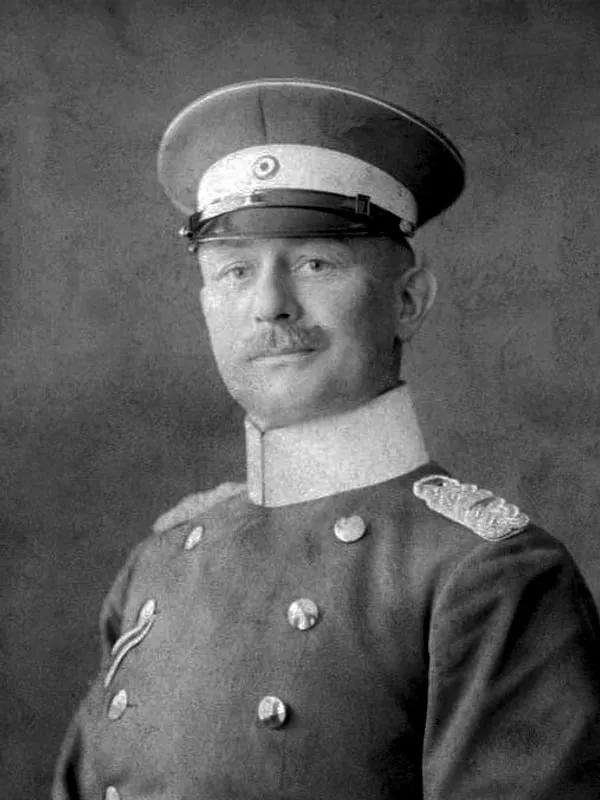
- Born:
- 20 March 1870, Saarlouis (Germany)
- Died:
- 9 March 1964, Hamburg
- Author:
- Natalia
- Photo:
- Bundesarchiv, Bild 183-R05765, CC BY-SA 3.0 DE, Wikimedia Commons

Paul von Lettow-Vorbeck commanded the German colonial troops, the Schutztruppe, in German East Africa. From August 1914 to November 1918, with an army made up mostly of African askaris and cut off from Germany by the British blockade, he fought British, South African, Indian, Belgian and Portuguese forces many times more numerous. He was never encircled or destroyed, and he laid down his arms only two weeks after the armistice of Compiègne. In Germany he became the legend of the general “undefeated in the field”. Today the enormous price paid for his campaign by the people of East Africa is also remembered.
Before the war
He was born on 20 March 1870 in Saarlouis, in the Rhineland, where his father was stationed, a Prussian officer from a Pomeranian noble family who later became a general of infantry. He was brought up in the cadet corps at Potsdam and Lichterfelde, and in 1888 he joined the 4th Foot Guards Regiment. In 1900–1901 he was adjutant of the brigade sent to China to put down the Boxer Rebellion.
In 1904–1906 he served in German South West Africa, first on the staff of General Lothar von Trotha, then as a company commander. He took part in the war against the Herero and Nama, which historians today regard as genocide. According to his biographers he helped plan the Battle of Waterberg, and he never afterwards condemned Trotha’s methods. In 1906, fighting Nama units, he was wounded in the eye, which lost its sight. After returning to Germany he served on the Great General Staff and on the staff of XI Corps, and from 1909 he commanded a marine infantry battalion in Wilhelmshaven.
In October 1913, by then a lieutenant-colonel, he was appointed commander of the Schutztruppe in Kamerun, but before he took up the post he was sent to East Africa instead. He arrived in Dar es Salaam in January 1914. On the same voyage he met the Danish writer Karen Blixen, with whom he became friends. He formally took command in April. Before the war broke out he managed to tour much of the colony and get to know his troops: a few hundred Germans and about 2,500 askaris in 14 field companies, supported by the police.
1914–1915: Tanga and Jasin
The governor of the colony, Heinrich Schnee, wanted East Africa to remain neutral and invoked the Berlin Act of 1885, which provided for the neutrality of the Congo basin. Lettow-Vorbeck thought otherwise. He believed that the colony’s task was to tie down as many British troops as possible so that they could not fight in Europe. As early as 15 August his detachment took Taveta, on the border of British East Africa, from where the Germans could threaten the Uganda Railway.
At the beginning of November 1914 General Arthur Aitken’s Indian Expeditionary Force “B”, about 8,000 men, landed at Tanga. Lettow-Vorbeck moved his companies by rail from near Kilimanjaro to the coast and, in the Battle of Tanga, with roughly a thousand men forced the British to withdraw to their ships. He captured so many weapons and so much ammunition that he could arm several new companies, and his position towards the governor grew markedly stronger. In January 1915 he forced the British-Indian garrison of Jasin to surrender, but at the cost of so many officers and so much ammunition that he concluded he could not afford similar battles again.
For the next year he avoided major engagements and sent small detachments to raid the railway from Mombasa to Uganda. He also expanded his army, which at its peak numbered, according to various figures, 12,000–15,000 men, the overwhelming majority of them Africans. It was reinforced by sailors from the cruiser Königsberg, destroyed in July 1915 in the Rufiji delta, and the ship’s guns, mounted on carriages, served from then on as heavy field artillery. Only two supply ships got through the blockade: in April 1915 and in March 1916.
1916: Smuts
In February 1916 command in East Africa was taken over by the South African general Jan Smuts, with forces such as this theatre of war had not yet seen. In March his Kilimanjaro offensive drove the Germans from the Kilimanjaro area but failed to encircle them. Lettow-Vorbeck fell back, giving battle only on favourable ground, as at Latema and Kahe, and slipped out of one trap after another. In May he attacked van Deventer’s division at Kondoa Irangi, but his night assaults were repulsed. In August Smuts took Morogoro on the Central Railway, hoping for a decisive battle, but Lettow-Vorbeck considered waiting for it “madness” and withdrew through the Uluguru Mountains to the south. In September the British took Dar es Salaam and the whole coast, and the Belgians Tabora.
By the end of 1916 the Germans were left with only the southern part of the colony. Disease, especially malaria, was, however, also decimating Smuts’s forces, in which South African and British soldiers were increasingly replaced by African battalions. In November 1916 Lettow-Vorbeck received the Pour le Mérite, and in the same year he was promoted to colonel. At the beginning of 1917 Smuts left for London, convinced that the campaign was essentially over. Lettow-Vorbeck was by then beyond the Rufiji.
1917: Mahiwa and the Rovuma
Smuts’s successors, Generals Hoskins and van Deventer, waged a war of attrition. In the summer of 1917 the Germans repulsed an attack at Narungombe, and in October Lettow-Vorbeck won his greatest victory. In the Battle of Mahiwa, by his own count with about 1,500 men, he repulsed the attacks of the columns from Lindi and of the Nigerian Brigade. The British lost about 2,700 killed and wounded, but the Germans too lost 519 men, about a third of their fighting strength, and most of their ammunition. At the end of October, when news of the battle reached Berlin, he was promoted to major-general.
That victory could not be repeated. In the second half of November, at Newala, Lettow-Vorbeck left behind the sick, the wounded and many porters, and set off south with his best troops, about 300 Europeans and 1,700 askaris. On 25 November he forded the Rovuma into Portuguese Mozambique and overran the camp at Ngomano, capturing weapons, ammunition and medicines. Captain Tafel’s detachment, which had failed to join him in time, surrendered a few days later. In those same days the airship L 59 took off from Bulgaria with supplies for Lettow-Vorbeck, but turned back over Sudan.
1918: Mozambique and Rhodesia
For ten months Lettow-Vorbeck lived in Mozambique on what he captured from the enemy. Instead of turning north, as van Deventer expected, he led his column far to the south and at the beginning of July 1918 routed at Nhamacurra, near Quelimane, a Portuguese-British garrison, capturing huge stores. He then turned back, at the end of September crossed the Rovuma again into German East Africa, bypassed the British columns and turned west, into Northern Rhodesia. On 1 November he attacked the post at Fife, and on 9 November his vanguard occupied the abandoned Kasama.
He learned of the armistice on 13 November. The next day, on the Chambeshi River, he agreed to stop fighting, and on 25 November at Abercorn he laid down his arms. According to the South African official account his force then numbered 155 Europeans and 1,168 askaris, accompanied by more than a thousand porters. He argued with the British over whether the armistice, which spoke of the “evacuation” of troops from East Africa, meant capitulation, and noted with satisfaction that his soldiers had handed over only weapons captured from the enemy. On 2 March 1919 he led his veterans in worn tropical uniforms through the Brandenburg Gate in Berlin.
After the war
In July 1919 his troops entered Hamburg to put down food riots, and in March 1920, as commander of the troops in Mecklenburg, he supported the Kapp Putsch and arrested members of the local government. After the putsch collapsed he had to leave the army. He worked in trade in Bremen, gave lectures on the African campaign and demanded the return of the colonies to Germany. In 1928–1930 he was a member of the Reichstag for the conservative DNVP and then for the breakaway Conservative People’s Party. He was useful to the Nazis as a symbol, but according to his biographers he refused to join the NSDAP, and Joseph Goebbels called him a reactionary in his diary. Even so, he did not distance himself from the new regime, and in 1939 he received the titular rank of general of infantry. Two of his sons were killed in the Second World War.
After the war he lived in hard circumstances. According to accounts, his former opponent Smuts helped him financially. In 1953 he visited East Africa, where former askaris welcomed him. He died on 9 March 1964 in Hamburg. The West German government brought two former askaris to his funeral, and the defence minister called him in his funeral address “truly undefeated in the field”.
Assessment
As a commander Lettow-Vorbeck commands admiration even among his critics. With a small army and no supplies from home, for more than four years he tied down in Africa forces that in total far outnumbered his own. His soldiers, Germans and askaris alike, were loyal to him, and his opponents, Smuts foremost among them, treated him with respect. In Germany he was called the “Lion of Africa”.
Some historians, among them Hew Strachan, point out, however, that the strategic value of this campaign was limited. Most of the Allied forces in East Africa were African and Indian soldiers who would not have been sent to the Western Front anyway, and the colony itself was lost. Increasing attention is also paid to the victims of the war. Both sides requisitioned food, burned villages and conscripted porters, and the German column in Mozambique literally lived by plunder. The doctor Ludwig Deppe, who marched with the troops, wrote that they left behind them ruined fields, looted storehouses and famine, like the armies of the Thirty Years’ War. Tens of thousands of porters died of hunger and disease, by some estimates more than a hundred thousand on the British side alone, along with an unknown number of civilians.
His German biographers, Uwe Schulte-Varendorff and Eckard Michels, have also demolished the myth of the “loyal askaris”, which Lettow-Vorbeck cultivated after the war to support demands for the return of the colonies. They point to his part in the war in South West Africa and to the Kapp Putsch. They judge his views differently: Schulte-Varendorff much more harshly, accusing him of racism and antisemitism, Michels more cautiously, although he too describes his post-war stance as conservative and at times far right. Since the beginning of the 21st century several German cities have renamed streets named after him. To some he remains a brilliant tactician of guerrilla warfare, to others a symbol of a colonial war in which Africans paid for other people’s aims.
Sources
Spotted a mistake?Report an error
Commanded in battles
(06)Mentioned in battles
(01)Often appears with
People who appear in the same events.
On the timeline
(57)The 40 most important of 57 events. All tagged “Paul von Lettow-Vorbeck” (35) →
1914
1915
1916
February
March
- 21
- Fighting at KaheOn 21 March 1916 van Deventer's horsemen took Kahe hill and station, while Sheppard's infantry stalled at the Soko Nassai. At night Lettow-Vorbeck withdrew.
- Germans withdraw from KilimanjaroOn the night of 21–22 March 1916 Lettow-Vorbeck left his Ruvu positions and fell back along the Usambara Railway. Kilimanjaro passed to the British.
April
May
June
July
August
September
- 07
- Action at KisakiOn 7–8 September 1916 two of Smuts's columns attacked the Germans separately at Kisaki, south of the Uluguru Mountains. Both were repulsed; the pursuit stalled.
- British occupy KilwaOn 7 September 1916 British ships landed troops at Kilwa Kisiwani and Kilwa Kivinje, south of Dar es Salaam. Both ports were taken almost without a fight.