Germany · The Central Powers
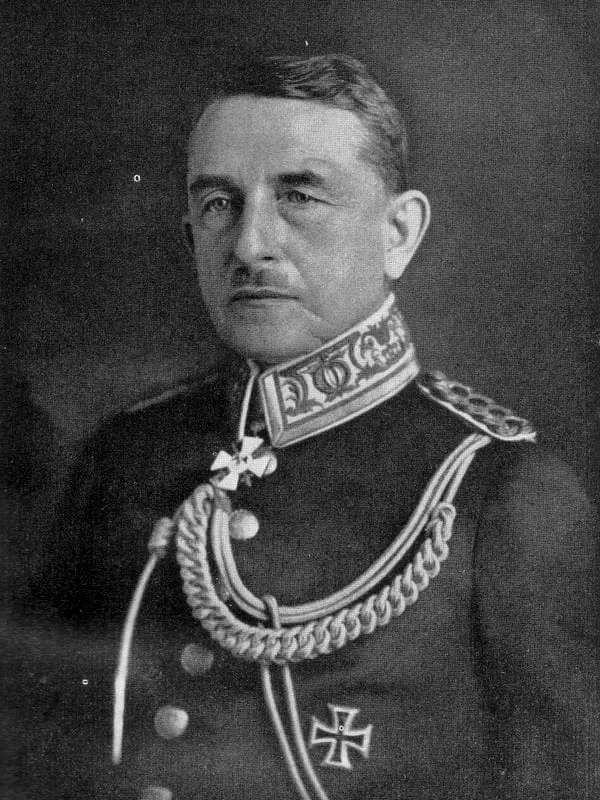
Heinrich Schnee
Governor of German East Africa (1912–1919)
- Born:
- 4 February 1871, Neuhaldensleben (Germany)
- Died:
- 23 June 1949, Berlin
- Author:
- Natalia
- Photo:
- NN, domena publiczna, Wikimedia Commons

Heinrich Schnee was the last governor of German East Africa, the largest and most populous colony of the Reich. A civil servant, lawyer and administrator, in August 1914 he tried to keep the colony out of the war and concluded a truce with the British which the commander of the colonial forces, Paul von Lettow-Vorbeck, regarded as humiliating. The dispute between the two men over whether the colony should merely defend itself or fight was settled by Lettow-Vorbeck’s victories. The governor, formally the superior of the military, withdrew more and more into the background, and from 1916 he wandered through the bush with the army until the surrender in November 1918. After the war he became the leading advocate of Germany’s recovery of its colonies.
Before the war
He was born on 4 February 1871 in Neuhaldensleben in the Prussian Province of Saxony, the son of a judge. He studied law and political science in Heidelberg, Kiel and Berlin, where he obtained his doctorate in 1893. He then learned Swahili and colonial studies at the Seminar for Oriental Languages in Berlin. In 1897 he joined the colonial department of the Foreign Office, and a year later he went out to the Pacific, where he was a judge and deputy governor of German New Guinea, and from 1900 deputy governor of German Samoa. In 1901 in New York he married Ada Woodhill, a New Zealand-born daughter of an Englishman and a former actress, whom he had met on a voyage across the Pacific.
From 1904 he worked in Berlin again, served briefly as colonial adviser at the embassy in London, and in 1911 became director of the political and administrative department of the Reich Colonial Office. In 1912 he took office as governor of German East Africa. He continued the policy of his predecessor, the liberal Albrecht von Rechenberg, who after the bloody suppression of the Maji Maji Rebellion of 1905–1907 had favoured economic development over conquest. Under his rule the Central Railway from Dar es Salaam to Lake Tanganyika was completed. He also tried to curb abuses in the recruitment of African labourers for European plantations, but without much success.
1914: the truce and the quarrel with Lettow-Vorbeck
The war caught the colony completely unprepared. Schnee, opposed to fighting by conviction and by virtue of his office, hoped that East Africa would remain neutral. He invoked the General Act of the Berlin Conference of 1885, which allowed the neutralisation of colonies in the so-called conventional basin of the Congo, and in August the German government accepted a Belgian proposal to that effect. The governor feared the destruction of costly ports and railways, and above all that the sight of war between white men would provoke a new African uprising. He forbade the defence of the ports against attack from the sea and agreed to assemble the troops for exercises only near Dar es Salaam, far from the border.
Lettow-Vorbeck thought quite differently. He believed that the fate of the colony would be decided in Europe and that the task of his troops was to tie down as many British forces in Africa as possible. On 8 August 1914 the cruiser Astraea shelled Dar es Salaam. When Lettow-Vorbeck hurried into the town with his troops, it turned out that behind his back the civil authorities had concluded a truce with the British in which Dar es Salaam was recognised as an open town. From then on relations between the commander and the governor were tense. Lettow-Vorbeck, however, had no intention of waiting, and in mid-August his detachment took the border town of Taveta in British East Africa. In the following days he persuaded the governor to let him move the troops north, to the Kilimanjaro area.
The turning point was the Battle of Tanga at the beginning of November 1914. Schnee, true to his policy of sparing the ports, forbade by telegraph any fighting near the town. Lettow-Vorbeck ignored the order and routed the British landing. The victory changed the balance of power in the colony: the governor, as the British official history puts it, could not help praising a success won against his orders, and the German settlers, previously distrustful of the newcomer, hailed Lettow-Vorbeck as a hero. From then on it was the military commander, not the governor, who set the tone of the colony’s policy.
1915–1916: the colony under siege
Cut off from Germany by the British blockade, the colony had to feed, arm and clothe itself. Schnee’s administration organised substitute production: workshops made uniforms, boots and soap, quinine and fuel were produced from local raw materials, and Tabora even minted its own coins. For the needs of the army, tens of thousands of porters were recruited or taken by force, a burden that fell above all on the African inhabitants. The casualty figures that the governor published after the war in his book Deutsch-Ostafrika im Weltkriege (German East Africa in the World War, 1919) remain one of the main sources of German figures, though British historians consider some of them too low.
In 1916 large Allied forces under Jan Smuts entered the colony from several directions. At the end of August the British took Morogoro, to which part of the administration had been moved from the coast as early as 1914, and on 4 September Dar es Salaam surrendered. On 19 September the Belgians took Tabora, the main centre of the interior. The governor’s wife, Ada Schnee, remained in the town; after the Belgians entered she was interned together with about 140 German women and children, and later returned to Germany via the Congo and Europe. The governor, who after the loss of the Central Railway and almost the whole of the north had nothing left to govern, joined Lettow-Vorbeck’s forces in the south of the colony.
At the end of September 1916 Smuts wrote the governor a letter. In it he expressed his appreciation of the gallantry of the German defence, but argued that further resistance would bring only suffering to the population, and proposed an honourable surrender and a personal meeting with the governor and Lettow-Vorbeck. Schnee refused.
1917–1918: a governor without a colony
For the next two years Schnee was a governor who ruled only a column of marching troops. As civil head he still meddled in the colony’s affairs, but in practice the last word belonged to Lettow-Vorbeck, who did not regard a civil official as his superior in matters of war. After the bloody Battle of Mahiwa in October 1917, when food supplies would last only a few weeks, Lettow-Vorbeck told him on 24 October that he was ready to fight on even at the cost of leaving the colony. At the end of November Schnee crossed the Rovuma together with the army into Portuguese East Africa. Formally, German authority in East Africa moved with him onto foreign territory.
Throughout 1918 he marched with the Schutztruppe through Mozambique, and in the autumn back through German East Africa into Northern Rhodesia. News of the Armistice of Compiègne reached the troops only after several days. On 25 November 1918 Schnee was present at Abercorn when Lettow-Vorbeck laid down his arms. In his list of the men who came in to Abercorn, Lettow-Vorbeck named the governor first.
After the war
At the beginning of 1919 the Germans from East Africa returned home. On 2 March 1919 Schnee and Lettow-Vorbeck led them in a ceremonial march through the Brandenburg Gate in Berlin. The Treaty of Versailles stripped Germany of all its colonies, and East Africa was divided into the British mandate of Tanganyika and Belgian Ruanda-Urundi. Schnee devoted the rest of his life to the struggle to recover them. He published a three-volume colonial lexicon, and in his well-known book Die koloniale Schuldlüge (The Colonial Guilt Lie, 1924) he rebutted the charges that Germany had governed its colonies badly and therefore did not deserve them. In 1924–1932 he was a member of the Reichstag for the German People’s Party, and in 1932 he sat on the League of Nations commission chaired by Lord Lytton, which investigated the Sino-Japanese conflict in Manchuria. From 1930 to 1936 he was president of the German Colonial Society.
In 1933 he joined the NSDAP and until 1945 was a member of the Nazi Reichstag. He hoped that Hitler would support the recovery of the colonies, but in 1936 the colonial organisations were subordinated to the party’s Reich Colonial League and Schnee lost his influence. He was killed in a car accident in Berlin on 23 June 1949.
Assessment
The British official history of the campaign wrote about Schnee with a certain sympathy: as an official who was not a soldier, who hated the thought of war and of the destruction of the work to which he had devoted himself, and who put the safety of the colony before the bold plans of the military. German authors of the inter-war period, following Lettow-Vorbeck, saw him rather as a brake who had nearly surrendered the colony without a fight. More recent historians judge him more mildly and note that his fears proved justified. The guerrilla war, waged for four years, did not save the colony, and an enormous price was paid for it by its African inhabitants: the porters, the soldiers and the people of the villages the armies passed through, who suffered from requisitions, hunger and disease.
For his post-war activity Schnee is regarded as one of the leading figures of German colonial revisionism. His books long perpetuated in Germany the image of a model colonial administration unjustly taken away by the victors, and his decision to throw in his lot with the Nazis after 1933 weighs heavily on his biography in the eyes of historians.
Sources
Spotted a mistake?Report an error
Commanded in battles
(01)Mentioned in battles
(03)Often appears with
People who appear in the same events.