Union of South Africa · The Entente
Jan Smuts
Minister of Defence of the Union of South Africa (1910–1920), commander-in-chief in East Africa (1916–1917), member of the British War Cabinet (1917–1919)
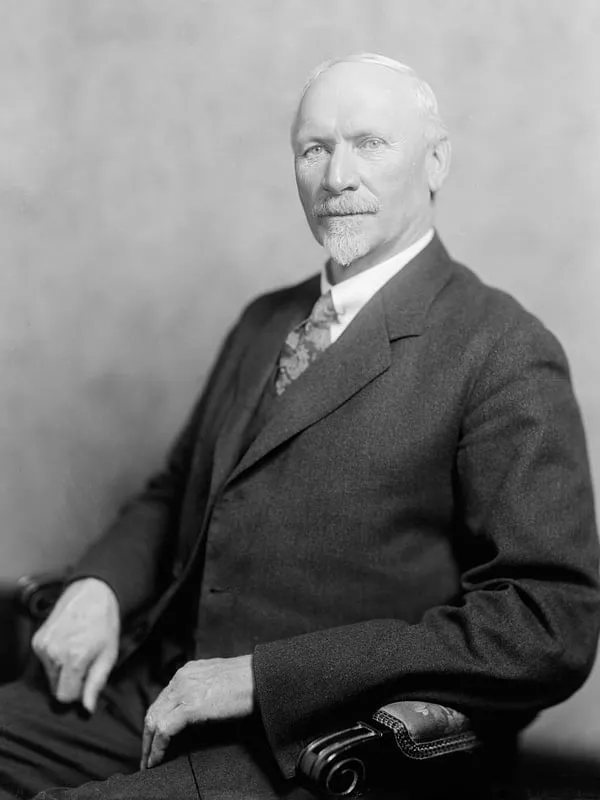
- Born:
- 24 May 1870, Bovenplaats near Riebeek West (Cape Colony)
- Died:
- 11 September 1950, Irene near Pretoria
- Author:
- Łukasz Skowroń
- Photo:
- Harris & Ewing, photographer, domena publiczna, Wikimedia Commons

Few men played such varied roles in the Great War as Jan Christiaan Smuts: he commanded an army of the British Empire in Africa and then sat in its government in London. A dozen or so years earlier, as a Boer general, he had fought against the British. In 1914, as defence minister of the Union of South Africa, he helped Louis Botha put down the Boer rebellion and planned the invasion of a German colony. In 1916 he led a great offensive in German East Africa and occupied most of the colony, but failed to destroy the forces of Paul von Lettow-Vorbeck. From 1917 he was in London as one of the closest advisers of David Lloyd George: he wrote the report from which the Royal Air Force grew, conducted secret peace talks with the Austrians, and in 1919 was among the founders of the League of Nations. To some he was a visionary and a statesman on an imperial scale; to others a politician who spoke of peace and a commonwealth of nations while entrenching the rule of the white minority at home.
Before the war
He was born on 24 May 1870 on the Bovenplaats farm near Riebeek West in the Cape Colony, into a prosperous family of Afrikaner farmers. He did not go to school until he was twelve, but he quickly made up for lost time. After studying at Stellenbosch he won a scholarship to the University of Cambridge, where in 1894 he graduated in law with the highest distinction in both parts of the examination. Smuts nevertheless returned to Africa. He began as a supporter of Cecil Rhodes, but after the Jameson Raid at the turn of 1895 and 1896 he felt betrayed, moved to the Transvaal and in 1898, aged only 28, became state attorney of that republic.
In the Second Boer War he was at first President Paul Kruger’s right-hand man in Pretoria, and from 1900 he fought in the field under General Koos de la Rey. In 1901 he led a commando deep into the Cape Colony, hoping for a rising of the Afrikaners there, and in the spring of 1902 he besieged the copper mines at Okiep. From there he was summoned to the peace talks. At the delegates’ assembly at Vereeniging he argued that further fighting threatened the destruction of the nation, and he helped secure acceptance of the Peace of Vereeniging.
From then on, together with Botha, eight years his senior, he staked everything on reconciliation with the British. In 1907 he joined the government of the now self-governing Transvaal, and the draft constitution he pushed through the National Convention in 1908–1909 became the basis of the Union of South Africa. In the first Union government in 1910 he took, among others, the interior and defence portfolios, and from 1912 defence and finance. He built the Union’s armed forces, the Union Defence Force, from scratch. He dealt harshly with his opponents: in January 1914, during a general strike, he declared martial law and deported the trade union leaders to England without trial. In the same year he reached an agreement with Mahatma Gandhi, with whom he had been at odds for years over the rights of Indians in South Africa.
1914–1915: the rebellion and South West Africa
When war broke out, Smuts as defence minister drew up a plan to attack German South West Africa from several directions and defended it in parliament, whose consent was needed to send troops abroad. He knew that some Afrikaners did not want to fight Germany, which had sympathised with the Boers in 1899. In September the first units took Lüderitzbucht, and in October the Boer rebellion broke out. When Botha led the troops against the rebels, Smuts ran the government and the defence ministry from Pretoria, in daily telegraphic contact with the prime minister. His most notorious decision was to confirm the death sentence on Captain Jopie Fourie, who had gone over to the rebels without resigning his commission in the Union army. Fourie was shot on 20 December 1914, and the nationalists never forgave Smuts for it.
After the collapse of the rebellion Botha personally took command in South West Africa, while Smuts stayed at home to run the country. In April 1915, when there was no longer any fear of a new revolt, he went to the front himself and took command of the forces advancing in the south of the colony, combined into a single army from the forces of General Duncan McKenzie, Colonel Jacob van Deventer and Colonel Berrangé. He fought no great battles: the Germans abandoned the south to defend themselves against Botha in the north, and by the end of April, after the skirmish at Gibeon, the whole of that part of the colony was in the Union’s hands. Smuts returned to Pretoria. On 9 July Botha accepted the surrender of the colony.
Even before the campaign ended Smuts was pressing for Union troops to fight in East Africa too. He hoped that taking part in the conquest of the German colony would give South Africa a say in its partition, perhaps even territorial gains. In the summer of 1915 recruitment began of volunteers for a brigade that was to fight in Europe and that later, in July 1916, bled to death in Delville Wood. At the end of 1915 Smuts declined the command in East Africa, because the political situation at home after the elections did not allow him to leave. But when General Horace Smith-Dorrien, appointed in his place, fell seriously ill, the post went to Smuts.
1916: East Africa
On 18 February 1916 Smuts was given the temporary rank of lieutenant-general in the British Army, and the next day he landed at Mombasa. He had about 27,000 soldiers under his command, a force such as this theatre of war had never seen. He did not wait for the end of the rainy season. At the beginning of March he was already attacking at Kilimanjaro from two sides, hoping to encircle and destroy Lettow-Vorbeck’s main forces. Having learned from the defeat at Salaita, in which the South Africans had suffered heavy losses just before his arrival, he avoided frontal attacks on entrenched positions in the bush and preferred wide outflanking moves by cavalry. Smuts’s troops took Taveta, the Latema Nek and Moshi, but each time the Germans slipped out of the trap.
This pattern repeated itself throughout the year. In April Smuts sent van Deventer’s division far into the interior of the colony, to Kondoa Irangi, while in May he himself set off with the main force along the Pangani river and the Usambara railway. The Belgians advanced from the Congo in the west, and General Edward Northey from the south-west. In August Smuts crossed the Nguru Mountains and on 26 August took Morogoro on the Central Railway, where he hoped for a decisive battle. Lettow-Vorbeck, however, withdrew south through the Uluguru Mountains. On 4 September Dar es Salaam, the capital of the colony, surrendered, and soon afterwards the navy took the ports on the southern coast. A dispersed attack at Kisaki in September ended in failure, however, and on the Mgeta river the troops came to a halt for many months.
The price of the rapid march was the soldiers’ health. The supply lines stretched for hundreds of kilometres through the bush, porters and pack animals died, and the soldiers from South Africa and Britain went down with malaria and dysentery in huge numbers. At the end of 1916 Smuts sent thousands of exhausted men home and replaced them with African battalions. On 1 January 1917 he opened one more offensive, on the Rufiji, and at Beho-Beho once again tried to trap the Germans in a pocket. This time too, as he himself wrote, the enemy “slipped away again”. On 20 January 1917 he handed over command to General Reginald Hoskins and left for London. By then he controlled the whole colony north of the Rufiji, with both railway lines and the main ports. On leaving he announced that the campaign could be considered over. Lettow-Vorbeck, however, fought on until November 1918, and Smuts’s words weighed on his successors.
1917: London
Smuts came to London to stand in for Botha at the meetings of the Imperial War Cabinet, which began in March 1917. He quickly gained great authority in Britain: a former enemy who spoke of the empire as a community of free nations was, for the British, living proof that their cause was just. Together with the Canadian prime minister Robert Borden he was the main author of the resolution that foreshadowed the recognition of the dominions as “autonomous nations of an Imperial Commonwealth”, and in his speeches of this period he popularised the idea of a British Commonwealth of Nations. He received the honorary rank of lieutenant-general in the New Year of 1917.
Lloyd George asked him to stay in London. In May he offered him the command in Egypt and Palestine, but Smuts, who demanded a guarantee of forces sufficient for a decisive victory, declined on 30 May. In June he joined the British War Cabinet, although he did not sit in parliament, and the War Policy Committee. The prime minister hoped Smuts would help him persuade the generals to seek a decision away from the Western Front. At first, however, Smuts backed the plan of Douglas Haig and the offensive in Flanders. His faith in offensives in the west was shaken only by the losses of the Third Battle of Ypres.
His most lasting achievement that year was the reform of air power. After the daylight Gotha raids on London in June and July the government set up a committee whose work was in practice done by Smuts. The first report, in July, dealt with the air defence of the capital. The second, of 17 August 1917, recommended merging the army and navy air services into an independent armed service, equal to the army and the fleet, and predicted that air power could on its own destroy the enemy’s industry and break his morale. On this basis parliament passed the Air Force Act in November, and on 1 April 1918 the Royal Air Force was formed. In November he accompanied the prime minister to the Rapallo Conference, which gave rise to the Supreme War Council, and after the Battle of Cambrai he gave the government an opinion on the causes of the German counter-attack.
In December 1917 Smuts went to Geneva, where on 18 and 19 December he held secret talks with the Austro-Hungarian diplomat Count Albert Mensdorff. The British wanted to find out whether Austria-Hungary could be detached from Germany. Mensdorff, however, was authorised only to discuss a general peace, and Smuts came back convinced that Vienna would not bring itself to make a separate peace.
1918: strategist of the empire
In January 1918 Lloyd George sent Smuts and Maurice Hankey to France to look discreetly for a possible successor to Haig. Smuts was also increasingly critical of the Chief of the Imperial General Staff, William Robertson, whose demands for reinforcements he considered excessive, and he supported his removal. In February the government sent him to Egypt to settle with General Edmund Allenby and the command from Mesopotamia how to resume the offensive against the Turks. Smuts proposed that the Mesopotamian front go over to the defensive and hand some of its troops over to Palestine, and he backed the plan for a raid across the Jordan. The plan drawn up jointly with Allenby envisaged a march on Haifa and Damascus. The German spring offensive in France forced the British to send some of Allenby’s troops back to Europe, but the ideas of February served in the autumn as the basis for the Battle of Megiddo.
Towards the end of the war he devoted more and more attention to the coming peace. In December 1918, a few weeks after the Armistice of Compiègne, he published the pamphlet The League of Nations: A Practical Suggestion.
1919: Paris
Smuts’s pamphlet made a great impression on Woodrow Wilson, and many of its ideas went into the Covenant of the League of Nations: a permanent council of the great powers with the participation of smaller states, a permanent secretariat and the mandate system. Smuts proposed mandates for the lands taken from Russia, Austria-Hungary and the Ottoman Empire, not for the German colonies, which South Africa and Australia wanted simply to annex. In the end the Union received South West Africa as a Class C mandate, which in practice allowed it to be governed as part of the Union’s own territory.
At the peace conference Smuts called for moderation towards Germany and warned that too harsh a peace would breed a new war. At the same time he was the author of a memorandum arguing that the war damage for which Germany was to pay should include pensions and allowances for invalids, widows and orphans. This argument, accepted by Wilson, roughly doubled the estimates of the reparations due, something critics, led by John Maynard Keynes, long held against him. At the beginning of April 1919 the Supreme Council sent him to Budapest, to the government of Béla Kun. Smuts offered the Hungarians a more favourable demarcation line with Romania, but Kun rejected the offer and the mission ended after two days.
Smuts considered the finished treaty with Germany too harsh and hesitated to the last moment over whether to sign it. Botha, for whom the signature was proof that South Africa had become a state on an equal footing with others, persuaded him. On 28 June 1919 they both signed the Treaty of Versailles, and at the same time Smuts issued a statement announcing that the League of Nations would in time have to soften its terms.
After the war
When Botha died in August 1919, Smuts became prime minister of the Union on 3 September. Without the conciliatory Botha he was unable to reconcile the feuding factions. In 1922 he bloodily suppressed a strike of white miners on the Witwatersrand, with aircraft and artillery used against them, and in 1924 he lost the election to Barry Hertzog’s nationalists. In 1926 he published the book Holism and Evolution. After years in opposition he joined Hertzog’s government in 1933, and in September 1939, when parliament voted for war with Germany, he became prime minister again. In 1941 he was made a British field marshal, he was a close adviser of Winston Churchill, and in 1945 in San Francisco he helped draft the Charter of the United Nations. In 1948 he lost the election to the National Party, which began building apartheid. He died on 11 September 1950 at his farm Doornkloof in Irene near Pretoria.
Assessment
Smuts’s record as a commander has long been disputed. His intelligence chief in East Africa, Richard Meinertzhagen, wrote that with his caution and his outflanking moves instead of decisive attacks Smuts had cost Britain hundreds of lives and millions of pounds, and that he was “a brilliant statesman but no soldier”. Historians treat these words with reserve: Meinertzhagen wrote them after Smuts had removed him from his post, and his diaries turned out in many places to have been reworked later. There is no doubt, however, that Smuts underestimated the difficulties of supply and disease, which killed far more of his soldiers than bullets did. His defenders stress that in less than a year he occupied almost the whole colony at relatively low combat losses, and that none of his successors managed to defeat Lettow-Vorbeck.
As an imperial politician Smuts made a great impression on his contemporaries in 1917–1919. Lloyd George valued him as one of the few men capable of thinking about the war on a global scale, and the 1917 report is regarded as the founding act of independent air power. His role in creating the League of Nations and in transforming the empire into the Commonwealth of Nations earned him a reputation as a visionary. More recent historians point out, however, that this visionary was also a ruthless politician who had strikers shot at home, and that his vision of world order assumed that whites would for a long time act as guardians over the rest of mankind. In this view the mandate system was not only a step towards self-determination but also a new form of colonialism.
Sources
Spotted a mistake?Report an error
Commanded in battles
(02)Mentioned in battles
(04)Often appears with
People who appear in the same events.
On the timeline
(56)1914
1915
1916
January
February
March
- 21
- Fighting at KaheOn 21 March 1916 van Deventer's horsemen took Kahe hill and station, while Sheppard's infantry stalled at the Soko Nassai. At night Lettow-Vorbeck withdrew.
- Germans withdraw from KilimanjaroOn the night of 21–22 March 1916 Lettow-Vorbeck left his Ruvu positions and fell back along the Usambara Railway. Kilimanjaro passed to the British.
April
May
June
July
August
September
- 07
- Action at KisakiOn 7–8 September 1916 two of Smuts's columns attacked the Germans separately at Kisaki, south of the Uluguru Mountains. Both were repulsed; the pursuit stalled.
- British occupy KilwaOn 7 September 1916 British ships landed troops at Kilwa Kisiwani and Kilwa Kivinje, south of Dar es Salaam. Both ports were taken almost without a fight.
December
1917
January
March
May
June
July
September
- 04
- First Gotha night raid on LondonOn the night of 4 September 1917 Gothas bombed London after dark for the first time. A bomb hit a tram by Cleopatra's Needle. In the capital 16 people died.
- London conference on aid to ItalyOn 4 September 1917 in London Foch asked for consent to send Italy a hundred French heavy guns from Flanders. The War Cabinet left the decision to Haig.