Key event
Battle of Delville Wood begins
- Category:
- Military operations
- Front:
- Western Front
- Date:
- 15 July 1916
- Author:
- Natalia
- Battle:
- Battle of Delville Wood
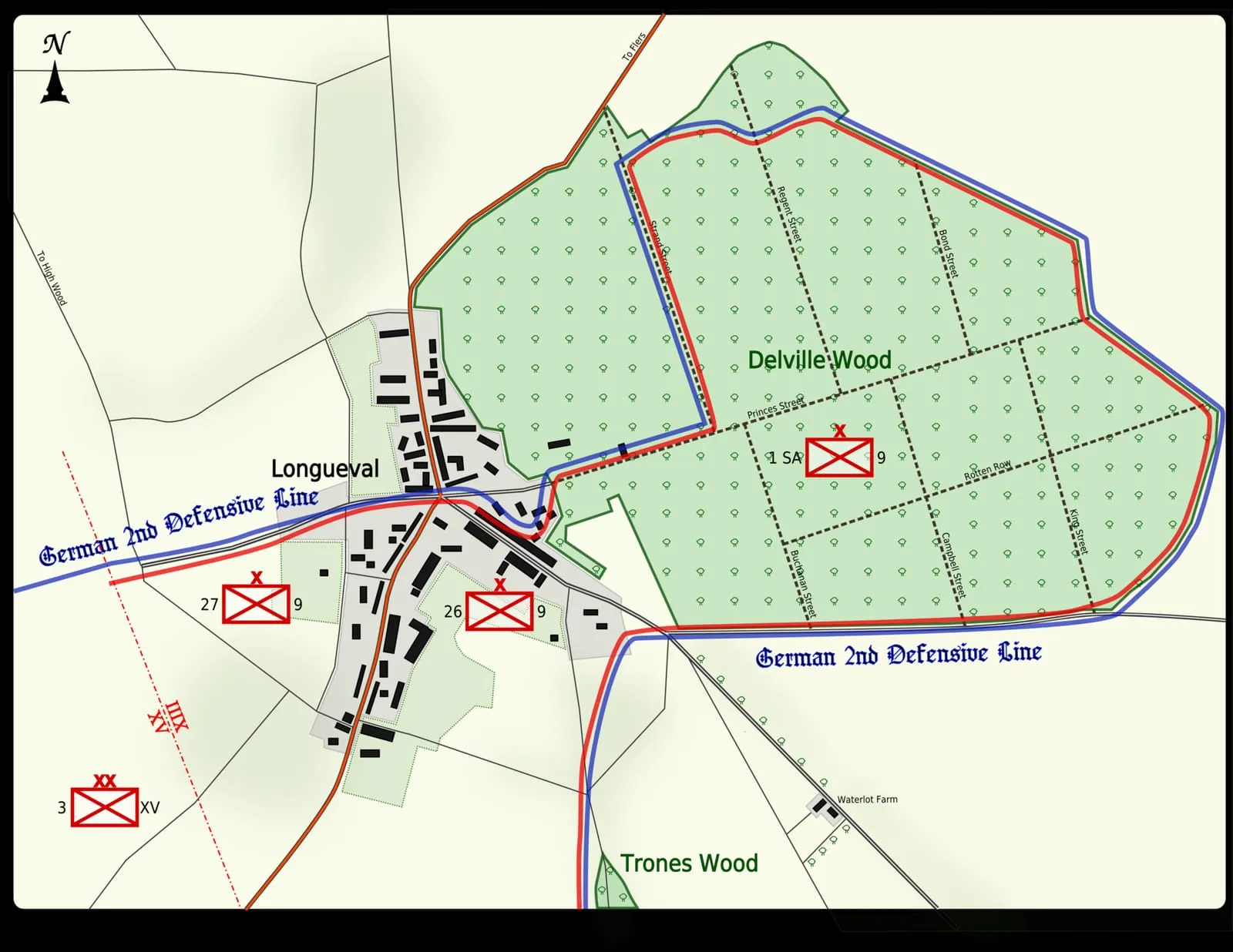
At about six in the morning on 15 July 1916 three battalions of Brigadier-General Henry Lukin’s 1st South African Infantry Brigade entered Delville Wood, on the eastern edge of the village of Longueval in Picardy. Within a few hours they had taken almost the whole wood, and before evening they beat off the first German counter-attacks. It was the baptism of fire on the Western Front for soldiers from the Union of South Africa, and at the same time the start of fighting that would rage over this small wood for the weeks to come. British soldiers soon called it Devil’s Wood.
The wood behind Longueval
The day before, 14 July, General Henry Rawlinson’s British Fourth Army had launched a dawn attack on the German second position on the Somme, from Bazentin-le-Petit to Longueval. On the right wing General Walter Congreve’s XIII Corps was to take Longueval and Delville Wood. Together the village and the wood formed a salient driven into the German lines and under fire from three sides. Worse still, neither could easily be held without the other: the northern part of Longueval, where the road climbed towards Flers, lay beneath the wood, and on its western side the wood adjoined the orchards and gardens on the edge of the village.
Delville Wood, in French Bois d’Elville, was, as John Buchan, author of the history of the South African forces in France, wrote, shaped like a blunt triangle with its apex pointing north. According to the history of the 9th (Scottish) Division it covered about 159 acres, just under 65 hectares. It consisted mainly of beech and hornbeam, and its dense hazel undergrowth was cut by grassy rides. The British gave these the names of London and Glasgow streets. Princes Street ran through the middle of the wood from east to west; to the north of it ran the Strand, Regent Street and Bond Street, to the south Buchanan Street, Campbell Street and King Street, and parallel to Princes Street, nearer the southern edge, ran Rotten Row. The Germans had dug trenches along and across the rides, and their main machine-gun posts lay 50–200 metres from the edge of the wood, to the north, north-east and south-east.
On 14 July the Scottish 26th Brigade broke into Longueval and in house-to-house fighting took its western and south-western parts, but the northern end of the village was still in German hands. It was helped by the 1st South African Infantry Battalion, which in the afternoon attacked the rest of the village and was held up by machine-gun fire. At 1 p.m. the commander of the 9th Division, Major-General William Furse, told Lukin that his brigade would take the wood as soon as the village fell. The time of the attack was put back several times: from 5 p.m. to 7 p.m., then to 7.30 p.m., until in the evening a conference at Montauban decided that the attack would go in on the morning of 15 July. The order was that the wood must be taken at all costs, even if the Scots did not capture the northern part of Longueval.
A brigade from Africa
Lukin’s brigade was a volunteer formation. The Union of South Africa’s Defence Act of 1914 did not allow troops to be sent outside southern Africa, so Prime Minister Louis Botha and Defence Minister Jan Smuts created a separate overseas force, which formally had the status of imperial troops. The brigade was recruited in August and September 1915 at Potchefstroom from white volunteers, many of them veterans of the recent campaign in German South West Africa, including many Boers. Its battalions were named so as to represent the whole country: the 1st Battalion was the regiment of the Cape Province, the 2nd of Natal and the Orange Free State, the 3rd of the Transvaal and Rhodesia, while the 4th Battalion, the South African Scottish, drew on the country’s Scottish military traditions. It was commanded by Lukin, a 56-year-old officer who had been fighting in southern Africa since the Zulu War of 1879.
The brigade had its first test in Egypt, where in the spring of 1916 it fought the Senussi order, among other places at Agagia. In April it sailed for Marseille and joined the Scottish 9th Division, made up of volunteers from Kitchener’s New Armies. On 1 July the division was in XIII Corps reserve, and in the days that followed the South Africans held the line in Bernafay and Trônes Woods. By 13 July, without yet having taken part in any major attack, they had lost more than 500 men to shellfire, and on 11 July the commander of the 4th Battalion, Lieutenant-Colonel F. A. Jones, was killed by a shell splinter.
Attack at dawn
Two hours before dawn the 2nd and 3rd Battalions left Montauban, followed by the 4th Battalion in support. The attack was commanded by Lieutenant-Colonel William Tanner, commander of the 2nd Battalion. Lukin told him first to find out what was happening in Longueval and only then to make his plan, because the officer sent to reconnoitre the village in the evening had not yet returned. On the way the division took two companies of the 4th Battalion to help the Scots at Waterlot Farm, a ruined sugar refinery south-east of the village. According to Buchan the morning was overcast, and when the sun rose the dark mass of the wood loomed ahead of the men, while the ruins of Longueval “spouted like a volcano” with bursting shells.
Tanner established that the Germans still held the northern part of the village and the adjoining edge of the wood. It turned out, however, that during the night a company of the 5th Battalion, Cameron Highlanders, had dug in along Buchanan Street in the south-western corner of the wood. Tanner decided to use this covered route. A Scottish guide led the South Africans in single file through the southern end of Longueval and across the fields to the trench at Buchanan Street, which the leading 3rd Battalion reached at about six. The plan was simple: first to clear the part of the wood south of Princes Street, then to move north and take the Strand and the whole edge of the wood round to the south-western corner. Only the north-western corner, adjoining the uncaptured part of the village, was to remain outside South African hands.
At first everything went quickly. By about seven the 3rd Battalion, supported by a company of the 2nd Battalion, had taken the whole southern half of the wood, meeting mainly individual snipers. Tanner then sent the remaining three companies of the 2nd Battalion to the northern edge. According to the history of the 9th Division resistance was surprisingly weak, because the Germans had thinned out the garrison on account of the shelling, and the worst obstacle was the wood itself: tangled undergrowth and trees brought down by shells, through which the sweating, panting men struggled with difficulty. The three weakened companies reached their objective, but had to man about 1,200 metres of edge, along which it was hard even to keep in touch. Meanwhile, in the east, patrols of the 3rd Battalion under Captains Medlicott and Tomlinson caught the Germans at close quarters and took prisoners. The figures differ: Buchan writes of 3 officers, 185 men and a machine gun, the history of the 9th Division of 138 prisoners.
At 2.40 p.m., according to Buchan, Tanner reported to Lukin that he held the whole wood except for German pockets of resistance in the north-western corner near Longueval and in the orchards to the north. The history of the 9th Division says the report came shortly after 2 p.m. Either way, by the afternoon almost the whole wood was in the brigade’s hands.
The first counter-attacks
Lukin knew from the start that it would be harder to hold the wood than to take it. He wanted to leave only a few posts with machine guns in it, because a dense clump of trees under artillery fire was a death trap for large units. The Germans, however, gave him no time for that. The wood was too important to them: it covered their positions and barred the British way to Ginchy and Guillemont. The front at Longueval belonged to General Friedrich Sixt von Armin’s IV Corps, which was drawing everything it had to hand into the area.
According to the British official history a battalion of the German 24th Reserve Division counter-attacked from the south-east before noon, with only five minutes’ warning, and went to ground about 70 metres short of the wood. A second battalion, attacking from the Ginchy–Flers road, was also beaten off, and the two together lost 528 men. In the early afternoon a battalion of the 8th Division struck the north-eastern edge and fell back, having lost all its officers. At about 3 p.m. troops of the 6th Bavarian Reserve Infantry Regiment of the 10th Bavarian Division attacked in strength from the east, and the South Africans drove them back with rifle fire. At 4.40 p.m. Tanner reported that the Germans were massing to the north, and at 6.30 p.m. that they were concentrating to the north and north-east. His losses were heavy: one company of the 2nd Battalion had practically ceased to exist. Lukin sent him a company each from the 4th Battalion and from the 1st Battalion, which had returned from Longueval, and ordered the commanders to have the men dig in despite their exhaustion, since heavy shelling was to be expected the next day.
Digging in the wood proved almost impossible. The hard ground was laced with tangled roots, and fallen trunks and wire blocked the way. The men carried enough spades, but managed to dig only shallow ditches and holes, and an attempt to run barbed wire along the edge was interrupted by a Bavarian counter-attack. Meanwhile the two companies of the 4th Battalion at Waterlot Farm covered the Camerons’ attack on the refinery, which the Germans were still defending. In the evening the artillery broke up German units approaching from Guillemont, and towards morning both companies were relieved.
A night under fire
When the sun went down the German shelling grew even heavier. According to Buchan shells and fire turned the night into a “fevered, blazing noon”, and at its height up to 400 shells a minute were falling on the wood. The Germans also fired gas shells. According to some accounts, at midnight three battalions of the German 8th Division and 12th Reserve Division advanced with orders to retake the wood at all costs, and got to within about 45 metres before artillery and machine-gun fire forced them to go to ground.
On the evening of 15 July twelve South African companies, already badly thinned, held the whole perimeter of the wood except the north-western corner. That corner gave the Germans a covered entrance into the wood, and the other three sides were ringed by a semicircle of their trenches. The headquarters of the 2nd and 3rd Battalions were at the junction of Buchanan Street and Princes Street, and the machine guns stood at the northern apex and on the eastern edge. Lukin had in reserve only one company of the 1st Battalion and the two companies of the 4th Battalion, which were due back from Waterlot Farm in the morning. All night the men dug for their lives.
What came next
The struggle for the wood was only beginning. For the next five days the South Africans held out under incessant shelling against one fresh German division after another, until on 20 July only a handful of survivors came out of the wood. The brigade lost more than 2,500 men in this fighting. The Germans were finally driven out of Delville Wood only at the turn of August and September. For South Africa the wood became a place of national remembrance: today it holds a memorial to all the country’s soldiers who fell in the First World War.
Remember the articles you have read? Only in this browser; nothing is sent anywhere.How it works
Read ·
A voice from the front
“You know what a wood looks like when the trees are in bloom - well, that is what it was like when we first drove them out. Since then they have continually bombarded it with hundreds and hundreds of guns, until now it is just like one or two poles stuck in the ground. Yesterday they gave us ten solid hours bombardment with guns of all sizes and kinds […]. How I'm alive, mother, I can't say.”
Spotted a mistake?Report an error
Meanwhile
(03)Elsewhere in the same days.
- 14 July 1916 · DiplomacyInter-Allied financial conference in LondonOn 14–15 July 1916 Entente representatives met in London on financing the war. Russia sought new British credits for purchases abroad.
- 14 July 1916 · AfricaBritish take MwanzaOn 14 July 1916 Charles Crewe's troops, carried by steamer across Lake Victoria, took Mwanza. The German garrison managed to withdraw to the south.
- 18 July 1916 · Middle EastTreaty with Ibn Saud ratifiedOn 18 July 1916 the Viceroy of India, Lord Chelmsford, ratified the Treaty of Darin at Simla. Ibn Saud's Najd formally came under British protection.
Related events
(04)The same battle, people or subject.
- 14 July 1916 · Western FrontBattle of Bazentin Ridge beginsAt dawn on 14 July 1916, after a night approach and five minutes of shelling, the British took the German second position from Longueval to Bazentin-le-Petit.
- 3 September 1916 · Western FrontBattle of Delville Wood endsOn 3 September 1916, by British naming, the Battle of Delville Wood ended. An attack on the wood's eastern edge, supporting an assault on Ginchy, failed.
- 18 October 1916 · Western FrontEnd of the Battle of the Transloy RidgesOn 18 October 1916 the British Fourth Army attacked on the Somme before dawn, in rain and mud. It took a few trenches but did not reach Le Transloy.
- 23 July 1916 · Western FrontBattle of Pozières Ridge beginsOn the night of 23 July 1916 the 1st Australian Division took most of Pozières on the Somme, the only success of the great British attack that night.