Key event
Battle of Pozières Ridge begins
- Category:
- Military operations
- Front:
- Western Front
- Date:
- 23 July 1916
- Author:
- Natalia
- Battle:
- Battle of Pozières Ridge
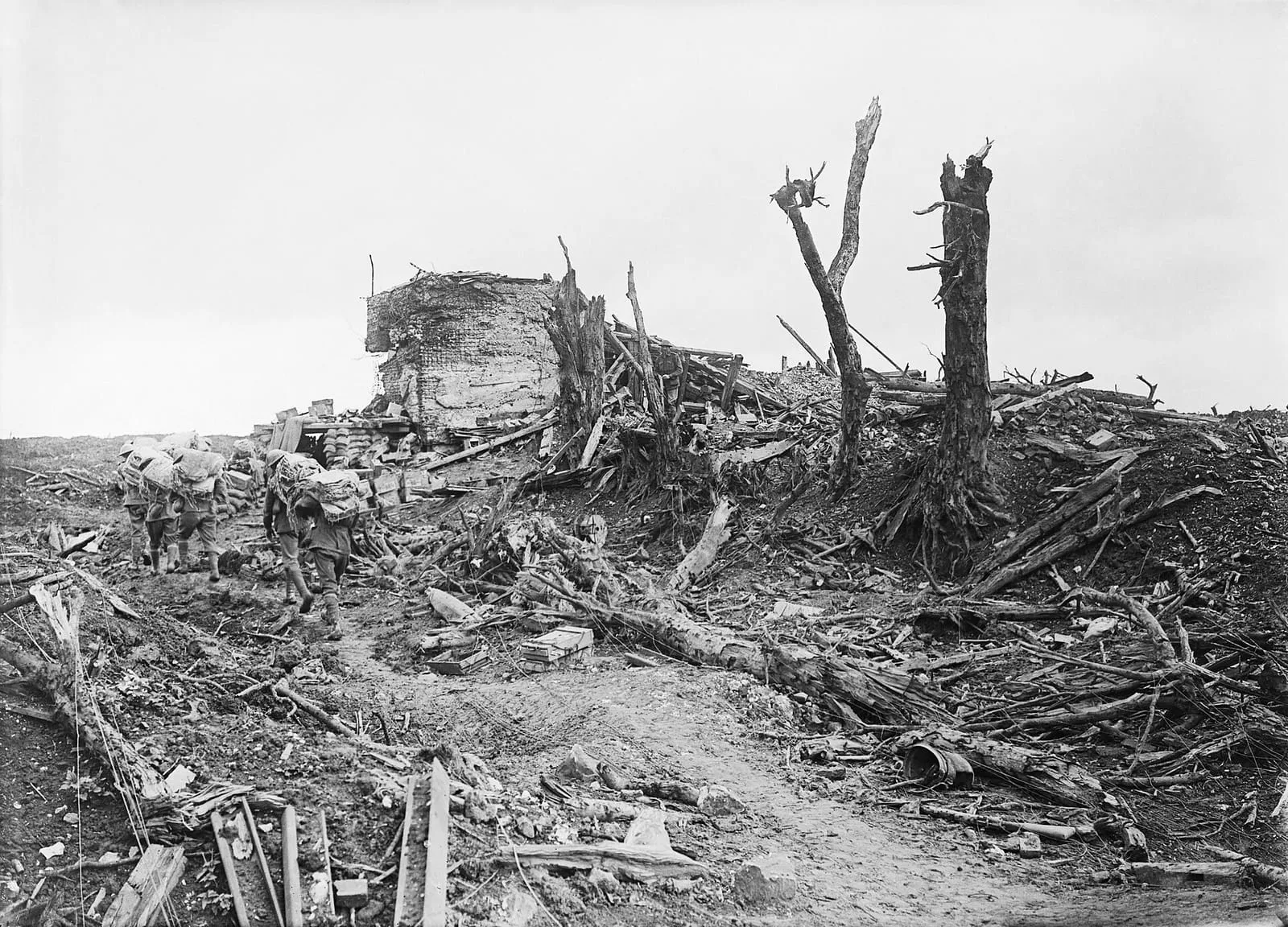
On Sunday 23 July 1916, half an hour after midnight, the infantry of the 1st Australian Division went in to attack the village of Pozières in Picardy, which lay on a ridge beside the road from Albert to Bapaume. Over the previous three weeks of the Battle of the Somme the British had several times attacked this heavily fortified point without success. The Australians took it within two hours. By dawn they had dug in along the main street, in the morning they beat off the first German counter-attack, and the following night they occupied the northern part of the village. The great attack of the British Fourth Army, made the same night from Pozières to Guillemont, broke down everywhere else. The capture of the village was therefore the only success of the day, and for the Australians the beginning of six weeks of the heaviest fighting in their history.
A village on the ridge
Pozières was a small farming village. Its houses, with orchards and hedges, stretched for more than a kilometre along the Albert–Bapaume road, where the highway climbs to the crest of the ridge. A few hundred metres beyond the village ran the two trenches of the German second position, which the British called the O.G. Lines (from Old German), and behind them, on the very summit, stood the remains of a windmill. The Germans called the spot Hill 160. As the Australian official historian Charles Bean writes, the point did not seem higher than the rest of the ridge, but it was one of the highest on the whole battlefield. The village had been incorporated into the German second position by digging a trench along its southern edge, which the British named Pozières Trench. On the west it was covered by “K” Trench, which ran north towards Mouquet Farm and Thiepval. From the exposed, open plateau the defenders had a field of fire of hundreds of metres in every direction.
On 14 July the British Fourth Army of General Henry Rawlinson captured at dawn the German second position on the sector from Bazentin-le-Petit to Longueval. On the left flank, at Pozières, however, the attack failed: the village and the trenches behind it remained in German hands. Further attempts by III Corps, made from Contalmaison, also failed. On 17 July an attack by the 34th Division broke down on uncut wire, and the dead were left hanging on it. The next day Douglas Haig decided to relieve the Fourth Army of responsibility for this flank and handed the task of taking Pozières to the Reserve Army of General Hubert Gough, which was operating north of the Bapaume road.
Australians on the Somme
For this task Gough was given the 1st Australian Division. Its commander was an Englishman, Major-General Harold Walker, who had already led it at Gallipoli. The division belonged to General William Birdwood’s I ANZAC Corps. The corps had sailed from Egypt to France in the spring of 1916 and at first held a quiet sector near Armentières, where it learned trench warfare in Flanders. In the first half of July its three divisions were moved to the Somme, to the area of Amiens. The fourth, the 5th Australian Division, stayed in the north and on the night of 19/20 July suffered heavy losses in the attack at Fromelles, which was meant to draw the Germans away from the Somme.
Gough was impatient and did not want to wait until Birdwood’s corps staff took over the sector. He decided to direct the 1st Division straight from his own headquarters. Bean quotes the words with which he greeted Walker: “I want you to go into the line and attack Pozières tomorrow night!” Walker, fearing a hasty attack, pressed hard for a delay. On the night of 19/20 July his brigades marched through Albert and took over the freshly dug trenches south of the village. It turned out that the jumping-off trenches were not ready and that the only route to the right flank was a narrow, crowded trench. Birdwood and his chief of staff, General Brudenell White, although formally not responsible for the sector, obtained from Gough’s staff a postponement of the attack and a widening of its objectives. When on the eve of the attack White discovered that under the plan the barrage, after its second lift, would fall on their own infantry, the date was put back by another day. In the end it was fixed for 12.30 a.m. on 23 July. At the last moment Walker secured an hour’s delay on the original time, so that the right flank could reach its positions.
The plan of the night attack
The division was to attack from the south-east, on a front about 1.6 kilometres long. Walker chose this direction so as not to expose his left flank to fire from “K” Trench. The attack was divided into three stages, half an hour apart. First the infantry was to take Pozières Trench, then the rear hedges and orchards of the village, and finally the south side of the main street, that is, the Bapaume road. On the right flank the 3rd Brigade, made up of men from Queensland, South Australia, Western Australia and Tasmania, was at the same time to take the southern stretch of the O.G. Lines. On the left flank the 1st Brigade from New South Wales attacked, while the Victorian 2nd Brigade waited in reserve. Bean notes that the Australian commanders entrusted the hardest tasks to men from the less populous states, who were regarded as the toughest.
Each objective was to be taken by a different line of infantry. In the 1st Brigade the men of the first line wore a white ribbon on the right shoulder, the second line blue and the third green, so that in the dark they would know where to stop. After two minutes of hurricane fire the artillery was to lift on to the next objectives. West of the road the British 48th Division was to attack German communication trenches at the same time, and in the east the British 1st Division a trench called Munster Alley. The attack on Pozières finally became the left wing of a great attack by the whole Fourth Army, whose command moved its own zero hour to match the Australian one.
The night of 22/23 July
The bombardment preceding the attack was, as Bean writes, famous even among the many famous bombardments of the Western Front. It took place at night, before moonrise, and could be seen from nearly 30 kilometres away. At about 10 p.m. the battalions of the third line set out from their bivouacs towards the front. The Germans, who had long expected an attack, laid a barrage on the approach roads. The crossroads the troops called Casualty Corner and the road to Contalmaison were shelled with shrapnel, high explosive and phosgene shells. In places the men ran through one at a time, and the wounded had to crawl to safety by themselves.
At about 12.10 a.m. the first wave crawled out of the jumping-off trenches and crept as close as possible to the German trench. On the left flank scouts had earlier laid out a tape on which it was to form up. White flares rose over the village, but the men, pressed to the ground, hid in shell holes and clumps of thistles. In some places they got within less than 50 metres of the parapet. At 12.28 a.m. the fire of the division’s entire field artillery fell on Pozières Trench. One gun of the 6th Battery, brought up the Bapaume road with its wheels and harness muffled to less than 400 metres from the village, fired 115 rounds point-blank along the main street. At 12.30 a.m. the artillery lifted on to the orchards and the infantry rose to the assault.
Pozières Trench fell almost at once. On the left flank the Australians found few Germans in it, in the centre several dozen, who surrendered, and they shot or bayoneted the crew of one machine gun before it could fire more than a few shots. On the right flank the trench was so churned up by shell holes that it was hard to recognise. The second line passed through the first and at 1 a.m. moved on to the second objective. It turned out that there was no trench at all along the rear hedges, because the night bombardment had prevented the Germans from finishing it. Some of the men came upon an abandoned battery of old Belgian howitzers in a copse and chalked their battalion number on them. By the light railway track running behind the village the officers gathered and sorted out the men, and at 1.30 a.m. the third line entered the ruins. The main street was by now just a strip of rubble and roof beams. The men began to dig a trench behind the heaps of bricks. Most had thrown away in the heat of the fight the picks and shovels they were supposed to carry, and worked with small entrenching tools.
On the right flank two battalions of the 3rd Brigade that were to support the attack got stuck in a narrow communication trench. In the cloud of gas some of the men put on old-type masks in which they could see almost nothing, missed the entrance to the trench and, turning back, became mixed up with the next company. At 2 a.m. the brigade commander, General Ewen Sinclair-MacLagan, received a message that the companies were still standing in the trench, with a request to hold the barrage on the third objective. Bean recorded his exclamation: “God Almighty!” The situation was not, however, as dangerous as it seemed. The late companies set off across the open and shortly after two found men of both brigades already digging in on their objective.
The fight in the O.G. Lines
Only on the extreme right flank, where the attack went along the two trenches of the O.G. Lines, did the Germans put up strong resistance. The first trench was in tatters. The second, turned by the bombardment into a “tumbled sea of earthen waves”, could not be found at all in the dark. In the first, the attack was halted by two machine guns and German grenades, which were thrown further than the Australian ones. Private John Leak of the 9th Battalion then jumped out of the trench without orders, threw three grenades into the German post and leapt in after them. His commander found him a moment later wiping the blood off his bayonet with his hat. It was 12.59 a.m. Leak received the Victoria Cross for this deed.
Further north, along the O.G. trenches, the attack stalled. Second Lieutenant Arthur Blackburn of the 10th Battalion led eight successive attacks on the German posts, supported by mortars and howitzers, and advanced step by step, but of his roughly 70 men nearly 40 were killed or wounded. Bean writes that his persistence saved the situation in the O.G. Lines. Blackburn too received the Victoria Cross. Here the attack stopped about 550 metres short of its objective, and the gap between this sector and the village was closed by the bent-back flank of the 12th Battalion.
Morning in the ruins
By dawn the trench along the main street was already more than a metre deep, and in the front line stood a dozen or so light Lewis guns, which this time the Australians had boldly sent forward with the assault waves. The artillery on both sides fell almost silent, because neither command knew exactly where its infantry was. Snipers began firing from the ruins on the other side of the road. Small groups of Australians, some under orders and some on their own initiative, in search of adventure and souvenirs, combed the rubble. They threw phosphorus grenades into cellars and dugouts, which filled them with smoke and forced the Germans hiding there to come out. Bean describes this “grim sport” without embellishment: those who fled were chased and bayoneted or shot, and a few men sometimes brought back a dozen or more prisoners. In one dugout seventeen men surrendered, including five officers, in another twelve with two doctors wearing gloves, the elder of whom said in English: “This is a real blessing!”
At about 5.30 a.m. several hundred Germans came out of the O.G. Lines and the open ground east of the village and advanced in an extended line on the eastern edge of Pozières. This was a counter-attack by the III Battalion of the 157th Infantry Regiment, called up from Courcelette. The Australians, unmoved by the shelling, met it with rifle and Lewis-gun fire. The attackers went to ground in shell holes and after a few minutes withdrew behind the road, where the artillery that had been called for caught them.
During the day the Australians tidied up their line and in places dug down to a depth of more than two metres. At the western end of the village a patrol of the 2nd Battalion worked round a concrete observation shelter reinforced with steel grating and took its garrison prisoner: three officers and 23 men with three machine guns. The Australians named the shelter Gibraltar, but because of their own shelling could not occupy it at once. Many of the men believed that the Germans had withdrawn from the northern part of the village early in the morning and that had the artillery lifted further sooner, it could have been taken without a fight. Gough’s order to send patrols forward reached the last batteries only at about 3.30 p.m. In the evening men of the 2nd Battalion seized the southern end of “K” Trench together with Gibraltar, and at about 11 p.m. two companies of the 8th Battalion crossed in the dark through the ruins north of the road, past the remains of the church, and established posts on the northern edge of the village without meeting a single German.
On the other side
That night the village was held by units of two divisions. On the west and south-west stood the relatively fresh I Battalion of the 157th Infantry Regiment of the 117th Division, formed in Silesia and brought down from Ypres. On the south-east, including the O.G. Lines, the tired battalions of the 7th Division, which had been beating off British attacks since 13 July, were just being relieved in the dark. In a dugout on the main street sat the commanders and staffs of three battalions, who knew almost nothing about the course of the battle until a runner reported that he had seen the enemy at the entrance. Two staffs withdrew through the barrage; the third stayed and was taken prisoner. At 1.30 a.m. the commander of the 157th Regiment in Courcelette learned that the line at Pozières had been broken and sent his reserve battalion to counter-attack. Its attack at dawn was shattered by Australian fire. Bean notes that the account in the German official history was very inaccurate at this point. Among other things it claimed that each Australian division had an additional brigade of New Zealanders.
Defeat on the rest of the front
The great attack of the Fourth Army, made the same night, did not repeat the success of 14 July. On the right flank the attack on Guillemont at 3.40 a.m. was repulsed. Between Delville Wood and Pozières the divisions of three corps, after six and a half hours of bombardment, did not permanently gain a scrap of ground. The Scottish 51st Division failed to clear High Wood, and the 19th Division ran into the fire of Germans hidden in shell holes and new trenches far in front of the bombarded line. Immediately east of the Australians the attack of the British 1st Division on Munster Alley and Switch Trench also broke down. West of the Bapaume road the 48th Division took short stretches of two German communication trenches, and the neighbouring 49th Division was repulsed at Thiepval.
According to Bean, the whole third great British attack on the Somme thus ended in breaking one of the two props of the German flank, Pozières (the other was Thiepval), and in failure everywhere else. Haig concluded from this that the Germans, strengthened by reinforcements, could now build a defence that could not be broken by sudden blows like those of 1 and 14 July. He did not, however, intend to break off the battle. Instead he decided to wear the enemy down with a series of smaller attacks.
What came next
For the Germans Pozières became a point to be retaken at any cost. From 24 July their artillery began turning the captured village into a field of shell holes. Bean writes that the bombardment over the following days was probably the heaviest to which Australian soldiers had yet been subjected. On 25 July the 1st Division took the rest of “K” Trench west of the village and made contact with the 48th Division, but it still had not taken the O.G. Lines on the ridge. On the night of 26/27 July it was relieved by the 2nd Australian Division. In four days of fighting the 1st Division lost 5,285 killed, wounded and missing. Ahead of Birdwood’s corps lay another six weeks of fighting for the windmill ridge and Mouquet Farm.
The times in this article are given according to the Australian official history, that is, in British time. In German accounts they are shifted by an hour.
Remember the articles you have read? Only in this browser; nothing is sent anywhere.How it works
Read ·
Voices from the front
“We reckoned when we came here the night before last we were going straight into it - we were all schooled right up to the point physically and mentally - now we are held here; it is disappointing. I feel as one who, having stripped himself of his clothes, has posed his body ready to leap into the swift icy current - and is then held back.”
“One feels on a battlefield such as this that one can never survive, or that if the body lives the brain must go forever. […] We are lousy, stinking, ragged, unshaven, sleepless. Even when we're back a bit we can't sleep for our own guns. I have one puttee, a dead man's helmet, another dead man's gas protector, a dead man's bayonet.”
Spotted a mistake?Report an error
Meanwhile
(02)Elsewhere in the same days.
- 25 July 1916 · Middle EastRussians take ErzincanOn 25 July 1916 the Russian 39th Division entered Erzincan, abandoned by the shattered Ottoman Third Army. It was the peak of Russian gains in Anatolia.
- 20 July 1916 · Balkan FrontReports of a new Entente loan to GreeceA British chronology says the Zaimis government concluded an £800,000 loan with the Entente on 20 July 1916. Other sources do not confirm the agreement.
Related events
(04)The same battle, people or subject.
- 3 September 1916 · Western FrontEnd of the Battle of Pozières RidgeOn 3 September 1916 the Australians attacked Mouquet Farm for the last time. They held it for a few hours, but kept only a stretch of trench on the ridge.
- 1 July 1916 · Western FrontFirst day on the SommeOn 1 July 1916 the British and French attacked on the Somme. The French and the British right succeeded, but the British Army lost 57,000 men.
- 22 September 1916 · Western FrontEnd of the Battle of Flers–CourceletteOn 22 September 1916 the Battle of Flers–Courcelette ended. After a week of fighting in rain and mud the British were preparing to attack Morval and Thiepval.
- 17 July 1916 · Western FrontBattle of Bazentin Ridge endsOn 17 July 1916 the Battle of Bazentin Ridge ended. The British held the German second position but lost High Wood and failed to take all of Longueval.