Key event
Battle of Bazentin Ridge begins
- Category:
- Military operations
- Front:
- Western Front
- Date:
- 14 July 1916
- Author:
- Łukasz Skowroń
- Battle:
- Battle of Bazentin Ridge
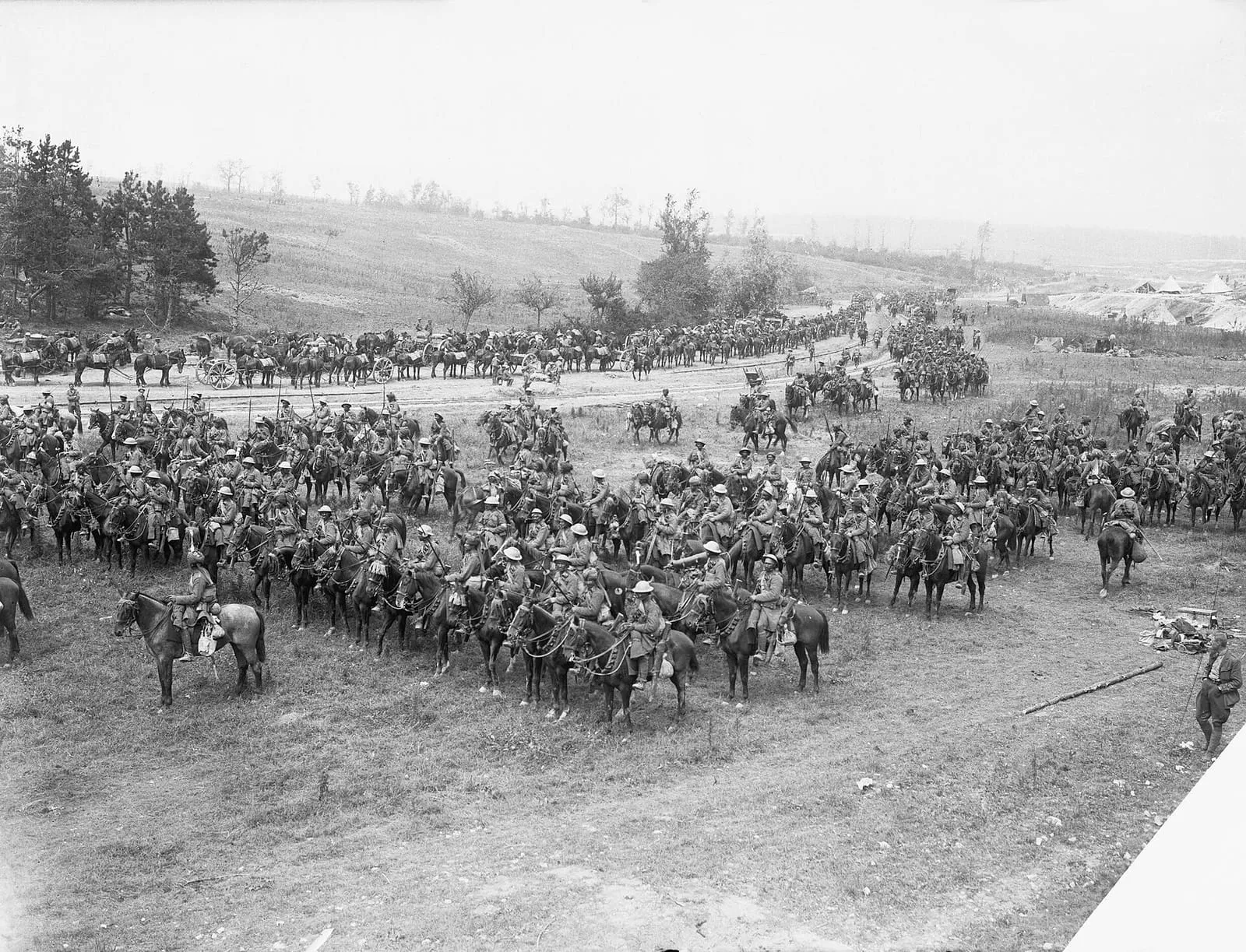
On 14 July 1916, the day of the French national holiday, the British Fourth Army carried out its most successful attack since the start of the Battle of the Somme. Two weeks after the first day, when its infantry had advanced in broad daylight, in even waves, often onto uncut wire and surviving machine guns, General Henry Rawlinson tried something entirely different. Four divisions crossed no man’s land by night, formed up a few hundred metres from the German trenches and at 3.25 a.m., in the grey light before dawn, after only five minutes of hurricane fire, went in to the assault. By noon the German second position on a front of about 5.5 kilometres, from Longueval to Bazentin-le-Petit Wood, was in British hands. In the evening the cavalry went into the attack. Yet the day also ended with the first signs that the success could not be fully exploited.
The dispute over the night attack
The German second position ran along a ridge rising north of Montauban, taken on 1 July: from the Waterlot Farm sugar refinery through the village of Longueval and Delville Wood, through the two villages of Bazentin – Bazentin-le-Grand and Bazentin-le-Petit – and the two woods of the same names, and on towards Pozières. It was separated from the British lines by a valley the soldiers called Caterpillar Valley. For almost two weeks of the Battle of Albert the British had been taking the woods and villages in front of this position.
Rawlinson and his corps commanders wanted to attack at dawn, when the German machine gunners could not yet see far. To do so the men of XIII Corps had to cross almost a kilometre of no man’s land in the dark. Douglas Haig long opposed this, believing that freshly trained volunteers and inexperienced staff officers would not manage a night manoeuvre that would be difficult even on peacetime exercises. He gave way only on 12 July, when all the corps and divisional commanders came out in favour of Rawlinson’s plan. The French were even more sceptical. On the evening of 13 July the British liaison officer Captain Edward Spears brought a warning from General Balfourier, commander of the neighbouring French XX Corps, that such inexperienced troops were not capable of a night approach. The Fourth Army’s chief of staff, General Archibald Montgomery, replied: “Tell General Balfourier, with my compliments, that if we are not on the Longueval ridge at eight tomorrow morning, I will eat my hat.”
The night of 13–14 July
The moon, almost full, set at 1.28 a.m. Covering parties with Lewis light machine guns had already been pushed out in front of the lines, lying in shell holes blown specially by howitzers. Behind them came staff officers and sappers with white tapes. In the 26th Brigade of the 9th (Scottish) Division, along the two roads running from Montauban and from Bernafay Wood to Longueval, sets of three markers were placed every 70 metres, and from them tapes were stretched to the right marking the place of each platoon. After midnight the Scottish battalions, the 8th Black Watch and the 10th Argyll and Sutherland Highlanders, set off in single file across no man’s land. Each platoon, on reaching its marker, turned and marched along the tape. By three o’clock the brigade stood in eight waves, ready to attack. Losses during the approach were one officer and six men wounded. In the neighbouring 27th Brigade the sappers laid out the main direction line, a tape almost a kilometre long, by compass in 45 minutes. The official history notes that only the day before there had been a frantic search for tapes, because a large part of them had somehow “gone astray”.
The greatest fear was that the Germans would notice something. On the morning of 13 July it was discovered that they were listening in on the telephones of the 62nd Brigade, so in the evening a false order cancelling the attack was passed to it by telephone. At about one in the morning three deserters from the Guards Fusilier Regiment gave assurances that the Germans were not expecting an attack. A sentry of the Bavarian 16th Infantry Regiment in Bazentin-le-Grand reported at about two that the British were right at the wire, and his battalion stood to, but on most sectors the Germans did not even send out patrols. By three o’clock six assault brigades, more than 22,000 men, stood about 350–450 metres from the German trenches, almost without loss. Some battalions of the 3rd Division crawled even closer, a dozen or so metres every quarter of an hour, until they lay 50–110 metres from the enemy.
Five minutes of fire
At 3.20 a.m. the sky behind the waiting infantry “seemed to open with a great roar of flame”, as the British official history puts it. For five minutes every gun of XIII and XV Corps pounded the German trenches, while machine guns fired along lines laid down before dark. At 3.25 the fire lifted, and a creeping barrage moved off ahead of the infantry, this time made up solely of high-explosive shells (PL) rather than shrapnel. Thirteen battalions went into the attack, all but one of them from Kitchener’s New Armies. In the morning mist it was just light enough to tell friend from foe.
Surprise was almost complete. The first wave reached the German wire before a shot was fired, and the German barrage came down late on the now empty valley behind the attackers. On the 7th Division’s front the wire and trenches were completely smashed, and the defenders of the forward salient known as the Snout had been killed by the shelling. The 8th Devonshire and 2nd Border took the first line at the very moment the fire lifted, and at 4.25 a.m. Bazentin-le-Grand Wood. In front of the 3rd Division the 8th Brigade ran into almost uncut wire, but the brigade major with a company of the 2nd Royal Scots forced his way in alongside and began clearing the German trenches with bombs, whereupon the rest got through the wire. The 9th Brigade, whose wire the artillery had destroyed, fell upon the defenders, and the 1st Northumberland Fusiliers took Bazentin-le-Grand. On the left flank the Leicestershire battalions of the 21st Division took two lines of trenches by four in the morning, and then Bazentin-le-Petit Wood. The 2nd Royal Irish of the 7th Division took the village of Bazentin-le-Petit at about 7.30 a.m., capturing the staff of the Bavarian 16th Infantry Regiment and more than two hundred men. An hour later a German counter-attack drove the Irish out of the northern part of the village, but with the help of the 2nd Gordon Highlanders they later regained it.
Trônes Wood and Longueval
On the right flank the 18th Division was still fighting for Trônes Wood, whose capture was meant to cover the attack. The last assault was led by Lieutenant-Colonel Frank Maxwell, a cavalryman of the Indian Army and a Victoria Cross holder from the Boer War. When contact with a whole battalion was lost in the thicket after the first attack, Maxwell gathered the scattered men in the south-eastern corner of the wood, formed them in a single line across the wood and led them shoulder to shoulder northwards, keeping direction by compass and ordering them to fire ahead into the undergrowth. At about 9.30 a.m. his men reached the northern end of the wood, and the fleeing Germans came under fire from its edge.
Longueval proved the hardest. The Scots of the 26th and 27th Brigades crossed two lines of trenches and broke into the village, where they began fighting among the ruins. By ten o’clock they had taken the southern part of the village and the edge of Delville Wood. Twice, at seven in the morning and at four in the afternoon, XIII Corps reported the capture of the whole of Longueval, and twice it had to withdraw the report. The Germans brought reinforcements into the village, and from the 9th Division’s reserve the 1st South African Infantry Battalion went into the fight. The only consolation was a large stock of bottled mineral water found in the village, which solved the problem of supplying the troops with water.
When reports of success reached Fourth Army headquarters, the news was passed by telephone to General Balfourier. His liaison officer with the Fourth Army, Captain Serot, said simply: “They dared, and they have succeeded.” From the French headquarters came the reply: “So General Montgomery will not eat his hat.”
The empty wood on the crest
By about ten o’clock resistance in front of the 3rd and 7th Divisions had almost ceased. The day was fine, the ground open. The commander of the 9th Brigade and the chief engineer of the 3rd Division walked up the slope towards High Wood on the crest of the ridge. Nobody fired at them, and they saw neither a single German nor any defences. The commander of the 7th Division, General Herbert Watts, wanted to send his reserve 91st Brigade there, but corps ordered that the task be left to the cavalry. The commander of the 3rd Division wanted to use his reserve for the pursuit, but army headquarters ordered it to be held back in case of counter-attacks. The British official history judges these decisions “most unfortunate”: at a moment when fresh troops were at hand, the momentum of the attack was checked, when the decision could have been taken by experienced divisional commanders on the spot.
At 10.30 a.m. a British aircraft broadcast by wireless, in the hope that German stations would pick it up, a message about the capture of the second line of defence on a front of 6,000 yards and about cavalry “now passing through in pursuit of the demoralised enemy”. According to the British history of the air war this was a deliberate exaggeration. The 2nd Indian Cavalry Division set out from near Morlancourt at 8.20 a.m., but over slippery ground, churned up by shell holes and cut by trenches, it moved so slowly that its leading Secunderabad Cavalry Brigade reached Montauban only in the afternoon. There it waited again, because the fighting in Longueval was still going on. In the afternoon a German counter-attack struck Bazentin-le-Petit and the wood, and the 21st Division had already been bled so badly that the planned attack on the second position towards Pozières was cancelled. An evening raid by patrols of the 34th Division right up to Pozières was repulsed.
The charge at High Wood
Only after five in the afternoon, following another false report of the capture of Longueval, did General Henry Horne, commander of XV Corps, order the 7th Division to go for High Wood and the cavalry to cover its right flank. At about seven in the evening two battalions of the 91st Brigade, the 2nd Queen’s and the 1st South Staffordshire, advanced across open ground. On their right rode squadrons of the Indian 20th Deccan Horse and the British 7th Dragoon Guards. It was one of the few moments on the Western Front since the end of 1914 when cavalry went into action mounted. Of the Indian formations that had fought in France only the cavalry divisions remained there by then, because the two infantry divisions had left for Mesopotamia at the end of 1915.
Over the battlefield circled a Morane of No. 3 Squadron, Royal Flying Corps, with Captain A. M. Miller as pilot and C. W. Short as observer. The airmen spotted German infantry hidden in the tall corn in front of the wood and to the east of it. Miller came down to about 90 metres to draw their fire and give away the German positions, while the observer raked them with his machine gun. The aircraft, riddled with bullets, had to turn back, but before that the observer sketched the German positions and dropped the sketch to the cavalrymen in a message bag. The dragoons charged the Germans in the corn, speared some with their lances and took 32 prisoners. A German machine gun near Longueval was silenced by the cavalry’s machine guns. At half past nine, when it grew too dark for mounted action, the squadrons held a line from Longueval to the southern corner of High Wood, with their horses hidden behind a bank along a field track.
The two battalions entered High Wood almost simultaneously and found few Germans there. The greatest obstacle was the dense undergrowth. The northern corner of the wood could not be taken, however, because a new German trench cut across it, and the western part of the wood remained in enemy hands. The troops dug in across the wood and along its eastern edge, and the sappers, while building strongpoints, repeatedly had to take up their rifles to beat off counter-attacks. The commander of the 100th Brigade of the 33rd Division, General Baird, learned at the 91st Brigade’s headquarters that the 7th Division was counting on support, and on his own responsibility sent two battalions, which filled the gap between High Wood and Bazentin-le-Petit.
On the German side
For the Germans it was a hard day. The Bavarian 16th Infantry Regiment, which had all three battalions in the front line, lost almost 2,300 men, and the commanders and staffs of two regiments were captured. At nine in the morning General Friedrich Sixt von Armin, commander of IV Corps, took over command of the sector from Longueval to the river Ancre. He found the situation critical: according to the German official history “there were no rear positions, no switch lines, no communication trenches”, and the artillery had been badly thinned. He ordered everyone to hold where they stood and threw into the fight the 7th Division, which happened to be arriving, together with units from many other divisions. West of Longueval the Germans rallied on a new trench which ran on the reverse slope of the ridge from Flers through the northern part of High Wood to the Bapaume road. The British called it the Switch Line.
The appearance of the cavalry in the evening caused alarm in the German staffs. Reports reached corps and Second Army headquarters that the British had broken through the front between Longueval and Pozières and reached the line Flers–High Wood–Martinpuich. During the night General Fritz von Below placed all available reserves, four divisions, at Sixt von Armin’s disposal, with orders to stop the breakthrough and counter-attack. When it became clear that no breakthrough had taken place, the great counter-attack was called off and some of the divisions returned to reserve.
The day’s balance
The British stood on the ridge. They had taken 42 officers and about 1,400 men prisoner. According to the official history the attack cost the four assault divisions 9,194 killed, wounded and missing, most of them on 14 July itself, although some units reported losses for several days. That was still a lot, but little compared with the losses of 1 July. In the evening Rawlinson ordered that the next day the enemy’s confusion and demoralisation be exploited and the capture of Longueval and Delville Wood completed. The success aroused great optimism at British General Headquarters.
The gains had weak points, however. The new British line formed a broad, blunt wedge, on whose right shoulder the Germans still held the northern part of Longueval and Delville Wood. Through High Wood ran a German line that had not existed in the morning, and the wood, which had stood empty in the morning, the British entered only in the evening and only in part. The next day the South African Brigade entered the fight for Delville Wood, and High Wood was to cost another two months of fighting.
Remember the articles you have read? Only in this browser; nothing is sent anywhere.How it works
Read ·
Spotted a mistake?Report an error
Meanwhile
(02)Elsewhere in the same days.
- 14 July 1916 · DiplomacyInter-Allied financial conference in LondonOn 14–15 July 1916 Entente representatives met in London on financing the war. Russia sought new British credits for purchases abroad.
- 14 July 1916 · PoliticsWarsaw city council electionsOn 14 July 1916 voting ended in the Warsaw city council elections called by the German occupiers. Councillors were elected in six curiae.
Related events
(04)The same battle, people or subject.
- 17 July 1916 · Western FrontBattle of Bazentin Ridge endsOn 17 July 1916 the Battle of Bazentin Ridge ended. The British held the German second position but lost High Wood and failed to take all of Longueval.
- 1 July 1916 · Western FrontFirst day on the SommeOn 1 July 1916 the British and French attacked on the Somme. The French and the British right succeeded, but the British Army lost 57,000 men.
- 3 September 1916 · Western FrontBattle of Guillemont beginsOn 3 September 1916 British and Irish troops took Guillemont on the Somme in under three hours, after it had been fought for in vain since late July.
- 15 July 1916 · Western FrontBattle of Delville Wood beginsOn 15 July 1916 Lukin's South Africans broke into Delville Wood near Longueval. By afternoon they held almost all of it, and the Germans counter-attacked.