United Kingdom · The Entente
Henry Rawlinson
Commander of the British Fourth Army (1916–1918), general
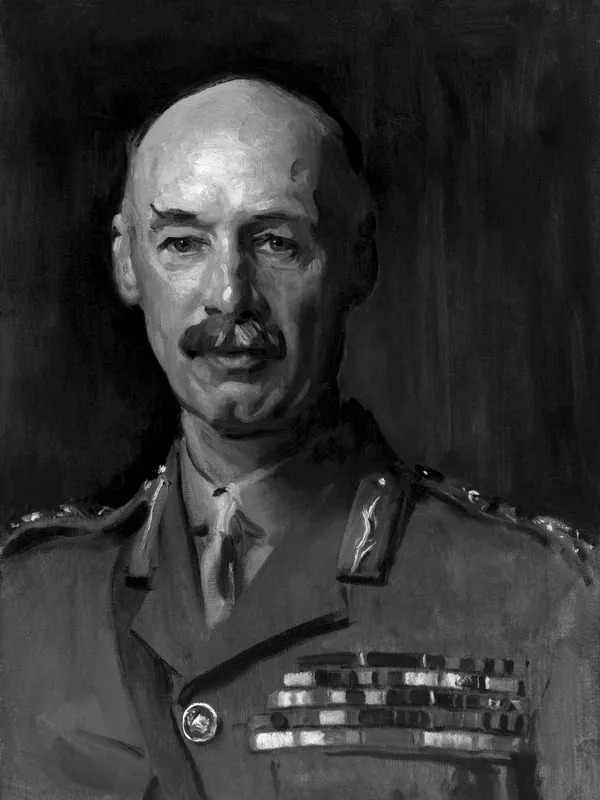
- Born:
- 20 February 1864, Trent (England)
- Died:
- 28 March 1925, Delhi (British India)
- Author:
- Natalia
- Photo:
- John Singer Sargent, domena publiczna, Wikimedia Commons

Sir Henry Rawlinson, Baron Rawlinson from 1919, commanded the British Fourth Army in two battles that mark the extremes of the British experience on the Western Front. On 1 July 1916 his soldiers suffered, on the Somme, the heaviest losses of a single day in the history of the British Army. On 8 August 1918 the same army, with Canadians and Australians in the front line, broke through the front at Amiens on a day that Erich Ludendorff called the black day of the German Army. Rawlinson was an intelligent, ambitious and sociable officer, valued by politicians but also regarded as an intriguer. For historians, his path from the Somme to Amiens is the best example of how the British Army learned to wage industrial war.
Before the war
He was born on 20 February 1864 at Trent, on the border of Dorset and Somerset, the elder son of Sir Henry Rawlinson, an officer, diplomat and scholar regarded as the father of Assyriology. He was educated at Eton and, after the Royal Military College, Sandhurst, joined the King’s Royal Rifle Corps in India in 1884. His father found him a place on the staff of his friend General Frederick Roberts, Commander-in-Chief in India. Rawlinson remained a friend of the Roberts family for the rest of his life. He fought in Burma, then transferred to the Coldstream Guards and graduated from the Staff College at Camberley.
In 1898 he served on Kitchener’s staff in the advance on Omdurman, and in the Boer War he commanded a column that took part in the last battle of that war. From 1903 to 1907 he was Commandant of the Staff College and, as the first of three successive reformers, began to turn it into a true school of war. He then commanded a brigade at Aldershot and the 3rd Division. In the 1912 manoeuvres he attracted attention by his skilful use of artillery. In May 1914 he handed over his division and was on leave when war broke out.
1914: Antwerp and Ypres
For a few weeks he directed recruiting at the War Office, and in September he briefly replaced the wounded commander of the 4th Division on the Aisne. At the beginning of October he took over the new IV Corps, made up of the 7th Division and the 3rd Cavalry Division, which landed in Belgium to help defend Antwerp. Rawlinson reached the city on 6 October and quickly concluded that it could not be held. His divisions covered the retreat of the Belgian Army to the Yser, and themselves reached Ypres on 14 October.
In the First Battle of Ypres IV Corps held the most exposed sector. On 19 October the 7th Division advanced on Menin, but Rawlinson called off the attack when airmen spotted large German forces approaching. Over the following days his division defended itself against the main German blow and suffered enormous losses. On 28 October its remnants were taken over by Douglas Haig, and Rawlinson went to England to prepare the 8th Division, which was to complete his corps.
1915: “bite and hold”
In 1915 IV Corps fought in Haig’s First Army in all the major British attacks. At Neuve Chapelle in March some 340 guns were concentrated on a narrow front, and a short, violent bombardment made it possible to take the village. The attack then stalled, and Rawlinson blamed the delay on the commander of the 8th Division, General Francis Davies. When it turned out that Davies had acted in accordance with corps orders, John French wanted to send Rawlinson home, and only Haig’s intercession saved his post. The episode revealed a trait he was reproached for throughout the war: a tendency to shift the blame onto others.
From Neuve Chapelle, however, Rawlinson drew a sound conclusion. He judged that a trench line could be broken by good artillery preparation and surprise, but that instead of seeking a breakthrough it was better to “bite off” a piece of the enemy position and hold it, inflicting twice the losses on the Germans in their counter-attacks. From then on he would repeat this principle, called “bite and hold”. The attack on Aubers Ridge in May and the battle of Loos in September, in which his corps took Loos but failed to hold Hill 70, only confirmed him in it. When Haig replaced French in December, Rawlinson temporarily commanded the First Army for a few weeks, and in January 1916 he was given the new Fourth Army.
The Somme
Haig entrusted him with preparing the great offensive on the Somme. In April Rawlinson proposed a limited attack: after a long, methodical bombardment the infantry would take the first German position, hold it and only then push further. Haig wanted a breakthrough and ordered him to go straight for the second position. Rawlinson complied, although privately he considered the plan too optimistic. As a result the artillery fire was spread over too many targets. When the French, bled white at Verdun, reduced their share, the main burden fell on his inexperienced army, made up mostly of volunteers.
On 1 July 1916 eleven divisions of the Fourth Army attacked from Maricourt to Serre. North of the Albert–Bapaume road the attack collapsed under machine-gun fire, and the British Army lost more than 57,000 men that day. Contrary to legend, Rawlinson did not order the infantry to advance at a walk: his tactical notes left battalion commanders free to choose, and many units went out into no man’s land before the signal. The success on the southern flank, where French heavy artillery helped, showed on the other hand that limited objectives and concentrated fire produced results.
Rawlinson made use of this on 14 July. Despite Haig’s misgivings, four divisions crept across no man’s land at night and at dawn, after a short, very heavy bombardment, took the second German position on Bazentin Ridge. Later, however, for many weeks he allowed his corps to attack on narrow fronts, with one or two brigades at a time, against Delville Wood and High Wood and Guillemont, which historians regard as the weakest period of his command. The successful attacks at Flers–Courcelette, where tanks were used for the first time, and at Morval in September came after longer preparation. The autumn fighting for the Transloy Ridges sank in the mud.
1917: in the shadows
In January 1917 Rawlinson was promoted to full general. In the spring his army followed the Germans as they withdrew to the Hindenburg Line, and in the summer its headquarters was moved to the Belgian coast, where it prepared a landing near Ostend that was to accompany the Third Battle of Ypres. The operation never took place. When Herbert Plumer left for Italy in November, Rawlinson took over his Second Army. In February 1918, after Robertson’s dismissal, he became the British military representative on the Supreme War Council at Versailles.
1918: from Villers-Bretonneux to the Sambre
When Operation Michael shattered the Fifth Army, the government recalled Hubert Gough, and on 28 March Rawlinson took his place. His army, renamed the Fourth Army on 2 April, stopped the Germans in front of Amiens. After the loss of Villers-Bretonneux on 24 April Rawlinson decided that the town had to be retaken at once, and a night counter-attack by the Australians recovered it the next day.
In the summer Rawlinson began to prepare an offensive. He backed the plan of the Australian general John Monash, who on 4 July took Hamel in an hour and a half thanks to careful cooperation between infantry, tanks, artillery and aircraft. On this basis he proposed to Haig a larger blow east of Amiens. The attack of 8 August was prepared in strict secrecy: the Canadian Corps was moved secretly from near Arras, and the artillery opened fire only at the moment of the attack, without any preliminary bombardment. On the first day some 12,000 prisoners and 450 guns were taken. As resistance stiffened, Rawlinson advised Haig to halt the attack rather than bleed the army white on the old trenches of 1916.
In the autumn the Fourth Army led the Hundred Days Offensive. The Australians took Mont Saint-Quentin and Péronne, although Rawlinson at first considered the plan too bold. On 18 September his army attacked at Épehy, and on 29 September at the St Quentin Canal it broke through the strongest sector of the Hindenburg Line. Monash planned the main blow, but Rawlinson widened the front, and the 46th Division of his IX Corps crossed the canal where the Germans did not expect it and took more than 5,000 prisoners. Then came the battles of the Selle and of the Sambre. According to British tallies, during the Hundred Days the Fourth Army took about 80,000 prisoners and 1,100 guns. After the armistice, together with Plumer’s army, it led the march to the Rhine.
After the war
In 1919 Parliament passed a vote of thanks to him and granted him £30,000, and the King made him a baron. In the summer of that year he went to North Russia to direct the evacuation of the intervention forces from Archangel and Murmansk. He then briefly held the Aldershot command, and in 1920, thanks to the support of Winston Churchill, against custom, he became Commander-in-Chief in India. He took over at a difficult time, after the Amritsar massacre and during Gandhi’s civil disobedience campaign. He reduced the size and cost of the army, improved its equipment and announced the gradual opening of officer posts to Indians. He died suddenly in Delhi on 28 March 1925, aged 61, after a stomach operation. Shortly before, he had still been playing polo and cricket. He was soon to return to London as Chief of the Imperial General Staff. He was buried in his family’s home of Trent.
Assessment
Rawlinson was long judged through the lens of 1 July 1916. To many he was Haig’s accomplice in planning the slaughter, and an officer who could shift the blame onto his subordinates. The Australian official historian Charles Bean and some Dominion officers believed that his army’s successes in 1918 owed more to Monash and the Canadians than to Rawlinson himself.
The most thorough analysis of his command was presented by Robin Prior and Trevor Wilson in their book “Command on the Western Front”. Their verdict is mixed. They praise him for understanding the importance of artillery and limited objectives, and at the same time criticise him for not defending these convictions when Haig wanted more, and for allowing small, costly, uncoordinated attacks for long weeks in the summer of 1916. The biographer Rodney Atwood, for his part, writes of a path “from tragedy to triumph”: in his view no British army commander learned so much or turned that knowledge so effectively into the victories of autumn 1918.
Sources
Spotted a mistake?Report an error
Commanded in battles
(30)- 19 October – 22 November 1914First Battle of YpresWestern Front
- 21–24 October 1914Battle of Langemarck (1914)Western Front
- 10–13 March 1915Battle of Neuve ChapelleWestern Front
- 9 May 1915Battle of Aubers RidgeWestern Front
- 25 September – 8 October 1915Battle of LoosWestern Front
- 1 July – 18 November 1916Battle of the SommeWestern Front
- 1–13 July 1916Battle of Albert (1916)Western Front
- 14–17 July 1916Battle of Bazentin RidgeWestern Front
- 15 July – 3 September 1916Battle of Delville WoodWestern Front
- 3–6 September 1916Battle of GuillemontWestern Front
- 9 September 1916Battle of GinchyWestern Front
- 15–22 September 1916Battle of Flers–CourceletteWestern Front
- 25–28 September 1916Battle of MorvalWestern Front
- 1–18 October 1916Battle of the Transloy RidgesWestern Front
- 22 February – 5 April 1917German retreat to the Hindenburg LineWestern Front
- 4 April 1918Battle of the AvreWestern Front
- 24–25 April 1918Battle of Villers-BretonneuxWestern Front
- 4 July 1918Battle of HamelWestern Front
- 8–11 August 1918Battle of AmiensWestern Front
- 8 August – 11 November 1918Hundred Days OffensiveWestern Front
- 21–23 August 1918Battle of Albert (1918)Western Front
- 21 August – 3 September 1918Second Battle of the SommeWestern Front
- 31 August – 3 September 1918Second Battle of BapaumeWestern Front
- 12 September – 12 October 1918Battles of the Hindenburg LineWestern Front
- 18 September 1918Battle of ÉpehyWestern Front
- 29 September – 2 October 1918Battle of the St Quentin CanalWestern Front
- 3–5 October 1918Battle of the Beaurevoir LineWestern Front
- 8–9 October 1918Battle of CambraiWestern Front
- 17–25 October 1918Battle of the SelleWestern Front
- 4 November 1918Battle of the SambreWestern Front
Mentioned in battles
(05)Often appears with
People who appear in the same events.
On the timeline
(44)1914
1915
1916
July
- 01
- Key eventFirst day on the SommeOn 1 July 1916 the British and French attacked on the Somme. The French and the British right succeeded, but the British Army lost 57,000 men.
- First RFC contact patrolsOn 1 July 1916 over the Somme, RFC airmen closely followed the infantry's advance, watching for flares and flashing mirrors. Such trials dated from 1915.