Key event
Fighting at Villers-Bretonneux
- Category:
- Military operations
- Front:
- Western Front
- Date:
- 24 April 1918
- Author:
- Łukasz Skowroń
- Battle:
- Battle of Villers-Bretonneux
- Tags:
- Australia, Great Britain, Germany, tanks
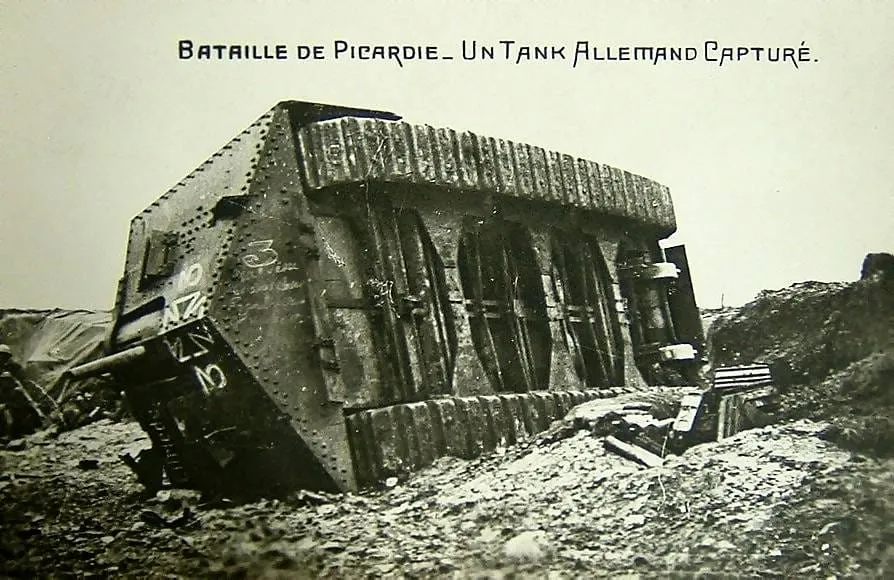
On 24 April 1918 the Germans tried for the last time to approach Amiens. At dawn, in thick mist, four divisions of the German Second Army, led by thirteen A7V tanks, struck the British III Corps on the plateau south of the Somme and within a few hours took the small town of Villers-Bretonneux, the same one that Australians and British had defended three weeks earlier, on 4 April. Before noon, near the village of Cachy, a British tank fought a duel with an enemy tank for the first time in history. In the evening the Allied commanders decided to retake the town that same night. Two Australian brigades advanced in the dark, without an artillery preparation, and by the morning of 25 April, the third anniversary of the landing at Gallipoli, Villers-Bretonneux was back in Allied hands.
Attack in the mist
This attack had been expected for a week. From 17 April the Germans had drenched Villers-Bretonneux and the surrounding woods with gas shells every day, and prisoners several times gave successive dates for the attack. On the night of 23/24 April a British airman reported that the trenches in Hangard Wood were full of troops, so the Allied artillery shelled the approach roads all night, and aircraft, despite the bad weather, bombed billets and railway stations behind the German front. The thirteen German tanks were assembled at Wiencourt, a few kilometres behind the front line. At 3.30 a.m. they set off for their starting positions near Marcelcave.
At 3.45 a.m. the bombardment crashed down: gas and high explosive on the batteries, the roads and Amiens itself, and finally on the front line. Two and a quarter hours later, at 6 a.m., the infantry advanced with the tanks. The British 8th and 58th Divisions, badly mauled in March and filled up with young recruits, did not see the enemy until he was at the trenches. The German tanks, larger and heavier than the British ones, with armour hanging low like a bell, emerged from the mist, halted over the trenches and fired along them. Behind them came infantry with flamethrowers. The British had nothing with which to defend themselves against tanks, so many surrendered. Wherever the Germans attacked without tanks the attack broke down, but in the centre the front gave way and the flanks had to fall back. Some of the German tanks failed: Lieutenant Heinz Theunissen’s “Mephisto” first stopped because of a blocked fuel line, then fell into a fresh shell crater and the crew had to abandon it.
The gas had poisoned the town so badly that the 2nd Battalion of the East Lancashire Regiment defending it could not keep men among the houses and held only its eastern edge. The remnants of the 2nd Battalion of the West Yorkshire Regiment, reduced to 140 men, defended the station until 9 a.m. The first news reached 8th Division headquarters at 7.20 a.m., but at first it was taken for panic. By about 8.30 a.m. there was no longer any doubt that Villers-Bretonneux was in German hands. The 4th Guards Division entered Aquenne Wood behind the town, and the Germans reached the road from Cachy to Fouilloy, about 13 kilometres from Amiens. They got no further.
The first tank duel
General William Heneker, commander of the 8th Division, had at hand four Mark IV tanks of the British Tank Corps. Three of them, one “male” with two 6-pounder guns and two “females” with machine guns only, were sent to defend the line in front of Cachy. At about 9.30 a.m. Lieutenant Wilhelm Biltz’s A7V “Nixe” came out against them. The German tank quickly put both “females” out of action, as their machine guns could not pierce its armour. Then the “male” of Lieutenant Frank Mitchell, although one of its guns had been damaged, hit “Nixe” several times. The German tank heeled over and stopped, and the crew abandoned it. Mitchell later wrote of fighting three tanks at once, but according to German and British combat reports the A7Vs were not moving together and the duel was fought with one. Soon, however, more German tanks came up. The crew of one fled, while another, fired on by six machine guns, stopped in front of Cachy and its men surrendered. Mitchell’s tank was finally hit by artillery, and its crew escaped to the nearest trench.
Half a year after the British had shown at Cambrai what massed tanks could do, tank met tank. At about 10.20 a.m. seven new, fast Whippet tanks also entered the fight. Alerted by an airman who dropped a message about two German battalions resting in a hollow in front of Cachy, they drove in among them and twice ran in line through the surprised infantry. The British estimated that they killed or wounded at least four hundred men. Mitchell recalled that the tracks of the returning Whippets were smeared with blood.
The dispute over the counter-attack
General Henry Rawlinson, commander of the Fourth Army, at once judged the recapture of Villers-Bretonneux to be essential “for the safety of Amiens”. At about 9.40 a.m. he ordered General Thomas William Glasgow’s 13th Australian Brigade, which was in reserve on the north bank of the Somme, to move south. The brigade left its packs and blankets behind and by 4 p.m. was in Blangy Wood. Meanwhile arguments went on for several hours. The commander of the 5th Australian Division, General Talbot Hobbs, twice proposed throwing in General Harold “Pompey” Elliott’s 15th Brigade, which had been preparing for just such a counter-attack for weeks. III Corps headquarters at first refused, and Heneker judged that an attack by day across the flat plateau under machine-gun fire would end in disaster. The French General Debeney promised help only for the following day.
Around noon General Ferdinand Foch, for ten days commander-in-chief of the Allied armies in France, wrote a sharp letter to Rawlinson. On the basis of an unclear telephone message he believed that it was the British who were dragging their feet, and he reminded them that the importance of Villers-Bretonneux, “which dominates Amiens”, could not be ignored, and that the town must be recovered without delay. Meanwhile, at 12.30 p.m., Field Marshal Douglas Haig arrived at Rawlinson’s headquarters and asked Foch to order the French to co-operate. Foch’s letter reached the British only at about 3 p.m. In fact the plan was already ready. At 5.30 p.m. Heneker issued his orders: the 15th Brigade was to go round the town from the north, the 13th Brigade from the south, with the British 54th Brigade beside it, and two British battalions were then to clear the streets. Glasgow refused to attack at 8 p.m., while it was still light. According to the Australian Dictionary of Biography he said: “If it was God Almighty who gave the order, we couldn’t do it in daylight”. The attack was put back to 10 p.m.
The night of 25 April
There was a full moon, but clouds kept covering it. At 10 p.m. the artillery began to shell the town and its surroundings, and the 13th Brigade set off ten minutes later. On the wire in front of Cachy the soldiers became entangled with one another, and German machine guns fired into their left flank from Aquenne Wood. Lieutenant Clifford Sadlier’s platoon of the 51st Battalion went into the wood and took them with grenades and the bayonet; Sadlier, twice wounded, received the Victoria Cross. The Australians went through the German positions, bayoneting and taking prisoners, but at the railway embankment and at the monument on the hill south-east of the town the resistance was too strong, and at about 1 a.m. the brigade halted.
The 15th Brigade had two kilometres to its assembly point, but the battalion commanders returned late from the briefing, and in the dark the units skirted hollows full of gas and one company lost its way. It set off almost two hours late, at about midnight. That is why German accounts describe its attack as a separate, second assault. When the German outposts began firing, the officer leading the 59th Battalion shouted “Charge!” and the whole line rushed forward with a yell, guided by the light of the burning houses on the edge of Villers-Bretonneux and the German flares calling for barrage fire. The machine guns in the town fired too high. By about 1.30 a.m. the Australians were on the road to Hamel, east of the town, having lost only about 150 men.
On the German side there was confusion. XIV Corps headquarters learned of the counter-attack only at 2.30 a.m., the 228th Division was still reporting that it held Villers-Bretonneux, and at 6 a.m. the 4th Guards Division claimed that it was in Aquenne Wood. A gap remained between the Australian brigades, however, and some of the Germans slipped out of the encirclement through a railway cutting.
Morning on Anzac Day
At 4 a.m. on 25 April, in the dark and the morning mist, the remnants of the British 23rd Brigade with three tanks advanced on Aquenne Wood and after an hour and a half of fighting drove the Germans out of it. At dawn two companies of the Australian 57th Battalion and the British 2nd Battalion of the Royal Berkshire Regiment entered the town from the north, and pioneers of the Durham Light Infantry from the west. They met in the middle, taking 472 prisoners and 60 machine guns. Many of the captured Germans had been poisoned by the gas they themselves had fired on the town. A German counter-attack ordered for 7 a.m. was put back first to 8.30 and then to 9 a.m., and finally cancelled. That same morning in Flanders the Germans stormed Mount Kemmel, but the attack at Amiens, which was meant to draw Allied attention there, ended in failure.
So on 25 April 1918, exactly three years after the landing at Anzac Cove on Gallipoli, in which Elliott had also taken part, the Australians retook Villers-Bretonneux. The fighting for the rest of the lost ground went on for two more days, and on 26 April the French Moroccan Division attacked south of the town with heavy losses. The front at Amiens nevertheless settled, and the Germans never again came so close to the city. To this day Australians hold a dawn Anzac Day service at Villers-Bretonneux, and in the school rebuilt with money from Australian children hangs the inscription: “Let us never forget Australia”.
Remember the articles you have read? Only in this browser; nothing is sent anywhere.How it works
Read ·
A voice from the front
“The 8th and 58th Divisions have been fighting more or less continuously since March 21, and the reinforcements which they have received are mainly composed of young boys, who were under fire for the first time. I fear that the heavy bombardment which the Germans put on before the attack must have shaken these children a good deal, hence the success of their second effort.”
Spotted a mistake?Report an error
Meanwhile
(04)Elsewhere in the same days.
- 23 April 1918 · DiplomacyGuatemala declares war on GermanyOn 23 April 1918 President Estrada Cabrera promulgated a decree by which Guatemala adopted towards Germany the same belligerent attitude as the United States.
- 23 April 1918 · War at seaZeebrugge raidOn St George's night, 23 April 1918, the Royal Navy attacked Zeebrugge and Ostend to seal the Germans' exits from Bruges. Two blockships were sunk at Zeebrugge.
- 25 April 1918 · Middle EastOttomans occupy KarsOn 25 April 1918, on orders from Tiflis, the Armenians gave up Kars fortress to the Turks without a fight, with its guns and stores. Russia took it in 1877.
- 22 April 1918 · Middle EastTranscaucasia declares independenceOn 22 April 1918 the Transcaucasian Sejm in Tiflis proclaimed the independent Transcaucasian Democratic Federative Republic, the Turks' condition for new talks.
Related events
(04)The same battle, people or subject.
- 8 August 1918 · Western FrontBattle of Amiens beginsOn 8 August 1918, in fog, Canadians, Australians and tanks broke the front at Amiens, taking over 15,000 prisoners. Ludendorff called it the "black day".
- 4 July 1918 · Western FrontAustralians take HamelAt 3.10 a.m. on 4 July 1918 Australians with Mark V tanks and Americans attacked Hamel on the Somme. In about 90 minutes they took the village, woods and ridge.
- 4 April 1918 · Western FrontFighting on the AvreOn 4 April 1918, in the rain, the Germans struck at Amiens. By evening they were at Villers-Bretonneux, but an Australian counter-attack threw them back.
- 8 October 1918 · Western FrontBattle of Cambrai beginsOn 8 October 1918 the British Third and Fourth Armies and the Americans attacked between Sequehart and Cambrai. At Niergnies the Germans used captured tanks.