1917: The Western Front
Battle of Cambrai
- Dates:
- 20 November – 7 December 1917
- Front:
- Western Front
- Location:
- The sector of the Hindenburg Line between the St Quentin Canal and the Canal du Nord, from the Bonavis ridge and Gonnelieu to Havrincourt, Flesquières and Bourlon Wood, south-west of Cambrai, Nord and Pas-de-Calais departments (France)On the battle map →
- Sides:
- United Kingdom, Newfoundland, Canada and British IndiaDouglas Haig, Julian Byng, William Pulteney, Charles WoollcombeGerman EmpireRupprecht, Crown Prince of Bavaria, Georg von der Marwitz, Otto von Moser
- Result:
- Inconclusive. The British broke through the Hindenburg Line to a depth of several kilometres but did not take the Bourlon ridge, and after the German counter-attack of 30 November they withdrew to the Flesquières ridge. Each side lost about 40,000–45,000 men.
- Author:
- Łukasz Skowroń
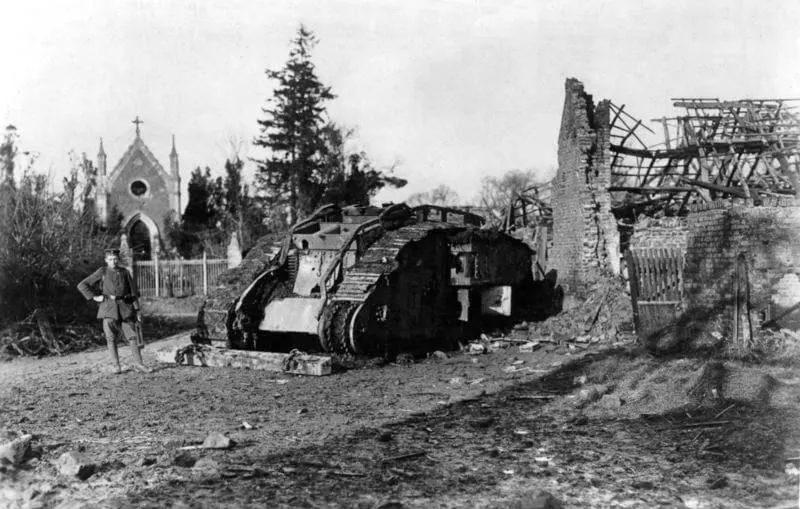
The Battle of Cambrai was the first battle in history in which tanks, used in mass on dry ground not churned up by shellfire, led the attack of a whole army. On the morning of 20 November 1917 the British Third Army of General Julian Byng attacked south-west of Cambrai without the usual bombardment lasting several days. Several hundred tanks crushed the wire of the Hindenburg Line, thought to be impregnable, and more than a thousand guns opened fire only at the moment of the attack, shooting from maps and calculations without registering beforehand. Within a few hours the British passed through the whole system of German defences on a front of about ten kilometres and advanced five or six kilometres, at a cost of about four thousand men. In Britain the church bells were rung at the news. The success could not be exploited, however: the cavalry did not get across the canal, the attack stalled in front of the Bourlon ridge, and on 30 November the Germans struck by surprise from the south and took back most of the British gains. At the beginning of December the Third Army withdrew to the Flesquières ridge, and the losses of the two sides turned out to be roughly equal.
Name and dates
In English the battle is called the Battle of Cambrai 1917; in German it is often called the “tank battle of Cambrai” (Tankschlacht bei Cambrai). The British Battles Nomenclature Committee distinguished three phases within it: The Tank Attack on 20–21 November, the capture of Bourlon Wood on 23–28 November, and the German counter-attacks from 30 November to 3 December. The British official history (Wilfrid Miles, Military Operations France and Belgium 1917, volume III, 1948) writes that the battle had ended by 7 December, when after a retreat of several days the Third Army stood on a new winter line of defence. The history of the British air services gives the same date, and we adopt it. In some accounts, among them the Polish Wikipedia, the battle ends on 3 or 6 December. We give times according to the official history, that is in British time, one hour behind German time.
Background
In the spring of 1917 the Germans withdrew to the Hindenburg Line, which they called the Siegfriedstellung. Between the St Quentin Canal, running along the valley of the upper Scheldt, and the dry, unfinished Canal du Nord, it was a position six or seven kilometres deep: an outpost zone, a front line with trenches more than three metres wide, protected by four belts of wire about a hundred metres deep in all, a support line, and one more line in the rear, which the British called the Masnières–Beaurevoir line. The sector was quiet, however, and the tired German divisions holding it called it the “Flanders sanatorium”. The rolling chalk country had hardly been touched by artillery, and Havrincourt Wood and the villages around it could hide a concentration of troops.
The idea of an attack at this spot arose in the summer of 1917 from several quarters at once. The commander of the British Tank Corps, Brigadier-General Hugh Elles, and his chief of staff, Lieutenant-Colonel J. F. C. Fuller, were looking for dry ground for the tanks, because in the mud of Flanders the machines bogged down. At the beginning of August Fuller proposed a great tank raid in the Cambrai area. Independently of them, Brigadier-General Henry Hugh Tudor, artillery commander of the 9th Division, devised a surprise attack in which the guns would not register beforehand but would fire according to accurate survey, while the tanks would make the gaps in the wire. Byng, who had commanded the Third Army since June, adopted both ideas and developed them into a plan to break the front, after which the cavalry was to pass out into open country. The Commander-in-Chief, Douglas Haig, long put off the decision, because the Third Battle of Ypres was swallowing all his forces. He gave his consent to the preparations only on 13 October. After the Italian defeat at Caporetto he had to send further divisions to Italy, but he judged that a blow on the Western Front would be the best help for the ally and the best way to end the year with a success.
Plan and forces
Under the final plan of 13 November, the Third Army was to break the Hindenburg Line between the two canals, seize the crossings of the St Quentin Canal at Masnières and Marcoing, pass the cavalry through the gap to cut off Cambrai and seize the crossings of the river Sensée, and take the Bourlon ridge with the wood on its crest, which dominated the western approaches to the town. Haig considered the capture of Bourlon on the first day more important than Cambrai itself. He also stipulated that if after 48 hours the results did not justify further fighting, the attack would be stopped.
The main weight fell on two corps: III Corps of General William Pulteney (the 12th, 20th and 6th Divisions, with the 29th Division in the second wave) on the right wing, and IV Corps of General Charles Woollcombe (the 51st and 62nd Divisions, and west of the Canal du Nord one brigade of the 36th Division) on the left. Behind them waited the Cavalry Corps of General Charles Kavanagh with five divisions, including Indian brigades and a Canadian brigade, with V Corps in reserve. The artillery numbered 1,003 guns. So as not to betray the intention, Byng did not allow a single shot to be fired from the newly arrived batteries before zero hour. The position of each was fixed by surveyors, the guns were calibrated on special ranges, and wind, temperature and air pressure were included in the calculations. The British called this “unregistered” and later “predicted” fire. Two thirds of the guns were to engage the German artillery.
The Tank Corps sent all three of its brigades, 476 Mark IV tanks in all: 378 fighting tanks, 54 supply tanks, 32 fitted with grapnels to tear away wire on the cavalry routes, two carrying bridging material, nine with wireless sets and one for laying telephone cable. A little over four thousand men served in them. Each fighting tank carried on its roof a fascine, a huge bundle of brushwood weighing more than a tonne and a half, which it dropped into a wide trench in order to cross over it. The Tank Corps staff worked out new tactics: the tanks went in sections of three, one crushing the wire and firing on the front line while the other two crossed on the fascines and turned along the trenches, and the infantry followed them in files through the flattened lanes. In the first half of November each division practised cooperation with tanks for several days on models of German trenches.
On the German side the sector belonged to the Second Army of General Georg von der Marwitz, in the army group of the Crown Prince of Bavaria, Rupprecht. On the front of the attack there stood in effect only two divisions of Group “Caudry”, the 20th Landwehr Division and the 54th Division, plus the wing of the 9th Reserve Division, with few guns and a meagre supply of ammunition. From 10 November fog prevented air reconnaissance. Only on 18 November did prisoners from the 36th Division reveal that an attack was being prepared in the Havrincourt area, and the Germans raised their state of readiness. On the eve of the battle the 107th Division, coming from Russia, happened to begin arriving at Cambrai; it was to relieve the weak Landwehr division.
Course of the battle
20 November: the breakthrough. At 6.10 a.m., while it was still dark, the tanks moved off, and ten minutes later, as they were crossing the British line, more than a thousand guns suddenly opened fire. The bombardment fell on the German batteries, strongpoints and villages in the rear, while a screen of fire and smoke moved forward ahead of the tanks and infantry. The surprise was complete. Most of the defenders in the outpost zone surrendered or fled. By about 11.30 a.m. III and IV Corps had taken both lines of the Hindenburg Line along almost the whole front, including Havrincourt, Ribécourt, Lateau Wood and Marcoing. Only at Flesquières was the Scottish 51st (Highland) Division held up, when its tanks, coming over the ridge, were shot to pieces by German field guns and the infantry stopped in front of uncut wire. At Masnières the bridge over the canal collapsed under a tank, and the division that included the Newfoundlanders could not take the Masnières–Beaurevoir line. Of the cavalry, only one squadron of the Canadian Fort Garry Horse crossed the canal; it charged a German battery and returned on foot after dark. On the left wing the 62nd Division took Graincourt and reached Bourlon Wood, the deepest penetration of the day. By evening the British had taken more than four thousand prisoners and about a hundred guns.
21–22 November. During the night the Germans abandoned Flesquières. On 21 November the Scots, with tanks and cavalry, took Cantaing and Fontaine-Notre-Dame, and the 62nd Division took Anneux, but the attack on the wood and the village of Bourlon itself failed. III Corps could not get across the canal and went over to the defensive. By evening the number of prisoners had risen to about 7,500. German reinforcements were arriving, however, and the 48 hours which by British reckoning separated the Germans from the arrival of larger forces ran out at dawn on 22 November. Haig nevertheless decided to go on fighting for the Bourlon ridge, because the positions in the valley below it could not be held and the alternative was retreat. He also reckoned that in this way he would help the Italians most effectively. On 22 November the Germans retook Fontaine.
23–28 November: Bourlon Wood. On 23 November the fresh 40th Division, with several dozen tanks, took most of Bourlon Wood and stood on the ridge, but the 51st Division did not recover Fontaine, and the attacks on the village of Bourlon broke down. According to most sources it was on this day, Friday 23 November, that the bells were rung in Britain to celebrate the victory (Fuller wrote of 21 November). Over the following days bitter fighting against German counter-attacks went on in the wood and the village. On 27 November the Guards Division suffered heavy losses in a failed attack on Fontaine, and the 62nd Division again failed to take the village of Bourlon. That day Byng halted the offensive, having exhausted his forces. The British were left in a deep, narrow salient, and from 28 November the Germans drenched Bourlon Wood with gas shells.
30 November: the German counter-attack. The Germans had meanwhile assembled more than a dozen divisions. Marwitz’s plan provided for a blow from two sides: the main one from the east and south-east, from the area of Banteux and Honnecourt, by Groups “Caudry” and “Busigny”, and a second one from the north, by Group “Arras” of General Otto von Moser, against the Bourlon ridge. At about seven in the morning, after a short hurricane bombardment with gas and smoke shells, the German infantry, in small groups with light machine guns and in places with flamethrowers, advanced against the flank of VII and III Corps. The storm troops (Stoßtruppen) bypassed strongpoints, and low-flying aircraft bombed and machine-gunned the defenders. The Germans took Villers-Guislain, Gonnelieu and Gouzeaucourt and the Bonavis ridge, capturing thousands of prisoners and guns. Gouzeaucourt was retaken the same day by the Guards Division, and at Masnières and Les Rues Vertes the 29th Division held on after heavy fighting. The blow from the north, against Bourlon and Mœuvres, broke down under the fire of British artillery and machine guns, with heavy German losses.
1–7 December: the withdrawal. On 1 December the Guards, tanks and cavalry, including the Indian brigades, counter-attacked at Gonnelieu and Gauche Wood with mixed results. During the night of 1–2 December the British abandoned Masnières, and on 3 December they lost La Vacquerie and withdrew from the bend of the canal at Marcoing. That day Haig decided that the Marcoing–Bourlon salient was more a burden than a gain and ordered a withdrawal to the Flesquières ridge, roughly to the line of the former German support line. The withdrawal on the night of 4–5 December and in the following days went smoothly and surprised the Germans. By the morning of 7 December the Third Army was already standing on the new winter line.
Losses
According to the Third Army’s report, its losses, including the Tank Corps and the air services, came from 20 November to 8 December to 44,207 killed, wounded and missing, more than 40,000 of them in the battle itself. On 30 November alone about 6,000 British soldiers were taken prisoner, and the Germans captured more than 150 guns. On the first day 179 of the 378 fighting tanks fell out of action: 65 were destroyed by artillery, 71 broke down and 43 ditched or suffered other mishaps. The German official history puts German losses at about 41,000 men, 14,000 of them during the counter-attack. The British official history, adding the lightly wounded, whom the Germans did not usually count, estimates them at 45,000–53,000. The British took more than 11,000 Germans prisoner and captured about 140 guns.
Significance
The first day of the battle showed that even the strongest defences could be broken without a long bombardment, which until then had always betrayed the intention to attack. The combination of tanks, infantry, artillery firing without registration and aircraft attacking from low altitude gave a success without precedent on the Western Front, and at losses many times smaller than in Flanders. Even the sceptics in the British army were won over to the tanks. Rupprecht of Bavaria is said to have remarked that from then on, wherever the ground favoured tanks, there were no more quiet sectors of the front, and the Germans had to devote considerable forces to anti-tank defence.
The battle also exposed weaknesses, however. The British had no reserves to exploit the success, the cavalry proved helpless against the canal and machine guns, and the loss of more than half the tanks on the first day meant that afterwards the infantry fought almost without them. The defeat of 30 November caused a storm in Britain. The government demanded explanations, General Jan Smuts gave his opinion, and in January 1918 Haig set up a court of inquiry at Hesdin, whose members included General Ivor Maxse. The blame was laid mainly on the poor training of junior officers and men, not on the command. Rupprecht wrote of the greatest German success against the British since 1915, and Moser of “the first retreat of the proud English since 1914”.
Both sides drew lessons from Cambrai for 1918. The Germans repeated the method of 30 November, a short bombardment and an attack by storm troops, in their great spring offensive. The British, together with the Australians and Canadians, combined tanks, surprise and unregistered fire in the summer of 1918 in their victorious attacks at Amiens, and in September and October 1918 they broke the Hindenburg Line and took Cambrai itself. British armoured troops still celebrate 20 November as their day.
Spotted a mistake?Report an error