United Kingdom · The Entente
Ivor Maxse
Commander of the 18th Division (1914–1917) and XVIII Corps (1917–1918), Inspector-General of Training (1918), lieutenant-general
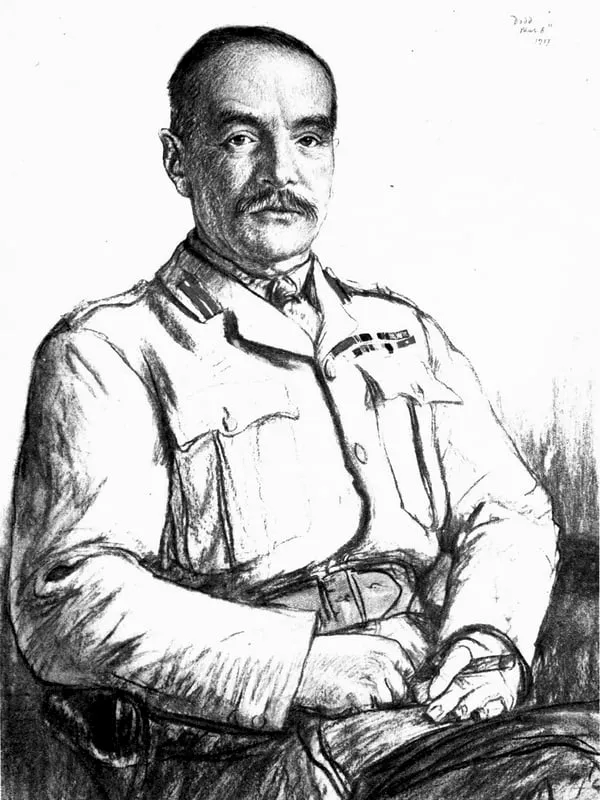
- Born:
- 22 December 1862, London
- Died:
- 28 January 1958, Midhurst (England)
- Author:
- Łukasz Skowroń
- Photo:
- Francis Dodd, domena publiczna, Wikimedia Commons

Sir Ivor Maxse was one of those British generals who best understood what trench warfare demanded. He was not a great strategist or an army commander, but a teacher. From volunteers of Kitchener’s New Armies he built the 18th Division, one of the best in the British Army, which on 1 July 1916 took all its objectives and in September captured Thiepval, considered an impregnable fortress. He then commanded a corps at Ypres and during the German offensive in the spring of 1918, and in the last months of the war, as Inspector-General of Training, he standardised the fighting methods of the army that defeated the Germans in the autumn. He was a fiery and demanding man who struck fear into lazy officers, yet he was open to new ideas and warm towards those who were not afraid of him.
Before the war
He was born on 22 December 1862 in London, the eldest child of Admiral Frederick Maxse. His brother Leopold edited the influential Conservative monthly National Review, and his sister Violet, wife of Lord Edward Cecil, married Lord Alfred Milner in 1921. He was educated at Rugby and at the Royal Military College, Sandhurst, and in 1882 joined the Royal Fusiliers, with whom he served in India. In 1891 he transferred to the Coldstream Guards. He served in the Egyptian Army, fought at Atbara and Omdurman, and in 1899 commanded a Sudanese battalion in the final fighting against the Khalifa Abdullahi. In the Boer War he was a staff officer in the transport service. From 1903 to 1907 he commanded the 1st Battalion, Coldstream Guards, and in 1910 took over the 1st Guards Brigade at Aldershot. Even then he was known for his passion for training and his sharp tongue.
1914: the Guards Brigade
In August 1914 he took the 1st Guards Brigade, part of Douglas Haig’s I Corps, to France. During the retreat from Mons his brigade covered the corps’ rear. On 27 August at Étreux the rearguard was the 2nd Battalion, Royal Munster Fusiliers, which Maxse had ordered to hold its position until recalled. The order to retire, sent at noon by cyclists in two copies, never reached the battalion. The Munsters held off the Germans for several hours but were surrounded, and most of the survivors were taken prisoner. Their sacrifice allowed the rest of the corps to break away from the pursuit. Maxse’s brigade then fought on the Marne and on the Aisne. In September he was recalled home, and at the beginning of October, now a major-general, he took command of the new 18th Division, one of Lord Kitchener’s New Army divisions, made up of volunteers from London and the eastern counties of England.
The 18th Division
Maxse trained his volunteers in England for almost a year, and in the summer of 1915 the division crossed to France. He believed that without good preparation even the bravest troops fail and their heroism is wasted. He required every officer and NCO to know his unit’s task and to be able to act on his own when his commander was killed. Before every attack the division rehearsed on models of the ground, and commanders at every level viewed the field of the coming battle.
On 1 July 1916, the blackest day in the history of the British Army, the 18th Division was one of the few that took all their assigned objectives. As part of XIII Corps, on the right wing next to the French, it took the Pommiers Redoubt and the ridge above Mametz, while the neighbouring 30th Division entered Montauban. Maxse pushed his first waves out into no man’s land before zero hour, and the infantry advanced close behind the artillery fire. It was also helped by a heavy bombardment, supported by French heavy artillery, which on this sector really had destroyed the German defences. In the following weeks the division fought for Trônes Wood, completing its capture on the morning of 14 July, the first day of the Battle of Bazentin Ridge.
Its greatest success came in September. The division was transferred to General Hubert Gough’s Reserve Army and given the ruins of the village of Thiepval, which the British had been attacking in vain since 1 July. Maxse trained the division for the attack for three weeks, and the company, battalion and brigade commanders toured the sector. He chose an unusual hour for the attack, 12.35 p.m., so that the infantry would have only a few hours of daylight on the captured positions and could consolidate them after dark. On the evening before the attack he sent his soldiers a short message: a Württemberg regiment had withstood attacks on Thiepval for two years, but the 18th Division would take it tomorrow. On 26 September his battalions entered the village, and the next morning they completed its capture. On 28 September the division attacked the Schwaben Redoubt and was still fighting for its northern corner at the beginning of October, in the first days of the Battle of the Ancre Heights. The last scrap of the redoubt was taken by another division, on 14 October. The capture of Thiepval brought fame to the division and its commander, and Maxse’s methods became a model for others. To his irritation, at home the credit was long given to the Canadians, who had attacked alongside.
XVIII Corps
In January 1917 Maxse was made a Knight Commander of the Order of the Bath and, as a temporary lieutenant-general, commander of the new XVIII Corps in Gough’s Fifth Army. The experience of commanders like him shaped the army’s new training instructions, which from the turn of 1916 and 1917 emphasised the platoon as the basic fighting unit, with its own rifle grenadiers and Lewis light machine guns.
In the Third Battle of Ypres XVIII Corps attacked Pilckem Ridge from near Sint-Juliaan on 31 July, and on 16 August took part in the Battle of Langemarck. In the mud and against strong German concrete shelters progress was slight. On 19 August the corps, helped by tanks and a smoke screen, took with minimal losses several fortified farms that had stopped it three days earlier. It was one of the few successful actions of that month. The corps fought on in the further attacks of the autumn. In January 1918 Maxse sat on the court of inquiry that examined the causes of the defeat after the German counter-attack at Cambrai, which laid the blame mainly on the poor training of junior officers and men.
Spring 1918
At the beginning of 1918 XVIII Corps held the Fifth Army’s front at Saint-Quentin, recently taken over from the French. Maxse organised the defence on a new principle modelled on the German one: a lightly held forward zone, and behind it a battle zone with redoubts. On 21 March the Germans launched Operation Michael. On the first day Maxse assured Gough that the battle zone was intact, although the eight battalions of the forward zone had been almost wiped out. On 22 March at 10.45 a.m. Gough informed the corps in writing that in the event of a heavy attack they were to fight a rearguard action back to the Green Line, and further if necessary. Maxse took this as an order to retreat and early in the afternoon ordered XVIII Corps to fall back all the way behind the Somme. Gough tried to stop him, but it was too late. The British official history judges this long leap critically, because it exposed the neighbouring XIX Corps and made it easier for the Germans to reach the line of the canals.
In the following days the corps, without its artillery, which the French had kept with them, fought alongside the French troops of General Robillot. Maxse urged them in vain to counter-attack, and then refused to retreat south-west with them. On 26 March his exhausted divisions closed the gap at Roye between the French and XIX Corps and in the Battle of Rosières defended the road to Amiens.
Inspector-General of Training
Soon after the offensive Maxse lost command of the corps and became Inspector-General of Training of the British armies in France and at home. Sources differ on when this happened, from April to July 1918. He himself regarded the transfer as a sign of failure, but Haig appointed him to a task for which he was suited like no one else. He was to standardise training in an army which after the losses of the spring consisted largely of young recruits, and to prepare it for fighting both in attacks on fortifications and in the open field. In September he restored the division of platoons into four sections, two of them with Lewis guns, reversing cuts made in June for lack of men. The Hundred Days Offensive, in which the British Army won the greatest victories in its history, was also a test of the methods Maxse had been instilling in it since 1915.
He was implacable towards the Germans. During the armistice talks he wrote that they wanted peace only in order to rebuild their strength and strike again, and that their army must be crushed and humiliated.
After the war
In 1919 he commanded IX Corps in the Army of the Rhine, and from 1919 to 1923 Northern Command in England. In 1923 he was promoted to general, and in 1926 he retired. He caused controversy by saying at a reception that he preferred a league of tanks to the League of Nations. In retirement in Sussex he set up a fruit-growing business. He died on 28 January 1958 in a nursing home near Midhurst.
Assessment
Maxse does not arouse the kind of controversy that Haig or Gough do. Basil Liddell Hart described him as a short, swarthy man with the look of a Tartar chieftain, who grasped the heart of any idea in a flash, though he sometimes judged too hastily, and who hid a warm heart beneath a fearsome exterior. The historian Correlli Barnett called him one of the ablest officers of his generation. John Baynes’s biography is titled Far from a Donkey, alluding to the popular view of British generals as donkeys leading lions. Historians who describe how the British Army learned to fight between the Somme and the Hundred Days place Maxse among its most important teachers.
His decisions of 22 March 1918 are the most often criticised. The British official history and Gough’s biographers accuse him of reading the army’s order too hastily and giving up without a fight a line that could still have been defended. His defenders point out that the corps faced overwhelming forces and that Gough’s orders left commanders a great deal of freedom. This episode did not overshadow, however, the achievement of a man who believed more than anyone else in the British Army that a well-trained soldier is a soldier who survives.
Sources
Spotted a mistake?Report an error
Commanded in battles
(02)Mentioned in battles
(05)Often appears with
People who appear in the same events.