Key event
Start of the Battle of Thiepval Ridge
- Category:
- Military operations
- Front:
- Western Front
- Date:
- 26 September 1916
- Author:
- Natalia
- Battle:
- Battle of Thiepval Ridge
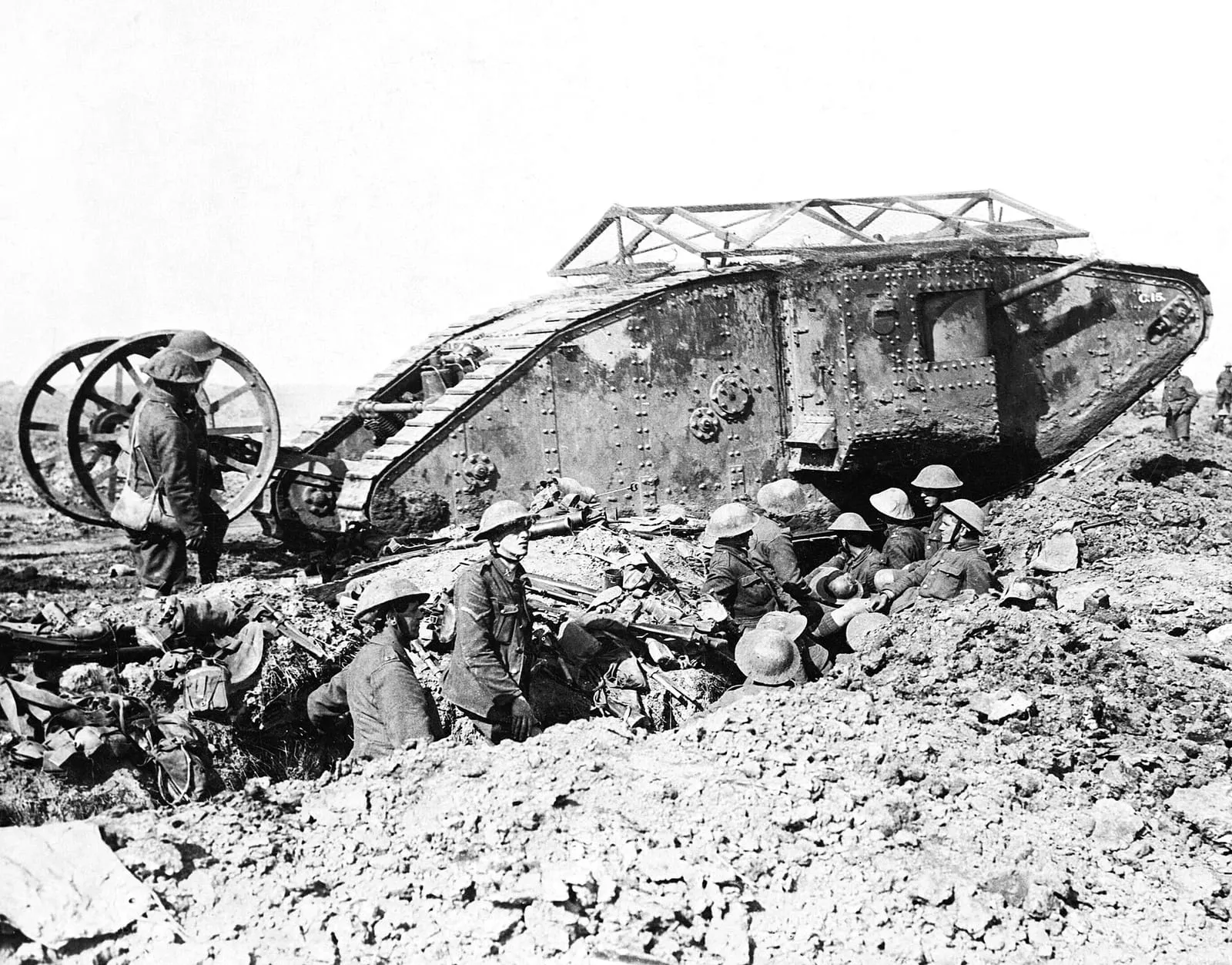
On 26 September 1916 at 12.35 p.m., on a sunny autumn midday, General Hubert Gough’s Reserve Army went into the attack on Thiepval Ridge, the last high ridge above the Somme north of the Albert–Bapaume road still held by the Germans. The front of the attack was about five and a half kilometres long, from Courcelette to the old German trenches south of Thiepval. By evening the Canadians had advanced onto the heights beyond Courcelette and almost reached the crest of the ridge, the British 11th Division had, after hours of fighting, taken the ruins of Mouquet Farm, for which the Australians had fought in vain since August, and the 18th Division had broken into Thiepval and taken most of the village. The most important points on the crest of the ridge, the Stuff and Schwaben Redoubts, nevertheless remained in German hands.
The fortress no one had taken
Thiepval had stood in the front line since the autumn of 1914. Ever since then it had been defended by the 180th Infantry Regiment from Württemberg, one of the regiments of the 26th Reserve Division. The Württembergers had turned the village into a fortress. Beneath the ruins of the château that stood at its southern edge, and along the road to the cemetery, they dug deep cellars and dugouts linked by tunnels, and the village was covered by redoubts: Zollern to the east, Stuff on the crest of the ridge and Schwaben to the north, above the slope falling towards the river Ancre. On 1 July the British had been smashed against this position. At Thiepval the attack broke down under machine-gun fire, and the 36th (Ulster) Division, which had broken into the Schwaben Redoubt, had to give it up in the evening. In July and August further attacks from the west and the south achieved nothing. The last of them, on 3 September, also failed. For three months German observers on the ridge could see from here the British rear areas as far as the town of Albert.
After the Battle of Flers-Courcelette Haig concluded that the German reserves were almost exhausted. He decided to strike with two armies at once. On 25 September General Rawlinson’s Fourth Army attacked Morval and Lesbœufs, and the next day it was the Reserve Army’s turn. That same day, 26 September, the British and French occupied Combles, abandoned by the Germans, and the Fourth Army took Gueudecourt. The Germans on the Somme were thus in trouble along the whole British sector at once.
Before the attack
Two corps attacked the ridge: on the right flank General Julian Byng’s Canadian Corps, on the left General Claud Jacob’s II Corps, with the 11th Division opposite Mouquet Farm and the 18th Division facing Thiepval. From 23 September heavy shellfire fell on the German positions. Two days before the attack the engineers drenched Thiepval with tear-gas shells, which silenced the troublesome German trench mortars. The commander of the 18th Division, General Ivor Maxse, was famous for meticulous training. His division had rehearsed the attack for three weeks, and officers of every rank had gone over the ground of the coming fight. It was he who chose the unusual hour of the attack. Attacks were usually made at dawn, but Maxse wanted the infantry to have at most two or three hours of daylight on the captured positions and to consolidate them after dark, out of sight of German observers. On the evening of 25 September his message went round the division: “The 180th Württemberg Regiment has withstood attacks on Thiepval for two years, but the 18th Division will take it tomorrow.” Gough was bolder still. That night he announced that in the event of great success both corps were to push on, since the enemy’s resistance might collapse completely.
The Germans knew that the attack was coming. As early as 22 September their First Army had sent out a warning, and the Württembergers in Thiepval could see the British digging jumping-off trenches. They did not know only when. Before dawn on 26 September the British and Canadian battalions took up their places in the trenches without much interference and lay motionless in them throughout the fine morning. The German artillery was almost silent.
12.35 p.m.
Punctually at 12.35 p.m. the British barrage came down, so deafening that, according to the history of the 18th Division, no one could hear his own voice. The first waves of infantry set off across no man’s land at a walk, close behind the wall of shrapnel. In the sector of the 18th Division’s 53rd Brigade the German trenches were about 230 metres away, and the barrage was initially to move forward 90 metres every three minutes. The brigade commander, General Higginson, resorted to a ruse: instead of immediately filling the vacated jumping-off trenches with further waves, he left them empty. A few minutes after zero hour the German barrage fell on them but killed no one, and the reserve battalion moved off only when the shelling had died down.
In some sectors German resistance collapsed at once. Half-dressed, unarmed Germans with their hands up ran out of Joseph Trench towards the Suffolk battalion, running through the British barrage to surrender. The chaplain of the Essex battalion, David Randell, who went forward with the second wave, came across three young German machine-gunners in a shell hole. He said “pastor” to them and showed his badges. One of the prisoners, who knew a little English, told him that he had once been in London. Such scenes were not the rule, however. In Schwaben, Zollern and Bulgar Trenches the defenders fought hard.
The Canadians on the ridge
The Canadians were to take the high ground north-west of Courcelette, which they had captured eleven days earlier. Two tanks that were to go round the village and support the right flank failed: one got stuck, the other was hit by a shell that set off all its ammunition. The 29th Battalion from Vancouver took a German trench east of the village in ten minutes, but the neighbouring battalion from Alberta was held up under fire and took its objective only in a renewed attack late in the evening. The main attack was made by General Arthur Currie’s 1st Canadian Division. The 14th Battalion from Montreal reached Kenora Trench on the top of the hill and held it all afternoon under heavy shellfire and counter-attacks. To its left, battalions of the 2nd Brigade took Zollern Trench and part of Hessian Trench at the highest point of the ridge, but their left flank was in the air, because their British neighbours had been unable to keep pace. Regina Trench, the Canadians’ final objective beyond the ridge, remained untouched. In the evening Byng reported to Gough that the situation was “on the whole” good and that, although both attacking brigades had suffered heavy losses, there was no shortage of men. At about 8.30 p.m. a shell hit the headquarters of the 13th Battalion in the ruins of Courcelette and set fire to a petrol store. The battalion commander and almost his entire staff were killed.
The fall of Mouquet Farm
Since August Mouquet Farm had been the curse of the soldiers fighting north of Pozières. Nothing but rubble was left of the buildings, but beneath it lay deep cellars from which the defenders emerged after every bombardment. Australians, Canadians and British had broken into the ruins many times and had been driven out every time. The last attempt, two days before the attack, had also failed. This time the bombers of a Lancashire Fusiliers battalion of the 11th Division ran up to the farm thirty seconds before zero hour and occupied the known cellar exits, while the main force went on towards the Zollern Redoubt. There the attack fell apart. Accurate fire from the Zollern Redoubt, Hessian Trench and the Stuff Redoubt cut down officers and men, and the smoke of the German shelling obscured everything. Optimistic reports that the objectives had been reached reached the headquarters. When the commanders of two fusilier battalions went forward themselves to see what was happening, they found “an empty battlefield” with scattered small groups of soldiers in shell holes.
At the farm a fierce fight for the cellar entrances went on all afternoon. The two tanks assigned to its capture got stuck on the way, but the crew of one came up on foot and fought on with their machine guns. They were joined by soldiers of the Dorset and Manchester battalions and by pioneers of the East Yorkshire battalion. At about 5.30 p.m. smoke candles were thrown into the cellars. According to the British official history, 56 Germans, an officer and 55 men of the 165th Infantry Regiment, came out of the underground and surrendered. Haig in his dispatch gives the time as 6 p.m. and credits the pioneers, who attacked on their own initiative. After seven weeks of fighting that had cost thousands of killed and wounded, Mouquet Farm was in British hands.
The fight for Thiepval
On the left wing of the 18th Division the Suffolk and Essex battalions took the first objective in twelve minutes and before 1.15 p.m. reached Zollern Trench beyond the village. The Essex battalion passed through the eastern part of Thiepval along a sunken road and found many Germans in it waiting to be taken prisoner. The Württembergers managed to release two pigeons with a message, but almost half an hour passed before their artillery opened fire on the ruins of the village. Further up the slope towards the redoubts it proved impossible to go. Machine-gun fire from the front and the flanks pinned both battalions to the ground.
The hardest fighting fell to the 54th Brigade, which was to pass through the western part of the village and clear the old German trenches west of it. Lieutenant-Colonel Frank Maxwell’s 12th Middlesex battalion advanced quickly until it reached the ruins of the château. From there machine guns stopped the attack. Then a Mark I tank came up, crushed the gun positions and opened the way for the infantry before itself getting stuck in the rubble. German accounts confirm that its appearance had an immediate effect. After that the fighting broke up into dozens of clashes among ruins, shell holes and dugouts. Most of the defenders fought to the end, and the attackers were often led by privates when the officers and NCOs had fallen. Private Frederick Edwards of the 12th Middlesex, when a machine gun threatened to break the attack, rushed it alone and bombed it with grenades. A comrade from his battalion, Private Robert Ryder, cleared a German trench with a Lewis gun under a hail of bullets. Both received the Victoria Cross. The fusiliers fighting in the old German trenches captured there an imposing telephone exchange headquarters, which they called “the palace”, and smoked out with fire the Germans who refused to come out of one of the dugouts.
According to a German account, the commander of the I Battalion of the 180th Regiment was last seen by the church in the middle of the village, where he and his men refused to surrender. At 6.30 p.m. a carrier pigeon reached the headquarters of the 26th Reserve Division with the message that eighteen men were left in the battalion’s dugout. On the British side, Maxwell, who had set up his headquarters in the ruins of the château, reported in the afternoon that both battalions were “practically exhausted”. The Northamptonshire battalion coming to their aid suffered heavy losses from artillery fire on the way, and its commander was mortally wounded. After dark Maxwell, the only surviving battalion commander, gathered the remnants of three battalions into a continuous line along the northern edge of the village. The three battalions of the 54th Brigade lost 840 of their 2,290 men that day. The north-western corner of Thiepval and the old trenches west of it were still held by the Germans, and bombing skirmishes went on there in the dark.
Evening
When night fell, there was confusion at British headquarters. For several hours it was believed that the 11th Division had taken its final objectives. Only late in the evening did it turn out that the Zollern and Stuff Redoubts were still in German hands and that a gap yawned between the Canadians and II Corps. At 8.45 p.m. the Reserve Army telegraphed that all the day’s objectives remained in force for the next day as well, and Gough ordered II Corps to clear up the situation that night and establish contact with the Canadians. The attack on the Schwaben Redoubt was postponed to the following days. The official history summed up the day as another partial success: in some sectors the British and Canadians had advanced considerably and the Germans had suffered heavy losses, but the most important positions on the ridge had remained in their hands.
On the other side the situation was more serious than the British believed. The commander of the regimental sector facing the Canadians reported that a counter-attack made sense only as a large operation with adequate forces, and these did not exist. At 8 p.m. the German army command ordered a withdrawal from Courcelette to Regina Trench and the Le Sars line, beginning at two in the morning. Before dawn the Germans also abandoned the Zollern Redoubt. According to more recent studies, the garrison of Thiepval lost about three-quarters of its men, and its remnants gathered in the trenches behind the village.
Significance of the day
After three months and countless failed attacks the British had at last entered Thiepval, and Mouquet Farm, the symbol of the Australians’ futile fighting, had ceased to exist as a German fortress. On the morning of the next day the 18th Division completed the capture of the village. Maxse had proved that a carefully prepared attack on a limited objective could take a position considered impregnable, and his division won fame as one of the best in the British Army. At the same time the first day of the battle showed how hard it would be to push the Germans off the crest of the ridge. In the Stuff and Schwaben Redoubts and in Regina Trench the fighting was to go on for many more days, and at home, to Maxse’s irritation, the credit for taking Thiepval was for a long time given to the Canadians.
Remember the articles you have read? Only in this browser; nothing is sent anywhere.How it works
Read ·
A voice from the front
“On the 26th of September I spent the night in a dressing station in the sunken road near Courcelette. […] It had three openings to the road. One of them had had a direct hit that night, and mid the debris which blocked it were the fragments of a human body. The Germans gave the place no rest, and all along the road shells were falling, and bits would clatter upon the corrugated iron which roofed the shelter by the wayside.”
Spotted a mistake?Report an error
Meanwhile
(02)Elsewhere in the same days.
- 26 September 1916 · Balkan FrontVenizelos forms a provisional government on CreteOn 26 September 1916 Venizelos and Admiral Kountouriotis landed on Crete and formed a provisional government at Chania, opposed to the government in Athens.
- 29 September 1916 · Balkan FrontEnd of the Battle of HermannstadtOn 29 September 1916 the last units of the Romanian I Corps retreated across the mountains from Hermannstadt. They escaped but lost 3,000 prisoners and 13 guns.
Related events
(04)The same battle, people or subject.
- 1 October 1916 · Western FrontStart of the Battle of the Ancre HeightsOn 1 October 1916 the Canadians attacked Regina Trench beyond the Thiepval ridge on the Somme. Uncut wire and German marines repelled almost the whole assault.
- 28 September 1916 · Western FrontEnd of the Battle of Thiepval RidgeOn 28 September 1916 the British broke into the Schwaben Redoubt above Thiepval. The Germans, however, held part of the redoubt until mid-October.
- 3 September 1916 · Western FrontEnd of the Battle of Pozières RidgeOn 3 September 1916 the Australians attacked Mouquet Farm for the last time. They held it for a few hours, but kept only a stretch of trench on the ridge.
- 22 September 1916 · Western FrontEnd of the Battle of Flers–CourceletteOn 22 September 1916 the Battle of Flers–Courcelette ended. After a week of fighting in rain and mud the British were preparing to attack Morval and Thiepval.