Key event
Start of the Battle of Morval
- Category:
- Military operations
- Front:
- Western Front
- Date:
- 25 September 1916
- Author:
- Łukasz Skowroń
- Battle:
- Battle of Morval
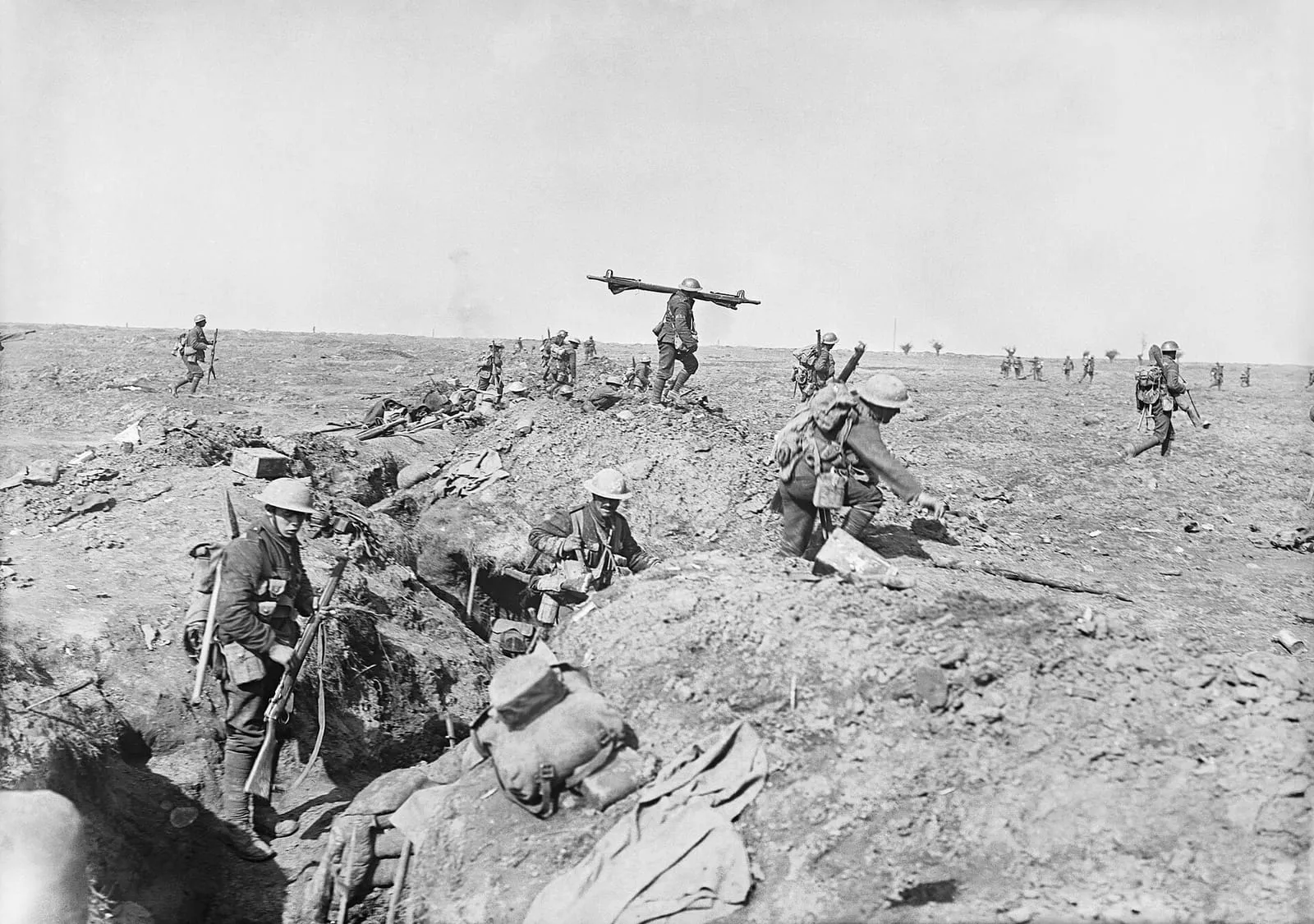
On 25 September 1916, exactly a year after the first day of the Battle of Loos, the British Fourth Army of General Henry Rawlinson launched another great attack in the Battle of the Somme. At 12.35 p.m., at noon on a fine autumn day, the infantry of four divisions of XIV Corps left their trenches behind a curtain of fire from their own artillery and in less than three hours took two villages on the ridge above the Somme, Morval and Lesbœufs. The British official history called it an “exhilarating experience” and judged the attack the most successful operation of the Fourth Army since mid-July. On the left wing, however, the attack on a third village, Gueudecourt, collapsed before uncut wire, and the French on the right wing failed to encircle Combles. Even so, by evening the German command judged its position to be dangerous.
After three postponements
Morval, Lesbœufs and Gueudecourt were to have fallen as early as 15 September, the day on which tanks went into battle for the first time in history. That day the British took Flers and High Wood, but on the right wing the attack stalled before the German fortifications between Ginchy and Morval. A new attack was set for 21 September, but torrential rain and the delayed preparations of the French Sixth Army, which was to attack on the right of the British, forced it to be put off three times. On 21 September General Ferdinand Foch agreed with Douglas Haig that both armies would attack together on 25 September, no earlier than noon. The French preferred to attack later in the day, so as to use the good morning light for the final stage of the bombardment. The British, who since July had liked to attack at dawn, gave way this time.
The plan was more modest than on 15 September. The Fourth Army was to advance 1,100–1,400 metres in three stages, with hour-long pauses, and to stand beyond the villages before three in the afternoon. The XIV Corps of General Lord Cavan was to take Morval and Lesbœufs, the XV Corps of General Henry Horne Gueudecourt, and III Corps on the left wing was only to improve its line by the road to Bapaume. There were few Mark I tanks and they were kept in reserve, because Rawlinson judged that they could not be hidden in the assembly positions from dawn until noon. In the rear, near Mametz, two brigades of the 1st Indian Cavalry Division waited, ready to move into open country if both villages fell before 6.30 p.m.
The bombardment began at seven in the morning on 24 September, in a thick autumn mist that made counter-battery fire against the German guns difficult. Airmen of the Royal Flying Corps bombed villages behind the front and railway lines around Lille and Douai, to hinder the Germans in bringing up reinforcements. The postponements also had a good side: for several nights the divisions dug new jumping-off trenches, often closer to the enemy. On the morning of 25 September, however, the soldiers in the crowded trenches had to wait more than six and a half hours from dawn to the attack, with almost no chance to move. The German artillery fired a great deal during the night, but before noon it hardly shelled the British lines at all.
Noon
The day was sunny, with a light haze. At 12.35 p.m. the barrage came down two hundred yards in front of the British line and the infantry moved off. The official history writes that the battalions of XIV Corps, “splendidly served by their artillery”, advanced steadily and methodically, without delays and almost without serious obstacles. Most of the Germans who had survived the bombardment were surprised before they were ready to defend themselves, and some ran away without their weapons. The German barrage usually came down too late. The British attacked divisions freshly brought into this sector: the 51st and 52nd Reserve Divisions at Combles, Morval and Lesbœufs, and the 6th Bavarian Division at Gueudecourt.
On the right wing the 56th (London) Division, waiting seven minutes to come level with its neighbours, cleared the northern edge of Bouleaux Wood, and the London Scottish battalion took the trenches towards the Combles valley. Beside it the 5th Division met heavy fire. The 1st Battalion of the East Surrey Regiment suffered heavy losses in front of the embankment of a light railway north of Combles, and a strongpoint by the road from Ginchy to Morval fell only when the 1st Battalion of the Devonshire Regiment entered the trench from the north. The 1st Battalion of the Norfolk Regiment was led in person by its commanding officer, Lieutenant-Colonel P. V. P. Stone, who had begged for permission because his battalion had recently received three large drafts from other regiments. According to the official history, Stone treated the attack “like a pheasant shoot, with his orderly as loader”. The battalion took its first objective in a single bound and captured more than a hundred prisoners, supported by the fire of the Stokes mortars of the neighbouring 6th Division.
The Guards Division, on the corps’ left wing, paid more. The right wing of the 2nd Battalion of the Grenadier Guards was held up by three belts of uncut wire. Officers and men fell fast, but the guardsmen cut the wire by hand under cover of their own snipers and bombers, and then took the trench. The 4th Battalion of the Grenadiers unexpectedly came upon a German trench in front of the main objective, took it with the bayonet, killing more than a hundred defenders, and reached the first objective only slightly late. One of the senior Guards officers said that “everything went like clockwork”.
Morval and Lesbœufs
At 1.35 p.m. the second stage began. Battalions of the 5th and 6th Divisions and of the Guards occupied within a few minutes the sunken road in front of both villages, bombing the crowded dugouts. An hour later the final bound began. The battalions of the 95th Brigade stormed the southern part of Morval, which according to the plan was to take four successive stages and took less than an hour and a half. To the soldiers of the 2nd Battalion of the King’s Own Scottish Borderers the Germans “seemed demoralised and not very eager to fight”, and “almost everyone in the battalion got some souvenir”. The 1st Battalion of the Cheshire Regiment occupied the northern part of Morval soon after three. According to a German regimental history, at about this time the British bombed the headquarters dugout of the III Battalion of the 239th Reserve Infantry Regiment in Morval, and the battalion itself was practically destroyed.
In Lesbœufs the battalions of the 6th Division and of the 1st Guards Brigade found few Germans. The Grenadiers and the Irish Guards occupied the village without difficulty, and by 3.30 p.m. the 1st Battalion of the Grenadiers had gone round it from the north and reached the final objective. Twenty-one minutes after the start of the final bound an observer in a balloon reported to corps headquarters that the whole final objective had been taken except the south-eastern edge of Morval, which fell in the evening. Contact patrol airmen reported that day an attack “splendidly carried out, in perfect order”, and a map of the positions of the troops drawn up in the evening from aerial observation proved more accurate than the reports of the units themselves.
The most remarkable deed was performed by Private Thomas Alfred Jones of the 1st Battalion of the Cheshire Regiment. He went out alone to silence a German sniper, killed him and then two more Germans. When he reached a German trench, he persuaded the occupants of several dugouts to surrender and brought back through the British barrage more than a hundred prisoners, including several officers. For this he received the Victoria Cross.
XIV Corps had broken through the last of the main German positions on a front of almost two thousand yards. German batteries were seen driving off in haste, and most of the German infantry was withdrawing out of range of the fighting. The Germans began to shell the ruins of both villages heavily, so the British held them only with small detachments, while the main forces dug in on the high ground beyond the villages. At six in the evening the 16th Battalion of the Royal Warwickshire dug in more than two hundred yards beyond the eastern edge of Morval. Three tanks of the 5th Division moved off behind the infantry, but two got stuck, and the third reached Morval at dusk and was sent back. The three tanks of the Guards were not used.
Gueudecourt
To the left of the Guards the 21st Division of XV Corps was to take Gird Trench, part of the German third position, and then Gueudecourt. Its 64th Brigade was held up before uncut wire and came under machine-gun fire from the trench behind it. Before the bombardment the Bavarians had withdrawn their machine guns from the front line to safer intermediate positions, so the weapons survived. The survivors lay in shell holes until dark. The Leicestershire battalions of the 110th Brigade took Goat Trench halfway, but fire from the right flank prevented them from taking Gird Trench. The wounded commander of the 9th Battalion, Lieutenant-Colonel C. H. Haig, rallied his men and sent a runner for reserves, but the runner was wounded on the way and help did not come. Some soldiers of the 8th Battalion are said to have pushed through as far as Gueudecourt and were never seen again. Because of the observers’ reports, divisional headquarters believed for a time that the village had been taken.
Further to the left things went better. The 55th (West Lancashire) Division took its trenches soon after one, advancing close behind the barrage, and the 1st Brigade of the New Zealand Division formed a defensive flank north of Flers in 25 minutes. At the crossroads called Factory Corner the whole staff of a battalion of the Bavarian 13th Infantry Regiment surrendered to the New Zealanders, and an Otago battalion took 80 prisoners and three machine guns. At five in the afternoon, when corps headquarters learned the truth about Gueudecourt, Horne ordered the commander of the 21st Division to renew the attack with the help of a tank. The latter asked for the attack to be put off until the morning and was given permission. On the army’s left wing III Corps gained little, and one of the two tanks that were to help it got stuck even before the attack.
The French at Combles
The French Sixth Army of General Émile Fayolle attacked at the same time on the front from Combles to the Somme. The Allies wanted not to storm Combles, a strongly fortified village in a valley at the junction of the two armies, but to encircle it: the British from the north, through Morval, and the French from the south, through the village of Frégicourt. The left wing of the French I Corps, however, was stopped by machine guns on the south-eastern edge of Combles, and Frégicourt held out. The Londoners, who in the afternoon had broken into a newly discovered trench overlooking the valley between Combles and Morval, saw no sign of a French attack. At five the French reported the capture of Frégicourt, but an hour later Lord Cavan corrected this by telephone: the village was still holding out. XXXII Corps had greater success, taking Rancourt on the road from Péronne to Bapaume in the early afternoon. Further south the French, held up by machine-gun fire, gained little.
Evening
In the afternoon the battalion commanders of XIV Corps reported that there was almost no resistance in front of them and that the cavalry could be useful. Lord Cavan, uncertain of the situation on both flanks, decided not to call it up. The Germans tried to retake Morval with the remnants of battalions of the 51st and 52nd Reserve Divisions, but advanced only a little, covering the withdrawal of their artillery. At night their line ran along the road to Le Transloy, about a kilometre beyond Morval. The Bavarian official history admitted that in the evening the situation was serious: there were not enough troops to counter-attack both west of Gueudecourt and at Lesbœufs at the same time.
At ten in the evening Foch came to see Haig, very disappointed by the slow progress of the French left wing. He explained that Fayolle’s attack on Sailly-Saillisel was blocked by Saint-Pierre-Vaast Wood, and asked whether he could pass French troops through Morval to attack Sailly-Saillisel from the west. Haig at once offered to hand over to the French both Morval and Lesbœufs, together with the narrow-gauge railway then being built. According to the British official history, Foch expressed surprise and gratitude, and two days later a personal letter of thanks came from General Joseph Joffre. Haig decided that XIV Corps, after helping to clear Combles, must now wait for the French, and that the rest of the Fourth Army could now only complete the capture of its assigned objectives. From now on the most important thing was the attack of the Reserve Army on Thiepval, set for the next day. At eleven in the evening the Fourth Army issued its orders: XIV Corps was to encircle Combles together with the French, and XV Corps to take Gird Trench and Gueudecourt.
At about ten in the evening soldiers of the 5th Division captured a German officer who stated that the Germans would abandon Combles that same night. A similar report came from the French. Patrols of the 56th Division moved towards the village. The next day Combles and Gueudecourt were already in Allied hands.
Remember the articles you have read? Only in this browser; nothing is sent anywhere.How it works
Read ·
Spotted a mistake?Report an error
Meanwhile
(03)Elsewhere in the same days.
- 26 September 1916 · Balkan FrontBattle of Hermannstadt beginsOn 26 September 1916 the German Ninth Army attacked the Romanians at Hermannstadt, and the Alpenkorps came down onto the Red Tower Pass road behind them.
- 26 September 1916 · Balkan FrontVenizelos forms a provisional government on CreteOn 26 September 1916 Venizelos and Admiral Kountouriotis landed on Crete and formed a provisional government at Chania, opposed to the government in Athens.
- 22 September 1916 · Middle EastThe Arabs take TaifOn 22 September 1916, after a three-month siege, the Turkish garrison of Ta'if surrendered to Emir Abdullah. Hejaz governor Ghalib Pasha was captured.
Related events
(04)The same battle, people or subject.
- 28 September 1916 · Western FrontEnd of the Battle of MorvalOn 28 September 1916 the Battle of Morval died down. The British held the villages taken and handed part of the front to the French, but could not go on.
- 22 September 1916 · Western FrontEnd of the Battle of Flers–CourceletteOn 22 September 1916 the Battle of Flers–Courcelette ended. After a week of fighting in rain and mud the British were preparing to attack Morval and Thiepval.
- 1 October 1916 · Western FrontStart of the Battle of the Transloy RidgesOn 1 October 1916 the British Fourth Army attacked on the Somme at Eaucourt l’Abbaye and the Flers Line, aided by tanks and New Zealanders. Next day it rained.
- 3 September 1916 · Western FrontBattle of Guillemont beginsOn 3 September 1916 British and Irish troops took Guillemont on the Somme in under three hours, after it had been fought for in vain since late July.