Key event
Start of the Battle of Flers-Courcelette
- Category:
- Military operations
- Front:
- Western Front
- Date:
- 15 September 1916
- Author:
- Natalia
- Battle:
- Battle of Flers–Courcelette
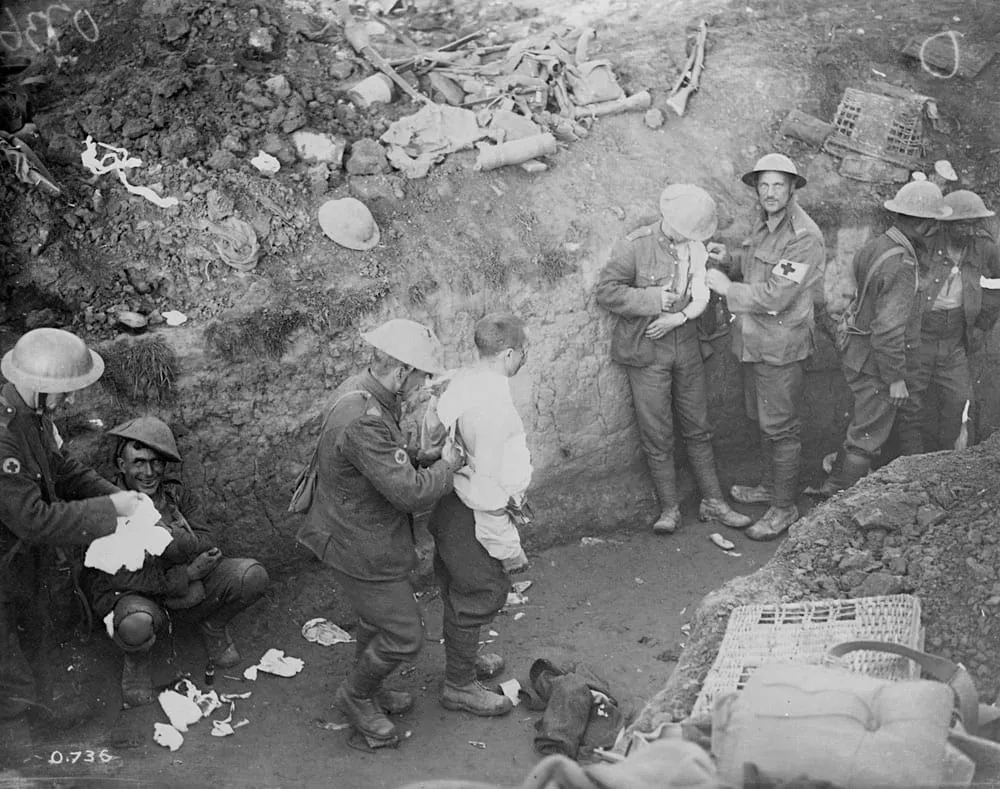
At 6.20 a.m. on 15 September 1916 the British Fourth Army and the right wing of the Reserve Army attacked on the Somme on a front of about ten kilometres, from the ravine near Combles to the Albert–Bapaume road. It was the strongest British attack since the first day of the battle, 1 July, and the first in history in which tanks took part. Several dozen steel machines, whose existence most British soldiers knew nothing about, let alone the Germans, crawled out of the morning mist ahead of the advancing infantry. By evening the British had taken High Wood and the villages of Flers and Martinpuich, and the Canadians Courcelette. The breakthrough that General Douglas Haig had hoped for did not come, but no day since the start of the offensive had won the British so much ground. What stayed in memory above all was a single sentence: about a tank driving up the main street of Flers with cheering soldiers behind it.
The night before the battle
The preparatory bombardment was already in its third day. According to the British official history, the Fourth Army’s artillery fired almost 289,000 shells in the last twenty-four hours before the attack, three times as many as in the first days of the bombardment, which had begun on 12 September. On the evening of 14 September the assault battalions left their bivouacs and occupied the jumping-off trenches. Most managed to sleep a few hours; a hot meal was served, and in places rum. Some battalions learned only towards morning at what time they were to go over. Behind the front stood five cavalry divisions that were to pass through the gap towards Bapaume, and their long columns, seen by the infantry on the way to the front, seemed a promise of victory.
Meanwhile the tanks were covering the last stretch to their starting points, one to two miles across ground churned up by shell holes, by the light of the setting moon, along routes marked with white tape. The crews had hardly slept for two days. The young tank commanders had to learn their routes, compass bearings and times by heart, because there were not enough maps for everyone, and old trenches, clearly visible on aerial photographs, were hard to recognise on the ground. Aircraft flew low over the German trenches so that the roar of their engines would drown the noise of the tracks. Some machines got stuck in shell holes, some sank into old dugouts, others broke down. Of the 42 tanks allotted to the Fourth Army, 30 reached their places according to the official history, as did all six assigned to the Canadians.
The first tanks in battle
The first tank went into action even before the main attack. At about 5.15 a.m. Captain Harold Mortimore’s D1 moved out from Delville Wood to clear, together with companies of a Yorkshire battalion, a German salient east of the wood. It shot several Germans before a shell destroyed its steering gear. It is regarded as the first tank to take part in a battle.
At about 6 a.m., in the mist in front of Ginchy, soldiers of the Bavarian 21st Infantry Regiment saw three strange vehicles approaching their trenches. According to the regimental history, they were at first taken for ambulances, but the vehicles raked the trench with machine-gun fire for several minutes and then turned back. Rumours of some British “armoured car” had been circulating among the German soldiers for several days, but almost no one knew what it was. Some, seeing smoke from the exhaust, thought it was gas and pulled on their masks as they ran. One of the captured Germans said in English that tanks were “not war, but bloody butchery”.
At 6.20 a.m. the artillery fire became a creeping barrage and the infantry left the trenches. The Otago battalion of the New Zealand Division set off half a minute early, following the example of a London battalion on its left, and ran into its own barrage.
“A tank in the main street of Flers”
The largest number of tanks, ten, was allotted to the 41st Division, which was to take Flers. It was a division of Kitchener’s New Armies, in France since May, fighting its first great battle. Its battalions took the first German lines in under an hour, and at about 8.20 a.m., when the fire lifted beyond the village, a tank drove into Flers. The British official history writes that it was a scene “without precedent in the history of war”: the tank rolled up the main street, firing, followed by cheering groups of infantry. Other machines drove along the eastern edge of the village and smashed houses in which machine-gunners were hiding. The official history identifies the main-street tank as D16, but most later accounts speak of tank D17 “Dinnaken” of Lieutenant Stuart Hastie, who received the Military Cross for that day. Most of the Bavarians fled towards Gueudecourt, and by ten o’clock resistance in Flers had ceased.
Contact aircraft of the Royal Flying Corps circled over the village; its airmen flew that day, as the official history writes, more hours and fought more combats than on any day since the start of the war. At 8.45 a.m. an airman’s message reached III Corps headquarters: “tank seen in main street Flers going on with large number of troops following it”. It was passed on to XV Corps, and the war correspondents, as the official history notes, “made the most of it”. In the newspapers the message took the form of a sentence that went round the world: “A tank is walking up the High Street of Flers with the British Army cheering behind”.
The reality after the capture of the village was less exalted. Few officers were left in the 41st Division, and many soldiers decided that with Flers taken their task was over. Under increasingly heavy German artillery fire they began drifting back in small groups to the trenches south of the village. Only in the afternoon did Major Gwyn Thomas of the brigade staff and a sapper, Lieutenant Carter, gather whoever they could, go round Flers on both sides and man a line beyond the village, at the moment when the forward groups, convinced they had been left alone, were about to withdraw. Of the four tanks that had helped to take Flers, one burned near Gueudecourt after a duel with a German battery, a second was smashed by shells in the trenches beyond the village, and a third, hit twice, was abandoned on the eastern edge of Flers. Only one came back unscathed.
To the left of Flers the New Zealanders had taken the German Switch Line by 6.50 a.m., and later further trenches. When a rifle battalion was held up before uncut wire, two tanks arrived at about 10.30 a.m., crushed the wire and dealt with the machine guns. By eleven the New Zealanders stood on the third objective north-west of the village.
The Guards at Ginchy
The day looked quite different on the right wing. The Guards Division set off from the ruins of Ginchy, taken six days earlier, towards Lesbœufs. Of the ten tanks allotted to it, none helped it: some did not arrive, others lost their way. The Guardsmen were advancing thirty yards behind the barrage when machine guns opened fire on them from the right, from the untaken redoubt called the Quadrilateral. Despite heavy losses they broke through the first trench. The 2nd and 3rd Battalions of the Coldstream Guards were led on by Lieutenant-Colonel John Campbell to the sound of a hunting horn, for which he received the Victoria Cross. In a landscape without any landmarks, however, the commanders mistook the captured trench for the third objective, which lay more than a kilometre further on.
At about 4.30 p.m., in the attack of the 3rd Battalion of the Grenadier Guards near Ginchy, Lieutenant Raymond Asquith, the eldest son of the Prime Minister Herbert Henry Asquith, was hit in the chest by a bullet. According to his men’s accounts, he lit a cigarette to hide how badly he was wounded and not to halt the attack. He died before he could be carried to the dressing station. The Prime Minister, who a week earlier had visited Haig’s headquarters in France, could not get over the news for a long time, according to his biographers. In the same attack another Grenadier officer, Harold Macmillan, the future prime minister, was severely wounded; he lay in a shell hole for more than twelve hours, reading Aeschylus, by his own account.
To the right of the Guards the 6th Division attacked the Quadrilateral in vain all day, and the 56th Division took only some of the trenches above the ravine near Combles. One of its tanks, immobilised by a shell, held off German bombers with machine-gun fire for five hours before it burned.
High Wood and Martinpuich
On the left wing the 47th (London) Division attacked High Wood, the wood on the crest of the ridge that the British had been fighting for since 14 July. Four tanks, sent in against the advice of their commanders among the stumps and shell holes in the middle of the wood, got stuck or were destroyed, and the infantry fell under machine-gun fire. Only at about 11.40 a.m. did a brigade Stokes mortar battery fire 750 bombs in a quarter of an hour, and the Bavarians began to surrender. At about 1 p.m. High Wood was at last in British hands. The 15th (Scottish) Division took the southern edge of Martinpuich before ten, and in the afternoon Scots of a Cameron Highlanders battalion drove the Germans out of the rest of the village.
Courcelette
On the left wing of the whole attack, in the Reserve Army, the Canadian Corps attacked. The night had been restless, as the Germans twice tried to drive the 4th Brigade out of its trenches, but at 6.20 a.m. the 2nd Canadian Division set off on time and took the first German trenches within a quarter of an hour. At about 7 a.m. it occupied the ruins of the sugar factory on the Albert–Bapaume road, where a battalion commander and his officers were captured in a deep dugout under the buildings. The six Canadian tanks could not keep up with the infantry, but, it was reported, the mere sight of them was encouraging.
Before noon General Julian Byng, the corps commander, ordered the village itself to be taken. The orders were explained to the battalion commanders verbally at about one o’clock, with no time for reconnaissance. At 6.15 p.m., in full daylight and without jumping-off trenches, the 22nd Battalion, made up of French-speaking Canadians from Quebec, and the 25th Battalion from Nova Scotia went forward behind a barrage and after a short bayonet fight passed through Courcelette. After dark a contact aircraft dropped at divisional headquarters a map marking Canadian flares along the eastern and northern edges of the village. Germans of the 45th Reserve Division were still hiding in cellars and dugouts, and during the night they counter-attacked again and again. The commander of the 22nd Battalion, Lieutenant-Colonel Thomas-Louis Tremblay, wrote in his diary: “If hell is as bad as what I have seen at Courcelette, I would not wish my worst enemy to go there”.
Evening
At about 3 p.m. General Henry Rawlinson concluded that the attack had lost its momentum. Most of the attacking battalions had lost 300–400 men each, many battalion commanders had been killed or wounded, and reports from the front contradicted one another: even after 1 p.m. an artillery observer reported that the Guards were in Lesbœufs. Rawlinson halted further attacks until the next morning. The cavalry did not move. To the right of the British the French Sixth Army attacked Rancourt and Frégicourt in the afternoon, but did not break through. The day’s gains were nonetheless considerable: according to the British official history, the third German position fell on a stretch of about four kilometres, and at Flers the British advanced more than three kilometres. Morval, Lesbœufs and Gueudecourt, beyond which the road to Bapaume was supposed to open, still held out against them, however.
British public opinion greeted the news of the tanks with enthusiasm. The newspapers wrote at length about the mysterious “land ironclads”, and the message from Flers became a symbol of the hope that trench warfare had at last found its solution. Of the 36 tanks that went into battle, fewer than a dozen helped in capturing defences according to the official history, but Haig was pleased. The creators of the new weapon, led by Lieutenant-Colonel Ernest Swinton, believed, however, that the secret had been squandered on too few machines, and this dispute was to last for decades.
Remember the articles you have read? Only in this browser; nothing is sent anywhere.How it works
Read ·
Voices from the front
“This time the infantry were to be assisted by Tanks, faint rumours of which had already reached us, only to be dismissed with incredulity. However, at Fricourt we were convinced by the evidence of our senses. In a flat near Braye were Tanks by the dozen huddled together like monstrous, horrible tortoises; they were still more uncanny when they moved, with a slow, ungainly gait suggestive of Nemesis.”
“Thus we went on, and they took up their position between two of these huge steel tanks on the near side of the ridge. […] it was an unpleasant journey of about half a mile over nothing but shell-holes full of dead and dying […]. Darling Moth', I am so thankful to be alive; I suppose you have heard who are dead? Guy Baring, Raymond Asquith, Sloper Mackenzie, and many others. It is a terrible list.”
Spotted a mistake?Report an error
Meanwhile
(04)Elsewhere in the same days.
- 16 September 1916 · Balkan FrontKalogeropoulos becomes Prime Minister of GreeceOn 16 September 1916 Nikolaos Kalogeropoulos, an opponent of Venizelos, formed a Greek government. The Entente saw a party cabinet as a breach of the June note.
- 17 September 1916 · AfricaBritish occupy LindiOn 17 September 1916 British warships landed the Indian 40th Pathans at Lindi. Soon the whole coast of German East Africa was in British hands.
- 17 September 1916 · Balkan FrontAllies retake FlorinaOn 17 September 1916 French and Russian troops entered Florina, taken by the Bulgarians a month before. The Serbian victory at Gornichevo opened the way.
- 18 September 1916 · Italian FrontEnd of the Seventh Battle of the IsonzoOn the evening of 17 September 1916 Cadorna halted the attack on the Karst; on 18 September the fighting died down. Italy took only San Grado and some trenches.
Related events
(04)The same battle, people or subject.
- 22 September 1916 · Western FrontEnd of the Battle of Flers–CourceletteOn 22 September 1916 the Battle of Flers–Courcelette ended. After a week of fighting in rain and mud the British were preparing to attack Morval and Thiepval.
- 1 October 1916 · Western FrontStart of the Battle of the Transloy RidgesOn 1 October 1916 the British Fourth Army attacked on the Somme at Eaucourt l’Abbaye and the Flers Line, aided by tanks and New Zealanders. Next day it rained.
- 1 October 1916 · Western FrontStart of the Battle of the Ancre HeightsOn 1 October 1916 the Canadians attacked Regina Trench beyond the Thiepval ridge on the Somme. Uncut wire and German marines repelled almost the whole assault.
- 13 June 1916 · Western FrontEnd of the Battle of Mount SorrelOn 13 June 1916, after days of shelling, the Canadians retook Mount Sorrel and Tor Top near Ypres in a night attack. Württembergers had taken them on 2 June.