United Kingdom · The Entente
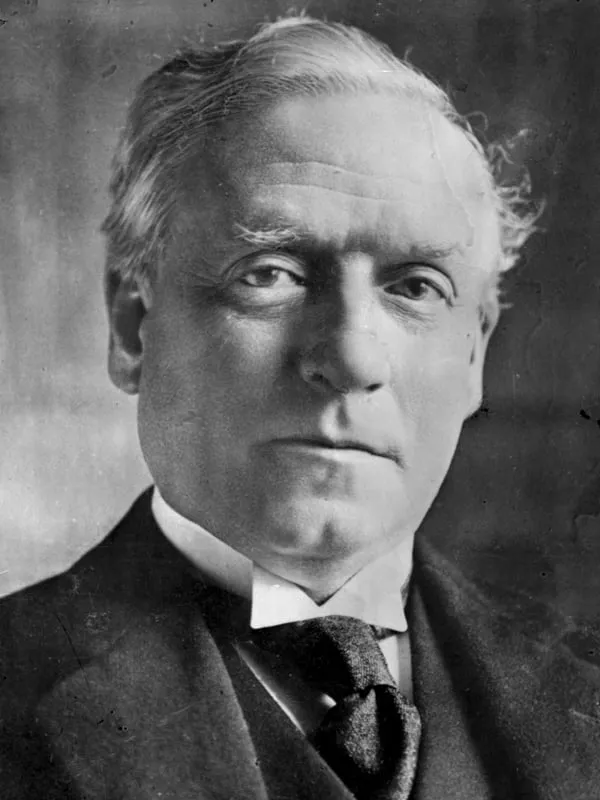
Herbert Henry Asquith
Prime Minister of the United Kingdom (1908–1916), leader of the Liberal Party
- Born:
- 12 September 1852, Morley (England)
- Died:
- 15 February 1928, Sutton Courtenay (England)
- Author:
- Łukasz Skowroń
- Photo:
- Bain News Service, domena publiczna, Wikimedia Commons

Herbert Henry Asquith was the Prime Minister who took Britain into the war as a united country and led its government for more than two years. A superb parliamentarian and a master at reconciling quarrelling ministers, he was seen as a man of peace who could not become the leader of a total war. Under his government the decisions were taken to send the army to France, to mount the Dardanelles expedition, to create the Ministry of Munitions and to introduce the first conscription in the country’s history. The Gallipoli disaster, the shell crisis, the rising in Dublin and the slaughter on the Somme undermined his authority, and in December 1916 his dispute with David Lloyd George ended his premiership and split the Liberal Party for good.
Before the war
He was born on 12 September 1852 in Morley in Yorkshire, into a Nonconformist family of wool merchants. He lost his father early, was educated at the City of London School and then as a scholar at Balliol College, Oxford, where he made his name as a speaker. He became a barrister, and in 1886 he entered the House of Commons as Liberal member for the Scottish constituency of East Fife. From 1892 to 1895 he was Home Secretary under Gladstone, from 1905 to 1908 Chancellor of the Exchequer, and in April 1908, after the resignation of the ailing Henry Campbell-Bannerman, he became Prime Minister. After the death of his first wife he married the brilliant and eccentric Margot Tennant.
His government carried out great social reforms, from pensions to insurance, and in 1909–1911 fought a victorious battle with the House of Lords, which had blocked Lloyd George’s budget. The price was dependence on the Irish Nationalists and the Irish Home Rule bill, which in the spring of 1914 brought the country to the brink of civil war. After the so-called Curragh incident, when officers in Ireland declared that they would not use force against Ulster, Asquith removed the Secretary of State for War and from 30 March 1914 ran the War Office himself. His closest colleagues included Edward Grey, Richard Haldane, Lloyd George and Winston Churchill. From 1912 he wrote hundreds of letters to the young Venetia Stanley, who was his confidante. These letters are today one of the most important sources for the history of his government.
August 1914
As late as 24 July 1914 he wrote to Venetia that Europe was close to a real Armageddon, but that nothing suggested Britain would be anything more than a spectator. The Cabinet was deeply divided, and most Liberals did not want war. Asquith had no intention of tying his hands either way, but when it became clear that Grey would resign if the government abandoned France, he took his side. On 29 July he approved the precautionary period in the army, on 1 August he allowed Churchill to mobilise the fleet, and after the German ultimatum to Belgium almost the whole Cabinet followed him. Only two ministers resigned. On 4 August Asquith informed the House of Commons of the ultimatum to Germany, and at 11 p.m. Britain was at war. The country entered it without a political split and without unrest, and that was his achievement.
The next day he convened the first war council, which decided to send the Expeditionary Force to France, and handed the War Office to Lord Kitchener, whom he appointed Secretary of State for War. He put the Irish question aside: the Home Rule bill reached the statute book, but suspended until the end of the war.
The War Council and the Dardanelles
Asquith believed that politicians set the aims and that execution should be left to the commanders. In November 1914 he set up the War Council, a small committee of the Cabinet, but he chaired its meetings like Cabinet sessions: he heard the sides, looked for compromise and rarely imposed a solution. So it was in January 1915, when the Council adopted Churchill’s plan and the Prime Minister drafted a vague resolution on a naval expedition that was to “take” the Gallipoli peninsula. Before the final decision he sided with Churchill against Fisher, and then for weeks reconciled Churchill and Kitchener in their dispute over troops for the Dardanelles.
In the spring of 1915 everything turned against him. On 20 April at Newcastle he declared that there was not a word of truth in the claims of a shortage of ammunition. On 14 May The Times published a dispatch on the shortage of shells at Aubers. Two days earlier Venetia Stanley had told him of her engagement to the minister Edwin Montagu, a heavy personal blow. On 15 May Lord Fisher left the Admiralty. Asquith decided that a purely Liberal government would not survive, and within a few days he opted for a coalition.
The coalition government
On 25 May 1915 a government of Liberals, Conservatives and Labour was formed. Asquith played the negotiations skilfully: the Liberals kept the most important departments, and the Conservative leader Andrew Bonar Law received only the Colonial Office. He paid a high price, however. The Conservatives demanded that Churchill leave the Admiralty, and the Prime Minister also agreed to the departure of the Lord Chancellor, Haldane, his oldest friend, whom the press accused of pro-German sympathies. Lloyd George took charge of the new Ministry of Munitions.
The Dardanelles Committee was set up to direct the war, and in November the smaller War Committee. Both grew, however, and their decisions came back for debate in a Cabinet of more than twenty. On 2 November 1915 Asquith made a great speech on the state of the war in which he assured Serbia that its independence was one of the Allies’ aims, and declared that he would not reverse the decision to go to war. In the autumn he sent Kitchener to the Dardanelles, hoping he would stay in the East, and took over the War Office himself during his absence. He used this to force Field Marshal John French to resign, replace him with Douglas Haig, and give the new Chief of the Imperial General Staff, William Robertson, the sole right to advise the government on military matters. In December the decision was taken to evacuate Gallipoli.
Conscription and Ireland
The hardest domestic issue was conscription. Many Liberals, Labour and the Irish Nationalists saw it as an attack on British liberty. Asquith approached it in small steps: through national registration, the Derby Scheme and the promise that married men would not be called up before single men. On 5 January 1916 he introduced the bill for the conscription of unmarried men, which the House of Commons passed by a huge majority. Only the Home Secretary, John Simon, left the Cabinet over it. In May, after a crisis that nearly broke up the government, Asquith extended conscription to married men. The advocates of compulsion still accused the Prime Minister of delay.
At Easter 1916 a rising broke out in Dublin. The government declared martial law throughout Ireland and handed power to General John Maxwell, and courts martial sentenced the leaders to death. The executions dragged on for ten days, and the Prime Minister, although he urged restraint on Maxwell, did not stop them at once. Only on 12 May did he go to Dublin himself, and no further sentences were carried out. By then, however, opinion in Ireland had turned. The Home Rule settlement that Lloyd George negotiated at his request collapsed in the face of Conservative opposition.
1916: the Somme and the fall
On 5 June 1916 Kitchener was killed. After a few weeks during which the Prime Minister again ran the War Office himself, Lloyd George became Secretary of State for War. The Prime Minister’s wife considered it the greatest political mistake of his life. In the summer and autumn the Battle of the Somme brought enormous losses without a breakthrough, and on 15 September the Prime Minister’s eldest son, Raymond, was killed at Flers-Courcelette. Asquith, crushed, was withdrawn into himself for weeks afterwards, according to those close to him.
In November Lloyd George, Bonar Law and the Ulster Unionist leader Edward Carson agreed that the war should be directed by a small council headed by Lloyd George, with the Prime Minister keeping only general oversight. After several days of compromises, broken agreements and attacks by Lord Northcliffe’s press, Asquith chose confrontation, convinced that no one else could form a government. He miscalculated. The Conservatives, and even Arthur Balfour, sided with his rival. On 5 December 1916 Asquith resigned, and two days later Lloyd George became Prime Minister. So ended more than eight and a half years of his government, the longest unbroken premiership since the 1820s.
Leader of the opposition
Asquith kept the leadership of the Liberal Party and the loyalty of most of its MPs and leading politicians. He spoke of a “well-organised conspiracy”, but did not intend to obstruct the new government. The only serious clash came in May 1918, when General Frederick Maurice accused the Prime Minister in the press of misleading Parliament about the strength of the army in France. On 9 May Asquith demanded a committee of inquiry, but Lloyd George replied with a brilliant speech, and the motion was defeated by 293 votes to 106. The vote drew the dividing line among the Liberals before the December 1918 election. It was Asquith who then contemptuously called the letters of endorsement for coalition candidates the “coupon”. His Liberals suffered a crushing defeat, and he himself lost East Fife, which he had represented since 1886.
After the war
In 1920 he returned to the House of Commons for Paisley and led the Liberals for a few more years, and in 1923 he was formally reconciled with Lloyd George. In 1924 he lost his seat, and a year later he accepted the title of Earl of Oxford and Asquith. In 1926 he resigned the party leadership. He died on 15 February 1928 at his home in Sutton Courtenay.
Assessment
For decades Asquith was regarded as the symbol of incompetent war leadership. Critics recalled his motto “wait and see”, his fondness for bridge, good food and the company of women, and his inclination to drink, which looked bad in wartime. Lloyd George and his supporters portrayed him as a man who never acted until forced to, and by then it was usually too late. Churchill wrote that a decisive Asquith would easily have won the struggle for power, but that there was no such Asquith.
Biographers, above all Roy Jenkins and later George Cassar, judge him more kindly. They stress that he brought a united nation into the war, formed a coalition without splitting the party, carried through conscription, which as late as 1914 had seemed unthinkable, and built the foundations of the war machine that Lloyd George took over. Many of the decisions for which he was blamed, from the Dardanelles to the Somme offensive, were also collective decisions, supported by the generals. Most historians agree, however, that the style of government that served him well in peacetime proved too slow for war, and that his fall opened the way to a more centralised direction of the state.
Sources
Spotted a mistake?Report an error
Mentioned in battles
(07)Often appears with
People who appear in the same events.
On the timeline
(83)The 40 most important of 83 events. All tagged “Herbert Henry Asquith” (29) →
1914
July
August
- 04
- Great Britain issues an ultimatum to GermanyOn 4 August 1914 London demanded that Germany respect Belgian neutrality by midnight. The chancellor called the treaty a "scrap of paper".
- Key eventBritain declares war on GermanyAt 11 p.m. London time on 4 August 1914 the ultimatum expired. Britain and its whole empire found themselves at war with Germany.