1916: The Battle of the Somme
Battle of Flers–Courcelette
- Dates:
- 15–22 September 1916
- Front:
- Western Front
- Location:
- The ridges north-east of Longueval and Pozières, from the ravine near Combles to the Albert–Bapaume road, with the villages of Flers, Martinpuich and Courcelette and High Wood, Somme department (France)On the battle map →
- Sides:
- United Kingdom, Canada, New Zealand and FranceDouglas Haig, Henry Rawlinson, Hubert Gough, Julian Byng, Émile FayolleGerman EmpireRupprecht, Crown Prince of Bavaria, Fritz von Below
- Result:
- Partial British victory. High Wood, Flers, Martinpuich, Courcelette and a stretch of the German third position were taken, but the front was not broken, and Morval, Lesbœufs and Gueudecourt remained in German hands.
- Author:
- Łukasz Skowroń
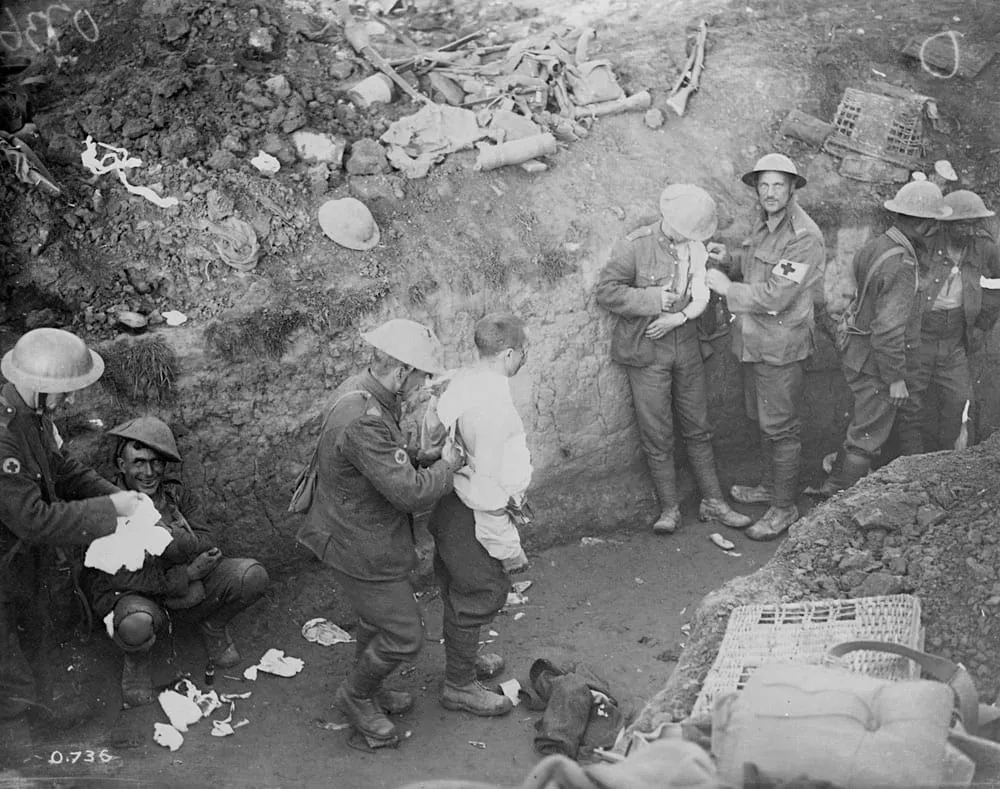
The Battle of Flers–Courcelette was the second great British attack in the Battle of the Somme designed to achieve a breakthrough, and the first battle in history in which tanks were used. At 6.20 a.m. on 15 September 1916 eleven British divisions of the Fourth Army and the Reserve Army, including the New Zealand Division and two Canadian divisions, attacked on a front about ten kilometres long, from the ravine near Combles to the road from Albert to Bapaume. Ahead of the infantry and alongside it rolled several dozen armoured tracked vehicles, the Mark I, built in strict secrecy and, to mislead the enemy, called “tanks”. General Douglas Haig hoped that the blow would pierce the last prepared German line and open the way for the cavalry. On the first day the British at last captured High Wood, which they had been fighting for since 14 July, as well as the villages of Flers and Martinpuich, and in the evening the Canadians took Courcelette. On the right flank, however, the attack stalled before a redoubt known as the Quadrilateral, and Morval, Lesbœufs and Gueudecourt remained in German hands. Until 22 September, in rain and mud, the fighting was only to improve the line. The battle brought the largest gain of ground since the start of the offensive, but not a breakthrough, and the debate over whether the tanks were used too early continues to this day.
Name and dates
The name “Battle of Flers–Courcelette” and the dates 15–22 September 1916 were set after the war by the British Battles Nomenclature Committee. The name joins the two villages that were the most important gains of the first day: Flers in the centre, taken by the 41st Division and the New Zealanders, and Courcelette on the left flank, taken by the Canadians. The battle covers the attack of 15 September and the local fighting in the following days, up to the pause before the Battle of Morval, which began on 25 September. The French attacks in these days, on both sides of the Somme, are not part of the British classification, although they were coordinated with the British. Times in the text are given in British Summer Time, as used in the British official history.
Background
After the dawn assault of 14 July on Bazentin Ridge, the Battle of the Somme turned into a series of costly attacks on individual villages and woods. For six weeks the British fought for Delville Wood, High Wood and Guillemont, and the Australians for Pozières Ridge. Haig believed that this “wearing out” was weakening the Germans, and the interrogation of prisoners and captured letters convinced his staff that the enemy’s morale was declining. In mid-August he decided to return to the original aim of the offensive, a breakthrough. On 16 August he warned the Fourth Army of General Henry Rawlinson and the Reserve Army of General Hubert Gough of a great attack in mid-September in which the new armoured vehicles were to take part.
Several reasons shaped the timing. The French commander-in-chief, General Joseph Joffre, was pressing for a joint blow as early as 5 September. The Allies were attacking on every front: in Galicia the Brusilov offensive was still under way, the Italians were preparing another attack on the Isonzo, Sarrail in Macedonia, and on 27 August Romania entered the war. A heavy blow on the Somme was meant to prevent German divisions from being transferred to other fronts. Haig decided, however, that he first had to take Guillemont and Ginchy, from which the Germans overlooked the ground of the coming attack. Guillemont fell on 3 September, Ginchy on 9 September. On 1 September it was settled that the great attack would begin on 15 September. On the German side, from 29 August the army was already directed by Hindenburg and Ludendorff, and the front north of the Somme was held by the First Army of General Fritz von Below, part of the army group of the Crown Prince of Bavaria, Rupprecht.
The new weapon
The vehicle that was to cross barbed wire and trenches, proof against rifle bullets and shell splinters, was the fruit of a year and a half of work in Britain. The idea of an armoured “machine-gun destroyer” on caterpillar tracks had been pushed since the autumn of 1914 by Lieutenant-Colonel Ernest Swinton, and in February 1915 the First Lord of the Admiralty, Winston Churchill, set up a committee for “landships” (the Landships Committee) and on his own initiative funded its work from naval money. The British official history acknowledges that it was above all to Churchill’s “receptiveness, courage and driving force” that the turning of the idea into practical form was owed. The machine was designed by William Tritton of the firm of Foster in Lincoln and Lieutenant Walter Wilson. On 2 February 1916 the prototype, named “Mother”, underwent trials at Hatfield before Lord Kitchener, Lloyd George and other dignitaries, and soon afterwards the first hundred were ordered. To preserve secrecy they were referred to in documents as water tanks, and from 24 December 1915 the word tank came into use.
The Mark I tank weighed about 28 tons and had a rhomboid shape, with tracks running round the whole hull. The “male” version had two 6-pounder (57 mm) guns in side sponsons and four machine guns; the “female”, weighing 27 tons, had machine guns only. A 105 hp Daimler engine gave about 6 km/h on a road, but on a field full of shell craters the machine covered less than a kilometre an hour. The eight-man crew worked in noise, heat and petrol fumes, and the driver saw the ground only through narrow slits. The crews formed a new unit, the Heavy Section, Machine Gun Corps, trained in the summer of 1916 at Elveden in Suffolk. The first machines arrived in France at the end of August, and at the beginning of September C and D Companies assembled at Yvrench near Abbeville. On 3 September Haig showed them to Joffre.
The creators of the tank, with Swinton at their head, warned against using a few dozen machines at once. Swinton wrote in February that the new weapon’s chance lay in complete surprise and that it must not be thrown into battle “in driblets”. By the autumn 150 tanks could be ready, and by the spring of 1917 several hundred more. Haig replied that the Allied offensive could only be conducted for a limited time and that if the Germans could not be driven from their positions before the autumn, the next opportunity for a joint blow would not come until the spring. “I shall use what I have,” he wrote on 22 August to General Robertson, because “it would be madness not to use every means” in what was to be the “culmination” of the year’s effort.
The plan
Haig wanted a breakthrough. On the first day the Fourth Army was to take Morval, Lesbœufs, Gueudecourt and Flers, that is, to break through the third and last prepared German position, and then, covering itself to the east on the line Morval–Le Transloy–Bapaume, to roll up the German front to the north. Behind the front waited five cavalry divisions, which were to pass through the gap and advance on Bapaume. Rawlinson was more cautious. At first he proposed a series of night attacks at full moon, with the tanks withdrawn before dawn, but Haig demanded a bolder plan. In the end the attack was planned in four successive objectives, marked on the maps in colours: green (the German Switch Line and the trenches before Martinpuich), brown, blue (the village of Flers) and red (Morval, Lesbœufs, Gueudecourt), which Rawlinson expected to reach before noon. Privately he called the attack “a legitimate gamble”.
The tanks were divided into small groups of two or three vehicles, allotted to divisions. They were to set off a few minutes before the infantry and destroy strongpoints, machine guns and trench junctions. For them, lanes about a hundred metres wide were left in the creeping barrage, into which the artillery did not fire. The British official history judged this idea “very doubtful”: where the tanks did not arrive, the infantry advanced against trenches that had not been shelled. Of the 49 tanks that were to be ready, 42 were allotted to the Fourth Army and the rest to the Canadian Corps of the Reserve Army. The Reserve Army was originally to play a supporting role, but a few days before the attack Haig demanded that the Canadians take Courcelette, and the Fourth Army Martinpuich, on the same day.
The attack was the largest since 1 July. On the Fourth Army’s sector, according to the official history, there was one field gun for every ten yards of front, twice as dense as at the start of the battle. On 13 September General Headquarters sent the armies a call for boldness: the enemy was “very inferior in numbers” and his morale was collapsing, so “risks may be taken which under less favourable circumstances would be unjustifiable”. British intelligence estimated that against the ten attacking divisions the Germans had fewer than five in the front line, mostly Bavarian. The preparatory bombardment began at six in the morning on 12 September and lasted three days and nights.
Course: 15 September
During the night of 14–15 September the tanks drove along taped routes to their starting points just behind the front line. Some got stuck in craters and collapsed dugouts, some broke down. Of the Fourth Army’s 42 vehicles, 30 reached their places, as did all six Canadian ones. So 36 tanks stood ready for the attack. On the morning of 15 September there was mist, and then the day turned fine. At 6.20 the bombardment turned into a creeping barrage and the infantry went forward.
Right flank (XIV Corps). The attack of Lord Cavan’s XIV Corps almost entirely failed. The 56th (London) Division took only part of the trenches above the ravine near Combles and the edge of Bouleaux Wood. The 6th Division attacked the redoubt known as the Quadrilateral, hidden behind a ridge east of Ginchy, with its wire concealed in long grass. Of the three tanks allotted to it, only one went into action, and the lane in the barrage, which no one needed any longer, was through a misunderstanding not closed. The battalions walked straight into untouched machine guns and fell in the craters. The Guards Division, which was to take Lesbœufs, received help from none of its ten tanks. The Guardsmen nevertheless broke through the first trenches, but, taken in the flank by fire from the Quadrilateral, they veered to the left, mistook a captured trench for the third objective and halted far short of Lesbœufs. Among those killed that day was Lieutenant Raymond Asquith of the 3rd Battalion, Grenadier Guards, the eldest son of the Prime Minister H. H. Asquith, and among the seriously wounded was a future prime minister, Harold Macmillan, an officer of the 2nd Battalion of the same regiment.
Centre (XV Corps): Flers. XV Corps under General Henry Horne did best. The 14th Division reached the road from Flers to Lesbœufs, and one of its tanks, D5, reached Gueudecourt on its own and fired on a German battery before it was set on fire. The 41st Division, with only a few months in France behind it, took the first two lines and at about 8.20 entered Flers. At that moment, as the British official history writes, a scene “unprecedented in the history of war” took place: a tank, firing, rolled down the main street of the village, followed by cheering groups of infantry. The official history identifies this tank as D16. Most later accounts, including the historians of the British Tank Museum, speak of D17 “Dinnaken” under Lieutenant Stuart Hastie. The other tanks, including D17, destroyed machine-gun nests on the eastern edge of the village. The Bavarians fled towards Gueudecourt and by ten o’clock resistance in Flers had ceased. An airman’s report at 8.45 that “a tank is seen in the main street of Flers going on with large numbers of troops following it” was turned by the press into the famous sentence about a tank “walking up the High Street of Flers with the British Army cheering behind”. After the village was taken, however, the 41st Division, deprived of its officers, began partly to fall back to the trenches south of it, and only in the afternoon did brigade staff officers gather the men and occupy the third objective beyond the village.
To its left the New Zealand Division fought its first battle on the Western Front. A battalion from Otago set off half a minute early, and the New Zealanders took the Switch Line by 6.50, then further trenches, and reached the third objective north-west of Flers, where two tanks, D11 and D12, crushed the wire holding up the 3rd Battalion of the Rifle Brigade. An attempt to form a flank guard further north, at the Grove Alley trench, collapsed under a German counter-attack.
Left flank (III Corps): High Wood and Martinpuich. The 47th (London) Division was to take High Wood. The opposing lines in the wood stood so close together that the artillery could not shell them, so the task was entrusted to four tanks. Against the advice of the tank and infantry commanders, the corps ordered them to drive through the wood, full of stumps and craters. None of them helped, and the infantry stuck fast under machine-gun fire. The wood fell only at about 1 p.m., after a quarter of an hour of hurricane fire in which the brigade’s Stokes mortar battery fired 750 bombs. Several hundred Bavarians were taken prisoner. So ended the struggle for a place the British had been fighting for since 14 July. The 50th (Northumbrian) Division advanced despite fire from the wood, and the 15th (Scottish) Division, supported by a tank, took the southern part of Martinpuich by 10 a.m. and the whole village in the afternoon.
The Canadians: Courcelette. In the Reserve Army the 2nd Canadian Division of General Richard Turner attacked along the Albert–Bapaume road. Within a quarter of an hour it drove the Germans from the first trenches, and by 7 a.m. it had taken the ruins of the sugar factory before Courcelette, capturing 125 prisoners and, in a deep dugout under the buildings, a battalion headquarters as well. The six Canadian tanks could not keep up with the infantry, but the sight of them, as was recorded, gave the soldiers “a feeling of superiority and security”. One of them laid 400 metres of telephone cable along the way from a drum on its tail. Before noon the commander of the Canadian Corps, General Julian Byng, ordered a second attack, on the village itself. At 6.15 p.m., in broad daylight and without jumping-off trenches, which Gough called something “without precedent in this campaign”, the 22nd Battalion, made up of French-speaking Canadians, and the 25th Battalion from Nova Scotia went through Courcelette. The 3rd Canadian Division took the Fabeck Graben trench to their left.
The French. To the right of the British, the French Sixth Army of General Émile Fayolle attacked Rancourt and Frégicourt at 3 p.m. to cover the British right flank, but the attack was stopped by artillery and machine-gun fire.
At about 3 p.m. Rawlinson realised that the momentum of the attack was spent. Many of the attacking battalions had lost 300–400 men each and most of their officers. With Haig’s consent he halted further attacks until the next day. The cavalry did not move. The day’s balance was nonetheless the best since the start of the offensive: according to the official history the British had taken the German third position on a stretch of about 4 kilometres, and near Flers had advanced more than three kilometres. On the right flank, before Morval, Lesbœufs and Gueudecourt, the way was still closed.
Course: 16–22 September
On 16 September the attack was renewed, but it was now a series of separate, poorly prepared attacks. A brigade of the 20th Division attached to the Guards took a stretch of the third objective before Lesbœufs, but the 3rd Guards Brigade, setting off without artillery support, stopped halfway. Near Gueudecourt the 64th Brigade, which had marched six miles in the rain during the night, attacked from more than a kilometre away behind the barrage and did not reach the Gird trenches. The New Zealanders took part of Grove Alley. The Canadians captured the rest of Fabeck Graben, and Private John Chipman Kerr of the 49th Battalion, wounded, ran along a German trench shooting at the defenders, for which he received the Victoria Cross. The attack on Zollern Graben trench and the Zollern Redoubt failed. In the following days the Canadians beat off counter-attacks near Courcelette, and on 20 September they took and lost again part of Zollern Graben.
On 17 September Rawlinson postponed the next great attack, because the French were not ready and the stock of field-gun shells had fallen by more than two thirds in a week. On 18 September, in a downpour, the 6th Division at last took the Quadrilateral, capturing about 140 prisoners. From that day the rain turned the battlefield into mud in which guns and ammunition wagons sank, and the soldiers came to regard it as their main enemy. The date of the attack was moved from the 21st to the 23rd and finally to 25 September. During the night of 21–22 September patrols discovered that the Germans had abandoned the Starfish and Prue trenches before Martinpuich, and on 22 September the 1st Canadian Division advanced about 500 metres east of Courcelette. South of the Somme the French Tenth Army took the villages of Berny, Deniécourt and Vermandovillers on 17 September, and on 20 September the French beat off a fierce counter-attack on Bouchavesnes. With that the battle ended.
Losses
The full losses of the battle cannot be given precisely. Robin Prior and Trevor Wilson calculated the losses of the nine Fourth Army divisions that attacked on 15 September at about 29,400 killed, wounded and missing, the heaviest being suffered by the 56th Division, the 14th Division, the Guards and the 47th Division. The Guards Division reported more than 4,900 casualties for 10–17 September, and the 47th Division 4,554 for 10–22 September. According to the Canadian official history the Canadian Corps lost 7,230 men in the course of a week. German losses in this battle were not given separately. It is known that some regiments, such as the Bavarian regiments at Flers and the reserve regiments of the 45th Reserve Division at Courcelette, were almost destroyed, and according to some accounts September was the bloodiest month of the Battle of the Somme for the German army, with about 130,000 casualties.
Of the 36 tanks that reached their starting points, fewer than a dozen, according to the British official history, helped in taking strongpoints and trenches. William Philpott states that 27 crossed no man’s land and six reached the third objective. By the next day only a few were still in working order.
Significance
The Battle of Flers–Courcelette was the greatest British success on the Somme since 14 July. Haig wrote in his dispatch that it had brought a gain “greater than any that our arms had achieved in a single operation since the beginning of the offensive”. Historians acknowledge that the British took roughly twice as much ground as on 1 July for roughly half of those losses, and that the German defence in the centre was close to collapse. There was, however, no breakthrough. The attack again broke down against undestroyed machine guns on the flanks, commanders lost contact with the infantry for hours, and the German reserves managed to plug the gap. Morval, Lesbœufs and Gueudecourt were taken only in the next battle, on 25 and 26 September.
The tanks were argued over from the first day. Their advocates, with Churchill and Swinton at their head, believed that the great secret had been wasted on a few ruined villages, instead of waiting for hundreds of machines and a single massed blow. Lloyd George later wrote in a similar vein. The British official history compared their use to the Germans’ premature use of gas at Ypres in 1915, noting, however, that the British escaped punishment because the Germans long underestimated the new weapon and did not prepare an effective anti-tank defence. Defenders of Haig’s decision, such as John Terraine, reply that the new weapon had to be tested in battle and that several hundred untested machines could not have been kept secret through the winter. The first appearance showed both the possibilities of the tanks and their weaknesses: unreliable engines and tracks, thin armour, the blindness of the crews and the lack of cooperation with the infantry and artillery. Haig was nonetheless pleased. On 17 September he told Swinton that the tanks had saved many lives, and two days later he asked the War Office for a thousand new machines. For the next year they were to be only a “valuable adjunct” to the ordinary attack of infantry and artillery, until in November 1917 at Cambrai they were at last used en masse, as Swinton had wanted.
For the Dominions the battle had special significance. The capture of Courcelette was the first great success of the Canadian Corps on the Somme, and the 22nd Battalion, from which today’s Royal 22nd Regiment descends, wrote one of the most famous pages of its history there. The battalion’s commander, Lieutenant-Colonel Thomas-Louis Tremblay, noted in his diary: “If Hell is as bad as what I have seen at Courcelette, I would not wish my worst enemy to go there.” For the New Zealanders, 15 September began 23 days of fighting on the Somme which, according to New Zealand accounts, cost their division about 7,000 men.
Spotted a mistake?Report an error
On the timeline
(03)1916
September
- 15
- Key eventStart of the Battle of Flers-CourceletteOn 15 September 1916 tanks went into battle for the first time, on the Somme. The British took Flers, Martinpuich and High Wood; the Canadians took Courcelette.
- Aircraft co-operate with tanksOn 15 September 1916 RFC airmen followed the first tanks in battle on the Somme. They sent the famous report of a tank driving up the main street of Flers.