United Kingdom · The Entente
Winston Churchill
First Lord of the Admiralty (1911–1915), Minister of Munitions (1917–1919), Secretary of State for War (from 1919)
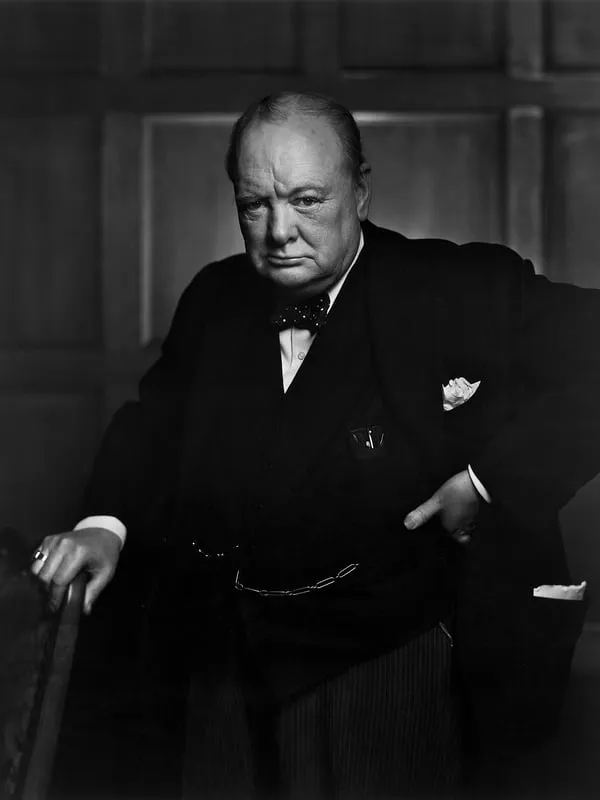
- Born:
- 30 November 1874, Blenheim Palace, Woodstock (England)
- Died:
- 24 January 1965, London
- Author:
- Łukasz Skowroń
- Photo:
- Flickr: Sir Winston Churchill, domena publiczna, Wikimedia Commons

Winston Churchill entered the war as one of the youngest, most energetic and most controversial members of H. H. Asquith’s government. As First Lord of the Admiralty, the minister responsible for the Royal Navy, he prepared the fleet for war even before it was declared, went to defend Antwerp, supported work on the tank and, above all, was the chief advocate of the Dardanelles expedition. Its failure cost him the Admiralty in May 1915 and his seat in the government in the autumn. For several months he commanded a battalion in the trenches of Flanders, and in 1917 he returned to power as Minister of Munitions. The war, which nearly ended his career, shaped his thinking about strategy for the rest of his life.
Before the war
He was born on 30 November 1874 at Blenheim Palace, the seat of the Dukes of Marlborough, the son of the Conservative politician Lord Randolph Churchill and the American Jennie Jerome. After cadet school at Sandhurst he served in the cavalry in Cuba, India and the Sudan, where in 1898 he took part in the Battle of Omdurman. During the Boer War, as a war correspondent, he was taken prisoner and escaped, which made him famous. In 1900 he entered the House of Commons as a Conservative, but in 1904, in the dispute over free trade, he crossed over to the Liberals. The Conservatives never forgave him.
He rose quickly in the Liberal governments: in 1908 he became President of the Board of Trade, in 1910 Home Secretary, and in October 1911, after the Agadir Crisis, First Lord of the Admiralty. He created a naval war staff, developed naval aviation, switched new ships from coal to oil and in 1914 pushed through the state purchase of a majority shareholding in the Anglo-Persian Oil Company to secure fuel for the fleet. His informal adviser was the retired Admiral John Fisher, creator of the dreadnought.
July 1914: “the fleet was ready”
In the summer of 1914, instead of the annual manoeuvres, Churchill held a test mobilisation, which allowed the reserve ships to be fully manned as well. When Austria-Hungary rejected Serbia’s reply, the First Sea Lord, Prince Louis of Battenberg, kept the fleet ready on 26 July, and Churchill, on his return to London, fully endorsed the decision. On 28 July he ordered the First Fleet to move to its base at Scapa Flow, on 29 July he persuaded the government to send the warning telegram, and on the evening of 1 August, although the Cabinet had refused him that morning, he ordered the mobilisation of the fleet, taking responsibility for it before the Prime Minister. He also seized two battleships being built in England for Turkey, which provoked a wave of indignation in Constantinople. Among the divided ministers he was one of the few who believed from the start that Britain must stand by France.
1914: Ostend, Heligoland, Antwerp
The first months of the war showed both his energy and his tendency to meddle in everything. At the end of August he sent the marines to Ostend to distract the Germans, backed the plan for a raid that ended in victory at the Battle of Heligoland Bight, and in September took over responsibility for the country’s air defence. After the sinking of three old cruisers by U-9 the press accused him of needlessly risking ships, although a few days earlier he himself had recommended withdrawing them.
The most notorious episode was Antwerp. On 3 October Churchill came to the besieged fortress, persuaded King Albert I and the Belgian government to halt the evacuation and brought in the marines, followed by two poorly trained naval brigades. On 5 October he offered the Prime Minister to resign his office and take command at Antwerp, which was received in London with astonishment. The fortress fell on 10 October, and a large part of the Naval Division was taken prisoner or interned in the Netherlands. Critics wrote of an irresponsible adventure; Churchill and his defenders argued that the few days gained at Antwerp allowed the Belgian army to escape to the Yser and the Allies to hold the Channel ports.
At the end of October, under pressure from anti-German feeling, he asked Battenberg to step down and brought in Fisher in his place. The pairing of two strong, impetuous men caused concern from the outset.
The Dardanelles
On learning that Turkey had entered the war, Churchill ordered the forts at the entrance to the Dardanelles to be shelled, which, according to many historians, merely warned the Turks. As early as November he spoke in the War Council of a strike at the Gallipoli peninsula, and when at the beginning of January 1915 Grand Duke Nicholas asked for help, he asked Vice-Admiral Sackville Carden whether the straits could be forced by ships alone. He received Carden’s plan with enthusiasm. On 13 January the War Council instructed the Admiralty to prepare an expedition, and on 28 January the final decision was taken, despite Fisher’s growing doubts. Churchill promised that the appearance of battleships off Constantinople would knock Turkey out of the war, open the way to Russia and bring the Balkan states over to the Entente.
The naval attack began on 19 February and on 18 March, after several battleships had been sunk by mines, it stalled. Churchill argued at length with Lord Kitchener over the 29th Division, without which the army could not support the fleet. When on 25 April troops landed at Gallipoli, the campaign turned into a bloody deadlock. On 15 May Fisher walked out of the Admiralty, accusing the First Lord of being impossible to dissuade from forcing the Dardanelles. The crisis over the admiral’s resignation and the simultaneous shell scandal brought down the purely Liberal government. The Conservatives set a condition for joining the coalition: Churchill had to leave the Admiralty.
At the end of May 1915 he handed over the office to Arthur Balfour and became Chancellor of the Duchy of Lancaster, a post with almost no duties. He still sat on the Dardanelles Committee and defended the expedition to the end. When a smaller War Committee was formed at the beginning of November, he was left out of it. He resigned and on 15 November made a speech in the House of Commons in which he argued that the attack on the Dardanelles had been a naval plan, prepared and approved by the admirals, and not the idea of a “civilian amateur”. A few days later he left for France.
Tanks
At the same time, on the margins of high politics, Churchill played a role that even his critics acknowledge. In February 1915 he set up a committee on “landships” at the Admiralty and on his own initiative financed its work from naval funds. The British official history admits that it was above all to his energy that the overcoming of resistance to the new weapon was owed. When in September 1916 tanks went into battle for the first time at Flers-Courcelette, Churchill, then out of office, was among those who believed that a great secret had been wasted on a few dozen machines.
In the trenches of Flanders
At the end of 1915 the 41-year-old former minister, with the rank of major, joined the 2nd Battalion of the Grenadier Guards for a few weeks to learn about life in the trenches. Field Marshal John French, an old acquaintance, promised him a brigade, but in London this was considered too much for a politician with no experience of command. On leaving his post, French asked his successor, General Douglas Haig, to give Churchill at least a battalion, and Haig agreed. In January 1916, as a lieutenant-colonel, he took command of the 6th Battalion of the Royal Scots Fusiliers, which held a sector of the front near Ploegsteert in Belgian Flanders. For three months the battalion endured shellfire but took part in no major battle. Churchill looked after his men, fought lice and went out into no man’s land many times. In May 1916, when the weakened battalion was merged with another, he returned to London and to the House of Commons.
For the next year he remained outside the government. On 1 August 1916 he circulated a memorandum to ministers arguing that the Somme offensive was costing too much in relation to its gains. He defended himself before the commission investigating the conduct of the Dardanelles expedition, which in its 1917 report criticised the way decisions had been taken in the War Council but did not lay the sole blame on him. When in December 1916 David Lloyd George became Prime Minister, Churchill did not join the government, because the Conservatives still saw him as the culprit of Gallipoli.
Minister of Munitions
Lloyd George brought him back in the summer of 1917. On 17 July Churchill became Minister of Munitions, at the head of a department created two years earlier by the Prime Minister himself. He reorganised its swollen administration, calmed strikes in the armaments factories and in 1918 increased the production of guns, aircraft and tanks, convinced that the war would be won by machines and not by further infantry attacks. He travelled to France many times and visited the front. He no longer had direct access to strategic decisions, however.
After the war
On 10 January 1919 he became Secretary of State for War and Air. He took charge of demobilisation, which he reorganised after mutinies among the soldiers, and was the most outspoken advocate in the government of intervention against the Bolsheviks in Russia. He then headed the Colonial Office, and in 1924, having drawn closer to the Conservatives again, he became Chancellor of the Exchequer in their government and held the post until 1929. Between 1923 and 1931 he published a multi-volume history of the war, “The World Crisis”. After years on the political margins, in May 1940 he became Prime Minister and led Britain through the Second World War. He died in London on 24 January 1965.
Assessment
For a long time Churchill in the First World War was regarded above all as the man of the Dardanelles. To his critics, from the Conservatives of the day to some modern historians such as Robin Prior, he was a minister who, with insufficient military knowledge, imposed on the admirals and the government an operation that could not be carried out by the fleet alone, and then drew the country into a land campaign that cost tens of thousands of lives. He was also accused of impulsiveness and of running the fleet over the heads of professional officers, of which Antwerp and the quarrel with Fisher were said to be examples.
His defenders stress that the final decisions were taken by the whole War Council, and that the admirals who kept silent at its meetings and Kitchener, who delayed sending troops, bear at least equal responsibility. They point out that Churchill rightly recognised the futility of frontal attacks in the west and looked for another way out of the deadlock, and that the preparation of the fleet in July 1914, the support for tanks and the work at the Ministry of Munitions were lasting achievements. Churchill himself defended his case in “The World Crisis”, an outstanding but partisan book. The barbed remark attributed to Balfour, that it was Winston’s autobiography disguised as a history of the universe, captures well how his opponents received it.
Sources
Spotted a mistake?Report an error
Mentioned in battles
(07)Often appears with
People who appear in the same events.
On the timeline
(56)The 40 most important of 56 events. All tagged “Winston Churchill” (19) →
1914
1915
January
February
March
- 04
- France sends a corps to the DardanellesIn early March 1915 General d'Amade's Orient Expeditionary Corps, a French division for the Dardanelles, sailed from ports in France and North Africa.
- Sinking of U-8On 4 March 1915 British destroyers destroyed the German submarine U-8 in the Strait of Dover after it had been detected thanks to indicator nets.
April
May
- 28
- Arthur Balfour becomes First Lord of the AdmiraltyIn late May 1915 the former prime minister Arthur Balfour replaced Churchill at the Admiralty. He was the only Conservative with real influence on the war.
- Henry Jackson becomes First Sea LordAt the end of May 1915 Admiral Henry Jackson, a wireless pioneer and planner of overseas expeditions, succeeded Fisher as professional head of the Royal Navy.