1914: The Belgian Army and the defence of Antwerp
Siege of Antwerp
- Dates:
- 27 September – 10 October 1914
- Front:
- Western Front
- Location:
- Antwerp and its rings of forts, BelgiumOn the battle map →
- Sides:
- BelgiumAlbert I, Victor DeguiseUnited KingdomArchibald ParisGerman EmpireHans von Beseler
- Result:
- German victory. The fortress capitulated on 10 October, but Belgium's field army withdrew westwards and took up the defence on the Yser.
- Author:
- Natalia
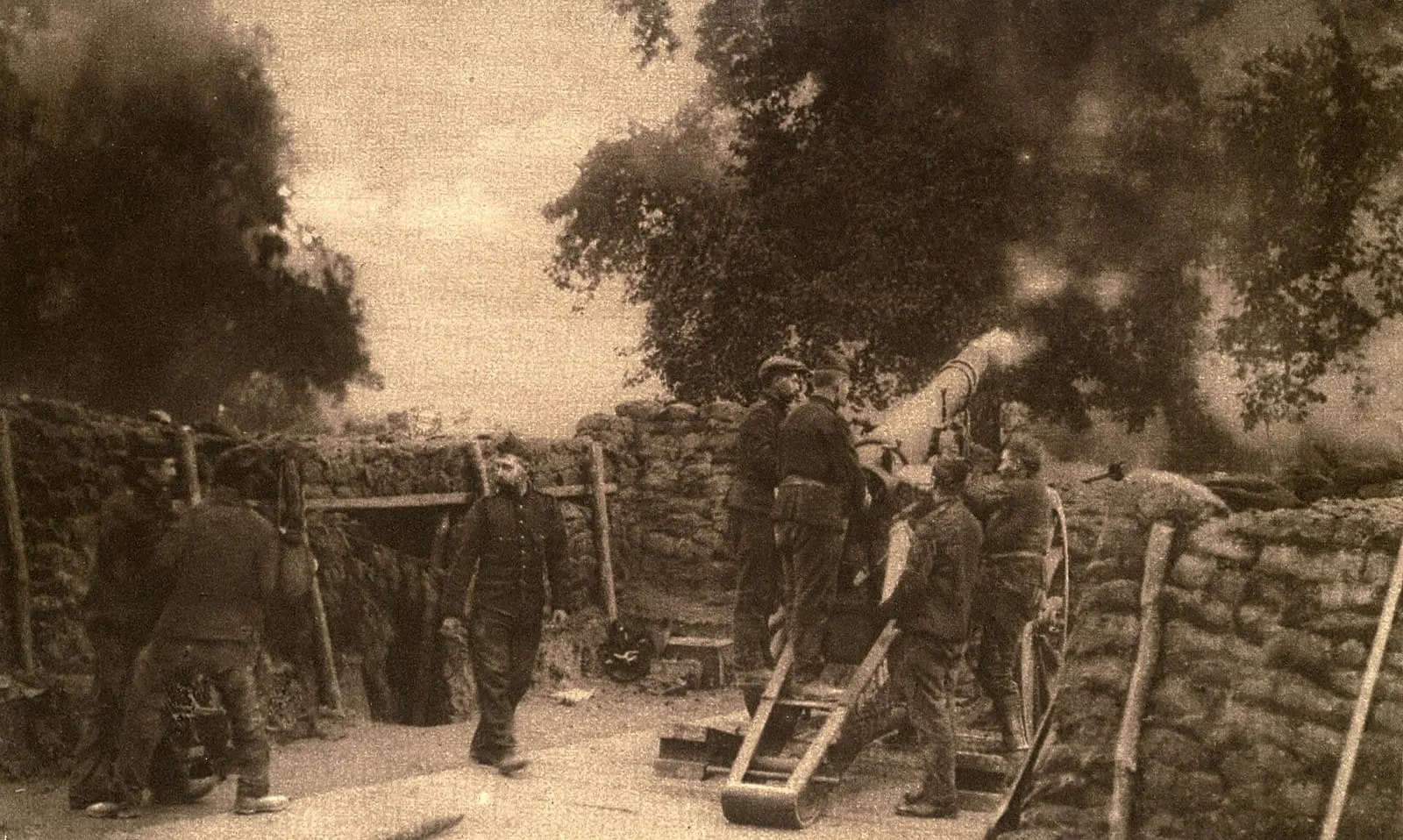
The siege of Antwerp, which lasted from 27 September to 10 October 1914, ended the struggle for Belgium’s last fortress. The German troops of General Hans von Beseler, supported by the heaviest siege artillery, smashed the outer ring of forts in less than two weeks and forced the city to capitulate. The Belgian army, whose destruction was the Germans’ main aim, nevertheless managed to withdraw and soon took up the defence on the river Yser.
The national redoubt
Antwerp, Belgium’s largest port, had been its national redoubt since the middle of the 19th century. The Belgian defence plan assumed that in the event of invasion the army, the government and the king would take refuge in this fortress and hold out there until the powers guaranteeing the country’s neutrality came to their aid. The city was surrounded by two rings of fortifications. The inner one, built in the 1860s to a design by General Henri Alexis Brialmont, ran a few kilometres from the centre. The outer one, built from the 1880s and still being extended just before the war, consisted of more than a dozen forts and numerous redoubts 10–15 kilometres from the city. The defences were completed by the rivers Nete and Rupel and by ground that could be flooded.
The fortress was considered one of the strongest in Europe. August 1914 showed, however, that forts built with older artillery in mind could not withstand the fire of modern siege mortars. The forts of Liège and Namur fell within a few days. The modernisation of Antwerp had not been completed in time.
The army in the fortress
After the Battle of the Gete the Belgian army withdrew to Antwerp and from 20 August based itself on its forts. It was commanded in person by King Albert I, and the fortress by its military governor, General Victor Deguise. Figures for the number of defenders vary. The British website greatwar.co.uk estimates the field army at about 65,000 soldiers and the fortress garrison at about 80,000. Other studies put the field army higher, at over 80,000. Many of the soldiers were poorly trained, and the artillery of the forts could not match the range of the German siege guns.
The Belgians did not wait passively for the siege. From the end of August the field army sortied from the fortress several times and struck at the German units watching Antwerp. The first sortie led to the Battle of Mechelen; the second, on 9–13 September, coincided with the Battle of the Marne. These sorties forced the Germans to keep considerable forces in Belgium.
The decision to take the fortress
After the retreat from the Marne the German Supreme Army Command concluded that the Belgian army in Antwerp posed too great a threat to the communications of the armies fighting in France. The new Chief of the General Staff, Erich von Falkenhayn, ordered the fortress to be taken. The task went to General von Beseler, a military engineer and fortifications expert who since August had commanded the troops watching Antwerp.
Beseler’s forces consisted of the III Reserve Corps, a naval division, replacement units and Landwehr brigades. According to some studies they numbered about 66,000 soldiers, although estimates differ. In infantry, therefore, they did not outnumber the defenders. The outcome of the siege was to be decided by the artillery. After the capitulation of Maubeuge on 7 September the Germans moved a heavy siege train to Antwerp, including Krupp 420 mm mortars known as Big Bertha, Austro-Hungarian Škoda 305 mm mortars and dozens of 150 mm and 210 mm howitzers and mortars.
Beseler decided not to encircle the whole fortress, but to strike at its south-eastern sector, between Mechelen and Lier. Once the ring of forts had been broken and the Nete crossed, his guns would be able to reach the city itself.
Course of the siege
27–28 September. The Germans moved forward, pushing back the Belgian outposts in front of the line of forts. On 28 September they occupied Mechelen and began the bombardment. The first targets were the forts of Walem and Sint-Katelijne-Waver and the neighbouring redoubts. The 305 mm and 420 mm shells pierced the concrete vaults and destroyed armoured cupolas and ammunition magazines.
29 September – 2 October. Within a few days Sint-Katelijne-Waver became unfit for defence, and Walem and the fort at Koningshooikt were badly damaged. On 1 October the German infantry attacked the sector between the forts. During the night of 1–2 October Sint-Katelijne-Waver and the Dorpveld redoubt fell, and on 2 October Walem and the Bosbeek redoubt. Fort Lier came under fire. The Belgian divisions defending this sector withdrew behind the Nete. The Belgian government began preparing to evacuate to Ostend.
3–4 October. News of the planned evacuation alarmed London. The loss of Antwerp meant that the Germans would draw closer to the Channel coast. On 3 October the First Lord of the Admiralty, Winston Churchill, arrived in the city. He persuaded the Belgians to hold out for a few more days and promised reinforcements. On 4 October the Royal Marine Brigade arrived, about 2,000 men, some of whom had been brought from the coast in requisitioned London buses. It took up positions on the Nete near Lier.
5–6 October. Churchill became so involved in the defence that on 5 October he proposed to the Prime Minister, H. H. Asquith, that he resign his office and take command in Antwerp. The offer was not accepted. During the night of 5–6 October the Germans crossed the Nete, and Belgian counter-attacks failed to throw them back. On 6 October two naval brigades arrived, made up mostly of young, almost untrained recruits. Among them was the poet Rupert Brooke, a sub-lieutenant in the Anson Battalion. The two brigades, together with the marines, formed the Royal Naval Division under the command of General Archibald Paris. On 6–8 October the British 7th Division and 3rd Cavalry Division landed at Zeebrugge and Ostend to cover the retreat from Antwerp.
6–8 October. King Albert decided that the field army would leave the fortress. During the night of 6–7 October its divisions began crossing the Scheldt to the west bank and marching towards Ghent. The defence of the inner ring of forts was taken over by the fortress garrison and the British sailors. On 7 October the government left for Ostend. Late that evening the German guns began shelling the city itself. The inhabitants fled in their thousands westwards and into the neighbouring Netherlands. On the evening of 8 October the British received the order to retreat.
9–10 October. The retreat of the Royal Naval Division was chaotic. Orders did not reach all units in time, and part of the 1st Brigade, cut off by the Germans, crossed the Dutch border. On 9 October the Germans found the forts of the inner ring abandoned and entered the city. The burgomaster, Jan De Vos, negotiated the terms of the city’s surrender at Kontich in order to spare it further bombardment. On 10 October General Deguise, who was in Fort Sainte-Marie on the left bank of the Scheldt, surrendered to the Germans. That day the fortress formally capitulated.
Retreat to the Yser
Belgium’s field army escaped the trap. The Germans tried to cut off its route by advancing towards Lokeren and the Dutch border, but the Belgian divisions, covered by the British 7th Division and the French naval fusiliers at Ghent, managed to withdraw along the coast. In mid-October they took up positions on the river Yser, in the last strip of unoccupied Belgium. There, in the Battle of the Yser, together with the French they halted the German offensive and held out until 1918.
Losses
The exact losses of the defenders are not known. According to various sources the Germans took about 30,000 Belgian soldiers prisoner, mainly from the fortress garrison. Another 30,000–40,000 or so crossed the Dutch border and were interned in the neutral Netherlands until the end of the war. According to British figures the Royal Naval Division lost several dozen killed and over a hundred wounded. Nearly 1,000 sailors were taken prisoner by the Germans, and about 1,500 were interned in the Netherlands, mainly in the camp at Groningen, which they jokingly called “HMS Timbertown”. German losses are not precisely known either.
The siege set off a huge wave of refugees. It is estimated that in 1914 about a million civilians left Belgium, fleeing to the Netherlands, Britain and France. Many inhabitants of Antwerp returned after a few weeks, but some remained in exile until the end of the war.
Significance
The fall of Antwerp was a heavy blow for Belgium. The country lost its largest port and almost all of its territory. The Germans removed the threat to their rear and freed Beseler’s corps for further operations. The troops that had taken Antwerp soon moved west and took part in the fighting on the Yser and at Ypres.
Most important of all, however, was that the Belgian army survived. Had it been shut up and destroyed in Antwerp, there would have been no troops on the Yser to bar the Germans’ way to Dunkirk and Calais. Churchill’s expedition was sharply criticised in Britain. He was accused of sending untrained recruits into battle and losing a large part of the division, mainly through internment and captivity. His defenders pointed out that prolonging the defence by a few days had helped the Belgian army to withdraw and the Allies to hold the Channel ports. The historians’ dispute over the sense of this operation continues to this day.
Spotted a mistake?Report an error