Germany · The Central Powers
Hans von Beseler
Governor-General of Warsaw (1915–1918), colonel general
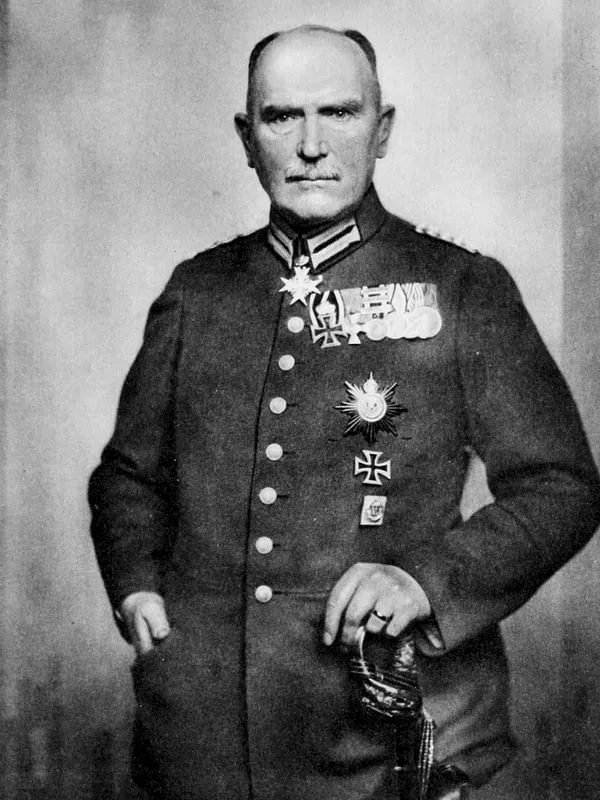
- Born:
- 27 April 1850, Greifswald (Germany)
- Died:
- 20 December 1921, Neubabelsberg near Potsdam
- Author:
- Natalia
- Photo:
- Nicola Perscheid, domena publiczna, Wikimedia Commons

Hans Hartwig von Beseler left his mark on the history of the First World War twice. First as a fortress specialist who in 1914 took Antwerp in less than two weeks, and in 1915 Novogeorgievsk, today’s Modlin, in a week. Then as the German Governor-General in Warsaw, who for more than three years ruled the occupied part of the Kingdom of Poland. It was he who on 5 November 1916 read out at the Royal Castle the manifesto announcing the creation of a Kingdom of Poland, and he who tried to build a Polish army at Germany’s side. His plan failed: the Poles did not want to fight for the Central Powers, and in November 1918 Beseler had to flee Warsaw in disguise.
Before the war
He was born on 27 April 1850 in Greifswald in Pomerania, into the family of a well-known jurist, Professor Georg Beseler. His brother Max later became Prussian Minister of Justice. In 1868 he joined the Guards Pioneer Battalion, with which he went through the Franco-Prussian War. He graduated from the War Academy, served on the General Staff and in the Prussian War Ministry, and in 1899 became one of the quartermasters of the General Staff. He was regarded as a candidate to succeed Alfred von Schlieffen, but in 1904, when he was also ennobled, he was appointed Inspector General of Fortresses and at the same time of the engineer and pioneer troops. He was one of the leading experts on fortification in the German Army. A few years before the war, as a General of the Infantry, he retired, and from 1912 he sat in the Prussian House of Lords.
Antwerp and the Yser
When war broke out, the 64-year-old Beseler returned to service as commander of the III Reserve Corps in the First Army of Alexander von Kluck. When the main German forces set off for France, his corps remained in Belgium to watch the Belgian Army, which had taken refuge in the fortress of Antwerp. At the end of August he repulsed its sorties in the Battle of Mechelen.
In September the German Supreme Army Command decided to take Antwerp and entrusted the task to Beseler. His forces, made up of reserve divisions, a naval division, depot units and Landwehr brigades, numbered about 66,000 men according to some accounts. Beseler did not try to surround the whole extensive fortress. On 27 September he began the siege with a blow against its south-eastern sector, between Mechelen and Lier, and smashed one fort after another with the fire of the heaviest mortars. As early as 10 October the city capitulated. The victory was a great propaganda success, but an incomplete one: the Belgian Army of King Albert I managed to withdraw to the west.
Beseler’s corps set off after it, on 15 October reached the coast near Ostend and became part of the new Fourth Army of Duke Albrecht of Württemberg. In the Battle of the Yser it attacked on the sector from the sea to Diksmuide, but the Belgians and French held on behind the river, and the Belgians’ opening of the sluices and flooding of the ground in front stopped the German attack. By December 1914 his corps was already fighting in Poland, in the Battle of the Bzura.
Novogeorgievsk
In the summer of 1915, during the great offensive of the Central Powers in the east, Beseler was given the task of taking Novogeorgievsk, the largest fortress of the Russian Empire, at the confluence of the Narew and the Vistula. He arrived before it on 20 July. His group, numbering about 80,000 men according to various figures, consisted mainly of Landwehr and Landsturm units, but had the heaviest German and Austro-Hungarian mortars at its disposal. Beseler again concentrated his blow on a single sector, the north-eastern forts fell within a few days, and on 20 August the fortress commandant, General Nikolai Bobyr, signed the capitulation. According to various figures, 80,000–90,000 Russians went into captivity. That same day Emperor Wilhelm II came to the fortress to thank Beseler and his soldiers.
Governor-General of Warsaw
At the end of August 1915 the Germans created the Government General of Warsaw in the part of the Kingdom of Poland they had occupied, and Beseler became its head. The southern part of the Kingdom was occupied by the Austrians, with a governor-general in Lublin. Beseler took up residence in the Royal Castle and from the outset combined harsh occupation with gestures towards the Poles. In September he dissolved the Central Citizens’ Committee, which had run the city after the Russians left, but as early as 15 November 1915 the Polish-language University of Warsaw and Warsaw University of Technology were opened, something the tsarist authorities had refused for decades. He was helped with their opening by Count Bogdan Hutten-Czapski, a Pole in German service and his close collaborator. In April 1916 Beseler incorporated the suburban communes into Warsaw, more than tripling the city’s area, and in the summer a City Council was elected.
The other side of the occupation was painful. The Germans requisitioned food, raw materials and machinery and shipped them to the Reich, and Warsaw went hungry. In October 1916 Beseler issued a decree that allowed men of working age to be forced to work, and the recruitment of workers for Germany increasingly took the form of compulsion.
In memoranda of 1915–1916 Beseler argued to Berlin that a Polish state should be created, linked to Germany politically, economically and militarily, with an army fighting at the Reich’s side. At the same time he demanded the annexation to Prussia of a border strip along the line of the Narew and the Biebrza, which he considered essential for the defence of East Prussia. In the summer of 1916 Erich Ludendorff, who was counting on Polish recruits, also came out in favour of the rapid creation of a Polish state.
The Act of 5 November and the Polish army
At noon on 5 November 1916, in the Great Hall of the Royal Castle, Beseler read out the manifesto of the two emperors, which announced the creation from the lands of the Kingdom of “an independent state with a hereditary monarchy and a constitutional system”. The Act of 5 November was the first promise of a Polish state made by the great powers since the partitions. Replying to expressions of thanks, Beseler said he hoped soon to see a Polish army fighting alongside the Central Powers. Four days later, together with the Austro-Hungarian governor-general, he called on Poles to volunteer. The call to arms, before any Polish government had been formed, provoked indignation, and few volunteers came forward.
In December Beseler and Kuk established the Provisional Council of State, a Polish advisory body on which Józef Piłsudski also sat. In April 1917 Austria-Hungary placed the Polish Auxiliary Corps, the former Legions, under Beseler’s command, and the Governor-General himself became commander-in-chief of the Polish Armed Forces then being formed. Piłsudski, however, demanded a Polish government first, and when in July the legionnaires were to swear loyalty to both emperors, most of them refused. The oath crisis wrecked Beseler’s plan. On 22 July the Germans arrested Piłsudski and took him to Magdeburg, and the legionnaires who had refused the oath were locked up in camps.
The Regency Council and the end
In the autumn of 1917 Beseler helped create a new façade of Polish statehood. The patent of 12 September announced a Regency Council, which took power on 27 October at a ceremony attended by both governors-general. The occupiers, however, kept control of the army, foreign policy and legislation, and Beseler repeatedly clashed with the regents, for example over the choice of prime minister. In January 1918 he was promoted to colonel general. A month later the Treaty of Brest-Litovsk with Ukraine, which gave it the Chełm Land, provoked a wave of protests in the Kingdom, and Beseler imposed a levy on Warsaw.
In the autumn of 1918, when Germany’s defeat was already clear, on 18 October he recognised the Regency Council’s authority over the army, and on 24 October he resigned as its commander-in-chief. On 10 November Piłsudski returned from Magdeburg to Warsaw, and the next day Polish soldiers and members of the Polish Military Organisation began disarming the German garrison, in which soldiers’ councils had already taken over. Beseler, fearing his own revolutionised soldiers, slipped out of Warsaw on the evening of 12 November disguised as a worker, by boat down the Vistula to Thorn, accompanied by two adjutants and two Polish officers whom Piłsudski had assigned to him.
After the war
In Germany he faced attacks from conservatives and nationalists, who accused him of excessive leniency towards the Poles and of sharing responsibility for the loss of the eastern territories. In Poland, on the other hand, he was remembered as a Prussian occupier. He died on 20 December 1921 in Neubabelsberg near Potsdam, according to contemporaries a broken man. He was buried in the Invalidenfriedhof in Berlin.
Assessment
As a commander, Beseler achieved two of the German Army’s most spectacular successes in the first year of the war and showed that modern heavy artillery could break within days fortresses built for long sieges. At Antwerp, however, he did not achieve his main objective, because the Belgian Army slipped out of the fortress, and Novogeorgievsk, abandoned by the retreating Russian field armies, was already doomed to a lonely defence by the time it was besieged.
His rule in Warsaw is judged ambiguously. Polish and German historians, among them Arkadiusz Stempin, describe it as an attempt at the “moral conquest” of the Poles: the opening of the universities, municipal self-government and the promise of a state were meant to win them over to Germany and give the Central Powers Polish soldiers. Beseler sincerely believed in this project and defended it against supporters of more far-reaching annexations, but his Polish state was to be permanently subordinate to the Reich, shorn of the border strip and deprived of the lands of the Prussian partition. Requisitions, forced labour and hunger, meanwhile, cost him the support even of those Poles who were inclined to cooperate with the Germans. Princess Maria Lubomirska, the wife of one of the regents, wrote of him that he was a good man full of good intentions but did not know how to govern, and that history would remember him as the conqueror of Antwerp and Modlin.
Sources
Spotted a mistake?Report an error
Commanded in battles
(06)- 25–27 August 1914Battle of MechelenWestern Front
- 15 September – 19 October 1914Race to the SeaWestern Front
- 27 September – 10 October 1914Siege of AntwerpWestern Front
- 16 October – 10 November 1914Battle of the YserWestern Front
- 30 November – 17 December 1914Battle of the BzuraEastern Front
- 9–20 August 1915Siege of NovogeorgievskEastern Front
Often appears with
People who appear in the same events.