Poland · The Polish cause
Józef Ostrowski
Member of the Regency Council of the Kingdom of Poland (1917–1918)
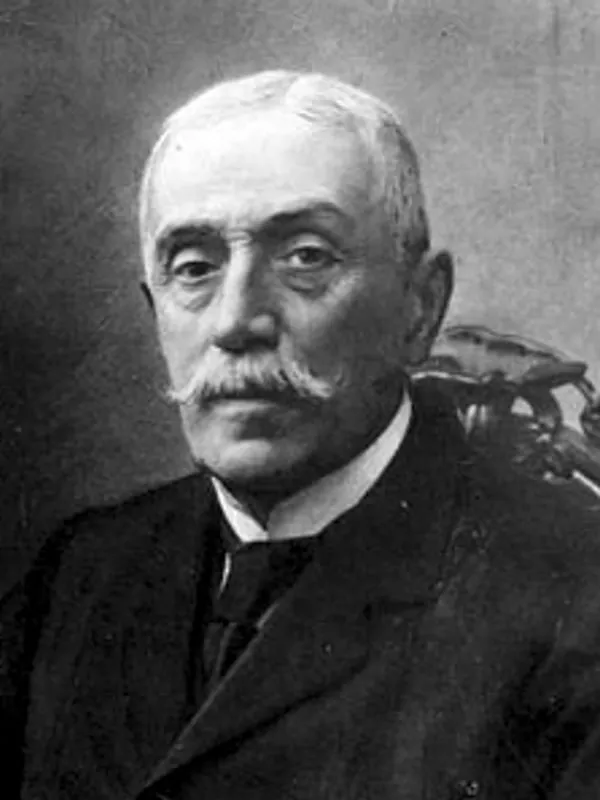
- Born:
- 21 January 1850, Maluszyn (Kingdom of Poland)
- Died:
- 20 June 1923, Maluszyn
- Author:
- Łukasz Skowroń
- Photo:
- autor nieznany, domena publiczna, Wikimedia Commons

Józef Ostrowski was the least known of the three regents of the Kingdom of Poland. Alongside Archbishop Aleksander Kakowski and Prince Zdzisław Lubomirski, he represented the landed gentry and the conservatives on the Regency Council. A wealthy owner of estates on the Pilica, a lawyer by training, co-founder and president of the Party of Real Politics (PL), he believed all his life in a policy of gradual concessions won from the partitioning powers. He joined the Council as a compromise candidate, at the age of 67. He did not speak at rallies or push himself forward, but together with the Council’s secretary he wrote most of its manifestos. It was in his Warsaw apartment that on 11 November 1918 the regents handed military authority over to Józef Piłsudski.
Before the war
He was born on 21 January 1850 in Maluszyn, the family estate of the Ostrowskis of the Korab coat of arms, the third of five children of Aleksander Ostrowski, president of the Land Credit Society, and Helena née Morsztyn. He finished the gymnasium in Warsaw and studied law at the Warsaw Main School and the Imperial University of Warsaw, completing it in 1870 with the degree of candidate of law. He continued his studies in Germany, attending lectures at the university in Berlin and at the agricultural faculties in Halle and Hohenheim. He was a district judge in Piotrków and was active in the Land Credit Society, of which, like his father before him, he was president in Kalisz. From 1896 he owned Maluszyn, where he ran a large farm with processing plants.
At first he engaged in politics in the quiet of the drawing room. According to Jan Molenda, the author of his entry in the Polish Biographical Dictionary, he belonged to an influential group of Polish landowners, industrialists and bankers who from the 1890s tried, through personal contacts with the Russian aristocracy and dignitaries, to persuade St Petersburg to soften its policy of Russification. In 1899 he joined the editorial board of the conservative daily Słowo, and in 1905 the Party of Real Politics grew out of the circle around that newspaper. Ostrowski became its president. The party, popularly known as the party of the “conciliators”, brought together landowners and conservative liberals and sought to win autonomy for the Kingdom, rights for the Polish language in offices and Polish schools through lawful cooperation with the Russian authorities. The left regarded this as betrayal.
In 1906–1910 Ostrowski sat on the Russian State Council, the upper house of the Empire’s parliament, where he chaired the Polish Circle. After 1910 he gave up his seat and limited his activity, probably for health reasons. His biographer Karolina Studnicka-Mariańczyk writes that he regained his energy only after the Russians withdrew from Warsaw in 1915.
Regent
In August 1917, after the oath crisis, the Provisional Council of State resigned, and the patent of 12 September transferred supreme authority in the Kingdom to a three-member Regency Council. Two names, Kakowski’s and Lubomirski’s, came up from the start. The third place was disputed. The candidacy of the Marshal of the Provisional Council of State, Wacław Niemojowski (PL), collapsed in the face of opposition from the moderate groups and the left, and Count Adam Tarnowski declined the office. On 2 September, at a confidential meeting with former members of the Provisional Council of State, Lubomirski put forward Ostrowski’s candidacy. It was also accepted by the passivists (PL), the supporters of the Entente, who had earlier rejected Niemojowski. On 18 September the Transitional Commission (PL) unanimously presented the three candidates to the occupiers, and on 15 October Berlin and Vienna approved the regents. That evening the audience at the Grand Theatre gave Lubomirski and Ostrowski an ovation. On 27 October the regents took their oath in the cathedral and assumed power at the Royal Castle.
On the Council Ostrowski was a backroom politician. Studnicka-Mariańczyk stresses that he was not one of those who sway crowds; he preferred talks in the quiet of the study and drafting statutes, appeals and programmes. This skill proved very useful on the Council: together with its secretary general, the prelate Father Zygmunt Chełmicki (PL), he was the author of most of its manifestos. The very first proclamation, of 27 October 1917, announced the building of a state “with a strong government and its own armed force” and invoked the tradition of the Constitution of 3 May. According to historians, Lubomirski showed the most initiative on the Council. Studnicka-Mariańczyk notes, however, that Ostrowski’s legal knowledge was particularly useful to him in his work as regent.
Ostrowski signed all the most important acts of the regency. In October and November 1917 the Council lost its dispute with Berlin over Tarnowski and appointed Jan Kucharzewski prime minister. In February 1918, after the Brest-Litovsk peace with Ukraine, the regents considered stepping down, but in the end on 13 February they issued a manifesto in which they protested against the “new partition” and announced that from then on they would exercise power “relying on the will of the Nation”. On 7 October 1918, when Germany and Austria-Hungary had asked President Wilson for an armistice, the Council issued the manifesto “To the Polish Nation” announcing an independent, united Poland with access to the sea.
November 1918
At the beginning of November the regents’ authority was very weak. On 4 November they dismissed the government of Józef Świeżyński, which the day before had renounced its obedience to them, and in Lublin a people’s government was formed that did not recognise them. On 10 November Piłsudski returned from Magdeburg and met the regents that same day. On the evening of 11 November the Council met in the Warsaw apartment of the ailing Ostrowski. At about eight o’clock Piłsudski joined them, and the regents handed him military authority and the supreme command. Three days later, on 14 November, they signed the act dissolving the Council and transferred all supreme authority to Piłsudski. The act stated that the division of power established on 11 November “cannot continue without harm to the emerging Polish State”.
After the war
After the Council was dissolved Ostrowski withdrew from politics and returned to Maluszyn. He never married and was the last male representative of the Maluszyn line of the Ostrowskis. He died in the manor house there on 20 June 1923. The estate passed to Henryk Potocki of Koniecpol.
Assessment
In historiography Ostrowski remains in the shadow of Kakowski and Lubomirski, and his role is hard to pin down because he worked behind the scenes. For the left and for Piłsudski’s camp he was, like the whole Regency Council, a representative of the conservative elites who had cooperated with the occupier. His earlier conciliatory activity towards Russia, and the fact that, according to some authors, even before the war he had begun to lean towards the Austrian and German orientation, reinforced this image.
Some historians judge him more leniently today. Paweł Rzewuski, writing in Teologia Polityczna, regards the Regency Council as a rare example of political realism in Polish history and writes that Ostrowski played a very important, though low-profile, role in it. According to Rzewuski, the reborn state owed the foundations of its legal system largely to his work. Studnicka-Mariańczyk sees him as a continuer of the political thought of Aleksander Wielopolski, for whom membership of the Regency Council was the crowning of his career. Ostrowski, who for decades had sought concessions from the partitioning powers, lived to sign an act announcing an independent Poland and then to hand power to its first leader.
Sources
Spotted a mistake?Report an error
Often appears with
People who appear in the same events.