Poland · The Polish cause
Aleksander Kakowski
Metropolitan Archbishop of Warsaw (1913–1938), member of the Regency Council of the Kingdom of Poland (1917–1918)
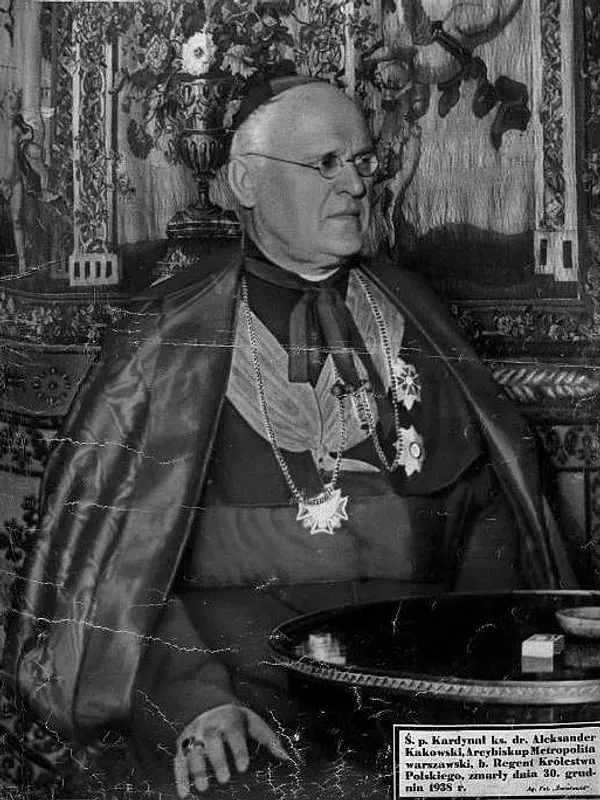
- Born:
- 5 February 1862, Dębiny near Przasnysz (Russian Empire)
- Died:
- 30 December 1938, Warsaw
- Author:
- Natalia
- Photo:
- autor nieznany, domena publiczna, Wikimedia Commons

During the Great War Aleksander Kakowski was the most important churchman in the Kingdom of Poland and one of the three regents who in 1917–1918 exercised the highest Polish authority in Warsaw. He became Archbishop of Warsaw in 1913 with the consent of the Tsarist government and for the first year of the war stood loyally by Russia. When the Germans took Warsaw in 1915, he stayed in the city and throughout the three years of occupation was one of the few undisputed authorities for the Poles. In 1917, reluctantly and after long hesitation, he joined the Regency Council set up by Berlin and Vienna. A year later that same council proclaimed Poland’s independence, and in November 1918 it handed power to Józef Piłsudski. Kakowski remained archbishop, and in 1919 he was made a cardinal.
Before the war
He was born on 5 February 1862 in Dębiny near Przasnysz, into a farming family of the minor gentry. His father had fought in the January Uprising. He finished the gymnasium in Pułtusk and then the theological seminary in Warsaw, the Theological Academy in St Petersburg and studies in Rome. According to Polish biographers, when leaving for Rome he had to hide from the Russian authorities, who obstructed clergy’s contacts with the Holy See. He was ordained priest in 1886. For many years he taught at the Warsaw seminary and headed it as rector, and in 1910 he became rector of the Theological Academy in St Petersburg, the only Catholic theological college in Russia.
In that post he made his name as a cautious cleric who avoided conflicts with the authorities. That is why in 1913, when the archdiocese of Warsaw had to be filled after the death of Archbishop Wincenty Popiel, the Russian government accepted his candidacy. Pope Pius X appointed him in May; on 22 June 1913 he was consecrated bishop in St Petersburg, and on 14 September he made his formal entry into St John’s Cathedral in Warsaw. He was a conservative and a supporter of a strong position for the Church in public life. He was regarded as an advocate of accommodation with Russia, close to the conservative Realists.
1914–1916: from the Tsar to the occupiers
After the outbreak of war Kakowski sided with Russia, as did most of the Kingdom’s Polish elite. In October 1914, when the Russians defended Warsaw against the Germans, he celebrated a thanksgiving service and sent Nicholas II a telegram of thanks. In the summer of 1915, as the Russians evacuated offices, factories and part of the population into the interior of the empire, the archbishop did not leave. He called on the inhabitants to stay in their homes if the Germans entered. On 5 August 1915 the Germans took Warsaw.
Under the occupation Kakowski tried to keep his distance from the new authorities. The Governor-General, Hans von Beseler, courted the Church’s goodwill, while the archbishop avoided both open collaboration and open resistance. The Church he led joined in relief for the starving population and the refugees. On 5 November 1916 he was present at the Royal Castle when the Act of 5 November, announcing the creation of a Kingdom of Poland, was read out. He received it with reserve, however. Politically he was close to the passivists of the Inter-Party Political Circle (PL), who distrusted the Central Powers and counted on an Entente victory.
Regent
After the fall of the Provisional Council of State and the patent of 12 September 1917, the Transitional Commission looked for three regents. The name of the Archbishop of Warsaw came up from the start, because his presence recalled the old tradition of the primate as interrex during an interregnum and gave the council a gravity no politician could give it. Kakowski hesitated for a long time. On 8 September he wrote to Wacław Niemojowski that he would withdraw if the council’s power turned out to be “not a real government, but a fiction of government”. In the end he agreed at the urging of the bishops, among them Bishop Antoni Julian Nowowiejski of Płock, and after obtaining the Pope’s consent. On 15 October 1917 Berlin and Vienna confirmed the regents: Kakowski, Prince Zdzisław Lubomirski and the landowner Józef Ostrowski. On 27 October the regents took their oath in the cathedral and took up office at the Royal Castle.
The regents’ power was severely limited. Every important decision had to be agreed with the occupiers, and in the very first days Berlin rejected their candidate for prime minister, Adam Tarnowski. In February 1918, after the Treaty of Brest-Litovsk with Ukraine, which gave the Chełm Land to Ukraine, the regents considered resigning, and in a proclamation of 13 February they protested against a “new partition” and declared that from then on they exercised power by the will of the nation. In the spring of 1918 the apostolic visitor Achille Ratti, the future Pope Pius XI, arrived in Warsaw, and the archbishop became his main partner in the affairs of the Church in the Kingdom.
When Germany began to lose the war, the regents found the courage to act on their own. On 7 October 1918 the council issued the proclamation “To the Polish Nation”, announcing an independent state comprising all the Polish lands, with access to the sea. Eight days later Pope Benedict XV wrote in a letter to Kakowski that “the dawn of Poland’s resurrection” had come, and announced his elevation to the rank of cardinal. In October the council took over command of the small Polish army, but its authority in the country was weak. The left regarded it as a creation of the occupiers, and in Lublin Ignacy Daszyński’s government was formed, which did not recognise the regents.
November 1918
On 10 November 1918, the day Piłsudski returned from Magdeburg, the regents received him in the afternoon at a council session in the archbishop’s palace. They knew that after Germany’s collapse they could not hold on to power by themselves. On the evening of 11 November, in the flat of the ailing Ostrowski, they handed Piłsudski military power and supreme command, and on 14 November they dissolved the council and transferred all supreme authority to him. Kakowski signed both acts. He remained Archbishop of Warsaw and withdrew from day-to-day politics.
After the war
In the autumn of 1919, in Warsaw cathedral, he consecrated Ratti, who had been appointed nuncio to Poland, as a bishop, and on 15 December 1919 Benedict XV created him a cardinal. From 1925 he used the title of Primate of the Kingdom of Poland, belonging to the archbishops of Warsaw. He was one of the architects of the 1925 concordat, organised Catholic Action and the building of new churches in fast-growing Warsaw. He led the conservative wing of the episcopate, fought plans for civil marriage and divorce, and hostile remarks about Jews appeared in his statements and memoirs. In 1935 he presided over the funeral ceremonies of Piłsudski. He died in Warsaw on 30 December 1938 and, in accordance with his wishes, was buried in Bródno Cemetery, among the graves of the poor. His memoirs, Z niewoli do niepodległości (“From Captivity to Independence”), were published only in 2000.
Assessment
The judgement of Kakowski is bound up with the judgement of the Regency Council as a whole. For years it was seen as a puppet of the occupiers, and its members were portrayed as conservatives who had believed the promises of Berlin and Vienna. Historians who have studied the council in recent decades, such as Zdzisław Julian Winnicki, judge it more leniently. They stress that the regents built the framework of a Polish administration, judiciary and school system that the independent state took over, that on 7 October 1918 they were the first on Polish soil to proclaim independence, and that in November they handed over power without dispute, preventing a dual authority in Warsaw.
Kakowski’s own role is harder to pin down. He was not a politician by vocation and entered the council with reluctance. According to historians, Lubomirski showed the most initiative in it, and the regents’ proclamations were written mainly by Ostrowski and the council’s secretary, Father Zygmunt Chełmicki. His presence, however, gave the regency the authority of the Church, and he was able to keep his dignity towards the occupiers. Critics recall that before 1915 he was loyal to the Tsar and that over the next three years he changed his orientation as the military situation changed. His defenders reply that most of the Kingdom’s Polish elite behaved the same way, and that the archbishop always put the survival of the Church and the nation first.
Sources
Spotted a mistake?Report an error
Often appears with
People who appear in the same events.