Key event
Battle of the Yser begins
- Category:
- Military operations
- Front:
- Western Front
- Date:
- 16 October 1914
- Author:
- Łukasz Skowroń
- Battle:
- Battle of the Yser
- Tags:
- Belgium, Germany, Albert I, Race to the Sea
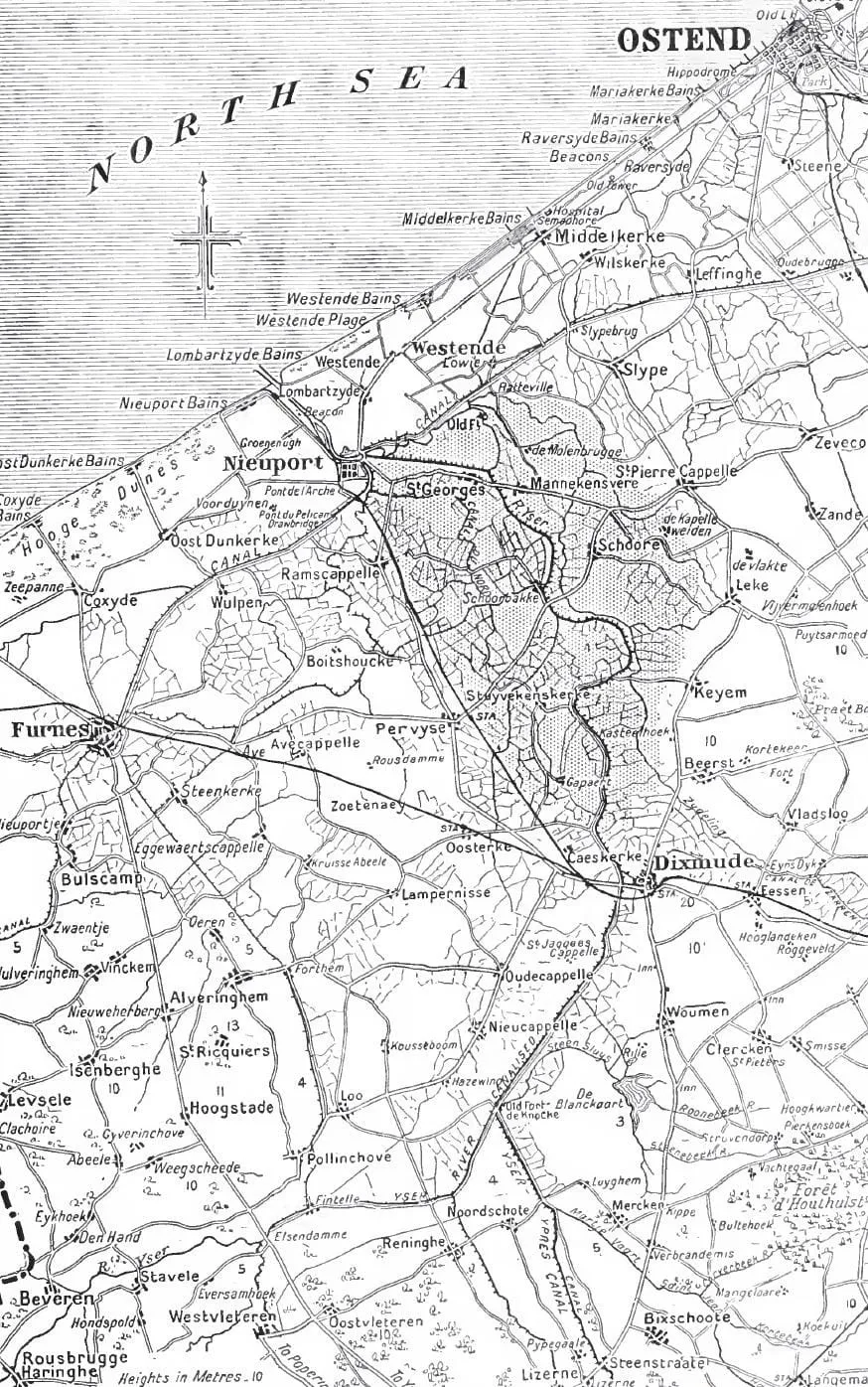
On 16 October 1914 the first German units attacked Diksmuide, a small town on the river Yser held by the Belgians and French marines. The Belgians date the Battle of the Yser from this day, and the British chronology of the war, recording it under this date, notes that it is the Belgian date. The main German attack began two days later. At stake was whether the Belgian army would hold the last strip of its country and whether the Germans would break through along the coast to the Channel ports.
An army on the river
The Belgian army reached the Yser utterly exhausted. After the fall of Antwerp it had retreated through Flanders, abandoned the ports on the coast, and on 14 and 15 October it took up the line of the river from Diksmuide to the sea. It numbered six weak infantry divisions and a cavalry division, by various estimates from about 50,000 to 70,000 men, and it was short of ammunition, guns and officers. King Albert I yielded to French pressure and agreed to fight here. In an order of the day he called on his soldiers to regard as a traitor anyone who spoke of retreat without orders.
The defensive line was not strong. The Yser, flowing between embankments across the flat plain of the polders, was barely a dozen or so metres wide here. The Belgians held several advanced posts on the eastern bank, in the villages of Mannekensvere, Schoore, Keiem and Beerst, and at Nieuport a bridgehead reaching to Lombardsijde. At the southern end, in Diksmuide, stood Rear-Admiral Pierre Ronarc’h’s French brigade of fusiliers marins, some 6,500 men, together with Colonel Alphonse Jacques’s Belgian brigade. Ronarc’h was ordered to hold the town and its crossing for a few days. He held it for more than three weeks.
First clashes
Soon after the Germans reached the coast and occupied Ostend, their columns set off along the roads to the south-west, towards the Yser. This was the route of the new Fourth Army of Duke Albrecht of Württemberg. On the sector from the sea to Diksmuide the III Reserve Corps of General Hans von Beseler, the conqueror of Antwerp, attacked, reinforced by the 4th Ersatz Division. Further south four new reserve corps brought from Germany were approaching.
On 16 October German units came up to Diksmuide and attacked. The sources differ on the details: some speak of an attack on 16 October, others of a reconnaissance that day and an attack the next. They agree that the fusiliers and the Belgians drove the Germans back and that the town remained in Allied hands. In the French and Belgian press the defence of Diksmuide quickly grew into a legend. Meanwhile German patrols prowled in front of the rest of the front, looking for weak points in the Belgian line.
The attack of 18 October
On 18 October the Fourth Army’s main attack began, covering the whole front from the sea to Ypres. German artillery shelled the Belgian advanced posts, and the infantry struck at Keiem, Schoore and Mannekensvere. That same morning Rear-Admiral Horace Hood’s British flotilla appeared off Nieuport, and its guns took the German troops on the coast under fire. That day General Ferdinand Foch came to Veurne and urged the King to have the Belgians go over to the offensive. Albert refused, pointing to the state of his army.
Over the next few days the Belgians lost all their advanced posts and withdrew behind the river. They blew the bridges, including the bridge in the bend at Tervate, but the Germans stood on the Yser along the whole length of the front. The line of the river, and behind it the Nieuport–Diksmuide railway embankment, were the last obstacle before Dunkirk and Calais. A few days later, when the Germans crossed the river, the Belgians reached for their last weapon: they opened the sluices at Nieuport and let the sea into the plain.
Remember the articles you have read? Only in this browser; nothing is sent anywhere.How it works
Read ·
Voices from the front
“This morning we took a wounded prisoner. As he passed, not one word of hatred, not one insult. Two sailors were helping him walk. He kept saying: “Good morning. War is terrible.” And the men answered him. Our men are more French than they think!”
Translated · Original (fr)
Et ce matin (22) nous avons fait un prisonnier blessé. Sur son passage pas un mot de haine, pas une injure. Deux marins l'aidaient à marcher. Il disait : « Bonjour. La guerre est terrible. » Et les hommes répondaient. Ils sont plus Français qu'ils ne croient, nos hommes !
“What one goes through in such an assault! One ages by years. Death whistles past; a hail of machine-gun fire and a hail of bullets, every moment one thinks one is hit. […] Away with war, the most hideous abortion of human vice! Men slaughter one another in masses without knowing, hating or loving one another.”
Translated · Original (de)
Was erlebt man nicht in einem solchen Sturm! Man reift um Jahre. Der Tod saust; Maschinengewehrhagel und Kugelhagel, jeden Augenblick glaubt man getroffen zu werden. […] Weg mit dem Krieg, der scheußlichsten Mißgeburt der Menschenlaster! Menschen schlachten sich in Massen ab, ohne sich zu kennen, zu hassen, zu lieben.
Spotted a mistake?Report an error
Meanwhile
(04)Elsewhere in the same days.
- 16 October 1914 · AfricaIndian Expeditionary Force "B" sails for AfricaOn 16 October 1914 General Aitken's Indian Expeditionary Force "B" sailed from Bombay. Some 8,000 soldiers were to conquer German East Africa.
- 16 October 1914 · Middle EastIndian Expeditionary Force D sails for the Persian GulfOn 16 October 1914 General Delamain's 16th Indian Brigade sailed from Bombay. It was to protect British oil in Persia in case of war with Turkey.
- 16 October 1914 · DiplomacyAntonino di San Giuliano diesOn 16 October 1914 the Italian Foreign Minister Antonino di San Giuliano, the architect of Italy's policy of neutrality, died in Rome.
- 15 October 1914 · MilitaryCanadians land in EnglandOn 15 October 1914 the first Canadian contingent began disembarking at Plymouth. It took over a week, and from there the soldiers went on to Salisbury Plain.
Related events
(04)The same battle, people or subject.
- 15 October 1914 · Western FrontGermans reach the Belgian coastOn 15 October 1914 the Germans reached the North Sea in Belgium. The race to the sea was ending; the Belgians dug in on the Yser between Nieuport and Dixmude.
- 10 November 1914 · Western FrontBattle of the Yser endsOn 10 November 1914 the fall of Diksmuide ended the Battle of the Yser. Belgium kept a scrap of its land, held for four years behind a flooded plain.
- 18 October 1914 · Western FrontBritish ships shell the Belgian coastOn 18 October 1914 Admiral Hood's flotilla backed the Belgians on the Yser from the sea, shelling the Germans on the coast between Nieuport and Ostend.
- 10 November 1914 · Western FrontGermans take DiksmuideOn 10 November 1914 the Germans took Diksmuide on the Yser, held since mid-October by French marines and Belgians. The defenders fell back across the Yser.