Germany · The Central Powers
Albrecht, Duke of Württemberg
Commander of the German Fourth Army (1914–1917) and of Army Group Duke Albrecht (1917–1918), field marshal
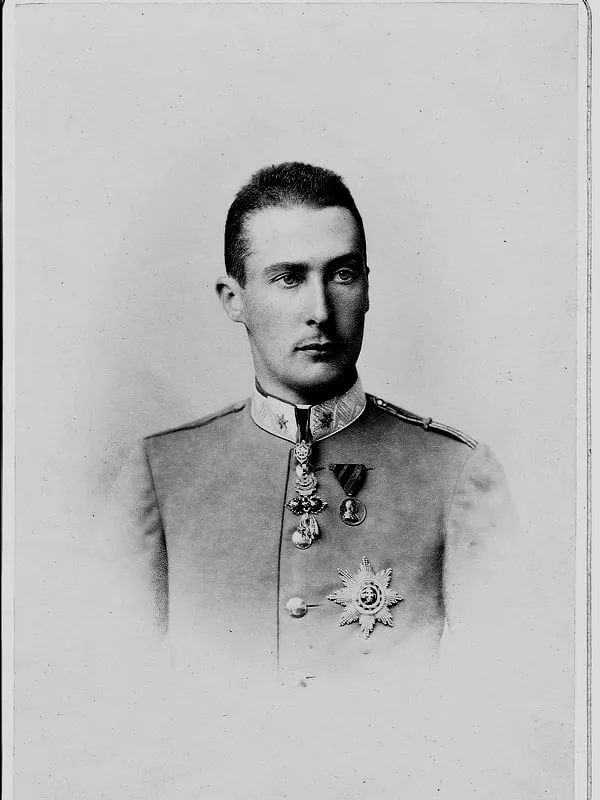
- Born:
- 23 December 1865, Vienna (Austria)
- Died:
- 29 October 1939, Altshausen (Württemberg)
- Author:
- Łukasz Skowroń
- Photo:
- autor nieznany, domena publiczna, Wikimedia Commons

Duke Albrecht of Württemberg, heir presumptive to the throne of the Kingdom of Württemberg, commanded the German Fourth Army from 1914 to 1917. His troops defeated the French in the Ardennes in August 1914, and in the autumn of that year, transferred to Flanders, they made bloody attacks on the Yser and at Ypres, which gave birth to the German Langemarck legend. Under his command, on 22 April 1915, the Germans carried out the first large-scale chlorine attack at Ypres. From 1917 until the end of the war he commanded an army group on the quieter, southern sector of the Western Front, in Lorraine and Alsace. He was one of those princely commanders who enjoyed respect in the army, although his name always remained in the shadow of his Bavarian cousin Rupprecht and his staff officers.
Before the war
He was born on 23 December 1865 in Vienna, the eldest son of Duke Philipp of Württemberg, of the Catholic line of the house, and Archduchess Maria Theresa, daughter of Archduke Albrecht, the victor of Custoza. He was thus closely related to the Habsburgs, and in 1893 he married Archduchess Margarete Sophie, sister of Archduke Franz Ferdinand. He was widowed in 1902 and never remarried. Since King Wilhelm II of Württemberg had no sons, Albrecht was regarded from his youth as the country’s future ruler.
He studied law at Tübingen and in 1885 joined the Württemberg army. He served in infantry and cavalry regiments, commanded a Guards cavalry brigade in Potsdam and then a division in Stuttgart. In 1906 he took over XI Corps in Kassel, and in 1908 the Württemberg XIII Corps in Stuttgart. In 1913 he became a colonel general and an army inspector.
1914: the Ardennes and the Marne
On 2 August 1914 he took command of the Fourth Army, which deployed in the centre of the German front, opposite Luxembourg and the Belgian Ardennes. Joffre believed the Germans were weak there and threw the French Third and Fourth Armies into the forests. On 22 August, the bloodiest day in the history of the French army, they ran into the battle-ready troops of Albrecht and of the Fifth Army of Crown Prince Wilhelm. After the Battle of the Ardennes the French fell back behind the Meuse, and the Fourth Army spent several days forcing the river at Sedan and Stenay.
During the Battle of the Marne Albrecht’s army attacked around Vitry-le-François against the French Fourth Army of General Fernand de Langle de Cary. The French held, and after the retreat of the German right wing Albrecht was ordered on 11 September to withdraw into Champagne.
1914: the Yser and Ypres
In October 1914 Albrecht’s staff was moved to Belgium. The new Chief of the General Staff, Erich von Falkenhayn, formed around it a new Fourth Army, made up of the corps of General Hans von Beseler, which had just taken Antwerp, and four new reserve corps, raised largely from young volunteers, often university and grammar-school students, after a few weeks’ training. It was to take the Belgian coast and break through towards the Channel ports.
In the second half of October the Fourth Army attacked along the whole front from the sea to Ypres. On the Yser the Belgian army of King Albert I held out until it flooded the ground in front with water from opened sluices. At Langemarck and Bixschoote the new reserve regiments advanced in dense waves and died in their thousands under the fire of British and French infantry. On the evening of 24 October Albrecht ordered the exhausted corps to dig in. The attacks were nevertheless renewed throughout November, until on 17 November the duke halted the attacks. A Supreme Army Command communiqué about volunteers who on 10 November had supposedly stormed forward at Langemarck singing the national anthem gave rise to a legend in which the defeat of poorly trained recruits became the heroic sacrifice of academic youth. In Germany people also spoke of the “massacre of the innocents” at Ypres.
1915: gas at Ypres
At the beginning of 1915 Falkenhayn chose the Fourth Army’s front for the first large-scale use of poison gas. The attack was to be a trial of the new weapon and at the same time divert the Allies’ attention from the transfer of German troops to the east. Falkenhayn refused Albrecht an additional division in case of success, and the order set a limited objective. After weeks of waiting for a favourable wind, on 22 April 1915 chlorine was released from thousands of cylinders against the French units north of Ypres. A gap several kilometres wide opened in the front, but the Germans, themselves surprised by the effect and without reserves, were unable to exploit it.
In the Second Battle of Ypres, which lasted until 25 May, the Fourth Army used gas several more times, among others against the Canadians at St. Julien. Albrecht wanted to eliminate the whole projecting Ypres salient but only managed to reduce it considerably. From May some of his ammunition and units were taken away for the armies fighting in Artois. In August 1915 he received the Pour le Mérite.
In 1916 the Fourth Army’s front in Flanders was relatively quiet. In the spring there was fighting for the hills south-east of Ypres, and in June the Württemberg XIII Corps of his army attacked the Canadians at Mount Sorrel. On 1 August 1916 Albrecht became a Prussian field marshal.
Army group in Lorraine
At the turn of February and March 1917 he handed the Fourth Army over to General Friedrich Sixt von Armin and took command of a new army group bearing his name, with headquarters in Strasbourg. It was responsible for the southern sector of the Western Front, in Lorraine, the Vosges and Alsace, as far as the Swiss border. For most of the war this was a quiet sector, on which both sides kept mainly weakened divisions or divisions resting after fighting elsewhere. For this reason Albrecht took no part in the great battles of 1917 and 1918, although his troops had to give up division after division for Ludendorff’s spring offensive. On his sector Foch planned a great Franco-American offensive in Lorraine for mid-November 1918, which never took place because of the Armistice of Compiègne. In February 1918 he received the oak leaves to the Pour le Mérite.
After the war
Unlike the Bavarian Crown Prince Rupprecht and the Prussian Wilhelm, Albrecht did not lay down his command during the days of the revolution. He remained in post until December 1918 and led the troops of his army group back home. On 30 November 1918 King Wilhelm II of Württemberg abdicated, and the monarchy in Württemberg ceased to exist. Albrecht did not join in this abdication and never formally renounced his rights to the throne. From 1919 he lived at the castle in Altshausen in Upper Swabia, and after the King’s death in 1921 he became head of the House of Württemberg. The family made no secret of its dislike of the Nazis. Albrecht died at Altshausen on 29 October 1939, and no senior representative of the Third Reich attended his funeral.
Assessment
Contemporaries thought highly of Albrecht. The German biographer Bernhard Schwertfeger wrote that as an army commander he was able to act on his own initiative in the spirit of the Supreme Army Command’s guidance, and counted him among the outstanding figures of the army, while others ranked him among the ablest commanders of the war. Such opinions, repeated in the hagiographic tone of the era, must however be treated with caution. Albrecht, like the other princes commanding armies, relied heavily on his chiefs of staff, and strategic decisions were taken at the Supreme Army Command.
His name is linked with two of the grimmest episodes of the war in the west. Under his command, in October and November 1914, poorly trained regiments of young volunteers were thrown into fruitless attacks at Ypres, which cost the Germans tens of thousands of men. It was also under his command, in April 1915, that poison gas was first used on a large scale. The decisions on both these undertakings, however, were taken by Falkenhayn, and historians assessing Albrecht tend rather to point out that with the limited forces he was given he achieved as much as could be achieved.
Sources
Spotted a mistake?Report an error
Commanded in battles
(14)- 7–25 August 1914Battle of the FrontiersWestern Front
- 21–24 August 1914Battle of the ArdennesWestern Front
- 25–28 August 1914Battle of the MeuseWestern Front
- 15 September – 19 October 1914Race to the SeaWestern Front
- 16 October – 10 November 1914Battle of the YserWestern Front
- 19 October – 22 November 1914First Battle of YpresWestern Front
- 21–24 October 1914Battle of Langemarck (1914)Western Front
- 17 April – 5 May 1915Fighting for Hill 60Western Front
- 22–23 April 1915Battle of Gravenstafel RidgeWestern Front
- 22 April – 25 May 1915Second Battle of YpresWestern Front
- 24 April – 4 May 1915Battle of St. JulienWestern Front
- 8–13 May 1915Battle of Frezenberg RidgeWestern Front
- 24–25 May 1915Battle of Bellewaarde RidgeWestern Front
- 2–13 June 1916Battle of Mount SorrelWestern Front
Mentioned in battles
(01)Often appears with
People who appear in the same events.