Key event
Second Battle of Ypres begins
- Category:
- Military operations
- Front:
- Western Front
- Date:
- 22 April 1915
- Author:
- Łukasz Skowroń
- Battle:
- Second Battle of Ypres
- Tags:
- Germany, France, Canada, chemical weapons
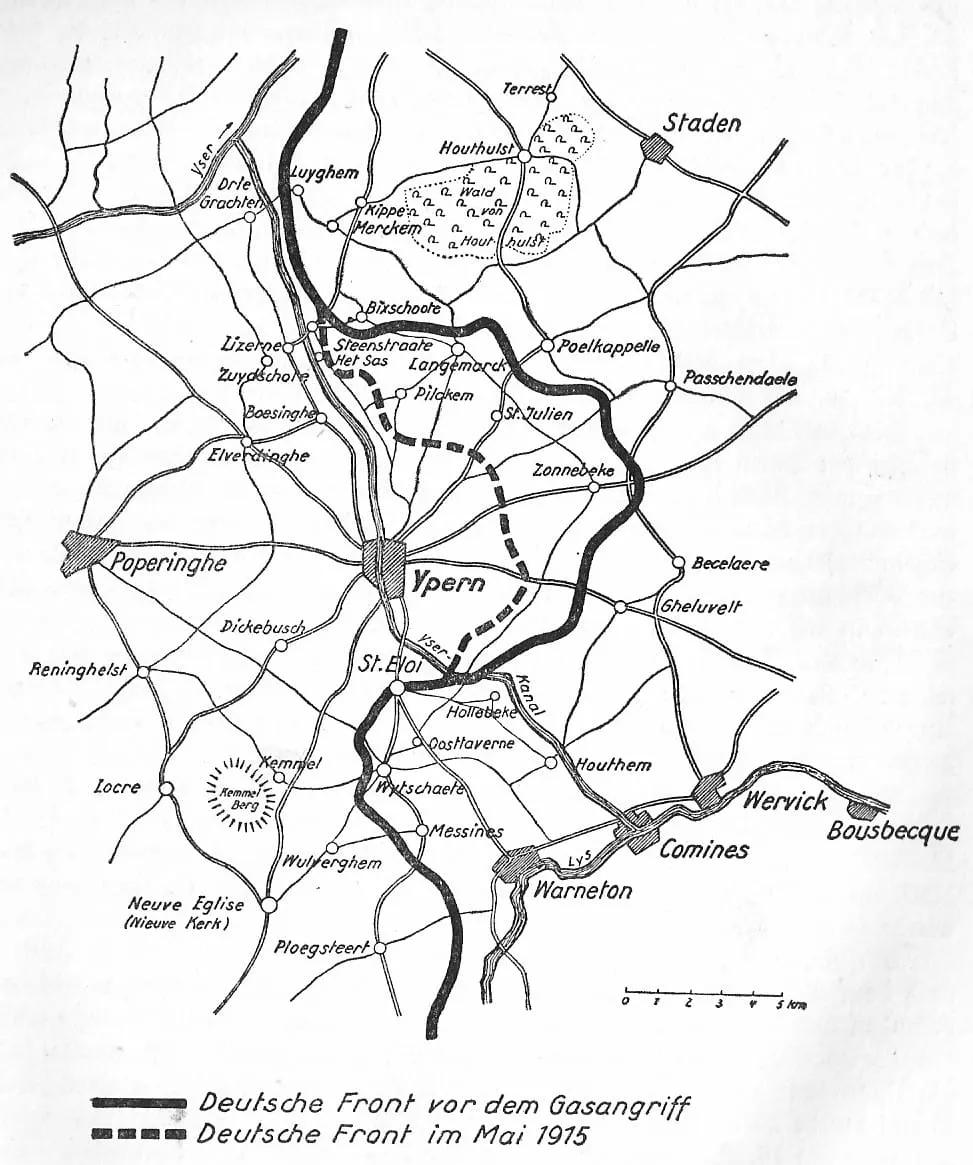
Towards evening on 22 April 1915, on the northern edge of the salient around Ypres, German pioneers opened the valves of several thousand steel cylinders. A greenish-yellow cloud of chlorine rose over no man’s land, and a light breeze carried it onto the trenches of two French divisions. Within an hour their defence had ceased to exist, and a gap several kilometres wide opened in the Allied front. It was the first attack on the Western Front with a war gas intended to kill, and at the same time the beginning of the Second Battle of Ypres, which lasted until 25 May.
Gas instead of shells
The Germans had made their first attempt with chemical weapons at the end of January at Bolimów, where they fired thousands of tear-gas shells at the Russians. In the frost the agent hardly worked, and building up a dense cloud would have required firing far more shells than the overstretched munitions factories could produce. The chemist Fritz Haber, director of the Kaiser Wilhelm Institute for Physical Chemistry in Berlin, proposed another method: to release the gas straight from cylinders and let the wind carry it onto the enemy’s trenches. He chose chlorine. The German chemical industry produced it in large quantities, it was stored in ordinary industrial cylinders, and being heavier than air it would flow along the ground and sink into the trenches. The Chief of the General Staff, General Erich von Falkenhayn, agreed to a trial at the front.
A special pioneer unit under Colonel Peterson was formed to handle the cylinders. Many volunteers, students and scientists served in it, and in the course of 1915 also the future Nobel laureates James Franck, Gustav Hertz and Otto Hahn. The unit was formally constituted as Pionier-Regiment Nr. 35 only on 27 April, and at the beginning of May a second gas regiment, No. 36, was formed. That is why accounts often attribute the attack of 22 April to “Pioneer Regiments 35 and 36”, although on that day it was carried out by the pioneers from whom those regiments were only later formed. Haber personally supervised the preparations.
The cylinders wait for the wind
The front of the German Fourth Army of Duke Albrecht of Württemberg at Ypres was chosen for the attack. First, in February, the pioneers dug in cylinders on the sector of XV Corps, south-east of the town, but a southerly wind was needed there, and it would not blow. On 25 March the army command decided to prepare a second sector, on the northern edge of the salient, between the village of Poelkapelle (PL) and Steenstrate (Steenstraat) on the Ypres–Yser canal. Here a northerly or north-easterly wind was enough. By 11 April, according to the Canadian official history, 5,730 cylinders, large and small, had been dug in along a front about 6 kilometres long. The quantity of chlorine is usually estimated at about 150 tonnes, although some accounts give 160–180 tonnes.
For nearly two weeks the wind blew the wrong way, and the attack was postponed from day to day. The German commanders made no secret of their distrust of the new, untested weapon, which made them dependent on the weather. Nor was the aim of the attack a breakthrough. Falkenhayn treated it as a trial of the new weapon and at the same time as one of the operations meant to divert Allied attention from the transfer of troops to the east, where the Germans were preparing a great offensive in Galicia. He refused Duke Albrecht an additional division in case of success. The order set a limited objective: to take the ridge near the village of Pilkem (Pilckem) and dig in on it.
There was no lack of warnings. In mid-April a deserter from the German 51st Reserve Division, later identified as August Jäger, told the French about cylinders buried in the trenches and the planned attack. The information was circulated right down to battalion level, as were reports from Belgian intelligence about an order placed in Ghent for 20,000 mouth-and-nose protectors. The higher commands, however, did not take them seriously. At the same time German war communiqués were accusing the French and the British of using gas shells.
A cloud over Langemarck
The morning of 22 April was windless, and the attack, planned for dawn, was called off once again. In the afternoon a light north-easterly breeze sprang up. At about 5 p.m. Allied time (6 p.m. on German clocks) the German artillery opened a heavy bombardment and the pioneers opened the valves. The gas flowed from the cylinders for several minutes. Two greenish-yellow clouds, on either side of the village of Langemarck, merged and drifted slowly south.
In the path of the cloud stood units of General Henri Putz’s French Détachement d’armée de Belgique: General Quiquandon’s 45th (Algerian) Division, with battalions of Algerian tirailleurs, African light infantry and Zouaves, and the 87th Territorial Division, made up of older reservists. The Algerian division had arrived in the sector only a few days earlier. The soldiers had no protection whatsoever against gas. Those whom the cloud caught in the trenches choked, coughed up blood and lost their sight. Colonel Jean Mordacq, commander of one of the brigades of the 45th Division, recalled crowds of fugitives who, “with their greatcoats open and their ties torn off, ran like madmen, crying for water, spitting blood, some rolling on the ground in a desperate effort to breathe”. The front of both divisions disintegrated within a few dozen minutes. The French abandoned their first and second lines and most of their guns.
A quarter of an hour after the gas was released, the German infantry of XXVI and XXIII Reserve Corps moved off. Some of the men had improvised pads soaked in a chemical solution. By about 5.40 p.m. the 52nd Reserve Division was already on the ridge near Pilkem, and shortly after 6 p.m. the ruins of Langemarck were in German hands. On the western wing the Germans crossed the canal at Het Sas and late in the evening took Steenstrate, although further north the Belgians of the 6th Division held their positions on the canal. On the eastern wing the Germans occupied a wood west of Sint-Juliaan (St. Julien), where they captured four British heavy guns.
The gap
In the evening a gap gaped in the Allied front between the canal bank and the left flank of the 1st Canadian Division, which for several days had been holding the neighbouring sector; according to British reports it was about 8,000 yards, or more than 7 kilometres, wide. It was covered only by scattered groups of Canadians, Zouaves and tirailleurs. From there it was only a few kilometres to Ypres, and east of the town stood three divisions of the British Second Army, two British and one Canadian, with all their artillery. Had the Germans reached the canal in the rear of the salient, they could have cut them off. The Canadians bent back their left flank, sent their reserves into the fight and counter-attacked that same night.
No one managed to count the victims of the gas itself precisely. Propaganda and some older accounts gave figures of 5,000 killed and 15,000 gassed, but these were greatly exaggerated. Modern historians estimate the number killed by the gas at 800–1,400 and those gassed at 2,000–3,000 men. French losses that evening were, however, much higher, as they also included wounded, prisoners and missing. The 87th Territorial Division alone reported 55 killed, 139 wounded and almost 2,400 missing.
Why the Germans stopped
In the evening the German attack came to a halt. British reports said that the Germans had stopped as early as about 7.30 p.m. and begun to dig in. Part of the reason lay in the plan itself. The attack was to be a trial, not a breakthrough, so the objective was only the ridge near Pilkem. Once it had been reached, the infantry began digging trenches as ordered. No reserves were waiting in the rear to pass through the gap. The cylinders had been opened towards evening, so little time remained before dark, and in darkness, on unfamiliar ground, nobody wanted to risk advancing further. The German soldiers were also afraid of their own gas and were in no hurry to walk into the remnants of the cloud. On the eastern wing they were finally stopped by the stubborn resistance of the Canadians and the fire of their artillery. General William Balck, who commanded one of the German divisions, later admitted that there had been no reserves to turn the break-in into a breakthrough, and that the effects of the new weapon had been underestimated.
The German communiqué of 23 April reported the capture of the heights south of Pilckem and the crossing of the canal, but did not say a word about gas. For the Allies the attack was a shock and a breach of the laws of war, since the Hague Conventions prohibited the use of poison. The very next day soldiers were ordered to cover their mouths and noses with wet handkerchiefs, and soon the first improvised masks were being hastily sewn. Haber saw that day as a wasted opportunity and claimed after the war that, had he been listened to and the attack prepared on a large scale, Germany could have won the war. Meanwhile a battle lasting several weeks had begun at Ypres, in which the Germans resorted to chlorine several more times.
Remember the articles you have read? Only in this browser; nothing is sent anywhere.How it works
Read ·
Voices from the front
“As we sat on the road we began to see the French stragglers--men without arms, wounded men, teams, wagons, civilians, refugees--some by the roads, some across country, all talking, shouting--the very picture of debacle. […] Women, old men, little children, hopeless, tearful, quiet or excited, tired, dodging the traffic,--and the wounded in singles or in groups.”
“We are right in the craziest corner, the first to have broken through the idle lying in position. But then again you see the long, long columns of wounded, you see the corpses on the battlefields, you see how the war works on people in spirit and morals, you see burning villages and all the rest. It is easier for you at home to stay cheerful.”
Translated · Original (de)
Wir sind gerade in der tollsten Ecke, die ersten, die das faule Liegen in der Stellung durchbrochen haben. Aber dann sieht man wieder die langen, langen Verwundetenzüge, sieht die Leichen auf den Schlachtfeldern, sieht, wie der Krieg seelisch und moralisch auf die Menschen wirkt, sieht brennende Dörfer und was alles. Da habt Ihr’s zu Hause leichter, froh zu bleiben.
Spotted a mistake?Report an error
Meanwhile
(04)Elsewhere in the same days.
- 23 April 1915 · AfricaBritish blockade of KamerunAt midnight on 23–24 April 1915 the Allies declared a blockade of the Kamerun coast to cut the Germans off from supplies smuggled from Spanish Guinea.
- 25 April 1915 · Middle EastAllies land at GallipoliOn 25 April 1915 British, Australian, New Zealand and French troops landed at the Dardanelles. The Turks put up fierce resistance.
- 25 April 1915 · War at seaRussians bombard the Bosporus againOn 25 April 1915, the day of the Gallipoli landings, the Russian Black Sea Fleet shelled the Bosporus forts to tie down Turkish forces near Constantinople.
- 25 April 1915 · AfricaClash at GibeonIn late April 1915 General McKenzie's mounted troops caught the retreating Germans at Gibeon. A night ambush failed, but in the morning the Germans were routed.
Related events
(04)The same battle, people or subject.
- 25 May 1915 · Western FrontEnd of the Second Battle of YpresOn 25 May 1915 the Second Battle of Ypres died down. After five weeks of fighting and gas attacks the Germans had shrunk the salient but not taken Ypres.
- 24 April 1915 · Western FrontBattle of St Julien beginsOn 24 April 1915 the Germans struck the Canadians at Ypres with chlorine. The 1st Canadian Division's front gave way, and in the afternoon St Julien fell.
- 3 May 1915 · Western FrontJohn McCrae writes "In Flanders Fields"On 3 May 1915 near Ypres the Canadian doctor John McCrae, a day after a friend's burial, wrote "In Flanders Fields", the poem behind the remembrance poppy.
- 14 April 1915 · Western FrontGermany accuses the French of using gasOn 14 April 1915 a German communiqué accused the French of using bombs with "asphyxiating" gas near Verdun. There were more such accusations in those days.