Key event
Battle of Gravenstafel Ridge begins
- Category:
- Military operations
- Front:
- Western Front
- Date:
- 22 April 1915
- Author:
- Natalia
- Battle:
- Battle of Gravenstafel Ridge
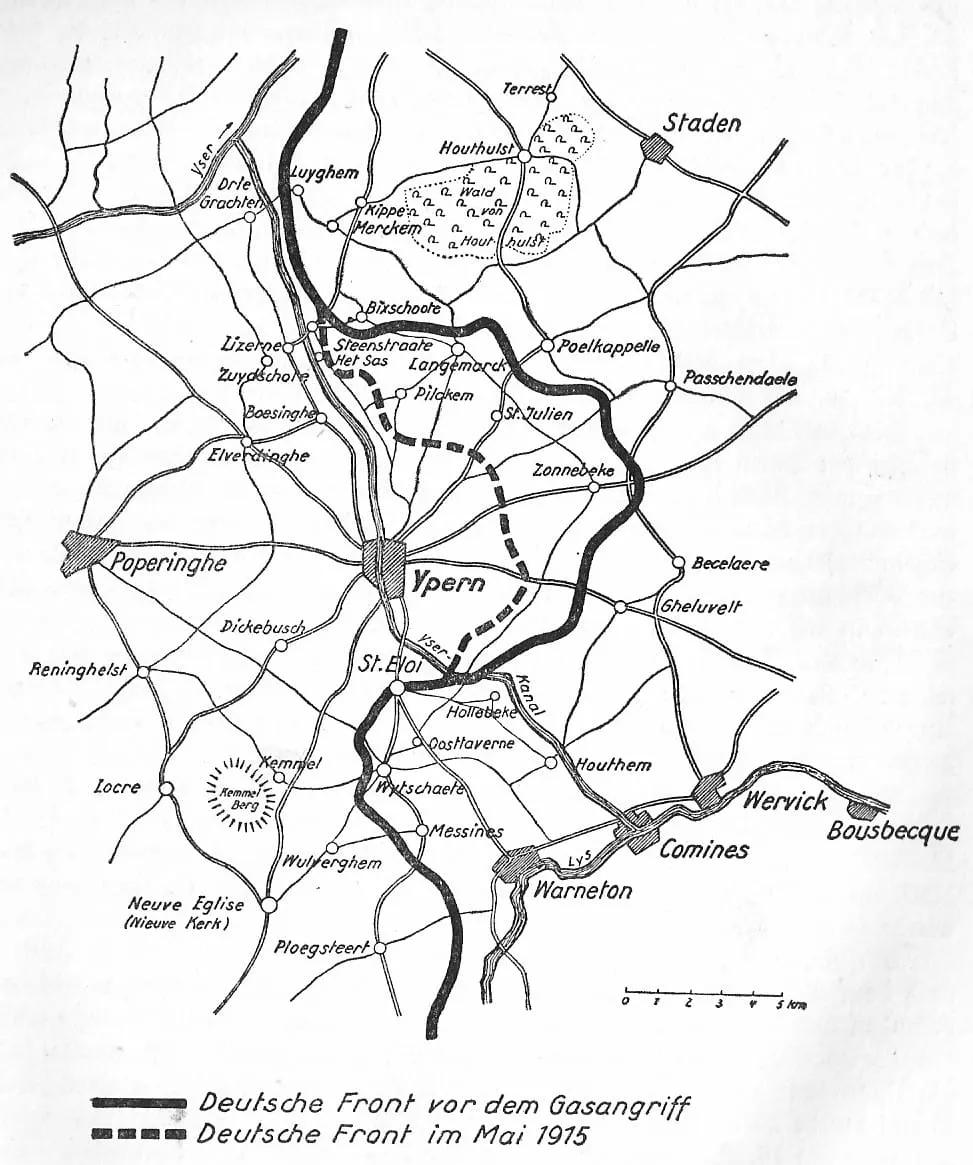
On the evening of 22 April 1915, when after the German chlorine attack the French divisions north of Ypres broke and scattered, the whole weight of the defence fell on their neighbours, the soldiers of the 1st Canadian Division. Through the night and the following day the Canadians and British battalions brought up in haste patched the gap in the front, counter-attacking without reconnaissance, without a plan and almost without artillery support. The British Battles Nomenclature Committee named this fighting the Battle of Gravenstafel Ridge and confined it to 22–23 April.
The Canadians in the Ypres salient
General Edwin Alderson’s Canadian division, which had crossed to France in February, took over a sector at Ypres from the French 11th Division on 14–17 April. Its front, about 4 kilometres long, ran in front of the low Gravenstafel Ridge, north-east of the town. On the right stood the British 27th and 28th Divisions, on the left the French 45th (Algerian) Division. In the line were General Arthur Currie’s 2nd Brigade and General Richard Turner’s 3rd Brigade, while General Malcolm Mercer’s 1st Brigade stood in reserve, ready to be sent to Hill 60. The Canadians were dismayed by the state of the trenches they took over: shallow, without traverses, with parapets that did not stop bullets.
The chlorine cloud passed by their sector. The left flank of the 3rd Brigade, the 13th Battalion, was however suddenly exposed. Two of its platoons, sent along the road from Poelkapelle to Sint-Juliaan (St. Julien) to help a handful of Algerian tirailleurs, fought to the last man. North of Sint-Juliaan a German column was stopped by the guns of the Canadian 10th Battery, firing at a range of a few hundred metres. Their withdrawal was covered with a machine gun by Lance Corporal Frederick Fisher of the 13th Battalion. According to the Canadian official history he was killed the next day, and for this deed he was posthumously awarded the Victoria Cross. Turner sent the reserve 14th Battalion into the fight, and it manned a line in the rear, by a farm later called Mouse Trap Farm, which housed brigade headquarters.
The charge on Kitcheners’ Wood
At about 8 p.m. a French liaison officer asked Alderson to support a counter-attack that the 45th Division was preparing towards Pilkem. The general ordered the 3rd Brigade to retake an oak wood west of Sint-Juliaan. The British called it Kitcheners’ Wood, although the name came not from Lord Kitchener but from the French Bois des Cuisiniers, “the cooks’ wood”. Two battalions from the divisional reserve were assigned to the attack: Lieutenant-Colonel Russell Boyle’s 10th Battalion and Lieutenant-Colonel Robert Leckie’s 16th Battalion (Canadian Scottish).
A few minutes before midnight about 1,500 men moved off in close order, in six waves, shoulder to shoulder. No one had reconnoitred the ground, and the order said only to “clear the wood”. In the moonlight they had silently covered half of the roughly one-kilometre distance when German machine guns opened fire on them from a trench in front of the wood. They covered the last stretch at a run and broke into the wood with the bayonet, taking prisoners from the German 234th Reserve Infantry Regiment. Boyle was mortally wounded. At 2.45 a.m. the brigade reported that the wood had been taken and four British guns, lost in the evening, recaptured.
The success was short-lived. In the darkness the companies became mixed up, many officers were killed, and the promised French attack on the left flank did not come. The Germans held on at the edges of the wood and fired into it from three sides. The guns had to be abandoned because the teams did not arrive, and at dawn the Canadians fell back to the southern edge of the wood, into a captured German trench. Fewer than 500 men were left of the two battalions. Further east Currie moved his 7th Battalion to a line between Sint-Juliaan and the crossroads at Keerselare, and a company of the British Buffs reached the 13th Battalion at the apex of the salient.
Morning at Mauser Ridge
During the night the headquarters of the British V Corps gathered four battalions from the reserves of the 28th Division and placed them under Colonel Geddes of the Buffs battalion. This improvised force was to close the gap between the Canadians and the canal. Alderson sent the last two battalions of the 1st Brigade, the 1st and 4th, to the same task. They crossed the canal at Brielen and at 5.25 a.m. moved north, counting on the support of a French counter-attack. In front of them, on a low rise the British called Mauser Ridge, the Germans were busily digging trenches.
The French did not appear, and the Canadians and two companies of a Middlesex battalion advanced across open fields under machine-gun and artillery fire. They halted in a shallow hollow a few hundred metres from the German positions, where for the rest of the day they were also shelled with tear-gas shells. In the afternoon, at 4.25 p.m., the British 13th Brigade, brought from Hill 60, and Geddes’s fresh battalions went into the attack. The artillery, which had not been told that the attack had been put back from 3 p.m., shelled the Germans too early, and there was not enough ammunition for a second preparation. The survivors of the 1st and 4th Battalions joined the attack. Some groups got to within 200 metres of the German trenches and a few parties even closer, but at about 7 p.m. the attack broke down. That day the 1st Battalion lost 404 men and the 4th Battalion 454, among them its commander, Lieutenant-Colonel Arthur Birchall.
By the evening of 23 April a continuous, if thin and barely entrenched, line ran from Kitcheners’ Wood to the canal, and the Germans did not renew their attack west of Sint-Juliaan. At the apex of the salient the Canadians pulled back a little after dark to straighten an over-sharp angle in the front. The British official history later judged that the afternoon attack “had no chance of success” and that the same could have been gained by a night advance, almost without losses. The Canadians had, however, bought the time the Allies needed to bring up reinforcements. A day later the Germans struck with gas at them too.
Remember the articles you have read? Only in this browser; nothing is sent anywhere.How it works
Read ·
Spotted a mistake?Report an error
Meanwhile
(04)Elsewhere in the same days.
- 20 April 1915 · Middle EastDefence of Van beginsOn 20 April 1915 the troops of Governor Cevdet Bey attacked the Armenian quarters of Van. Fearing a massacre, the Armenians took up armed self-defence.
- 25 April 1915 · Middle EastAllies land at GallipoliOn 25 April 1915 British, Australian, New Zealand and French troops landed at the Dardanelles. The Turks put up fierce resistance.
- 25 April 1915 · War at seaRussians bombard the Bosporus againOn 25 April 1915, the day of the Gallipoli landings, the Russian Black Sea Fleet shelled the Bosporus forts to tie down Turkish forces near Constantinople.
- 25 April 1915 · AfricaClash at GibeonIn late April 1915 General McKenzie's mounted troops caught the retreating Germans at Gibeon. A night ambush failed, but in the morning the Germans were routed.
Related events
(04)The same battle, people or subject.
- 24 April 1915 · Western FrontBattle of St Julien beginsOn 24 April 1915 the Germans struck the Canadians at Ypres with chlorine. The 1st Canadian Division's front gave way, and in the afternoon St Julien fell.
- 25 May 1915 · Western FrontEnd of the Second Battle of YpresOn 25 May 1915 the Second Battle of Ypres died down. After five weeks of fighting and gas attacks the Germans had shrunk the salient but not taken Ypres.
- 8 May 1915 · Western FrontBattle of Frezenberg Ridge beginsOn 8 May 1915, after a hurricane bombardment, the Germans broke the British front on Frezenberg Ridge near Ypres. The last reserves closed the gap at night.
- 24 May 1915 · Western FrontGerman gas attack at BellewaardeAt dawn on 24 May 1915 the Germans released chlorine at Ypres on a 7 km front, took Mouse Trap Farm and part of Bellewaarde Ridge but did not break through.