1915: The Second Battle of Ypres
Battle of Gravenstafel Ridge
- Dates:
- 22–23 April 1915
- Front:
- Western Front
- Location:
- The area of Langemarck, Sint-Juliaan (St. Julien), Wieltje and Pilkem (Pilckem) north and north-east of Ypres, between Gravenstafel Ridge and the Ypres–Yser canal, West Flanders (Belgium)On the battle map →
- Sides:
- United Kingdom and CanadaHorace Smith-Dorrien, Herbert Plumer, Edwin Alderson, Arthur Currie, Richard TurnerFranceHenri Putz, Ferdinand FochGerman EmpireAlbrecht, Duke of Württemberg, Otto von Hügel, Hugo von Kathen
- Result:
- Inconclusive. After the gas attack the Germans took the ridge near Pilkem and Langemarck, but the Allies closed the gap in the front and prevented a breakthrough.
- Author:
- Natalia
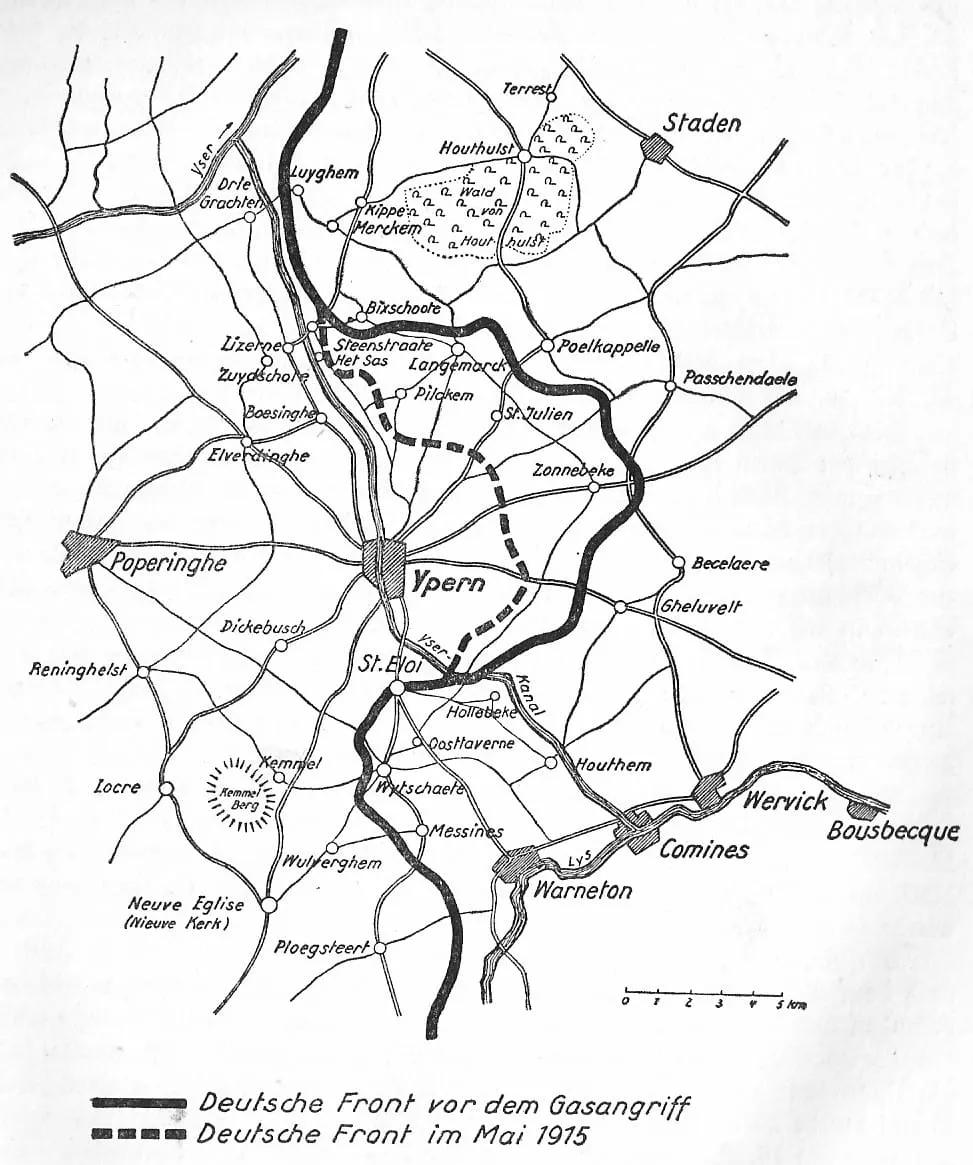
The Battle of Gravenstafel Ridge, fought on 22 and 23 April 1915 north of Ypres, was the first stage of the Second Battle of Ypres. It began with the first chlorine attack on the Western Front, which broke two French divisions and opened a gap several kilometres wide in the Allied line. Through the night and the following day the 1st Canadian Division and British battalions brought up from reserve closed it, counter-attacking without reconnaissance and almost without artillery support. The Germans got no further, but the price was enormous, and the lost ground was never regained.
Name and dates
The name Battle of Gravenstafel Ridge and the dates 22–23 April were fixed after the war by the British Battles Nomenclature Committee. The British official history considered the name ill-chosen. Gravenstafel is a low ridge and hamlet north-east of Ypres, in front of which lay the trenches of the Canadian 2nd and 3rd Brigades, but both the German attack and the Allied counter-attacks took place several kilometres further west, between Sint-Juliaan (St. Julien) and the canal. The official historian would rather have named it after the crossroads at Keerselare, where after the war a Canadian memorial was erected to the soldiers who fell in the April fighting.
Background
In mid-April 1915 the Canadians relieved the French 11th Division at Ypres. Their sector, about 4 kilometres long, lay on the north-eastern edge of the salient, in front of Gravenstafel Ridge. To their right stood the British 27th and 28th Divisions, and to their left, as far as the canal, two divisions of General Henri Putz’s French Army Detachment of Belgium: the 45th (Algerian) Division and the 87th Territorial Division. All three divisions of General Herbert Plumer’s British V Corps came under General Horace Smith-Dorrien’s Second Army.
Facing the French, the German XXVI Reserve Corps and the 46th Reserve Division of XXIII Reserve Corps had for weeks had thousands of chlorine cylinders buried in their trenches and were waiting for a north wind. Warnings from a deserter and from Belgian intelligence were ignored. The objective of the German attack was the ridge near Pilkem (Pilckem) and, if successful, the line of the canal as far as Ypres. The Germans, however, had not prepared reserves that could exploit a success.
Course of the fighting
22 April, evening. At about 5 p.m. Allied time the Germans opened the cylinders on a front about 6 kilometres long, from Poelkapelle to Steenstrate. The chlorine cloud drifted onto the trenches of French tirailleurs, African light infantry and territorials. The defence of both divisions collapsed within tens of minutes. The Germans took Langemarck, the ridge near Pilkem and the wood west of Sint-Juliaan known to the British as Kitchener’s Wood, where they captured a battery of four British heavy guns. In the west they crossed the canal at Het Sas and took Steenstrate, but the Belgian 6th Division repulsed their attempts to go further. At about 7.30 p.m. the German infantry began to dig in.
The Canadian left wing, the 13th Battalion, bent its front back along the road from Poelkapelle to Sint-Juliaan and, with the remnants of the French tirailleurs, held out until late at night. The guns of the Canadian 10th Battery halted the German units advancing on Sint-Juliaan, and their crews were covered by the machine-gun fire of Lance Corporal Frederick Fisher, later awarded the Victoria Cross posthumously. General Richard Turner, commander of the 3rd Brigade, manned a line in the rear with reserves near his headquarters at the farm later called Mouse Trap Farm, where several hundred French Zouaves joined them. The divisional commander, General Edwin Alderson, received two battalions of the 1st Brigade from the army reserve, and the commanders of the 27th and 28th Divisions sent their reserves towards the gap. Even so, at about 9 p.m. there remained three gaps between the canal and the Canadians, several kilometres wide in all.
Night of 22–23 April. At the request of the French, who were promising a counter-attack on Pilkem, the Canadian 10th and 16th Battalions, about 1,500 men together, attacked Kitchener’s Wood just before midnight. Under machine-gun fire they broke into the wood with the bayonet and retook the guns, but with no French support they had to withdraw to its southern edge at dawn. Fewer than 500 men were left of the two battalions. The guns had to be abandoned. Meanwhile V Corps headquarters gathered four battalions from the 28th Division’s reserves and placed them under Colonel Geddes. This improvised force, named after him, was to close the gap between the Canadians and the canal. General Arthur Currie of the 2nd Brigade moved his last battalion into the line between Sint-Juliaan and Keerselare.
23 April. At dawn the Canadian 1st and 4th Battalions and half a battalion of the Middlesex advanced from the canal area against the German trenches on a low rise the British called Mauser Ridge. The promised French attack did not come, and the advance stalled a few hundred metres from the German positions. Before noon the French, who had lost most of their guns, postponed their counter-attack to the afternoon. On the orders of Field Marshal John French, who had promised General Ferdinand Foch support for the French counter-attack, Smith-Dorrien ordered a general attack between Kitchener’s Wood and the canal. At 4.25 p.m., without artillery preparation or reconnaissance, the British 13th Brigade, withdrawn a few days earlier to rest after the fighting for Hill 60, and Geddes’s fresh battalions advanced, together with the surviving Canadians. On the French side only a few hundred Zouaves joined the attack. On the open, gentle slope the attackers were stopped by machine-gun and artillery fire, some units within a few dozen metres of the German trenches. At about 7 p.m. the attack collapsed. After dark a new continuous line took shape at the bottom of the shallow valley in front of Mauser Ridge, about 600 metres from the Germans, running from Kitchener’s Wood to the canal, where it linked up with the French. At the apex of the salient the Canadians withdrew slightly to straighten an overly sharp angle in the front.
Casualties
Losses for these two days alone have not been compiled separately. The Canadian battalions that attacked Kitchener’s Wood lost about 1,000 men, and the 1st and 4th Battalions lost 404 and 454 men respectively on 23 April. The commanders of the 10th and 4th Battalions were killed: Lieutenant-Colonels Russell Boyle, mortally wounded in the night attack, and Arthur Birchall. In the British battalions that attacked on the afternoon of 23 April, losses ranged from 200 to more than 400 men per battalion. The 1st Battalion, York and Lancaster Regiment lost 424 men, including its commander, and twenty soldiers were left of the half-battalion of the Middlesex. The British 13th Brigade lost so many men that, according to the official history, almost no one was left in it who had fought at Mons and Le Cateau in August 1914.
French losses on 22 April included gas casualties, wounded, prisoners and missing. Modern historians estimate the chlorine victims alone at 800–1,400 killed and 2,000–3,000 poisoned. The 87th Territorial Division reported 55 killed, 139 wounded and almost 2,400 missing. German losses for these days were not given separately.
Significance
The battle showed both the strength and the weakness of the new weapon. Within an hour the chlorine cloud did what ordinary attacks had been unable to achieve all winter: it broke the defence on a sector several kilometres wide. The Germans, however, lacked the forces to exploit this success, and their infantry, in accordance with orders, halted on the designated line. The gap left open gave the Allies a few hours, which the Canadians and British used to close it.
The British official history rated the night counter-attack on Kitchener’s Wood highly, as a true counter-attack, carried out quickly and resolutely, but sharply criticised the afternoon attack of 23 April, which in its author’s view had no chance whatever and caused losses that could have been avoided. The Canadian official history wrote that the costly counter-attacks had nevertheless stopped the Germans and forced them to change their plans. For the 1st Canadian Division it was a baptism of fire that established its reputation. The next day the Germans attacked the Canadians themselves with gas, and the Battle of St. Julien began.
Spotted a mistake?Report an error