1915: The Second Battle of Ypres
Fighting for Hill 60
- Dates:
- 17 April – 5 May 1915
- Front:
- Western Front
- Location:
- Hill 60 by the Ypres–Comines railway, between Zillebeke and Zwarteleen, south-east of Ypres, West Flanders (Belgium)On the battle map →
- Sides:
- United KingdomJohn French, Horace Smith-Dorrien, Herbert Plumer, Thomas MorlandGerman EmpireAlbrecht, Duke of Württemberg, Berthold von Deimling
- Result:
- German victory. The British took the hill on 17 April and beat off counter-attacks, but on 5 May the Germans, using gas, recovered the summit.
- Author:
- Łukasz Skowroń
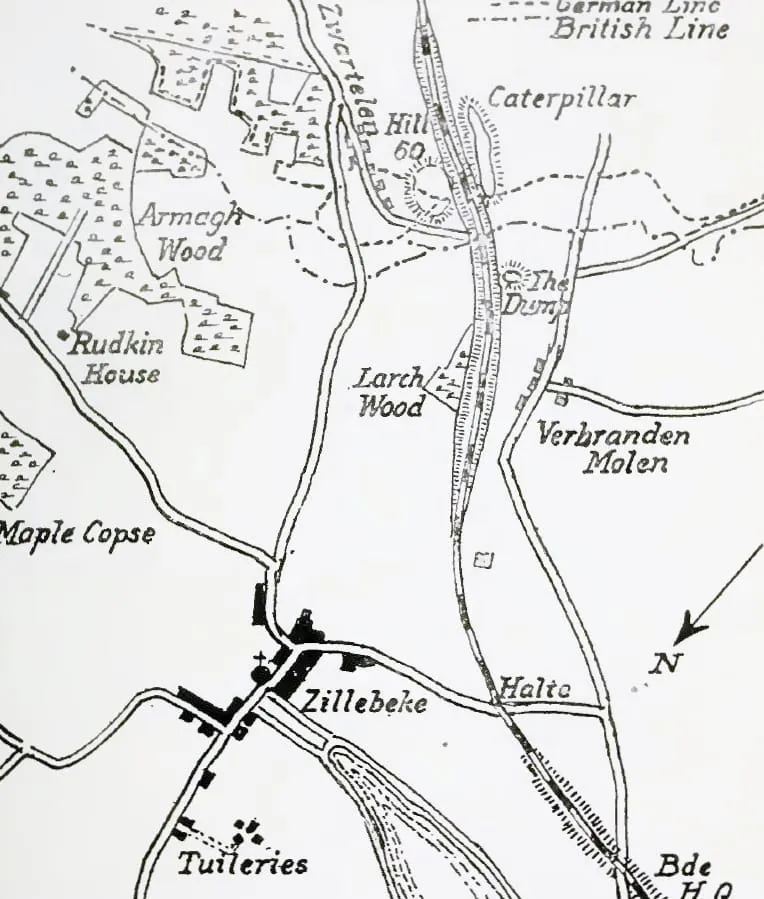
The fighting for Hill 60 took place in the spring of 1915 on the southern edge of the salient around Ypres. On the evening of 17 April British sappers blew mines laid in tunnels under the German trenches on the top of a small artificial mound near the village of Zillebeke, and the infantry of the 5th Division occupied it within minutes, almost without loss. Over the following days the British beat off violent German counter-attacks and held the hill, paying for it with thousands of killed and wounded. At the beginning of May the Germans twice attacked it using chlorine, and on 5 May they recovered the summit. It was the first large British mining operation on the Western Front and a foretaste of the two-year underground war that went on beneath the hill until June 1917.
Name and dates
The British chronology of the war on which our timeline is based gives the capture of Hill 60 under the dates 17–22 April 1915. The Long, Long Trail website adopts the same dates. They cover the explosion of the mines, the assault and the first days of the counter-attacks, up to 22 April, when the Germans began the Second Battle of Ypres north of Ypres and the attention of both sides shifted there. The fighting for the hill itself, however, went on. On this page we describe it from 17 April to 5 May, that is, from the capture to the loss of the summit. Some works, including the English Wikipedia, extend it to 7 May, when the last British counter-attack collapsed. The British speak of the “Capture of Hill 60”, although in the end the Germans were the victors.
The hill should not be confused with Hill 60 on the Gallipoli peninsula, which was fought over in August 1915.
Background
Hill 60 was not the work of nature. It was heaped up in the middle of the 19th century from the spoil dug out during the construction of the railway from Ypres to Comines, which cut in a deep cutting through a low ridge south-east of the town. Spoil heaps rose on both sides of the cutting. The British called the long one on the western side the Caterpillar, and a smaller one, lower down the slope, the Dump. On the eastern side, at the highest point of the ridge, lay the hill named after the 60-metre contour on the maps. Small though it was, it gave a view over Zillebeke and Ypres, and both sides contended for this observation point throughout the war.
The German 30th Division took the hill in November 1914, towards the end of the First Battle of Ypres. In mid-December it was taken over by the Saxon 105th Infantry Regiment of this division, which belonged to General Berthold von Deimling’s XV Corps in the Fourth Army of Albrecht, Duke of Württemberg. In the winter the sector opposite the hill was held by the French, who blew several small mines here. At the beginning of February 1915 they were relieved by General Edward Bulfin’s British 28th Division, and on 17 February its sappers fired a small mine taken over from the French. Bulfin began to prepare a raid on the summit. After the 28th Division was relieved, the plan was taken over by General Thomas Morland’s 5th Division of General Herbert Plumer’s V Corps, part of General Horace Smith-Dorrien’s Second Army. Some British commanders doubted whether it was worth turning a raid into a permanent occupation of a hill that jutted out like a wedge into the German line.
Preparations
At the beginning of March sappers of one of the new tunnelling companies of the Royal Engineers began work under the hill. These had been formed since February 1915 from professional miners, often from the collieries of Wales and Northumberland, on the initiative of the businessman and MP John Norton-Griffiths. Most works attribute the operation to the 173rd Tunnelling Company, although some sources also mention the 171st Company, which was working in the vicinity of Hill 60 at the same time. The British were about 50 metres from the German line. From a shaft about 5 metres deep the sappers drove three galleries, each eventually more than 90 metres long.
By 10 April the mine chambers had been prepared. According to the British official history, the two charges under the northern part of the German positions held about 900 kilograms of explosive each, the two under the central part about 1,200 kilograms each, and one in the south a little under a quarter of a ton of guncotton. Work on this last one was stopped because the gallery had come close to a German tunnel. Sources speak of five or six mines. The charges were ready on 15 April. Aircraft of No. 1 Squadron of the Royal Flying Corps photographed the area and on 16 April helped the artillery to register on the approaches to the hill.
The Germans also had their own plans here. Since February, cylinders of chlorine prepared for a gas attack had lain buried in the trenches on the XV Corps sector, including under Hill 60. Since the south wind that was needed refused to blow, at the end of March the German command decided to prepare a second sector, north of Ypres.
Course of the fighting
17 April. From dawn British aircraft patrolled the sky between Kemmel and Ypres to keep German airmen away from the place of the attack. At 7.05 p.m. the first pair of mines was fired, and ten seconds later the rest. Earth, beams and bodies flew nearly 100 metres into the air and came down over a radius of several hundred metres. A platoon of Saxon infantry in the front line was killed almost to a man. Soldiers of the 13th Brigade, from the 1st Battalion, Royal West Kent and the 2nd Battalion, King’s Own Scottish Borderers, rushed into the craters. The defenders who survived and resisted were killed with the bayonet, and about twenty were taken prisoner. According to the official history the attackers lost seven men. A Saxon counter-attack failed, and some of the German soldiers fled for fear that the explosions had broken the gas cylinders. By 12.30 a.m. the British had linked the new positions to the old line with two communication trenches.
18 April. German artillery pounded the hill from three sides: from Zandvoorde, from the Caterpillar and from Zwarteleen. At about 11 p.m. the previous day four companies of the 99th and 143rd Infantry Regiments had attacked frontally and from the flanks, and between 3.15 and 4 a.m. three more attacks followed. The British machine guns inflicted heavy losses on the attackers, but in the course of the day flanking fire drove the defenders off the summit. The Germans also used new artillery shells with lachrymatory xylyl bromide, which, as the German official history admitted, achieved little. In the evening, at about 6 p.m., two fresh battalions of the 13th Brigade, the 2nd Battalion, King’s Own Yorkshire Light Infantry and the 2nd Battalion, Duke of Wellington’s, recaptured the summit. That evening observers in aircraft spotted the flashes of 33 German guns, which the British artillery shelled the next day.
19–22 April. Before dawn on 19 April most of the 13th Brigade was relieved by the 15th Brigade. On 20 April, after two and a half hours of intense bombardment, the Germans attacked with bombing parties, and in the evening, at 6.30 and 8 p.m., with infantry. The attacks broke down under machine-gun fire. For the fighting of 20 and 21 April the Victoria Cross was awarded to Lieutenant George Roupell, Private Edward Dwyer and Second Lieutenant Benjamin Geary of the East Surrey battalions, and to Second Lieutenant Geoffrey Woolley of the London battalion of the Queen Victoria’s Rifles, who was the first officer of the British Territorial Force to receive the decoration. By 21 April the hill had turned into a lunar landscape of overlapping craters. The Germans dug jumping-off positions in front of it for further attacks. On 22 April the Second Battle of Ypres broke out north of Ypres, and battalions and batteries began to be taken away from Hill 60. The 13th Brigade was sent to counter-attack at Mauser Ridge.
1 May. In the evening, after a bombardment by heavy artillery, at 7 p.m. the Germans released chlorine from trenches less than 100 metres from the British ones, on a sector about 400 metres wide. The gas arrived so quickly that most of the defenders did not have time to put on their improvised respirators. German bombers advanced right behind the cloud. Part of the garrison, despite being gassed, opened fire, and reinforcements ran through the cloud and drove the attackers back with grenades. The 1st Battalion, Dorset suffered most, losing more than 90 dead from the gas. Private Edward Warner of the 1st Battalion, Bedfordshire, who single-handedly held an abandoned trench and brought reinforcements into it, died of gas poisoning the next day and was posthumously awarded the fifth Victoria Cross for the fighting for the hill.
5 May. At 8.45 a.m. the Germans released gas from two points opposite the hill. The wind carried the cloud along the British trenches rather than across them, so the defenders could not move aside, as their instructions required. Despite moistening their cotton pads, it was impossible to remain in the trenches, and those who stayed collapsed. A quarter of an hour after the gas was released, infantry of the 30th Division occupied almost the whole front line on the slope. At 11 a.m. the Germans released gas again, north-east of the hill, and broke through the defences in the salient at Zwarteleen. British reinforcements, coming up through the cloud and the barrage, recaptured some trenches, but the summit remained in German hands. At 10 p.m. the British 13th Brigade counter-attacked. In the darkness, on ground churned up by craters, only one group advanced; it reached the summit, but at 1 a.m. had to withdraw under fire from the Caterpillar and Zwarteleen. The last British attack, at dawn on 7 May, collapsed, and all who took part in it were killed or captured.
Losses
According to British calculations the 13th Brigade lost 1,362 men from 17 to 19 April, and the 15th Brigade 1,586 from 1 to 7 May. The total losses of the 5th Division in the fighting for the hill are estimated at about 3,100 killed, wounded and missing. According to one study, of the 2,413 British soldiers who were taken to hospital after the fighting for the hill, 227 died. German losses were also high. One British officer wrote of about 3,000 bodies on a patch of ground 150 yards square, although this was more the shaken account of an eyewitness than an exact count.
The gas controversy
Both sides accused each other of using gas in the fighting for the hill. The British had already smelled it during the April counter-attacks and attributed it to German shells, which did indeed fall on the hill in the following days. The Germans, for their part, feared that some of the cylinders they had buried had fallen into British hands. German propaganda, which for several weeks had already been accusing the French and the British of firing gas shells, used the fighting at Hill 60 to blame the enemy for resorting to chemical weapons. The first attack on the Western Front with a lethal war gas was, however, carried out by the Germans, a few days later, north of Ypres.
Significance
The capture of Hill 60 showed that blowing mines under the enemy’s trenches made it possible to take a strongly defended position almost without loss. It also showed that it was harder to hold it afterwards. The captured hill formed a narrow salient, shelled from three sides, and the British had not taken the neighbouring spoil heaps from which the Germans delivered flanking fire. As soon as the Germans prepared a methodical counter-attack using gas, the hill was lost.
Hill 60 remained in German hands for more than two years. Meanwhile the mine war went on underground. From August 1915 British, and later Canadian and Australian, sappers dug deep beneath the German tunnels until they had placed two huge charges under the hill and under the Caterpillar. On 7 June 1917, on the first day of the Battle of Messines, they went up together with more than a dozen other mines. Today on the hill, preserved as a memorial site, the craters of the explosions and the remains of bunkers can still be seen.
Spotted a mistake?Report an error