United Kingdom · The Entente
Herbert Plumer
Commander of the British Second Army (1915–1918) and of the British forces in Italy (1917–1918), general
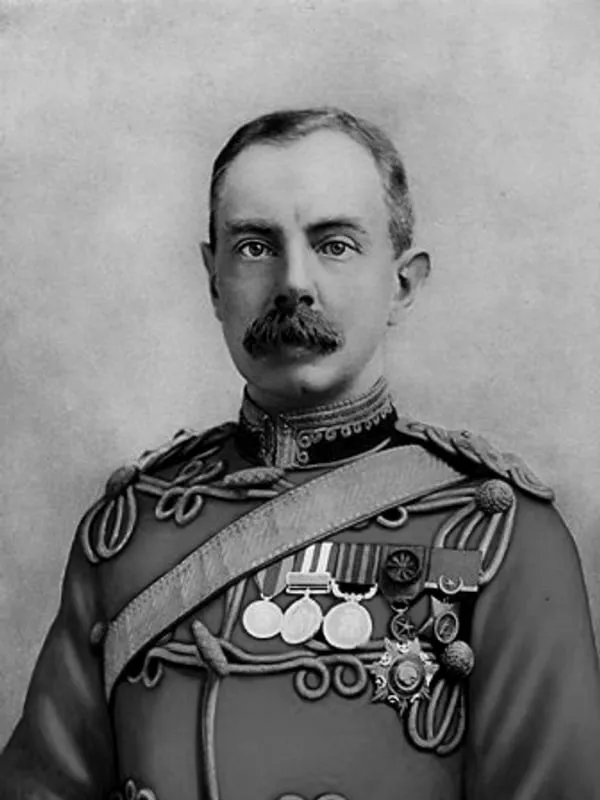
- Born:
- 13 March 1857, London
- Died:
- 16 July 1932, London
- Author:
- Natalia
- Photo:
- autor nieznany, domena publiczna, Wikimedia Commons

Sir Herbert Plumer, after the war a field marshal and Viscount Plumer of Messines, looked like a caricature of an old British general: short, plump, with a white moustache and a ruddy face. Behind this appearance, however, was a commander whom many historians regard as the best army commander in the British Expeditionary Force. For nearly three years he held the Ypres salient, the most hated sector of the front, with the Second Army. In June 1917 he took Messines Ridge in one of the best-prepared attacks of the war, and in September and October, in the Third Battle of Ypres, he led a series of limited attacks that for a few weeks gave the initiative back to the British. The soldiers called him “Daddy” or “Plum” and trusted him more than almost any other senior commander.
Before the war
He was born on 13 March 1857 in London, in Kensington (some sources give Torquay), into a prosperous middle-class family. After Eton, in 1876 he became an officer in the 65th Regiment of Foot, later the York and Lancaster Regiment, with which he served in India. In 1884 his battalion, on its way home, was diverted to the Sudan, where it fought at El Teb and Tamai. In the same year Plumer married Annie Goss, with whom he had a son and three daughters. He graduated from the Staff College at Camberley.
He made his name as a field commander in southern Africa. In 1896 he led a volunteer force in suppressing the Matabele rising in Rhodesia, and in the Second Boer War he raised a regiment of mounted infantry in Rhodesia and took part in the relief of Mafeking. Kitchener wrote that few officers had rendered better service. After the war he commanded a brigade and divisions, was Quartermaster-General of the army, and from 1911 commanded Northern Command at York. In August 1914, after the sudden death of General James Grierson, John French wanted him as commander of II Corps, but Kitchener sent Horace Smith-Dorrien to France.
Second Battle of Ypres
Plumer came to France in February 1915 as commander of the new V Corps, which held the south-eastern part of the Ypres salient, from Hill 60 to the area of Poelkapelle. When on 22 April the Germans used chlorine and the Second Battle of Ypres began, his divisions and the 1st Canadian Division under his command found themselves in the thick of the fighting at St. Julien. On 27 April the commander of the Second Army, Smith-Dorrien, proposed a withdrawal to a shorter line closer to the town. French, long at odds with him, took away his command of the troops in the salient and gave it to Plumer. Plumer soon proposed an almost identical withdrawal, and on the night of 3–4 May the troops abandoned the forward tip of the salient unnoticed. The German attacks on Frezenberg Ridge and Bellewaarde in May came to a halt on the new line. On 7 May Plumer took over the whole Second Army.
The Ypres salient 1915–1916
For the next two years the Second Army waged a war in Flanders without great offensives but with constant losses. The Ypres salient was surrounded on three sides by German positions on the high ground, and the waterlogged soil made it hard to dig trenches. Plumer came to know this ground better than anyone else. In spring 1916 his troops fought for the mine craters at St. Eloi, and in June the Germans took Mount Sorrel, from which they were driven only by a carefully prepared counter-attack by Julian Byng’s Canadians. In July, at the junction of his army with the neighbouring First Army, an unsuccessful attack was made at Fromelles, in which a single night cost the 5th Australian Division more than 5,500 men. It was Plumer who had pointed to this sector, and when doubts arose, he and General Charles Monro came out against calling off the attack.
From the beginning Plumer regarded the Messines–Wytschaete ridge south of Ypres as the most important objective in his sector, and as early as 1916 he began preparing for it underground. British, Canadian and Australian tunnelling companies dug galleries and chambers under the German lines, in which hundreds of tons of explosives were packed. Together with his chief of staff, General Charles Harington, Plumer created a staff known for its thoroughness, its care for supply and its insistence that lower-level commanders knew the plan in detail. Models of the ground were built behind the lines, and staff officers went up to the front instead of waiting for reports.
Messines
In spring 1917 Douglas Haig decided to shift the main offensive to Flanders. He entrusted the great attack from Ypres to a younger general, Hubert Gough, and left Plumer the capture of Messines Ridge. On 7 June 1917 at 3.10 a.m. 19 mines exploded under the German trenches. The roar was reportedly heard even in London. Nine divisions of the Second Army, among them Australians, New Zealanders and Irishmen from the north and south of the island, advanced behind the fire of more than two thousand guns and by the evening had taken the whole ridge. The remark attributed to Harington, that in this battle they might not make history but they would certainly change geography, became one of the best-known sayings of the war. The Battle of Messines was the cleanest British victory since the start of trench warfare. Haig wanted to strike on at once towards the Gheluvelt plateau, but Plumer needed three days to move his artillery forward, and the task passed to Gough.
Third Battle of Ypres
Gough began the Third Battle of Ypres on 31 July, but his attacks bogged down in rain and mud. On 25 August Haig handed the main task to Plumer. Plumer demanded three weeks for preparation and applied a method that came to be called “bite and hold”. Each attack was to go only about one and a half kilometres, within range of his own artillery, in successive bounds behind a dense barrage. On the captured line the infantry dug in at once, while the guns smashed the German counter-attack divisions before they could arrive. Between attacks there were pauses of several days to move the artillery forward.
The method worked. On 20 September Plumer’s troops took the Menin Road Ridge, on 26 September the Australians took Polygon Wood, and on 4 October the Anzacs and the British took Broodseinde Ridge, smashing in no man’s land German divisions that were ready to attack. The German command admitted that it had no good answer to such attacks. Then, however, the rain began again. Haig, convinced that the Germans were close to collapse, ordered the attacks to continue every three days, and Plumer, although like Gough he thought this premature, loyally carried out the order. The attacks at Poelcappelle on 9 October and in the First Battle of Passchendaele on 12 October drowned in the mud, because the artillery could not keep up with the infantry. On the evening of 9 October Plumer still reported to Haig that the line reached gave a good basis for a further advance, although the attack had in fact failed. Passchendaele Ridge was taken in November by the Canadians of Arthur Currie, with whom Plumer agreed the plan for the final attacks.
Italy and 1918
After the Italian defeat at Caporetto London sent five British divisions to Italy, and on 13 November 1917 Plumer took command of them. He helped to stabilise the front on the Piave and to raise the morale of the Italian allies. In February 1918 the Prime Minister, David Lloyd George, wanted to appoint him Chief of the Imperial General Staff in place of William Robertson, but Plumer declined. In March he returned to Flanders and again took over the Second Army, while in Italy he was succeeded by Lord Cavan.
In April the Germans attacked on the Lys. To spare his troops, on the night of 15–16 April Plumer gave up without a fight Passchendaele Ridge, won at such great cost in the autumn, and shortened the front around Ypres. The Germans took Mount Kemmel, defended by the French, but did not take Ypres itself. In September the Second Army became part of the Flanders Army Group under King Albert I. On 28 September, in the Fifth Battle of Ypres, it recovered in a single day all the ground that had been fought over for four years, and in October it crossed the Lys at Kortrijk. After the armistice Plumer’s army, together with the army of Henry Rawlinson, led the march to the Rhine.
After the war
In December 1918 Plumer took command of the British Army of the Rhine at Cologne and sharply warned the government that the blockade was starving German civilians. In 1919 he became a field marshal and Baron Plumer of Messines, and from 1919 to 1924 he was Governor of Malta. From 1925 to 1928, as High Commissioner for Palestine, he gained a reputation as an impartial administrator, respected by Jews and Arabs alike. On 24 July 1927 he unveiled the Menin Gate at Ypres, a memorial to more than 54,000 soldiers of the Empire missing in the salient. In his speech he said of them: “They are not missing; they are here.” In 1929 he was made a viscount. He died in London on 16 July 1932 and was buried in Westminster Abbey.
Assessment
Plumer is one of the few British generals of the war of whom historians write almost entirely favourably. They praise him for the thoroughness of his preparations, the close co-operation of infantry and artillery, his care for his soldiers and a well-organised staff that treated lower-level commanders as partners. Messines and the September attacks at Ypres show, in their view, that by 1917 the British army was already able to take strongly fortified positions at moderate cost.
There are, however, reservations. Some scholars, among them Robin Prior and Trevor Wilson, point out that Plumer’s limited attacks also cost tens of thousands of men, and that in October 1917 loyalty to Haig and over-optimistic reports led him to share responsibility for the worst days of Passchendaele. Others note that he achieved great successes where he had time to prepare, and that his method offered no chance of a quick breakthrough. Even so, in general opinion he remains the general who best understood how to fight this war without wasting the lives of his soldiers.
Sources
Spotted a mistake?Report an error
Commanded in battles
(27)- 17 April – 5 May 1915Fighting for Hill 60Western Front
- 22–23 April 1915Battle of Gravenstafel RidgeWestern Front
- 22 April – 25 May 1915Second Battle of YpresWestern Front
- 24 April – 4 May 1915Battle of St. JulienWestern Front
- 8–13 May 1915Battle of Frezenberg RidgeWestern Front
- 24–25 May 1915Battle of Bellewaarde RidgeWestern Front
- 2–13 June 1916Battle of Mount SorrelWestern Front
- 7–14 June 1917Battle of Messines (1917)Western Front
- 31 July – 2 August 1917Battle of Pilckem RidgeWestern Front
- 31 July – 10 November 1917Third Battle of YpresWestern Front
- 20–25 September 1917Battle of the Menin Road RidgeWestern Front
- 26 September – 3 October 1917Battle of Polygon WoodWestern Front
- 4 October 1917Battle of BroodseindeWestern Front
- 9 October 1917Battle of PoelcappelleWestern Front
- 12 October 1917First Battle of PasschendaeleWestern Front
- 26 October – 10 November 1917Second Battle of PasschendaeleWestern Front
- 10 November – 26 December 1917First Battle of the PiaveItalian Front
- 9–29 April 1918Battle of the LysWestern Front
- 10–11 April 1918Battle of Messines (1918)Western Front
- 12–15 April 1918Battle of HazebrouckWestern Front
- 13–15 April 1918Battle of BailleulWestern Front
- 17–19 April 1918First Battle of Kemmel RidgeWestern Front
- 25–26 April 1918Second Battle of Kemmel RidgeWestern Front
- 29 April 1918Battle of the ScherpenbergWestern Front
- 18 August 1918Battle of Outtersteene RidgeWestern Front
- 28 September – 2 October 1918Fifth Battle of YpresWestern Front
- 14–19 October 1918Battle of KortrijkWestern Front
Mentioned in battles
(04)Often appears with
People who appear in the same events.
On the timeline
(42)1915
1916
1917
1918
February
March
April
- 15
- Germans take BailleulOn 15 April 1918 the Germans took the Ravelsberg ridge east of Bailleul. That night the British left the town, which in later months was reduced to ruins.
- End of the Battle of HazebrouckOn 15 April 1918 the front before Hazebrouck settled at Nieppe Forest. Artillery broke up German attempts to attack the 5th Division and the Australians.