Key event
Battle of Frezenberg Ridge begins
- Category:
- Military operations
- Front:
- Western Front
- Date:
- 8 May 1915
- Author:
- Łukasz Skowroń
- Battle:
- Battle of Frezenberg Ridge
- Tags:
- British Expeditionary Force, Germany, Canada
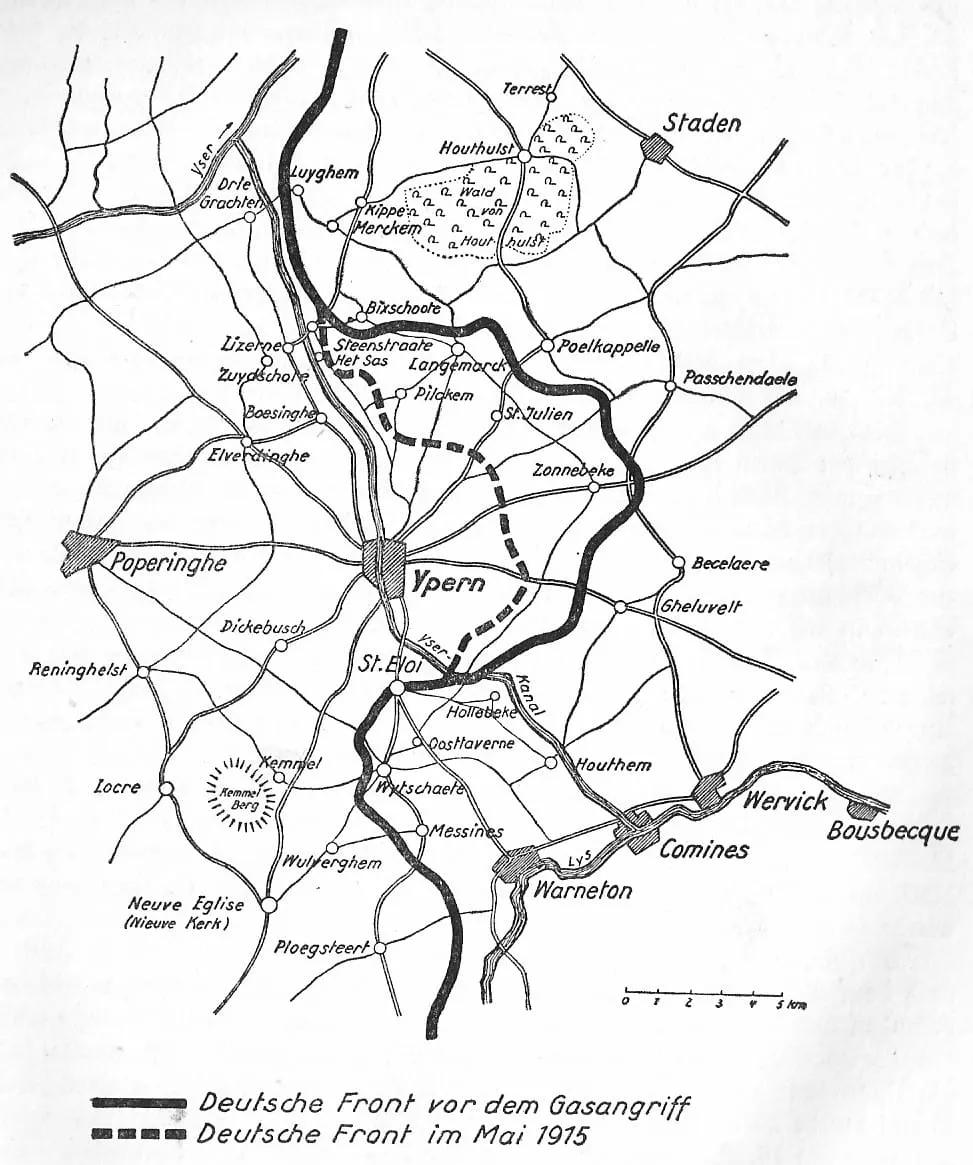
At 5.30 a.m. on 8 May 1915 the German artillery opened fire on the British trenches east of Ypres. It was one of the heaviest bombardments since the start of the Second Battle of Ypres. It struck hardest at the 28th Division, whose trenches lay on the exposed forward slope of the low Frezenberg Ridge. Before 10 a.m. the German infantry broke into the shattered line, and in the afternoon a gap more than 3 kilometres wide yawned in the British front. By evening it had been closed by the last reserves, sent into counter-attacks across open ground. So began the Battle of Frezenberg Ridge, which by British nomenclature lasted until 13 May.
The new line
Four days earlier the British had withdrawn from the tip of the salient to a new, shorter line. In the sector of General Edward Bulfin’s 28th Division the trenches were narrow, less than a metre deep, without dugouts or communication trenches, and work on the wire had barely begun. The Germans could see them from the higher ridges near Zonnebeke and Gravenstafel and from 4 May shelled them methodically. On 5 May they tried to take them by assault but were repulsed. That same day they retook Hill 60, at the southern edge of the salient, with gas.
There were also changes of command in the salient. On 6 May Field Marshal John French removed the commander of the Second Army, General Horace Smith-Dorrien, and on 7 May General Herbert Plumer took over the army. On the morning of 8 May Plumer ordered the troops to hold their positions stubbornly and not to count on reinforcements from the First Army, which was to begin its attack at Aubers the next day. The British had only a dozen or so heavy guns at Ypres, most of them obsolete and worn out, and little ammunition. Opposite them the German 4th Army had concentrated most of three corps and strong artillery.
The gap at Frezenberg
Between 7 and 9 a.m. the bombardment was so violent that it levelled most of the breastworks of the 83rd Brigade. The defenders still beat off the first two assaults, but when at about 10 a.m. the Germans attacked for the third time on both sides of the village of Frezenberg, almost no one in the front line was left alive. The brigade commander ordered a withdrawal to the support positions behind the ridge, but many soldiers did not receive the order and fought on until they were surrounded. Of the 2nd Battalion of the King’s Own, whose commanding officer was killed, fewer than a hundred men answered the evening roll call.
The Germans widened the gap in both directions. North of it stood the 84th Brigade. At 11.15 a.m. its commander sent his last reserve to help, the London Territorial battalion of the Rangers, by now only about two hundred strong. The battalion crossed the flat ridge under artillery fire and partly reached the front line, but at the evening roll call 53 of its men answered. Meanwhile the Germans were pushing deep into the gap and taking further trenches from the flank and rear. By evening the Germans had destroyed in turn the Cheshire and Suffolk battalions and the 1st Battalion of the Monmouthshire Regiment. The commanding officers of the Cheshire and Monmouthshire battalions were killed. Only the Northumberland Fusiliers battalion held on, at Mouse Trap Farm.
The Canadians on Bellewaarde Ridge
South of the breach, on Bellewaarde Ridge, stood the Canadian battalion Princess Patricia’s Canadian Light Infantry, formed in August 1914 from volunteers, most of them veterans of the British Army, and named after the daughter of the Governor General of Canada, Princess Patricia of Connaught. It fought as part of the British 27th Division, not with the rest of the Canadians, who had already left the salient after the April fighting. The bombardment destroyed its trenches and several machine-gun posts. When the German infantry advanced, the battalion’s commander, Major Hamilton Gault, sent signallers, pioneers, runners and orderlies into the trenches. The Canadians rebuilt the line three times and beat off attacks until the afternoon. Gault was wounded twice, and command passed from one officer to the next. The battalion’s colour, sewn by the princess with her own hands, was hit by bullets and shell fragments. By evening, of the several hundred soldiers who had been in the line in the morning, about 150 were left. Their defence, together with the neighbouring British King’s Royal Rifle Corps battalion and the remnants of the 83rd Brigade that held on at the edge of the breach, prevented the Germans from widening the gap to the south.
Counter-attacks
At about 2 p.m. a gap more than 3 kilometres wide yawned in the British front between the Canadians and Mouse Trap Farm. General Bulfin threw his last reserve, the 85th Brigade, into a counter-attack. Its battalions moved off after 3 p.m., but under artillery fire they did not reach the Germans, and some melted away to a few dozen men. In the evening, at about 7.30 p.m., battalions of the 4th Division arrived from the north side of the gap and advanced somewhat beyond the line of rear defences. Although neither attack recovered the lost trenches, they proved sufficient. The Germans were driven off the hill east of the village of Wieltje, and according to German accounts their corps gave up some of the ground they had won.
During the night the British established a new line behind Verlorenhoek Ridge, about 1.2 kilometres behind the morning’s front. The British official history judged that, apart from the losses in men, the day was not as disastrous as it had first seemed, because the lost ground was too exposed to be held. The losses were nonetheless enormous: eleven battalion commanders were killed or wounded that day, and many battalions were left with a few dozen men. A German communiqué spoke of about 800 prisoners taken at Ypres from 1 to 8 May. The 84th Brigade, withdrawn into reserve, could muster 1,400 men from its six battalions the next day.
Remember the articles you have read? Only in this browser; nothing is sent anywhere.How it works
Read ·
Spotted a mistake?Report an error
Meanwhile
(04)Elsewhere in the same days.
- 8 May 1915 · Eastern FrontBattle of Sanok and Rzeszów beginsOn 8 May 1915 the Russians, driven from the Wisłoka, tried to halt the Central Powers' pursuit on the Wisłok. They were to die in their positions, not retreat.
- 7 May 1915 · War at seaSinking of the LusitaniaOn 7 May 1915 U-20 torpedoed the British liner Lusitania off Ireland. Within 18 minutes almost 1,200 people died, including more than a hundred Americans.
- 7 May 1915 · DiplomacyGrey promises Serbia Bosnia and HerzegovinaAccording to the British chronology, on 7 May 1915 Sir Edward Grey assured Serbia's envoy that after victory Serbia would get Bosnia-Herzegovina and the sea.
- 7 May 1915 · Eastern FrontGermans occupy LibauOn 7 May 1915, supported by the fleet, the Germans entered Libau, a naval port in Courland. The Russian garrison withdrew, blowing up forts and depots.
Related events
(04)The same battle, people or subject.
- 13 May 1915 · Western FrontBattle of Frezenberg Ridge endsOn 13 May 1915 the Germans made their last attack at Ypres in the Battle of Frezenberg Ridge. Dismounted cavalry and British infantry held the front.
- 25 May 1915 · Western FrontEnd of the Battle of FestubertOn 25 May 1915 the London 47th Division took a German trench at Festubert and French decided to halt the offensive. Ten days of fighting cost 16,600 men.
- 4 May 1915 · Western FrontEnd of the Battle of St. JulienDuring the night of 3–4 May 1915 the British secretly left the tip of the Ypres salient. In the morning the Germans were still shelling empty trenches.
- 24 April 1915 · Western FrontBattle of St Julien beginsOn 24 April 1915 the Germans struck the Canadians at Ypres with chlorine. The 1st Canadian Division's front gave way, and in the afternoon St Julien fell.