Key event
Battle of St Julien begins
- Category:
- Military operations
- Front:
- Western Front
- Date:
- 24 April 1915
- Author:
- Łukasz Skowroń
- Battle:
- Battle of St. Julien
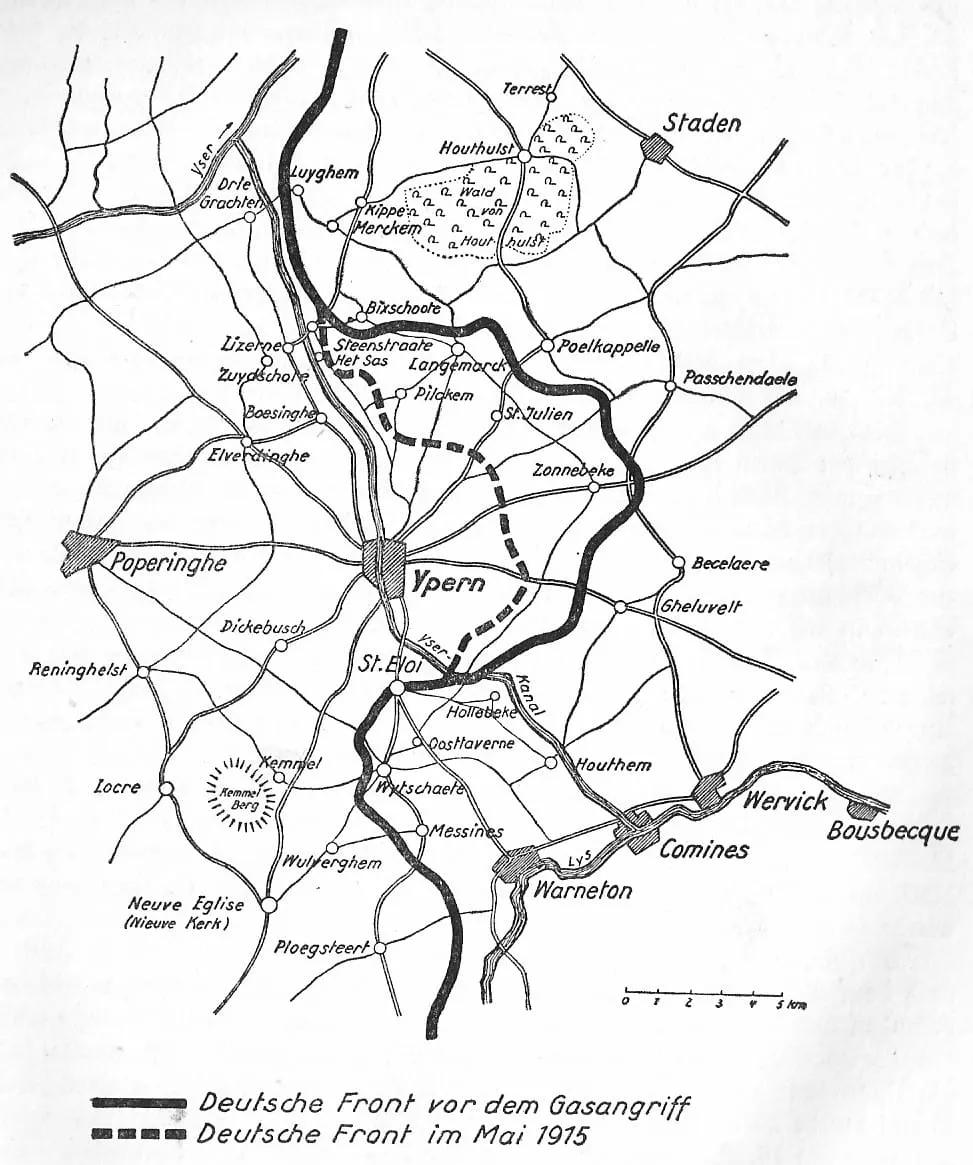
At dawn on 24 April 1915 the Germans released a cloud of chlorine near Ypres for the second time in three days. This time the gas drifted straight onto the trenches of the 1st Canadian Division, which since the evening of 22 April had been patching the gap left by the shattered French divisions. Behind the cloud came the infantry of the German reserve corps. The Canadians, gassed, fired on from three sides and fighting with rifles that jammed in action, fell back step by step all day. In the afternoon they lost the village of Sint-Juliaan, which the British called St Julien. It gave its name to the battle that began that day and, according to British nomenclature, lasted until 4 May.
The apex of the salient
After two days of fighting, described as the Battle of Gravenstafel Ridge, the Canadian front formed a sharp wedge. Its apex lay at the crossroads at Keerselare, where the road from Sint-Juliaan to Poelkapelle crossed the old front line. To the right of the crossroads, towards Gravenstafel Ridge, stood the 8th Battalion of General Arthur Currie’s 2nd Brigade, and to the left, on the line bent back towards Sint-Juliaan, the 15th Battalion of General Richard Turner’s 3rd Brigade. Further west, between Sint-Juliaan and the canal, stretched a thin line of Canadian and British battalions, gathered in haste after 22 April. Many units had already lost half their strength, and the men had not slept for two days and nights.
The second cloud
At about 4 a.m., after a short, heavy artillery bombardment, the Germans opened the cylinders opposite the apex of the salient. The cloud struck a sector several hundred metres wide, at the junction of the two Canadian brigades. The Canadians had no masks. The advice was passed along to cover the mouth and nose with handkerchiefs or pieces of cloth soaked in water, or, when there was none, in urine. It did little good. The worst hit was the 15th Battalion, made up of men of the Toronto regiment the 48th Highlanders, which was in the worst position in this sector: its flares calling for support went unanswered, because the battery that was to cover it had been moved. The battalion lost 647 men that day, more than two hundred of them taken prisoner. It was the heaviest loss suffered by a single Canadian battalion in a single battle in the whole war.
Lieutenant-Colonel Louis Lipsett’s 8th Battalion managed to hold most of its trenches, partly because one of its companies was beyond the reach of the gas and checked the attackers with flanking fire. Between the two battalions, however, the Germans broke into the Canadian line. Company Sergeant-Major Frederick Hall of the 8th Battalion was killed trying to carry a wounded man out of the line of fire, and Lieutenant Edward Bellew of the 7th Battalion kept up fire from two machine guns on a rise near Keerselare until his ammunition ran out. He then smashed the gun and, wounded, was taken prisoner. Both were awarded the Victoria Cross. The Canadians also complained about their Ross rifles, which in rapid fire jammed so badly that they had to be opened with a kick or a blow from an entrenching tool.
The fall of St Julien
Through the morning the front of the 3rd Brigade fell back southwards, towards Sint-Juliaan, and the German infantry advanced behind it, covered by artillery fire. The Canadian commanders, swamped with contradictory reports and orders, were losing their grasp of the situation. Turner, convinced that he was to hold the line in the rear, withdrew the remnants of his brigade to the so-called GHQ Line, a chain of fortified points about one and a half kilometres south-west of Sint-Juliaan. In doing so he exposed the left flank of Currie’s 2nd Brigade, which was still holding Gravenstafel Ridge. Currie himself rode to the rear to bring up British reinforcements. Canadian and British historians argued over who was responsible for the withdrawal of 24 April long after the war.
In the village and on its outskirts the remnants of several Canadian battalions held out to the end. In the afternoon, according to some accounts at about 3 p.m., when their ammunition ran out, the Germans occupied the ruins of Sint-Juliaan. The Canadians nevertheless held Gravenstafel Ridge, and in the rear, in front of the GHQ Line, the German advance was stopped by British battalions brought up in haste. According to Canadian figures 24 April was the division’s bloodiest day at Ypres: it lost 3,058 killed, wounded, gassed and taken prisoner that day.
The order to counter-attack
In the evening the British command ordered Sint-Juliaan to be retaken. The task was given to General Charles Hull, commander of the newly arrived 10th Brigade of the 4th Division, who was also given ten other battalions, most of them depleted in the preceding days. On the morning of 25 April his brigade advanced across open ground and was bled white by the fire of German machine guns. The village remained in German hands until the summer of 1917. In the following days most of the Canadians were relieved, and their place was taken by British and Indian divisions, which for more than another week fought for the northern edge of the Ypres salient.
Remember the articles you have read? Only in this browser; nothing is sent anywhere.How it works
Read ·
A voice from the front
“The Canadians and English who poured in from Ypres were terribly damaged, and the asphyxiating gas seems to have been simply diabolical. It was awful to see human beings so mangled, and I never get one bit accustomed to it. […] Many Canadians were there, and rows of British. God! how they were knocked about! The vast rooms echoed to the cries of pain.”
Spotted a mistake?Report an error
Meanwhile
(04)Elsewhere in the same days.
- 25 April 1915 · War at seaRussians bombard the Bosporus againOn 25 April 1915, the day of the Gallipoli landings, the Russian Black Sea Fleet shelled the Bosporus forts to tie down Turkish forces near Constantinople.
- 25 April 1915 · AfricaClash at GibeonIn late April 1915 General McKenzie's mounted troops caught the retreating Germans at Gibeon. A night ambush failed, but in the morning the Germans were routed.
- 26 April 1915 · DiplomacyItaly signs the Treaty of LondonOn 26 April 1915 Italy signed a secret pact with the Entente in London. In return for lands on the Adriatic it pledged to enter the war within a month.
- 26 April 1915 · War at seaInternment of the Kronprinz WilhelmOn 26 April 1915 the German auxiliary cruiser Kronprinz Wilhelm, the last Kaiserliche Marine raider then at large on the oceans, was interned at Newport News.
Related events
(04)The same battle, people or subject.
- 22 April 1915 · Western FrontBattle of Gravenstafel Ridge beginsOn the night of 22–23 April 1915 Canadians counter-attacked at Ypres to close the gas-attack gap. Of 1,500 men who charged the wood, under 500 were left.
- 25 May 1915 · Western FrontEnd of the Second Battle of YpresOn 25 May 1915 the Second Battle of Ypres died down. After five weeks of fighting and gas attacks the Germans had shrunk the salient but not taken Ypres.
- 22 April 1915 · Western FrontSecond Battle of Ypres beginsOn 22 April 1915 the Germans released a cloud of chlorine at Ypres. Two French divisions broke, and a gap several kilometres wide opened north of the town.
- 4 May 1915 · Western FrontEnd of the Battle of St. JulienDuring the night of 3–4 May 1915 the British secretly left the tip of the Ypres salient. In the morning the Germans were still shelling empty trenches.