Key event
Allies land at Gallipoli
- Category:
- Military operations
- Front:
- Middle East
- Date:
- 25 April 1915
- Author:
- Łukasz Skowroń
- Battle:
- Landing at Gallipoli
- Tags:
- Great Britain, Australia, Ottoman Empire, Dardanelles
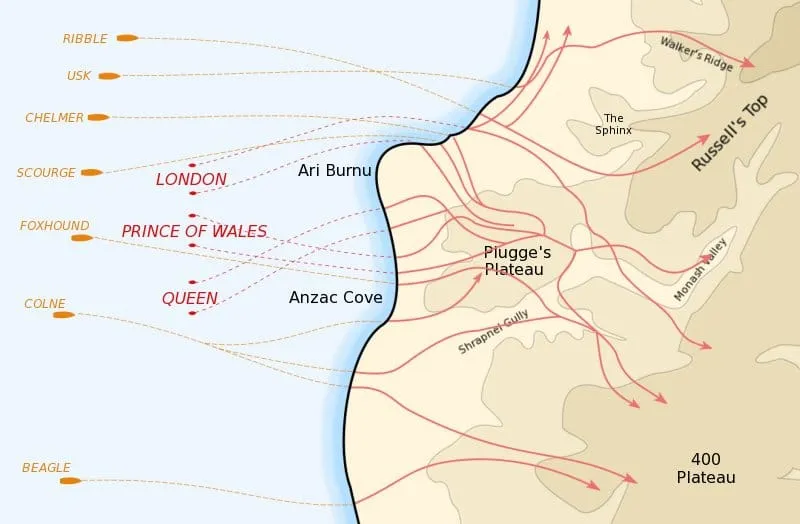
At dawn on 25 April 1915 Allied troops began landing on the Gallipoli peninsula. Five weeks after Turkish mines and forts had repulsed the fleet, General Ian Hamilton was trying to seize the shores of the Dardanelles with land forces. The British 29th Division landed on five beaches around Cape Helles, at the southern tip of the peninsula. The Australians and New Zealanders went ashore some twenty kilometres further north, on the west coast. The French put a force ashore on the Asian side of the strait, at Kum Kale, while ships carrying the Naval Division feigned a landing at the neck of the peninsula, at Bulair. It was the first day of the months-long Gallipoli campaign.
Before dawn
Hamilton had about 75,000 men. Preparations for the landing had been under way since he arrived at the Dardanelles on 17 March. The transports had to be reloaded in Egypt so that men and equipment would come off them in the order needed for the landing. The Turks made good use of the time. General Otto Liman von Sanders, who took command of the 5th Army at the end of March, concentrated his divisions inland and left only a few outposts on the coast. The beaches where a landing was expected were covered by the Turks with trenches, barbed wire and machine guns.
During the night of 24–25 April the fleet with the troops approached the shores of the peninsula. Hamilton watched the landing from the deck of the dreadnought Queen Elizabeth. The night was calm and the sea smooth. At the same time the Australian submarine AE2 was creeping through the minefields up the strait. That day it became the first Allied vessel to break through into the Sea of Marmara.
Anzac Cove
The first ashore were the Australians of Colonel Ewen Sinclair-MacLagan’s 3rd Brigade, the covering force of General William Birdwood’s ANZAC corps. Boats towed by steam pinnaces reached the shore at about 4.30 a.m., before sunrise. The times in the sources differ somewhat, from 4.10 to 4.32. In the darkness the boats drifted off course and landed roughly one and a half kilometres north of the planned spot near Gaba Tepe, at the foot of the Ari Burnu headland, in a small bay later named Anzac Cove. Instead of a gentle shore the men saw steep, scrub-covered slopes and a tangle of ravines. The shore here was guarded by only a few dozen Turks of the 27th Infantry Regiment. The Australians climbed the first hills with bayonets and pushed inland. The units, however, quickly became mixed up, and many officers did not know where they were.
At about 10 a.m. Lieutenant Colonel Mustafa Kemal, commander of the Turkish 19th Division, held in reserve near the village of Boghali, reached the Sarı Bair ridge. Without waiting for orders from his superiors, he led the 57th Infantry Regiment and a battery of artillery to the threatened sector. He stopped fleeing soldiers and threw his battalions into a counter-attack. According to his later recollections, he then told his men: “I do not order you to attack. I order you to die. In the time it takes us to die, other troops and commanders can come and take our places.” All day long fierce fighting raged for the hill the Australians called Baby 700, which changed hands several times. In the afternoon the Turks, reinforced by further regiments, drove the Australians and New Zealanders from their forward positions.
By nightfall some 16,000 men had come ashore. They held a beachhead less than three kilometres long and a few hundred metres deep. Both divisional commanders, Generals William Bridges and Alexander Godley, judged that their exhausted and decimated units would not survive another day of shelling and asked for evacuation. Birdwood passed the request on to Hamilton. The sailors, however, judged that re-embarking the troops was almost impossible. During the night Hamilton replied that they must dig in and stick it out: “dig, dig, dig, until you are safe”. He added that the Australian submarine had got through into the Sea of Marmara.
Five beaches at Helles
At the southern tip of the peninsula the British 29th Division of General Aylmer Hunter-Weston landed in daylight, after a bombardment from the ships. The beaches were designated by letters. On the two main ones, V and W, on either side of Cape Helles, tragedy unfolded.
V Beach lay below the old castle by the village of Sedd el Bahr. It was defended by roughly one company of Turkish infantry with four machine guns. When at about 6.30 a.m. the boats carrying the 1st Battalion, Royal Dublin Fusiliers approached the shore, the Turks opened fire at close range. Many men were killed in the boats, others drowned under the weight of their equipment. Alongside, the old collier River Clyde ran aground with about 2,000 men, chiefly of the 1st Battalion, Royal Munster Fusiliers and two companies of the Hampshire Regiment. Openings had been cut in her sides through which the men were to run down gangways onto lighters arranged as a bridge to the shore. Commander Edward Unwin and a few sailors, standing waist-deep in the water under fire, tried to hold the lighters in place. Company after company that came out of the hull was cut down on the gangways. By evening few men had landed on V Beach, and those who survived lay pinned down behind a low bank. General Henry Napier, commander of the 88th Brigade, was killed there. At about 10.20 a.m. Hamilton ordered the rest of the troops intended for V Beach to be diverted to W Beach.
On W Beach, later named Lancashire Landing, the 1st Battalion, Lancashire Fusiliers landed straight onto intact wire entanglements under fire from three sides. Despite enormous losses the men cut the wire and seized the heights above the beach. Six Victoria Crosses were awarded for this landing, which passed into British tradition as the “six VCs before breakfast”. On the lightly defended X and S Beaches the landing succeeded and losses were small. Furthest north, on Y Beach, two battalions landed unopposed. Their commanders, however, had no orders to advance inland. One of them, Lieutenant Colonel Godfrey Matthews, walked with his adjutant almost to the village of Krithia without meeting the enemy. In the afternoon the men began to dig in on top of the cliff, waiting for an advance from the direction of Helles that never came. In the evening the Turks attacked Y Beach.
Across the whole Helles sector the British had put more than twelve battalions ashore by midday against at most two Turkish battalions. Communications were lacking, however, and divisional headquarters was on board ship. By evening none of the first day’s objectives, neither the village of Krithia nor the hill of Achi Baba, had been reached.
Kum Kale and Bulair
On the Asian side of the strait French and British battleships and the Russian cruiser Askold shelled the area around the old fort of Kum Kale from dawn. The strong current flowing out of the Dardanelles delayed the landing, and the French 6th Mixed Colonial Regiment, which also included Senegalese tirailleurs, did not get ashore until shortly before noon. The French quickly took the fort and the village, but the advance inland stalled. During the night they beat off Turkish counter-attacks. The landing at Kum Kale was only meant to distract the Turks, and the troops of the Expeditionary Corps of the Orient were soon to join the British on the peninsula. Meanwhile in Besika Bay, further south, French transports feigned another landing.
In the north, in the Gulf of Saros, ships shelled the Bulair isthmus all day, and boats were lowered from the transports of the Naval Division as if troops were about to land. During the night Lieutenant Commander Bernard Freyberg, the future general and commander of the New Zealand forces in the Second World War, swam ashore and lit flares on the beach to simulate a landing. Liman von Sanders had long feared an attack precisely at Bulair and went there to watch the ships. Only later did he begin sending troops from there to the south.
The day’s toll
On the evening of 25 April the Allied troops were holding on at several points on the coast, but they had taken none of their main objectives. The exact number killed on the first day is not known. At Helles the British are estimated to have lost about 2,000 men before midday. At Anzac Cove, according to the Commonwealth War Graves Commission, 754 Australians and 147 New Zealanders were killed on 25 April, and about 2,000 were wounded. The Turks also suffered heavy losses: the 27th and 57th Regiments alone, which fought the Australians, are estimated to have lost about 2,000 men, roughly half their strength.
The fighting continued the next day. V Beach and the village of Sedd el Bahr were not taken until 26 April, and the troops on Y Beach were evacuated the same day. In Australia and New Zealand 25 April became a national day, observed as Anzac Day. In Turkey the defence of the peninsula and the figure of Mustafa Kemal, the future founder of the Turkish Republic, are among the most important national symbols.
Remember the articles you have read? Only in this browser; nothing is sent anywhere.How it works
Read ·
Voices from the front
“Watching these gallant souls from the safety of a battleship gave me a hateful feeling: Roger Keyes said to me he simply could not bear it. […] But, from the battleship, you are outside the frame of the picture. The thing becomes monstrous; too cold-blooded; like looking on at gladiators from the dress circle.”
“There were scores of casualties awaiting treatment, some of them horribly knocked about. It was my first experience of such a number of cases. In civil practice, if an accident took place in which three or four men were injured, the occurrence would be deemed out of the ordinary: but here there were almost as many hundreds, and all the flower of Australia.”
Spotted a mistake?Report an error
Meanwhile
(04)Elsewhere in the same days.
- 25 April 1915 · AfricaClash at GibeonIn late April 1915 General McKenzie's mounted troops caught the retreating Germans at Gibeon. A night ambush failed, but in the morning the Germans were routed.
- 26 April 1915 · DiplomacyItaly signs the Treaty of LondonOn 26 April 1915 Italy signed a secret pact with the Entente in London. In return for lands on the Adriatic it pledged to enter the war within a month.
- 26 April 1915 · War at seaInternment of the Kronprinz WilhelmOn 26 April 1915 the German auxiliary cruiser Kronprinz Wilhelm, the last Kaiserliche Marine raider then at large on the oceans, was interned at Newport News.
- 26 April 1915 · War at seaSinking of the cruiser Léon GambettaDuring the night of 26–27 April 1915 the Austro-Hungarian submarine U-5 sank the French cruiser Léon Gambetta at the mouth of the Adriatic. 684 men died.
Related events
(04)The same battle, people or subject.
- 21 August 1915 · Middle EastAttack on Scimitar HillOn 21 August 1915 the British attacked the hills above Suvla Bay. Twice they took the top of Scimitar Hill, but lost 5,300 men and returned to their positions.
- 8 May 1915 · Middle EastEnd of the Second Battle of KrithiaOn 8 May 1915 New Zealanders, Australians and French renewed the attack on Krithia. Thousands of killed and wounded bought gains measured in hundreds of metres.
- 9 August 1915 · Middle EastDecisive day of the Battle of Sari BairOn 9 August 1915 Major Allanson's Gurkhas broke onto the Sari Bair ridge, but under fire from unknown guns they had to come down. The Anzac offensive failed.
- 25 March 1915 · Middle EastLiman von Sanders takes command at the DardanellesAt the end of March 1915 Enver Pasha gave General Otto Liman von Sanders the new 5th Army, tasked with defending the Dardanelles and the Gallipoli peninsula.