1915: The Dardanelles
Landing at Gallipoli
- Dates:
- 25–26 April 1915
- Front:
- Middle East
- Location:
- Gallipoli peninsula (Cape Helles and Anzac Cove), the Bulair isthmus and Kum Kale on the Asian shore of the Dardanelles, Ottoman Empire (today Turkey)On the battle map →
- Sides:
- United Kingdom, Australia, New Zealand and FranceIan Hamilton, John de Robeck, Aylmer Hunter-Weston, William Birdwood, Albert d'AmadeOttoman EmpireOtto Liman von Sanders, Esat Pasha, Halil Sami, Mustafa Kemal
- Result:
- The Allies established two bridgeheads, at Helles and at Anzac Cove, but took neither the hill of Achi Baba nor the Sarı Bair ridge. The landing at Kum Kale ended in a planned withdrawal.
- Author:
- Łukasz Skowroń
The landing on the Gallipoli peninsula was the largest amphibious operation of the First World War. On 25 April 1915 General Ian Hamilton’s Mediterranean Expeditionary Force went ashore at two main points: the British 29th Division around Cape Helles at the southern tip of the peninsula, and the Australian and New Zealand corps on the west coast, in a cove later named Anzac Cove. The French landed briefly at Kum Kale, on the Asian shore of the strait, while at Bulair and in Besika Bay warships feigned further landings. The Allies held on to the shore, but at the cost of heavy losses, and they did not take the hills that were to open their way to the Narrows of the Dardanelles. The Gallipoli campaign had begun, and it lasted until January 1916.
Name and dates
This page covers the first two days of the landing, 25 and 26 April 1915, up to the capture of Sedd el Bahr, the evacuation of Y Beach and the decision to withdraw the French from Kum Kale. British lists of battles separate the Landing at Helles and the Landing at Anzac, while the Turks speak of the fighting at Seddülbahir and Arıburnu. Times are given in local time.
Background
After the failed naval attack of 18 March Admiral John de Robeck and General Hamilton concluded that the strait could not be forced unless troops occupied its shores. Hamilton had about 75,000 men at his disposal: the British 29th Division, the last division of the regular army, the Royal Naval Division, the two divisions of General William Birdwood’s ANZAC corps and General Albert d’Amade’s French Corps expéditionnaire d’Orient. Because the transports had been loaded in haste and with no thought of a landing, the troops sailed first to Egypt, where the ships were repacked. Only in the second half of April did the army assemble in Mudros Bay on Lemnos.
The Turks had a whole month for their preparations. The defence of the Dardanelles was entrusted to the Fifth Army of General Otto Liman von Sanders, who took command at the end of March. Liman believed that the most dangerous would be a landing on the Bulair isthmus at the neck of the peninsula or on the Asian shore, and he sent most of his forces there. The southern part of the peninsula, from Suvla Bay to Sedd el Bahr, was defended by Colonel Halil Sami’s 9th Division of Esat Pasha’s III Corps. Behind it, near the village of Boghali, stood the 19th Division of Lieutenant-Colonel Mustafa Kemal in reserve. On the coast the Turks left only weak outposts, backed by trenches, wire and machine guns at the places most suitable for landing.
Plan
Hamilton decided to strike at two places simultaneously and to mislead the enemy with two demonstrations. General Aylmer Hunter-Weston’s 29th Division was to land on five beaches around Cape Helles, marked with the letters S, V, W, X and Y, where the warships could support it with fire from three sides. On the first day it was to take the village of Krithia and the hill of Achi Baba that overlooked it, and then the Kilid Bahr plateau, from which the forts at the Narrows could be seen. The ANZAC corps was to land before dawn, without artillery preparation, between the headland of Gaba Tepe and a fisherman’s hut to the north, seize the Sarı Bair ridge and advance towards Maidos (today Eceabat) to cut off the Turks defending the south of the peninsula. A French regiment was to land at Kum Kale and for a time pin down the Turkish batteries on the Asian shore, while the Royal Naval Division feigned a landing at Bulair.
Course of events: 25 April
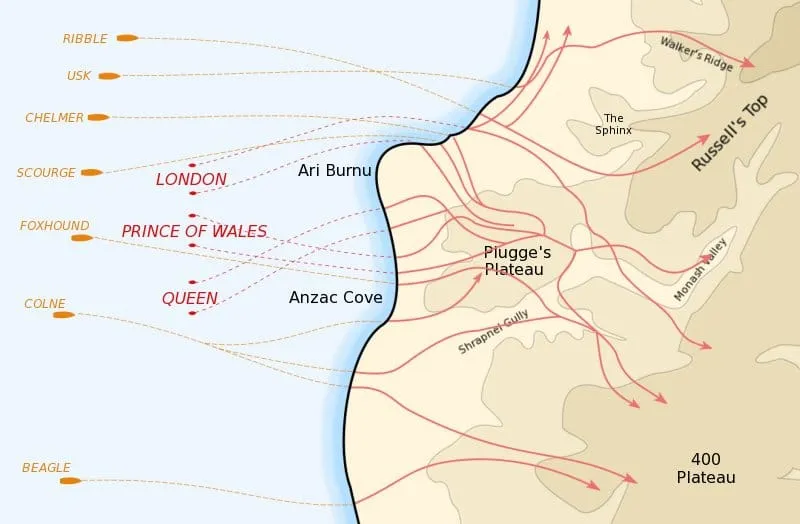
Anzac Cove. The first boats with the Australian 3rd Brigade reached the shore at about 4.30 a.m., in darkness. Carried by the current or badly steered, they landed roughly a mile and a half north of the planned spot, below the point of Ari Burnu, at the foot of steep hills cut by ravines. The resistance of a few dozen Turkish soldiers was quickly broken, but in the difficult terrain the units became scattered. In the morning Mustafa Kemal arrived at the threatened sector with the 57th Infantry Regiment and on his own initiative went over to the counter-attack. All day long fighting raged for the hill of Baby 700 and the plateau later named 400 Plateau. By evening about 16,000 men had gone ashore, but they held only a narrow bridgehead on the first ridges. In the evening the divisional commanders, Generals William Bridges and Alexander Godley, asked for an evacuation. Hamilton, after consulting the sailors, ordered them to stay and dig in.
Helles. On V Beach below Sedd el Bahr the Turks shot to pieces at close range the boats carrying the 1st Battalion, Royal Dublin Fusiliers, and the soldiers coming out of the hull of the collier River Clyde, which had been run aground. On W Beach the 1st Battalion, Lancashire Fusiliers broke through the wire and seized the heights above the shore at the cost of huge losses. On S, X and Y Beaches the landing met almost no resistance. There was, however, a lack of communication and initiative: divisional headquarters was on the cruiser Euryalus, and the commanders on the secondary beaches were to wait for the advance from the main beaches. By noon the British had more than twelve battalions ashore against at most two Turkish ones, but they did not exploit this superiority. In the evening and during the night the Turks attacked Y Beach.
Kum Kale and Bulair. The French 6th Mixed Colonial Regiment, delayed by a strong current, went ashore before noon under the cover of French battleships, the British Prince George and the Russian cruiser Askold. The French took the fort and village of Kum Kale, but their advance on Yeni Şehir stalled. At Bulair warships shelled the coast all day, and boats from the Royal Naval Division’s transports feigned a landing. Liman, convinced that the main blow would fall precisely there, went to watch the Gulf of Saros and only later began sending troops from there to the south.
Course of events: 26 April
At dawn the soldiers on V Beach, supported by the fire of the battleship Albion, advanced on the village of Sedd el Bahr, the old castle and the hill the British called Hill 141. The attack was led by two staff officers who had gone ashore from the River Clyde during the night, Lieutenant-Colonel Charles Doughty-Wylie and Captain Garth Walford. After several hours of house-to-house fighting, around noon or early in the afternoon, the hill was taken. Both officers were killed and both received the Victoria Cross posthumously. The Turks withdrew towards Krithia, and the troops from V, W and X Beaches joined up into a single front across the end of the peninsula.
On Y Beach the soldiers of the 1st Battalion, King’s Own Scottish Borderers and the Plymouth Battalion of the Royal Marines beat off Turkish attacks all night. They sat in shallow trenches less than half a metre deep, lost nearly 700 men, and towards morning began to run short of ammunition. When boats came in the morning to take off the wounded, some of the soldiers concluded that a general evacuation had begun. Although the last Turkish attack was driven off with the bayonet, by about 11 a.m. the whole force had left the beach. The Turks, who had also suffered heavy losses, did not interfere with the withdrawal. Many historians regard the abandonment of Y Beach as one of the greatest missed opportunities of the campaign, because the soldiers there stood in the rear of the Turkish defence of Helles.
At Kum Kale on the morning of 26 April the Turks took the cemetery near the village. Then a group of Turkish soldiers came forward with white flags and laid down their arms, but in the confusion, during the negotiations, a French officer, Captain Roeckel, was seized, and the Turks occupied several houses and two machine guns. The French regarded the surrender as a ruse and shot nine prisoners in reprisal. That same day Hamilton and d’Amade decided to end the demonstration. The re-embarkation began late in the evening of 26 April, and the next day the French landed at Helles and took over the right wing of the front. At Anzac Cove 26 April brought no major changes. Under constant fire the Australians and New Zealanders dug in on the bridgehead, while the Turks brought up reinforcements. The first strong Turkish counter-attack there came on 27 April.
Losses
The exact losses of the first two days are not known. At Helles the British are estimated to have lost about 2,000 men before noon on 25 April alone, most of them on V and W Beaches. Of the roughly 700 Royal Dublin Fusiliers who landed from the boats, about 300 were killed and many others wounded. The 29th Division lost two of its three brigade commanders, including General Henry Napier, killed on V Beach, and most of the senior officers of the covering battalions. According to the Turkish official history, the five Turkish battalions defending the south of the peninsula lost 1,898 men by the morning of 27 April.
At Anzac Cove, according to the Commonwealth War Graves Commission, 754 Australians and 147 New Zealanders were killed on 25 April, and about 2,000 wounded were evacuated on the first day. The Turkish 27th and 57th Regiments are estimated to have lost about 2,000 men, roughly half their strength. At Kum Kale the French lost 778 killed, wounded and missing, and the Turks about 1,730, including about 500 missing, most of them taken prisoner.
Significance
The landing of 25 April succeeded in so far as the Allies held on to the shore. They did not, however, reach their objectives either at Helles or at Anzac Cove. The hill of Achi Baba and the Sarı Bair ridge remained in Turkish hands, and with them command of the ground and of the roads to the Narrows. The British official history named as the main causes of the failure the lack of communication between the troops on the beaches and the command on the ships, the rigidity of a plan that made no provision for exploiting success on the secondary beaches, and the exceptionally high losses among officers. The Turks, although much weaker, defended themselves skilfully from prepared positions and quickly brought up their reserves. Liman von Sanders later wrote that the situation had been saved by the immediate and independent action of Mustafa Kemal’s 19th Division.
As early as 28 April Hunter-Weston made the first attempt to take Krithia and the hill of Achi Baba. Trench warfare began on the peninsula, similar to that on the Western Front, and the landing, which was to have been the prelude to a swift march on Constantinople, turned into a campaign of attrition. In Australia and New Zealand 25 April is commemorated as Anzac Day, one of the most important days of national remembrance. In Turkey the fighting for the peninsula became the source of the legend of Mustafa Kemal, the future founder of the Republic of Turkey.
Spotted a mistake?Report an error