1915: The Dardanelles
First Battle of Krithia
- Dates:
- 28 April 1915
- Front:
- Middle East
- Location:
- Southern part of the Gallipoli peninsula, between Cape Helles, the village of Krithia (today Alçıtepe) and the hill of Achi Baba, Ottoman Empire (today Turkey)On the battle map →
- Sides:
- United Kingdom and FranceIan Hamilton, Aylmer Hunter-Weston, Albert d'AmadeOttoman EmpireOtto Liman von Sanders, Halil Sami
- Result:
- Ottoman defensive victory. The Allies took neither Krithia nor the hill of Achi Baba, and the front moved only slightly.
- Author:
- Natalia
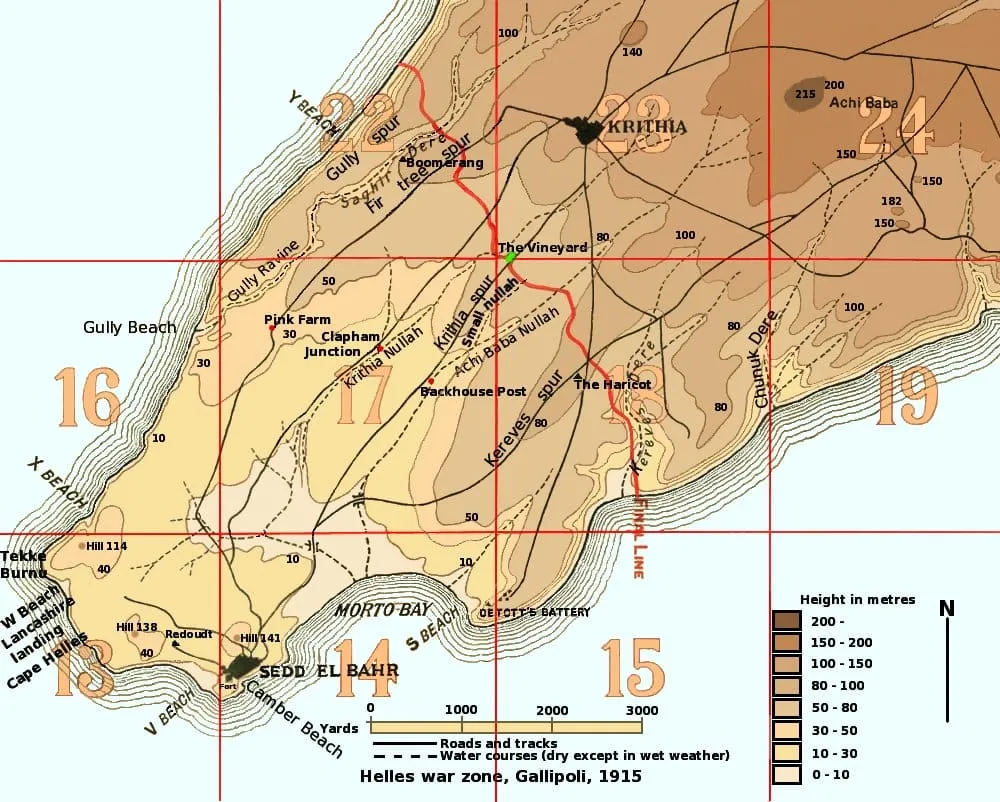
The First Battle of Krithia was the Allies’ first attempt to break out of the bridgehead they had won at Helles on the southern tip of the Gallipoli peninsula. On 28 April 1915 the British 29th Division and the French Expeditionary Corps of the Orient attacked the village of Krithia and the hill of Achi Baba, from which the Dardanelles strait could be seen. The Turks had fewer men, but they defended themselves fiercely and were receiving reinforcements. The British and French troops, exhausted by the fighting on the beaches, did not reach their objective, and in the evening the attack was called off. The battle dispelled hopes of a quick capture of the peninsula.
Name and dates
In British historiography the battle is called the First Battle of Krithia, in Turkish Birinci Kirte Muharebesi. The Greek village of Krithia, Kirte in Turkish, is today called Alçıtepe, as is the hill above it that Allied soldiers called Achi Baba. The Polish edition of this page uses the Polonised form Kritia. The battle lasted one day, 28 April 1915. The Allies attacked at Krithia twice more: in the second battle from 6 to 8 May and in the third on 4 June 1915.
Background
On 25 April 1915 General Ian Hamilton’s Mediterranean Expeditionary Force landed on the Gallipoli peninsula. At Helles General Aylmer Hunter-Weston’s British 29th Division was to take Krithia and Achi Baba on the first day, but after bloody fighting on V and W Beaches it barely held on to the shore. Only on 26 April did it take the village of Sedd el Bahr and join the bridgeheads into a single front across the tip of the peninsula. The same day Y Beach, on the west coast level with Krithia, was evacuated. On 27 April the British, meeting no resistance, moved the front about three kilometres north, because the Turks had withdrawn to new positions. General Albert d’Amade’s French, who the day before had ended their demonstration at Kum Kale on the Asian shore, took over the right flank, by the strait itself.
Hamilton wanted to strike as soon as possible, before the Turks brought up reinforcements. The state of his troops, however, was poor. On the beaches the 29th Division had lost two of its three brigade commanders and most of the senior officers of the covering battalions, and some battalions, such as the Royal Dublin Fusiliers and the Royal Munster Fusiliers, had been decimated. The men had hardly slept for three days. Few guns had yet been landed, and for lack of pack animals the infantry carried water, food and ammunition themselves. Hamilton’s staff also believed that considerable Turkish forces stood in front of Krithia, although in reality it was defended by depleted, tired units.
On the Turkish side the south of the peninsula was defended by Colonel Halil Sami’s 9th Division. Its 25th and 26th Regiments, which had been repelling the landing since 25 April, had lost nearly half their strength. General Otto Liman von Sanders, commander of the Fifth Army, had by now realised that the landing at Bulair was only a demonstration, and he sent south the 19th and 20th Regiments of the 7th Division and a gendarmerie battalion from Bursa. According to Turkish studies, on 28 April Halil Sami had about nine battalions at his disposal, and the Allies 19. Some of the Turkish reinforcements reached the front only during the battle.
Plan
Hunter-Weston, who commanded all the forces at Helles, prepared a plan based on wheeling the front. The French on the right flank, by the strait, were to advance slowly and form the pivot, while the British on the left swung round in an arc to the north and north-east. The 87th Brigade on the far left, along the Aegean coast, was to take the hills north and north-west of Krithia. The 88th Brigade in the centre was to take the village itself. The exhausted 86th Brigade formed the reserve. The troops were then to attack Achi Baba from the west and south. The plan was complicated, and the orders reached the brigade and battalion commanders late and in incomplete form. Many officers did not really know where they were supposed to go, and the maps were inaccurate.
Course of the battle
The battle began at about 8 a.m. with a bombardment from the ships. The fire of the land artillery was weak, because only a few dozen guns had so far been put ashore. At about 9 a.m. the infantry moved forward. At first the attack went easily and the Turks fell back from their forward positions. Soon, however, the soldiers ran into pockets of resistance and into four deep gullies through which water ran down from the slopes of Achi Baba to the sea. As some units got stuck while others pressed on, the front broke apart and the attackers exposed their own flanks.
On the left flank two battalions of the 87th Brigade, the 1st Battalion of the Border Regiment and the 1st Battalion of the Royal Inniskilling Fusiliers, entered Gully Ravine. The ground here was wild and tangled, resembling the hills above Anzac Cove. The battalions were stopped by the fire of a Turkish machine gun placed on a cliff near the abandoned Y Beach. It could not be taken until the night of 12/13 May, when the Gurkhas climbed up to it. According to British accounts a Turkish counter-attack on the ridge above the ravine was broken up by the guns of the dreadnought Queen Elizabeth – a single 15-inch (381 mm) shrapnel shell was said to contain about 13,000 balls.
In the centre the 88th Brigade advanced towards Krithia and, at the point where the Turkish 19th and 20th Regiments met, for a time threatened to break through the front. Halil Sami threw in his last reserves there, a depleted battalion of the 25th Regiment and a battalion of the 15th Regiment, and by about 10–11 a.m. had brought the situation under control. On the right flank French battalions pushed back Lieutenant Colonel Kadri Bey’s tired Turkish 26th Regiment and at about noon began to enter the Turkish positions. The Turkish 19th Regiment, which was to relieve the defenders here, had lost its way in the night and, several hours late, was stuck under the ships’ fire far behind the front. Halil Sami had already ordered a retreat on the left flank when, according to Turkish studies, Major Mahmut Sabri, the commander of the battalion that had defended V Beach on 25 April, led a bayonet counter-attack against the French with a reserve of about 800 men, gathering retreating soldiers on the way. The French units, including Senegalese tirailleurs, fell back in disorder, and Halil Sami cancelled the order to retreat.
The French withdrawal exposed the right flank of the British. In the afternoon, from about 3 p.m., British and French units began to fall back, in places all the way to the positions they had left in the morning. Men were collapsing from exhaustion, ammunition had to be carried up from the beaches, and many battalions were now commanded only by junior officers. Hunter-Weston directed the battle from afar and had almost no influence on its course. At about 6 p.m. the attack was called off. The troops dug in on positions only slightly in advance of the line of 27 April, still several kilometres short of Krithia.
Casualties
About 14,000 Allied soldiers took part in the attack. According to the British official history the British lost about 2,000 killed, wounded and missing, and the French 1,001. According to Turkish sources the losses of the 9th Division and its reinforcements were 2,378 men. These figures come from different studies and should be treated as approximate.
Significance
The battle lasted only one day and was small compared with the later fighting, but it was of great importance. It showed that the assumption that the Turks were a weak opponent who could be routed with a single blow was wrong. The chance of a quick capture of Achi Baba, which still existed on 25 April, when the village of Krithia was almost undefended, was gone. The Turks gained time to bring up more divisions.
On the nights of 1/2 May and 3/4 May the Turks themselves went over to the attack at Helles, but suffered heavy losses. On 6–8 May Hamilton, reinforced by brigades brought over from Anzac Cove and new French units, made a second attempt to take Krithia, again without success. Trench warfare set in at Helles, in which success was measured by the capture of a single trench or an advance of a few dozen metres. The village of Krithia and the hill of Achi Baba remained in Turkish hands until the end of the campaign.
Spotted a mistake?Report an error