United Kingdom · The Entente
Ian Hamilton
Commander of the Mediterranean Expeditionary Force at Gallipoli (March–October 1915), general
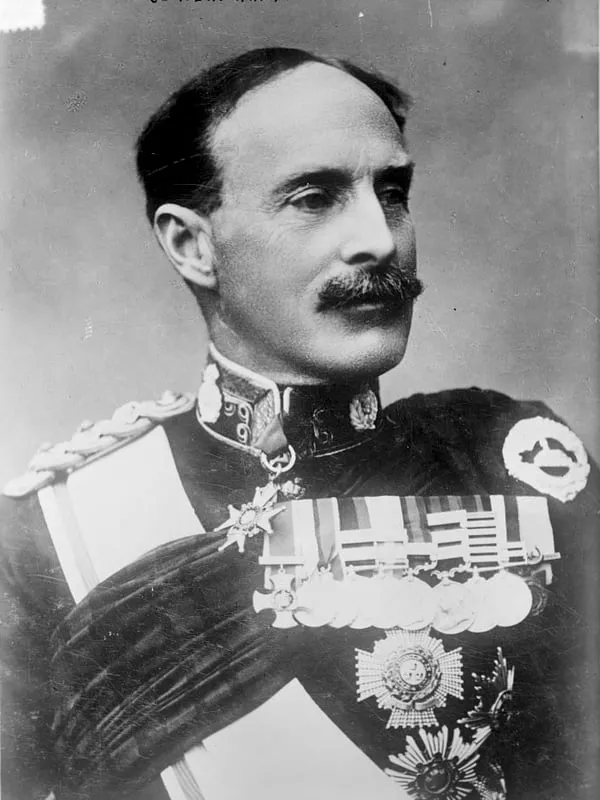
- Born:
- 16 January 1853, Corfu (Ionian Islands)
- Died:
- 12 October 1947, London
- Author:
- Łukasz Skowroń
- Photo:
- P. S. Rogers, domena publiczna, Wikimedia Commons

Sir Ian Hamilton was one of the most experienced and best-read British generals of his age. He fought on several continents, wrote poems and novels, spoke German and French, and watched the Russo-Japanese War at close quarters as an observer with the Japanese army. In March 1915 Lord Kitchener gave him command of the troops that were to help the fleet force its way through the Dardanelles. For seven months Hamilton conducted a campaign on the Gallipoli peninsula that was meant to open the road to Constantinople and ended as one of the Entente’s most painful defeats. In October 1915 the government recalled him, and he never again held a command in the field. Historians still argue over how much of the blame for the disaster was his and how much belonged to the politicians, who gave him too few men, too little ammunition and too little time.
Before the war
He was born on 16 January 1853 on Corfu, which was then a British protectorate. His father was an officer in the Scottish regiment the Gordon Highlanders; his mother, a daughter of the Irish Viscount Gort, died when Ian was three. He was educated at Wellington College, then for a time by a retired Hanoverian general in Germany, and in 1871 he passed out of the military college at Sandhurst. After a short spell in the Suffolk Regiment he transferred to the Gordon Highlanders, with whom he went to India.
He learned his trade in almost every colonial war of the late Victorian era. He fought in the Second Anglo-Afghan War, and in 1881, during the First Boer War, he was badly wounded at the battle of Majuba Hill and briefly taken prisoner. The wound left his left hand almost useless. He then took part in the Nile Expedition to relieve Khartoum, in the war in Burma and in expeditions on India’s North-West Frontier, where he commanded a brigade in the Tirah campaign. He belonged to the circle of protégés of Lord Roberts, Commander-in-Chief in India and later of the whole army. In 1887 he married Jean Muir, the daughter of a wealthy Glasgow merchant.
In the Second Boer War he commanded infantry at Elandslaagte, defended one sector of besieged Ladysmith, and then led a column of mounted infantry on the march to Pretoria, which a young correspondent, Winston Churchill, described in a book of dispatches. He was twice recommended for the Victoria Cross, but was refused both times, once on account of his age and once on account of his rank. At the end of the war he was Kitchener’s chief of staff. In 1904–1905 he observed the Russo-Japanese War with the Japanese army in Manchuria. He came away convinced that cavalry was losing its importance, but also that high morale would allow infantry to take even strongly fortified positions. He then commanded Southern Command, was Adjutant-General of the army, and from 1910 Inspector-General of Overseas Forces and commander in the Mediterranean. In the summer of 1914 his term was coming to an end.
1914: home defence
On the outbreak of war Hamilton took command of the home army, made up mainly of Territorial units, which was to repel any German landing on the east coast of England. He was considered too unconventional, too intellectual and too close to politicians to be given a command in France. Even so, on 1 November 1914, in the critical days at Ypres, Kitchener proposed to Joffre that he should replace John French. Joffre refused and Hamilton stayed at home.
1915: the Dardanelles
At the beginning of March 1915, while the fleet was bombarding the Dardanelles forts, Churchill, as First Lord of the Admiralty, asked that Hamilton be the one to take command of the land forces in the Mediterranean. On 12 March Kitchener summoned him to his office and told him of the appointment. His instructions were very general, knowledge of the enemy was scant and his staff was incomplete: the officers responsible for supply and personnel were to follow later. Hamilton arrived at the Dardanelles on 17 March, on the eve of the fleet’s great attack, and on 18 March watched it fail. Together with Admiral John de Robeck he concluded that the ships would not get through the straits until the army held their shores.
Over five weeks Hamilton then prepared the largest landing yet attempted. He had no special landing craft and no soldiers trained for such operations, and the supply ships had to be reloaded in Egypt. On 25 April his roughly 75,000 men went ashore in two main places: the British 29th Division around Cape Helles, and General William Birdwood’s Australians and New Zealanders in the cove later called Anzac. Hamilton watched the landing from the dreadnought Queen Elizabeth. When during the night Birdwood suggested evacuating the threatened beachhead, Hamilton wrote back that the men should dig “until you are safe”. His critics blame him for failing to exploit in the morning the success at Y Beach, where troops had landed unopposed, and for trusting too much in the tired commander of the 29th Division, General Aylmer Hunter-Weston.
The Turkish forces of Otto Liman von Sanders and of commanders such as Mustafa Kemal stopped the Allies just short of the shore. The First, Second and Third Battles of Krithia, fought in broad daylight against machine guns and with a chronic shortage of shells, brought the British no closer to the hill of Achi Baba. Hamilton reported the difficulties to Kitchener, but asked for reinforcements cautiously and with an optimism that London read as confidence of success. In June the Dardanelles Committee decided to send him new divisions.
Suvla and recall
For August Hamilton prepared a great offensive. From the Anzac beachhead the Sari Bair ridge was to be taken by night, and at Suvla Bay the new IX Corps was to be landed and seize the surrounding hills. The plan was bold and surprised the Turks, but those who carried it out let it down. The commander of IX Corps, General Frederick Stopford, then over sixty, who had never before commanded troops in battle, directed the landing from on board ship, while his divisions stood idle on the beach as the Turks brought up reinforcements. Hamilton, who did not want to interfere in his subordinates’ decisions, reached Suvla only on the evening of 8 August, because his destroyer had boiler trouble. When he finally ordered an attack it was too late: the Turks were already on the Tekke Tepe ridge. On 15 August he removed Stopford, and the fighting for Scimitar Hill closed the offensive. In the first four days losses exceeded 25,000 men.
From then on London’s confidence in Hamilton ebbed away. In September the Australian journalist Keith Murdoch carried off the peninsula a letter from the correspondent Ellis Ashmead-Bartlett criticising the command, and after it was confiscated in Marseilles he wrote his own, even harsher letter to the Prime Minister of Australia. The Prime Minister, H. H. Asquith, circulated it to members of the cabinet. On top of this came the report of the dismissed Stopford, who blamed GHQ. In October, when Bulgaria entered the war and some of the troops sailed for Salonika, Kitchener asked Hamilton how many men he would lose in an evacuation. The general replied that it could be as many as half. On 14 October the Dardanelles Committee decided to recall him, and Hamilton read the telegram on the morning of 16 October on the island of Imbros. His successor, General Charles Monro, almost at once recommended the evacuation of the peninsula, which was carried out almost without loss in December 1915 and January 1916.
The Dardanelles Commission
In 1916 Parliament set up a commission to investigate the causes of the defeat. Hamilton gave evidence before it and, as the historian Jenny Macleod has shown, quietly lobbied for a verdict favourable to himself. The report of 1917 and the final report of 1919 found the expedition badly planned and badly executed. The commission laid the blame above all on Kitchener and the government, but also reproached Hamilton for excessive optimism and for failing to set out his needs clearly. In 1920 the general published the two-volume Gallipoli Diary, which was largely a defence of his decisions.
After the war
After his recall he was given no further command. At the end of the war or just after it (sources give 1918 or 1919) he received the honorary post of Lieutenant of the Tower of London, and soon afterwards he retired. He devoted himself to veterans: he was president of the Scottish branch of the British Legion and from 1932 Rector of the University of Edinburgh. He wrote memoirs and essays warning against another war. In 1928 he co-founded the Anglo-German Association, which was meant to bring the two countries closer, and after Hitler came to power he spoke of him with admiration, which harms his memory. In 1934 he persuaded President Paul von Hindenburg to return the drums of a Gordon Highlanders battalion abandoned at Ostend in 1914, and collected them in person in Berlin. He died in London on 12 October 1947, aged 94. He was buried at Doune in Scotland.
Assessment
Hamilton aroused extreme opinions even in his lifetime. Asquith is said to have remarked that he had “too much feather in his brain”, and many staff officers thought him a charming but too soft commander. The Australian war correspondent and later official historian Charles Bean, on the other hand, credited him with a breadth of outlook that most of the army lacked.
Historians generally agree that Hamilton was given an almost impossible task: too few troops, too little artillery and ammunition, a plan drawn up in haste, and an enemy whom everyone in London underestimated. Many also stress that the landing of 25 April was, by the standards of the age, an organisational achievement. Critics, among them Robert Rhodes James, author of the classic history of the campaign, point nevertheless to his weaknesses as a commander: a reluctance to impose his will on subordinates, which let Hunter-Weston and Stopford make mistakes unchecked, the distance of his headquarters on Imbros from the battlefield, and the unjustified optimism of his reports, which made it harder for the government to judge the situation soberly. His biographer John Lee defends him as an able and modern-minded soldier who became the scapegoat for an enterprise doomed to failure. On one thing everyone agrees: at Gallipoli a career ended that for forty years had seemed headed for the very top of the British Army.
Sources
Spotted a mistake?Report an error
Commanded in battles
(09)- 19 February 1915 – 9 January 1916Gallipoli campaignMiddle East
- 25–26 April 1915Landing at GallipoliMiddle East
- 28 April 1915First Battle of KrithiaMiddle East
- 6–8 May 1915Second Battle of KrithiaMiddle East
- 4 June 1915Third Battle of KrithiaMiddle East
- 28 June – 5 July 1915Battle of Gully RavineMiddle East
- 6–10 August 1915Battle of Sari BairMiddle East
- 6–15 August 1915Landing at Suvla BayMiddle East
- 21 August 1915Battle of Scimitar HillMiddle East
Often appears with
People who appear in the same events.
On the timeline
(23)1915
March
April
May
June
August
- 06
- Landing at Suvla BayOn the evening of 6 August 1915 British IX Corps began landing at Suvla Bay on Gallipoli. The Turks had only three battalions there and were caught unawares.
- Battle of Sari Bair beginsOn 6 August 1915 Australians took the Turkish trenches at Lone Pine, and after dark columns from Anzac set off up the gullies towards the Sari Bair heights.