Greece · The Entente
Eleftherios Venizelos
Prime Minister of Greece (1910–1915, 1915, 1917–1920), head of the Provisional Government of National Defence in Salonika (1916–1917)
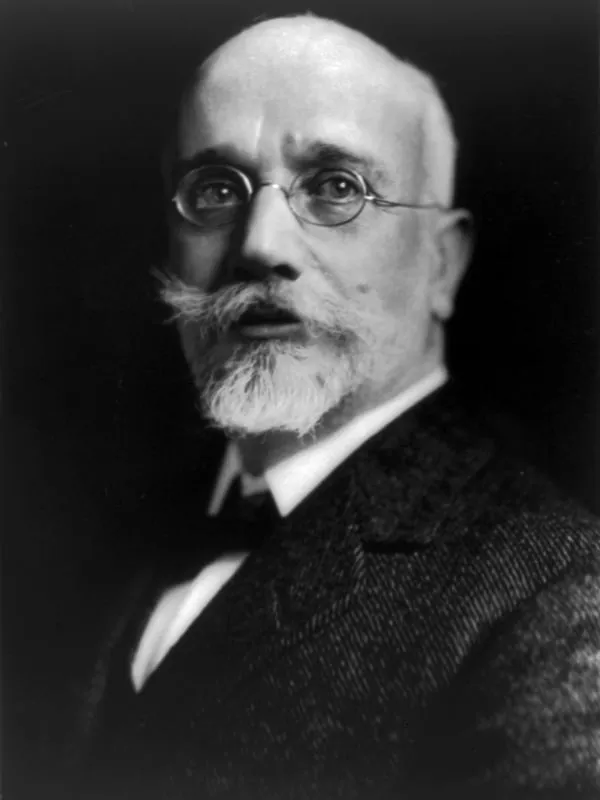
- Born:
- 23 August 1864, Mournies near Chania (Crete)
- Died:
- 18 March 1936, Paris
- Author:
- Natalia
- Photo:
- Harris & Ewing, domena publiczna, Wikimedia Commons

Eleftherios Venizelos was the most outstanding Greek politician of his age and one of the few leaders of small states with whom the great powers spoke as equals. A Cretan lawyer and insurgent, he took over the government in Athens in 1910, reformed the state and the army, and in the Balkan Wars almost doubled the territory of Greece. From the first days of the Great War he was convinced that the Entente would win and that Greece must stand at its side to gain the lands inhabited by Greeks in Asia Minor. King Constantine I thought otherwise and in 1915 twice forced him to resign. The quarrel between the two most popular men in Greece grew into the National Schism: in 1916 Venizelos headed a government in Salonika, and in June 1917, after the Entente had removed the king, he returned to Athens and brought the whole country into the war. After the war he brought back from Paris a treaty that fulfilled almost all the dreams of Greek nationalism, only to lose an election a few months later.
Before the war
He was born on 23 August 1864 (11 August in the Julian calendar) in the village of Mournies near Chania on Crete, then still Turkish, into a merchant’s family. He studied law in Athens and returned to the island as a lawyer and journalist. He took part in the Cretan risings against the Turks, and when after 1898 the island gained autonomy as the Cretan State, he became one of its ministers. He soon came into conflict with the High Commissioner, Prince George, Constantine’s brother. In 1905 he led the armed movement at Theriso, which brought about the prince’s departure. Already then the dynasty had an opponent in him.
In 1910 he was invited to Athens by the officers of the Military League, who after the Goudi coup were looking for a politician capable of carrying out reforms. In the autumn King George I entrusted him with the office of prime minister, and the Liberal Party he founded won successive elections by an enormous margin. Venizelos carried out a revision of the constitution, put the finances and administration in order, and brought in a French military mission for the army and a British one for the navy. He concluded alliances with Serbia and Bulgaria, and in the Balkan Wars of 1912–1913 Greece won southern Macedonia with Salonika, Epirus, the Aegean islands and Crete. It was then that the first clash with the heir to the throne took place: when Constantine wanted to march on Bitola, the prime minister ordered him to take Salonika before the Bulgarians did. In 1913 he concluded a defensive alliance with Serbia against Bulgaria. In July 1914 he was at the height of his fame and power.
1914–1915: two resignations
When the war broke out, Venizelos had no doubt who would win. He believed that a maritime state whose population lived on coasts and islands could not stand against the fleets of Great Britain and France. According to some accounts, as early as August 1914 he offered the Entente Greek assistance, but Sir Edward Grey turned it down so as not to push Turkey and Bulgaria into Germany’s arms. In the autumn Venizelos refused to send troops to help Serbia as long as Bulgaria threatened him from the north.
He changed his position when in January 1915 London promised Greece gains in Asia Minor. In memoranda to the king he argued that this was an opportunity that might not come again, and he was ready to pay for Bulgaria’s entry into the war by ceding Kavala and Drama to it. The king did not agree. In March Venizelos offered the Entente the fleet and the army for the Dardanelles, first three divisions, then one. The General Staff and Colonel Ioannis Metaxas judged the expedition too risky, and Russia, which wanted Constantinople for itself, had no intention of letting the Greeks in anyway. On 6 March 1915, when Constantine I rejected the plan, Venizelos resigned. He maintained that the king could not reject the policy of a government that had a majority in parliament.
According to Greek accounts, his successor, Dimitrios Gounaris, later disclosed the January memoranda on concessions to Bulgaria, which was a blow to Venizelos. Even so, the Liberals won the election of 13 June, and in August Venizelos became prime minister again. In September, when Bulgaria announced mobilisation, he obtained from the king the mobilisation of the army and asked France and Great Britain for 150,000 soldiers, who were to take the place of the Serbs in the alliance against Bulgaria. After a week of conflicting signals he agreed to the landing at Salonika, with a purely formal protest. On 4 October he told parliament that Greece was too small a state to commit the infamy of breaking a treaty and would keep its alliance with Serbia, even if it had to fight Germany as well. The chamber gave him a vote of confidence, but on 5 October, the day of the Entente landing, the king withdrew his support and Venizelos resigned for the second time. He did not want to govern against the crown, because he feared a civil war that would open the way to the Bulgarians.
For the following months his majority tolerated the government of Alexandros Zaimis, until in November it brought it down in a night vote. The king then dissolved the chamber, and Venizelos, regarding this as a breach of the constitution, boycotted the December election. The government of Stefanos Skouloudis pursued a policy that Venizelos considered disastrous, and when in May 1916 Fort Rupel was surrendered without a fight, he asked who would believe that the Germans would have started a war merely to take it.
1916: the government in Salonika
In the summer of 1916 the Bulgarians entered eastern Macedonia, and the government in Athens forbade the army to resist. On 27 August Venizelos called on the king at a rally to place himself at the head of the nation at the last moment. Three days later his supporters carried out the National Defence coup in Salonika, supported at least passively by General Maurice Sarrail. Venizelos hesitated for a long time, because the movement was splitting the state. He made up his mind after the capitulation of the Greek corps at Kavala. On the night of 25 September he left Athens with Admiral Pavlos Kountouriotis, formed a provisional government on Crete, and on 9 October arrived in Salonika. Together with Kountouriotis and General Panagiotis Danglis he formed a triumvirate that governed Macedonia, Crete and the Aegean islands. He insisted that he was not acting against the king but against the Bulgarians.
The Allies were long unwilling to recognise him. The French prime minister Aristide Briand still hoped for an understanding with Constantine, and Russia and Italy distrusted the Venizelists. At the Boulogne conference it was decided to finance the Salonika government but not to recognise it. On 23 November it declared war on Germany and Bulgaria and began to form an army, although volunteers were few and conscription in Macedonia went slowly. Only after the fighting in Athens on 1 December and the attacks on Venizelists did Great Britain and France recognise his government. In Athens a warrant for his arrest for high treason was then issued, and the archbishop pronounced an anathema on him.
1917–1918: prime minister of a fighting Greece
In June 1917 the French forced Constantine to leave the country. Venizelos sailed into Piraeus, and on 27 June, under the protection of French troops, he was sworn in as prime minister of the whole country. He relied on the chamber elected in 1915, restored without new elections, which his opponents called the “Lazarus chamber”. Greece entered the war, and the most diehard royalists, among them Gounaris and Metaxas, were exiled to Corsica. The government suspended the irremovability of judges and carried out purges in the army, the civil service and the Church. The Greek historian Loukianos Hassiotis judges that the king’s unconstitutional rule was in practice replaced by a Venizelos dictatorship lasting until 1920.
The hardest task was to create an army out of a weary and divided country. Mobilisation provoked mutinies, and money and food were short. At the first session of the Supreme War Council in December 1917 Venizelos asked the Allies for urgent deliveries of grain. The breakthrough came with the Battle of Skra-di-Legen on 30 May 1918, in which Greek divisions captured Bulgarian positions. The victory raised his prestige and made conscription easier even in the unsympathetic Peloponnese. In September 1918 about ten Greek divisions took part in the Vardar offensive, which forced Bulgaria into an armistice. In November, during the Geneva conference, the British passed word through him and Edvard Beneš to Nikola Pašić and the Yugoslav politicians that they must first come to terms among themselves.
After the war
At the Paris Peace Conference Venizelos was one of the most admired figures, and his arguments carried weight especially with David Lloyd George. In May 1919 Greek troops landed at Smyrna, the Treaty of Neuilly gave Greece Western Thrace, and the Treaty of Sèvres of 10 August 1920 gave it Eastern Thrace, Imbros and Tenedos as well as the administration of Smyrna. Two days later two royalist officers wounded Venizelos in an assassination attempt at the Gare de Lyon station in Paris. In November 1920, after the sudden death of King Alexander, the Greeks, weary of eight years of war, rejected him at the polls. He lost even his own seat and left the country. Constantine returned to the throne, and the war with Turkey ended in 1922 in defeat and the exodus of the Greeks from Asia Minor.
Venizelos returned to the game as negotiator of the Treaty of Lausanne, which in 1923 sealed the population exchange with Turkey. He was briefly prime minister in 1924, and in 1928–1932 he governed again, this time reconciled with Turkey, with which he concluded a treaty of friendship in 1930. He headed the government for the last time at the beginning of 1933. In the same year he survived another assassination attempt, and after a failed coup by his supporters in March 1935 he fled the country and was sentenced to death in absentia. He died in Paris on 18 March 1936. He was buried on Crete, on the Akrotiri hill above Chania.
Assessment
For most historians Venizelos is the creator of modern Greece, a politician of exceptional diplomatic talent who in 1915 correctly foresaw the victory of the Entente and understood that the fate of Greece depended on the powers that ruled the sea. His supporters stressed that he was right in the dispute with the king: keeping the alliance with Serbia was a matter of honour, and taking part in the war gave Greece a place at the victors’ table. Without him, they argued, instead of the Treaty of Sèvres the country would have ended up losing Macedonia to the Bulgarians.
His critics, from royalists such as George F. Abbott to some modern authors, accuse him of drawing foreign fleets and armies into a domestic quarrel, of splitting the state in 1916, and of returning to power in 1917 on French bayonets and governing without new elections while persecuting his opponents. It is also pointed out that his vision of a “Greater Greece” in Asia Minor, which the Entente had been promising him since 1915, was beyond the country’s strength and opened the way to the catastrophe of 1922, even though it was not he who led the Greeks deep into Anatolia. Hassiotis notes that many inhabitants of Macedonia, Muslims, Jews and Slavs, did not share his national aims. On one point everyone agrees: for three decades Venizelos was the axis around which Greek politics turned, and the division between Venizelists and their opponents outlived him by many years.
Sources
Spotted a mistake?Report an error
Mentioned in battles
(03)Often appears with
People who appear in the same events.
On the timeline
(74)The 40 most important of 74 events. All tagged “Eleftherios Venizelos” (37) →
1912
1913
1914
1915
January
February
March
April
July
August
September
October
- 06
- Alexandros Zaimis becomes prime minister of GreeceOn 6 October 1915, a day after Venizelos resigned, Alexandros Zaimis was forming a new government in Athens. Its members opposed war on Serbia's side.
- Constantine gives assurances of Greek neutralityIn early October 1915 King Constantine I assured the British minister that Greece would stay neutral. Mobilisation and the Entente landing were to go on.
November
1916
February
April
May
June
- 21
- Entente ultimatum to GreeceOn 21 June 1916 the ministers of France, Britain and Russia demanded that Greece demobilise, form a non-party government and hold elections. Athens gave in.
- Resignation of the Skouloudis governmentOn 21 June 1916, the day the Entente demanded a change of government in Greece, Prime Minister Stefanos Skouloudis resigned after less than eight months.