France · The Entente
Maurice Sarrail
Commander of the Third Army (1914–1915), commander-in-chief of the Allied armies in Macedonia (1915–1917)
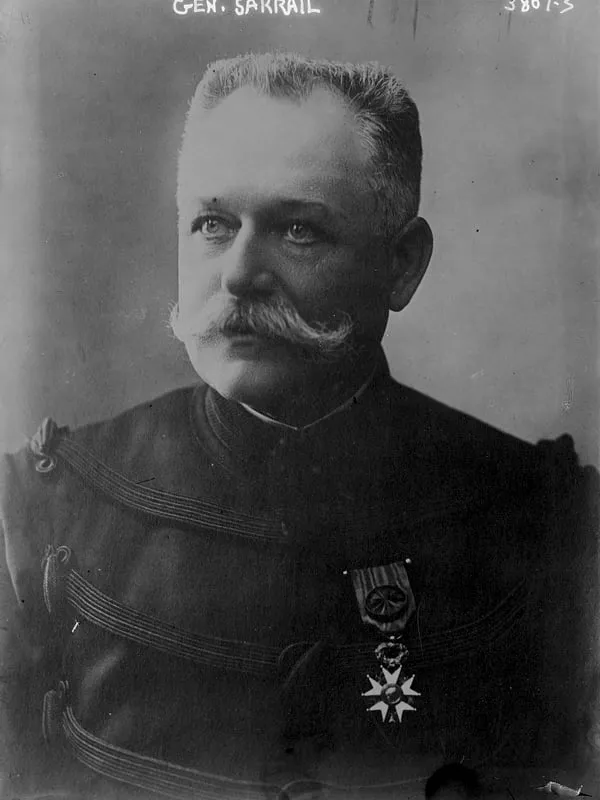
- Born:
- 6 April 1856, Carcassonne (France)
- Died:
- 23 March 1929, Paris
- Author:
- Łukasz Skowroń
- Photo:
- Bain News Service, domena publiczna, Wikimedia Commons

Maurice Sarrail was the most politicised general of the French army in this war. A republican, a Dreyfusard and a freemason, in an officer corps dominated by Catholics and conservatives he was regarded as a man of the left, and twice it was politics that decided his fate. In 1914 he commanded the Third Army at Verdun. In the summer of 1915 Joffre removed him from command, and the left’s defence of Sarrail provoked the first great conflict between politicians and the military in France. The government then gave him a new task: an expedition to the East. For more than two years Sarrail commanded at Salonika a multinational army of French, British, Serbs, Italians, Russians and Greeks, took Bitola and played an important part in removing the Greek king from his throne. He did not, however, lead his troops to victory in Macedonia, and by the end of 1917 he had lost the confidence of all the Allies.
Before the war
Maurice Paul Emmanuel Sarrail was born on 6 April 1856 in Carcassonne in the south of France. In 1877 he graduated from the military academy at Saint-Cyr as one of the best of his year, and then from the École supérieure de guerre. He served in the infantry, without taking part in colonial campaigns. His career was accelerated by the Dreyfus affair, after which republican governments wanted to “republicanise” the army. Sarrail was one of the officers they could count on. In 1901–1904 he headed the infantry school at Saint-Maixent, which trained officers promoted from the ranks, then commanded the guard of the Chamber of Deputies at the Palais Bourbon, and from 1907 to 1911 he was director of infantry at the Ministry of War. He was a freemason and kept close relations with politicians of the Radical Party, especially Joseph Caillaux.
He became a général de division in 1911. In November 1913 he took over VIII Corps, and in April 1914 VI Corps at Châlons-sur-Marne, covering the frontier north-east of Verdun. Some authors write that the left saw him as a future commander-in-chief in place of Joseph Joffre, but the outbreak of war put an end to such plans.
1914: the Ardennes and Verdun
In August 1914 VI Corps formed part of General Pierre Ruffey’s Third Army. On 22 August, in the Battle of the Ardennes, it fought at Virton and, according to most accounts, performed better than the neighbouring corps, although it too had to fall back. On 30 August Joffre dismissed Ruffey and gave command of the Third Army to Sarrail. During the Battle of the Marne this army stood on the right wing of the French front, between the Argonne and Verdun, facing the German Fifth Army of Crown Prince Wilhelm. From 6 September it fought heavy battles around Revigny, and Joffre sharply reprimanded its commander for the chaos in his units. When the Germans also attacked the forts south of Verdun, on 8 September Joffre allowed Sarrail to break away from the fortress so as not to be encircled. Sarrail did not take advantage of this and kept in contact with Verdun. Later he presented himself as its saviour. Historians, among them Robert Doughty and Holger Herwig, judge this decision much more harshly: the fortress, strongly garrisoned and armed, was not in direct danger at the time, and the commander’s obstinacy exposed his army to risk.
After the Marne the Third Army failed to regain much ground. At the end of September the Bavarians took Saint-Mihiel and Fort Camp des Romains, creating a salient that cut the railway along the Meuse. Joffre blamed Sarrail. In the winter and spring of 1915 his army waged in the forests of the Argonne and at Vauquois an exhausting mine war and dozens of small attacks that cost much blood.
1915: dismissal
At the turn of June and July 1915 German attacks in the Argonne pushed the Third Army out of some of its positions. Joffre ordered the commander of the Eastern Army Group, General Auguste Dubail, to investigate the causes of the failures. Dubail criticised over-simple plans, piecemeal attacks and the bad mood at army headquarters, and recommended a change of commander. On 22 July 1915 Joffre dismissed Sarrail, and his place was taken by General Georges Humbert.
The left in parliament regarded this as a political purge: the commander-in-chief was removing the only general openly associated with the republicans. The storm shook the government of the Union sacrée and damaged the Minister of War, Alexandre Millerand, who sided with Joffre. The solution was the expedition to the East, of which Aristide Briand was an ardent supporter. Sarrail regarded command of an expeditionary corps as a demotion. He agreed at the beginning of August, when he was promised that his troops would be called the Army of the Orient, would be reinforced and would not come under British command. At first a landing in Asia Minor was considered, to help the troops at the Dardanelles. Bulgaria’s entry into the war, however, diverted the expedition to Macedonia.
Salonika
Sarrail arrived in Salonika on 12 October 1915, when the first units had already landed and the Germans and Austrians were attacking Serbia from the north. His divisions moved by rail up the Vardar valley and at Krivolak clashed with the Bulgarians, but they were too weak to break through to the Serbs. On 12 November the government in Paris practically ordered him to break off the offensive, and when the Serbian army began to retreat through Albania, Sarrail skilfully withdrew his troops to Salonika. He later wrote that “you cannot make something out of nothing”. He turned the city into a fortified camp, and on 30 December, after an air raid on Salonika, had the consuls of the Central Powers arrested. In December he was subordinated to Joffre as commander-in-chief of all the French armies, and on 16 January 1916 he took command of all the Allied forces in Macedonia.
Throughout 1916 his army grew: it was joined by the reconstituted Serbian army, then by Russian brigades and an Italian division. The British suspected, however, that the Salonika front existed mainly to keep Sarrail occupied, and in Paris Joffre preferred to keep him away from France. After Fort Rupel was handed over to the Bulgarians, Sarrail proclaimed a state of siege on 3 June and took over authority in the city. In August, when he was due to go on the offensive after Romania’s entry into the war, the Bulgarians forestalled him at Florina. At the end of August Venizelos’s supporters rose up in Salonika, and Sarrail did not stand in their way; in October he welcomed Eleftherios Venizelos himself in the port.
The autumn offensive, fought from September on the Crna and for Bitola, brought him his greatest success. The Serbs took Kaymakchalan, and on 19 November 1916 the Allies entered Bitola, the first Serbian town to be recovered. This did not, however, save Romania. In October Sarrail dismissed the commander of the French Army of the Orient, General Victor Cordonnier, who accused him of pointless frontal attacks. In December a report by the Minister of War, Pierre Roques, which recommended reinforcing the troops in Macedonia and removing them from Joffre’s authority, contributed to the fall of the commander-in-chief.
Greece and the spring of 1917
At the Rome conference in January 1917 Sarrail made a good impression on the British. David Lloyd George found him an engaging and fiery figure, but refused him a free hand against King Constantine I. His title of commander-in-chief of the Allied armies was, however, confirmed, with the right of contingent commanders to appeal to their own governments. In March the attack at Bitola bogged down in the snow, and the great spring offensive, in which the British struck at Lake Doiran and the Serbs, French and Italians west of the Vardar, cost about 14,000 men and achieved nothing. On 21 May, after the Serbs refused to go on, Sarrail called it off.
He then turned against Athens. In June, when the French high commissioner Charles Jonnart presented Greece with an ultimatum, Sarrail’s troops occupied Thessaly and the Isthmus of Corinth, and the king abdicated. In the autumn the general pursued his own policy in Albania: as early as December 1916 he had supported the proclamation of an autonomous republic in Korçë, in September 1917 his troops occupied Pogradec, and he himself backed Essad Pasha Toptani. In doing so he angered the Italians, and his conduct was also the subject of complaints from the prime ministers of Serbia, Nikola Pašić, and of Greece, Venizelos.
Recall
Previous governments had shielded Sarrail from the demands of the Allies. The situation changed when Georges Clemenceau took power in November 1917. The general’s connections with Caillaux and Louis Malvy, then suspected of contacts with the Germans, made him suspect, and at the first meeting of the war committee the new prime minister declared that Sarrail could not remain at Salonika. On 10 December 1917 the general received a telegram recalling him, and on 22 December command was taken over by General Adolphe Guillaumat. Sarrail received no further posting, and in April 1918 he was placed on the reserve list.
After the war
He settled in Montauban and wrote his memoirs, “Mon commandement en Orient” (1920), in which he defended his campaign. In 1919 he stood unsuccessfully for parliament on a left-wing list. When the left returned to power in 1924, Édouard Herriot’s government appointed him French high commissioner in Syria and Lebanon. His rule in the mandate ended in disaster. He alienated the local elites, and his treatment of the Druze leaders contributed to the outbreak in 1925 of a revolt that engulfed much of Syria. In October Sarrail had Damascus shelled by artillery, which caused outrage around the world, and he was recalled that same month. He died in Paris on 23 March 1929, three days after Ferdinand Foch, and was buried at Les Invalides.
Assessment
Sarrail remains one of the most controversial figures of the French high command. For the right and for Joffre, who called him a “factional” general, he was a mediocre commander who owed his career to politicians. French and British studies often reproach him for claiming credit for saving Verdun in 1914 and for devoting more time in Macedonia to Balkan politics than to operations. The British official historian Cyril Falls credited him with charm, strength of character and a soldierly bearing, but also with secretiveness towards the Allies. In his view it was Sarrail, more than anyone else, who kept the Salonika campaign alive for two years, but he would never have led the Allies to victory, because none of them trusted him any longer. General George Milne wrote of him in 1916 as a strong man with a great mind, perhaps a good strategist, but conceited, hot-tempered and unscrupulous.
The American historian Jan Karl Tanenbaum, author of his biography, sees him above all as both a victim and a beneficiary of the entanglement of the army with politics in the Third Republic. Even critics admit that Sarrail operated in Macedonia in exceptionally difficult conditions: with an army made up of six nationalities and plagued by malaria, with a hostile Greek government in his rear and with allies who doubted the point of this front the whole time. The victory on the Vardar in September 1918 was won by his successors on the foundations of the army he had built.
Sources
Spotted a mistake?Report an error
Commanded in battles
(07)- 5 October 1915 – 30 September 1918The Salonika FrontBalkan Front
- 24 October – 3 December 1915Battle of KrivolakBalkan Front
- 6–12 December 1915Battle of KosturinoBalkan Front
- 17–19 August 1916Battle of FlorinaBalkan Front
- 5 October – 11 December 1916Battle of the Crna and BitolaBalkan Front
- 11–23 March 1917March offensive in MacedoniaBalkan Front
- 5–22 May 1917Battle of the Vardar (1917)Balkan Front
Mentioned in battles
(06)Often appears with
People who appear in the same events.
On the timeline
(68)1914
1915
October
- 21
- Bombardment of DedeagachOn 21 October 1915 British, French and Russian ships shelled the Bulgarian port of Dedeagach and the coast to Porto Lagos, wrecking barracks and rolling stock.
- Bulgarians take VelesAround 20 October 1915 Bulgarian cavalry took Veles on the Vardar. The Salonika–Skopje railway was cut and the Serbs were cut off from the French.
November
December
- 02
- Bulgarians take BitolaIn early December 1915 Bulgarian cavalry entered Bitola, the second city of Serbian Macedonia. Its defenders fell back not to Salonika but to Albania.
- French abandon KrivolakIn early December 1915 the French withdrew from Krivolak and the loop of the Vardar and Crna Reka before the Bulgarians could strike at them.
- 11
- Bulgarians take Dojran and GevgelijaOn 11–12 December 1915 the French and British withdrew into Greece and the Bulgarians entered Dojran and Gevgelija. The pursuit stopped at the border.
- Greece rejects the Entente demandOn 11 December 1915 Athens replied to the Allies. The Greeks kept Salonika and Fort Kara Burun but promised not to hinder the Allied defence of the city.
1916
January
March
May
June
- 21
- Entente ultimatum to GreeceOn 21 June 1916 the ministers of France, Britain and Russia demanded that Greece demobilise, form a non-party government and hold elections. Athens gave in.
- Resignation of the Skouloudis governmentOn 21 June 1916, the day the Entente demanded a change of government in Greece, Prime Minister Stefanos Skouloudis resigned after less than eight months.
July
August
- 17
- Romania's treaty with the EntenteOn 17 August 1916 in Bucharest Brătianu signed a secret treaty and military convention with the Entente, promising to attack Austria-Hungary by 28 August.
- Battle of Florina beginsOn 17 August 1916 the Bulgarian 1st Army attacked the Serbs in western Macedonia and took Greek Florina the same day, forestalling Sarrail's offensive.
September
October
November
December
1917
January
March
April
May
June
- 12
- Key eventAbdication of King ConstantineOn 12 June 1917 King Constantine I, forced by the Entente, left Athens, leaving the throne to his younger son Alexander. He did not formally abdicate.
- Entente occupies Thessaly and the Isthmus of CorinthOn 10–12 June 1917 the French occupied the Isthmus of Corinth and entered Thessaly. On 12 June they took Larissa, and a landing force went ashore at Piraeus.