Albania · The Entente
Essad Pasha Toptani
Head of the Albanian government in Durrës (1914–1916), then of the government in exile in Salonika
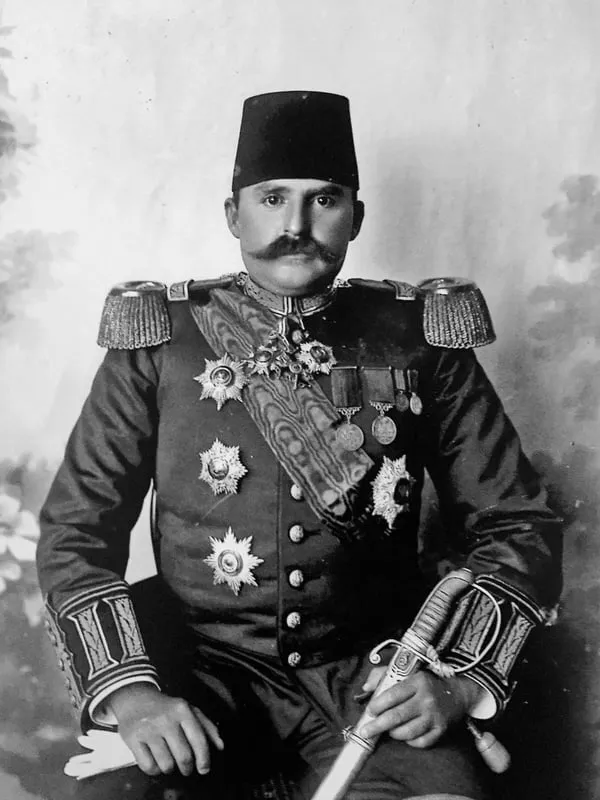
- Born:
- 1863, Tirana (Ottoman Empire, today Albania)
- Died:
- 13 June 1920, Paris
- Author:
- Natalia
- Photo:
- Pietro Marubi, domena publiczna, Wikimedia Commons

Essad Pasha Toptani was the most influential and at the same time the most hated by his compatriots of all Albanian politicians of the Great War years. A magnate from central Albania and a former Ottoman general, in the autumn of 1914 he returned from exile with Serbian money, took Durrës and headed a government whose authority seldom reached far beyond that town. He relied in turn on Serbia, Italy and France, and when the Austrians arrived in February 1916 he sailed away to Italy. He spent the rest of the war as head of a government without a country, first in Italy and France, then in Salonika. Many Albanians still regard him as a symbol of treason; in Serbia he is remembered as an ally from the darkest days of 1915.
Before the war
He was born in Tirana, according to most sources in 1863, although 1875 is also given. He came from the Toptani family, one of the richest landowning families of central Albania, which had played a part in the founding of Tirana. He was related to the future King of Albania, Ahmet Zogu. He made a career in the Ottoman administration and gendarmerie, in which he held commands in the vilayet of Janina among other places, and according to Albanian biographers he was promoted to general for his services in the war with Greece in 1897. After the revolution of 1908 he joined the Young Turks and sat in the parliament in Constantinople as one of the Albanian deputies. In April 1909 he was in the four-man delegation that informed Sultan Abdul Hamid II that parliament had deposed him.
In the First Balkan War Essad was in Scutari, besieged by the Montenegrins and Serbs. When the commander of the fortress, Hasan Riza Pasha, was murdered in January 1913, Essad took command. Some historians attribute complicity in this killing to him, which was never proved. In April 1913, after a siege of half a year, he surrendered the town to the Montenegrins in return for the right to march out under arms and, as is widely believed, for a promise of support for his bid for power in Albania. Soon afterwards he proclaimed in Durrës his own “senate” of central Albania, a rival to Ismail Qemali’s government in Vlorë.
The Great Powers gave the throne of the new state to a German prince, Wilhelm of Wied, who arrived in Durrës in March 1914. To keep his influence, Essad took the portfolios of the interior and of war in his government. He did not remain loyal for long. In May 1914, when a rising of Muslim peasants against the prince broke out in central Albania, he was accused of conspiracy. On 19 May Dutch gendarmerie officers fired on his house in Durrës. Essad capitulated and, instead of facing a court, found himself on a ship to Italy, banned from returning to the country.
1914–1915: the government in Durrës
The outbreak of the Great War gave him a second chance. Prince Wied, without money or troops, left Albania in September 1914. Essad went to Niš and, according to most sources, on 17 September concluded a secret agreement there with the Serbian prime minister Nikola Pašić. Serbia promised him money and arms, counting on a friendly government in Albania and a route to the Adriatic. The Italians helped him too. With a few thousand armed men gathered around Dibër he marched on Durrës, took it without a fight and at the beginning of October formed a government, becoming its head and commander-in-chief himself.
Essad’s authority was weak from the start. The Greeks entered the south of the country, and according to some historians Essad secretly agreed to the annexation of Northern Epirus by Greece. In December the Italians landed at Vlorë. The Muslim insurgents of central Albania, led by Haxhi Qamili, considered him a traitor and a servant of the Christian neighbours. In the spring of 1915 they hemmed him in at Durrës itself, and the town was defended mainly by the guns of Italian warships. The Entente at first advised Albania’s neighbours against intervention, but in June, called in by Essad, the Serbian army entered Albania and crushed the insurgents. The Serbs took Tirana and Elbasan, but, as the sources show, they did not enter Durrës, while the Montenegrins took Scutari. Haxhi Qamili was captured and executed.
The Serbian retreat and flight
In the autumn of 1915 Serbia was attacked by German, Austro-Hungarian and Bulgarian armies. When at the end of November the beaten Serbian army set off across the mountains towards the Adriatic, Essad was one of the few men in Albania it could count on. His men helped the Serbian columns in the central part of the country, and supplies and part of the evacuation went through Durrës, where an Italian brigade was stationed in December. According to Italian sources it was his field guns that fired on the Austro-Hungarian destroyers which on 29 December raided the port and ran into a minefield.
In the winter Essad’s position became hopeless. The last Serbs sailed from Durrës at the beginning of February 1916, Austro-Hungarian troops were approaching from the north, and many of the pasha’s former opponents went over to their side. His men gave up Berat, and most of his armed supporters dispersed. On 24 February, while the Austrians were storming the Italian positions in front of the town, Essad sailed to Brindisi on an Italian destroyer. According to the British historian Owen Pearson, that day he again declared war on Austria-Hungary. Three days later the Austrians entered Durrës. The Ottoman government, which he had once served, stripped him of his military rank.
A government without a country
For the next six months Essad moved between Rome, Nice, where his wife lived, and Paris. The Italians, who regarded Albania as their sphere of influence, wanted to keep him in their country and offered him a pension and a seat in Naples, on condition that other states would not have representatives with him. Essad chose France and Serbia. At the end of August 1916 a French cruiser brought him to Salonika, where General Maurice Sarrail received him with the honours due to an army commander. In Salonika the pasha set up a semblance of a government, to which France, Serbia and Greece accredited representatives, and raised a unit of a few hundred Albanians.
This unit, called a tabor, fought alongside the French in the valley of the Shkumbin river, and in September 1917 took part in the capture of Pogradec on Lake Ohrid. The promise of a great rising behind the Austrian lines, however, was never fulfilled. The support Sarrail gave him angered the Italians and was one of the charges against the French general, who in December 1917 was recalled from Salonika. According to his biographers, Essad received the French Legion of Honour and the Croix de Guerre for his part in the fighting on the Macedonian front.
After the war
After the armistice Essad moved to Paris and sought admission to the peace conference as Albania’s representative, supported by the Yugoslav delegation. The Powers ignored him, and at home his following dwindled. The Congress of Lushnjë, which met in January 1920, formed a government that rejected both an Italian protectorate and the pasha’s claims. On 13 June 1920, as Essad was leaving the Hotel Continental in Paris, he was shot dead by a young Albanian nationalist, Avni Rustemi. In December a Paris court acquitted the assassin, and Albania welcomed him as a hero. Essad was buried in the cemetery at Thiais near Paris, in the plot of Serbian soldiers.
Assessment
Albanian historiography, both before 1944 and in the communist era, judges Essad unequivocally badly: as a man who gave Scutari to the Montenegrins, betrayed Prince Wied and sold the country’s interests to Serbia, Greece and Italy in return for power. The British Balkan expert Edith Durham, who knew him well, compared him to the medieval condottieri, ready to go over to whoever paid more, and denied him both national feeling and honour.
Some Western historians, however, see in him a typical Ottoman magnate rather than a traitor, one who in a collapsing world sought support from stronger neighbours because he had none of his own. During the war he proved an ally of the Entente loyal to the very end, although he was of little use to it. In Serbia he is remembered above all for helping the Serbian army during the retreat of 1915. A street in Belgrade bears his name, and in 2014 a Serbian minister laid flowers on his grave.
Sources
Spotted a mistake?Report an error
Mentioned in battles
(01)Often appears with
People who appear in the same events.