Italy · The Entente
Luigi Cadorna
Chief of the General Staff of the Italian army and de facto commander-in-chief (1914–1917), Marshal of Italy (1924)
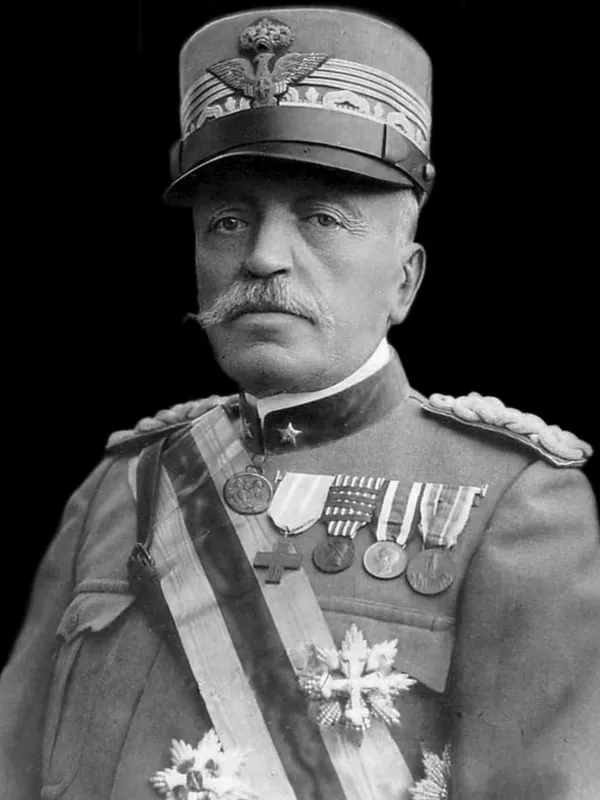
- Born:
- 4 September 1850, Pallanza, now Verbania (Italy)
- Died:
- 21 December 1928, Bordighera (Italy)
- Author:
- Łukasz Skowroń
- Photo:
- autor nieznany, domena publiczna, Wikimedia Commons

Luigi Cadorna commanded the Italian army from the first day of the war with Austria-Hungary until the autumn of 1917, and for two and a half years he held power in Italy such as no other commander in the Entente countries had. Formally he was only chief of staff, yet he commanded the army in the king’s name, admitting neither the government nor parliament to it. He waged a war of attrition on the Isonzo: eleven offensives in which the Italians lost hundreds of thousands of men to push the front forward by a few or a dozen or so kilometres. In August 1916 he took Gorizia, and in the summer of 1917 he brought Austria-Hungary to the brink of exhaustion, but in the autumn of that year the German-Austrian offensive at Caporetto drove his army back to the Piave. Ruthless towards his soldiers and subordinates and distrustful of politicians, after the war he became for many Italians a symbol of cruelty and incompetence, and for others a stern but devoted commander who built an army capable of victory.
Before the war
He was born on 4 September 1850 in Pallanza on Lake Maggiore, today part of the town of Verbania, the only son of General Raffaele Cadorna, who in 1870 commanded the troops that captured Rome. At the age of ten he entered a military school in Milan, at fifteen the military academy in Turin, from which he graduated in 1868 at the top of his year. As a young artillery officer he took part in the capture of Rome under his father’s command. After that he served mainly on staffs, walking the border with Austria, which he described in topographical studies. In 1892–1896 he commanded the 10th Bersaglieri Regiment and gained a reputation as a commander strict to the point of ruthlessness. In a pamphlet on infantry tactics, published from 1898, he argued that an attack always ends up as a frontal assault, which with good preparation, cooperation of the arms and the iron will of the commander can succeed despite the fire of modern weapons.
In 1908 he was one of the candidates for chief of the general staff, but he declared that in wartime he would not tolerate any interference in command. The post then went to General Alberto Pollio. Cadorna commanded a corps in Genoa and in the event of war was to take over the Second Army. In 1913 he became a senator. When Pollio died suddenly at the turn of June and July 1914, the choice fell on him. He made it a condition that he would answer only to King Victor Emmanuel III, not to the government. On 27 July 1914, on the eve of the outbreak of war in Europe, he took up the office of chief of the general staff of the army.
Neutrality
Cadorna considered the army poorly prepared for war: there was a shortage of guns, machine guns, ammunition and officers, and considerable forces were tied down in Libya. Immediately after taking office he was still preparing to carry out the old plans for war alongside Germany, but when the government declared neutrality, he demanded general mobilisation against Austria. Prime Minister Antonio Salandra refused, because mobilisation would all but decide entry into the war. A dispute over money for armaments cost the minister of war, General Domenico Grandi, his post in October 1914 and indirectly led to a reshaping of the government. Only when Salandra postponed a possible entry into the war to the spring of 1915 did Cadorna, together with the new minister of war, General Vittorio Zupelli, carry out a great rearmament programme: he rebuilt the units sent to Libya and Albania, bought weapons, created heavy artillery and trained new officers in accelerated courses. In February 1915 he sent officers a new edition of his pamphlet under the telling title “Frontal Attack and Tactical Training”. The government negotiated with the Entente and signed the Treaty of London without asking the chief of staff for his opinion.
1915–1916: the Isonzo, the Tyrol and Gorizia
On 23 May 1915 Italy declared war on Austria-Hungary, and a royal decree made Cadorna de facto commander-in-chief. The next day his troops crossed the border. He had 35 divisions and a considerable numerical superiority, but little heavy artillery. The plan was simple: stand on the defensive in the Trentino, where the border was unfavourable to the Italians, and direct the main blow across the Isonzo and the Karst eastwards, towards Ljubljana, in order to destroy as many enemy forces as possible. When the first bound brought no breakthrough, Cadorna moved to a series of offensives. In the First, Second, Third and Fourth Battles of the Isonzo in 1915 the Italians stormed Monte San Michele, the heights above Gorizia and the mountains above Tolmin. The defenders under Svetozar Boroević, numerically weaker but entrenched on the heights, held almost all their positions. Cadorna did not change his method. He believed that the war would end in the exhaustion of men and resources, and that Austria was closer to exhaustion than Italy.
In March 1916, at the request of the French, who were fighting at Verdun, he launched the Fifth Battle of the Isonzo, which changed nothing. He disregarded warnings of an Austrian concentration in the Tyrol, and the Austro-Hungarian offensive in the Trentino, launched on 15 May, took him by surprise. The troops of Franz Conrad von Hötzendorf took Asiago and Arsiero, and in Rome it was feared that the armies on the Isonzo would be cut off. Cadorna kept his nerve. He moved reinforcements by rail and lorry, formed a new Fifth Army from the reserves on the plain and stopped the attack on the last ridges. When Prime Minister Salandra came to headquarters to dismiss him, the king took the general’s side. In June it was Salandra’s government that fell, not Cadorna, who on 16 June opened a counter-offensive in the Trentino.
He quickly moved forces back to the Isonzo, and in the Sixth Battle, in August 1916, he surprised the weakened Austrians. The Italians took Monte Sabotino and Monte San Michele, and on 9 August entered Gorizia. It was Cadorna’s greatest victory and the moment of his greatest popularity. In the autumn, in the Seventh, Eighth and Ninth Battles, he pushed the front on the Karst forward by a few more kilometres, but again without a breakthrough.
Power and discipline
After Salandra’s fall the government of Paolo Boselli was weak and usually gave way in disputes with the high command. In this period Cadorna built an army much larger and better armed than in 1915. The number of infantry battalions rose from 548 to 867, and an army that had begun the war with fewer than 250 medium-calibre guns had about 3,000 of them in 1917. The chief of staff imposed the army’s needs for men and equipment on the government, directed the mobilisation of industry and allowed no one to interfere in operations. At headquarters in Udine he worked surrounded by young staff officers, far from the front. He demanded absolute obedience and dismissed commanders who had failed or seemed to him too soft. According to the Italian Biographical Dictionary, he removed 206 generals and 255 colonels during the war.
He was just as harsh towards the soldiers. He did not care enough about leave, food and rest, and attributed every sign of weariness or mutiny to the activity of socialists and pacifists. In circulars he urged courts martial to pass swift sentences and officers to carry out summary executions. In 1916 and 1917, in several mutinous units, soldiers chosen by lot were shot, which was called decimation. According to the most frequently cited estimates, courts martial sentenced more than 4,000 Italian soldiers to death, of whom about 750 were executed, more than in any other army of the war. On top of this came executions without trial. The commission that investigated the Caporetto defeat after the war called decimation a senseless measure that often struck the innocent.
At Allied conferences Cadorna saw the war more broadly than Italian politicians. He proposed concentrating Entente forces against Austria-Hungary as the weakest link among the enemies, preferred to strengthen the Macedonian front rather than keep troops in Libya and Albania, and at the Rome conference in January 1917 the sending of Allied guns and divisions to Italy was discussed, although he himself approached it without enthusiasm.
1917: the Bainsizza and Caporetto
In the spring of 1917 Cadorna resumed the offensives. In the Tenth Battle of the Isonzo the Italians took Kuk and Vodice, and in the Eleventh, in August and September, they crossed the Isonzo and took most of the Bainsizza plateau and Monte Santo. Austria-Hungary was at the limit of its endurance and asked Germany for help. But the Italian army was exhausted too, with weariness and discontent growing in its ranks. In August food riots broke out in Turin. In letters to the government Cadorna blamed the decline of morale in the army on the weak domestic policy of the minister of the interior, Vittorio Emanuele Orlando. In September, knowing that the Germans were coming, he ordered a switch to the defensive, but his orders were carried out only partially. The commander of the Second Army, General Luigi Capello, was still preparing his troops for an attack.
On 24 October 1917 the German Fourteenth Army of Otto von Below and Austro-Hungarian troops broke through the front at Caporetto. Cadorna knew the date and place of the attack from deserters, but did not believe the enemy could develop a great offensive in such difficult mountains. The speed with which the Germans advanced along the valleys took him completely by surprise. He gave the order to retreat to the Tagliamento only on the morning of 27 October, and the army’s withdrawal turned in places into flight. On 28 October he issued a communiqué in which he blamed the defeat on units of the Second Army, which had allegedly “retreated like cowards without fighting or ignominiously surrendered”. The government stopped its publication at home, but the text went round the world. In the Twelfth Battle of the Isonzo the Italians lost nearly 300,000 prisoners and more than 3,000 guns.
Cadorna did not, however, lose his head entirely. On 4 November he ordered a retreat behind the Piave, to a line running from the sea through the Monte Grappa massif to the Asiago plateau, which he had chosen himself and in whose mountain section roads and fortifications had been under construction since 1916. On this line his successor fought the victorious First Battle of the Piave. Cadorna’s fate, however, was already sealed. The new prime minister, Orlando, wanted to be rid of him, and at the Rapallo conference the prime ministers of Britain and France, David Lloyd George and Paul Painlevé, made his removal a condition for sending their divisions to Italy. On the evening of 8 November the king dismissed Cadorna, and his place was taken by General Armando Diaz.
Versailles and the commission of inquiry
As a consolation Cadorna was given the post of Italy’s permanent military representative on the Supreme War Council at Versailles. He accepted it out of a sense of duty and, according to Italian historians, did useful work there, arguing for a unified Allied command. In February 1918, however, the government recalled him home and placed him at the disposal of the commission investigating the causes of the Caporetto defeat. Its report, published in the summer of 1919, laid the main responsibility on him, while sparing many other generals and politicians. In September 1919 he was retired. He answered the charges in two volumes of memoirs, “La guerra alla fronte italiana” (1921), in which he defended his decisions and blamed the soldiers and the government for Caporetto.
After the war
The dispute over Cadorna divided Italy throughout the 1920s. Nationalists and part of the liberal press demanded his rehabilitation; socialists and the Popular Party opposed it. On 4 November 1924 Benito Mussolini cut the debate short by making Cadorna and Diaz Marshals of Italy. Cadorna returned to the Senate, and a villa in his native Pallanza was presented to him from a national subscription. He died on 21 December 1928 in Bordighera on the Riviera, and in 1932 he was buried in a mausoleum in Pallanza. His son Raffaele, also a general, commanded the Italian resistance in the north of the country in 1944–1945.
Assessment
Cadorna’s reputation is as disputed as that of his contemporaries Joffre and Haig. The British historian David Stevenson counted him among the most callous and incompetent commanders of the war. Critics point to his attachment to the frontal attack, his disregard for losses and for the soldiers’ living conditions, his brutal discipline, his distrust of the government and his subordinates, and the fact that after Caporetto he shifted the blame onto his own soldiers.
The Italian historian Giorgio Rochat, author of his entry in the Biographical Dictionary, judges him severely for his scant concern for the soldiers, but recalls that trench warfare had its own terrible logic, independent of Cadorna, as of the other commanders. He credits him with great faith in his mission, a broad strategic vision, an understanding of the needs of modern war and the energy with which he waged two and a half years of bloody fighting. The Austrian general Alfred Krauss, one of the commanders at Caporetto, wrote of his “iron will”. Cadorna’s defenders point out that he built the army that in 1918 held on the Piave and won at Vittorio Veneto, and that his offensives of 1917 forced Austria-Hungary to call the Germans to its aid. Yet even they admit that he could not understand an army made up of millions of peasants in uniform, and that his style of command, based on fear, contributed to the collapse at Caporetto.
Sources
Spotted a mistake?Report an error
Commanded in battles
(16)- 23 June 1915 – 9 November 1917Battles of the IsonzoItalian Front
- 23 June – 7 July 1915First Battle of the IsonzoItalian Front
- 8 July 1915 – 18 April 1916Fighting on the Col di LanaItalian Front
- 18 July – 3 August 1915Second Battle of the IsonzoItalian Front
- 18 October – 4 November 1915Third Battle of the IsonzoItalian Front
- 10 November – 2 December 1915Fourth Battle of the IsonzoItalian Front
- 11–16 March 1916Fifth Battle of the IsonzoItalian Front
- 15 May – 25 June 1916Battle of AsiagoItalian Front
- 6–17 August 1916Sixth Battle of the IsonzoItalian Front
- 14–18 September 1916Seventh Battle of the IsonzoItalian Front
- 9–12 October 1916Eighth Battle of the IsonzoItalian Front
- 31 October – 4 November 1916Ninth Battle of the IsonzoItalian Front
- 12 May – 5 June 1917Tenth Battle of the IsonzoItalian Front
- 10–29 June 1917Battle of Mount OrtigaraItalian Front
- 17 August – 12 September 1917Eleventh Battle of the IsonzoItalian Front
- 24 October – 9 November 1917Twelfth Battle of the IsonzoItalian Front
Mentioned in battles
(02)Often appears with
People who appear in the same events.
On the timeline
(55)The 40 most important of 55 events. All tagged “Luigi Cadorna” (40) →
1914
1915
May
- 23
- Key eventItaly declares war on Austria-HungaryOn 23 May 1915 Italy declared war on Austria-Hungary, its ally in the Triple Alliance. The state of war took effect the following day.
- Luigi Cadorna takes charge of the Italian armyOn 23 May 1915 a decree of King Victor Emmanuel III gave effective direction of the army's operations to the Chief of the General Staff, General Luigi Cadorna.