1916: The Italian front
Ninth Battle of the Isonzo
- Dates:
- 31 October – 4 November 1916
- Front:
- Italian Front
- Location:
- The northern part of the Karst plateau east of the Vallone valley (Veliki Hribach, Pečinka, hill 308, Fajti hrib, Kostanjevica), the sector from Hudi Log and Lukatič to hill 208 and hill 144 near Jamiano; the hills east of Gorizia (San Marco, Tivoli, Sober, the lower Vertojbica), Austria-Hungary (now Slovenia and Italy)On the battle map →
- Sides:
- Austria-HungarySvetozar Boroević, Archduke Joseph August of Austria, Alfred von Schenk
- Result:
- Inconclusive. The Italians took a belt of hills on the northern edge of the Karst as far as Fajti hrib, but did not break the front. The Austrians manned a new, better line of defence before Kostanjevica.
- Author:
- Łukasz Skowroń
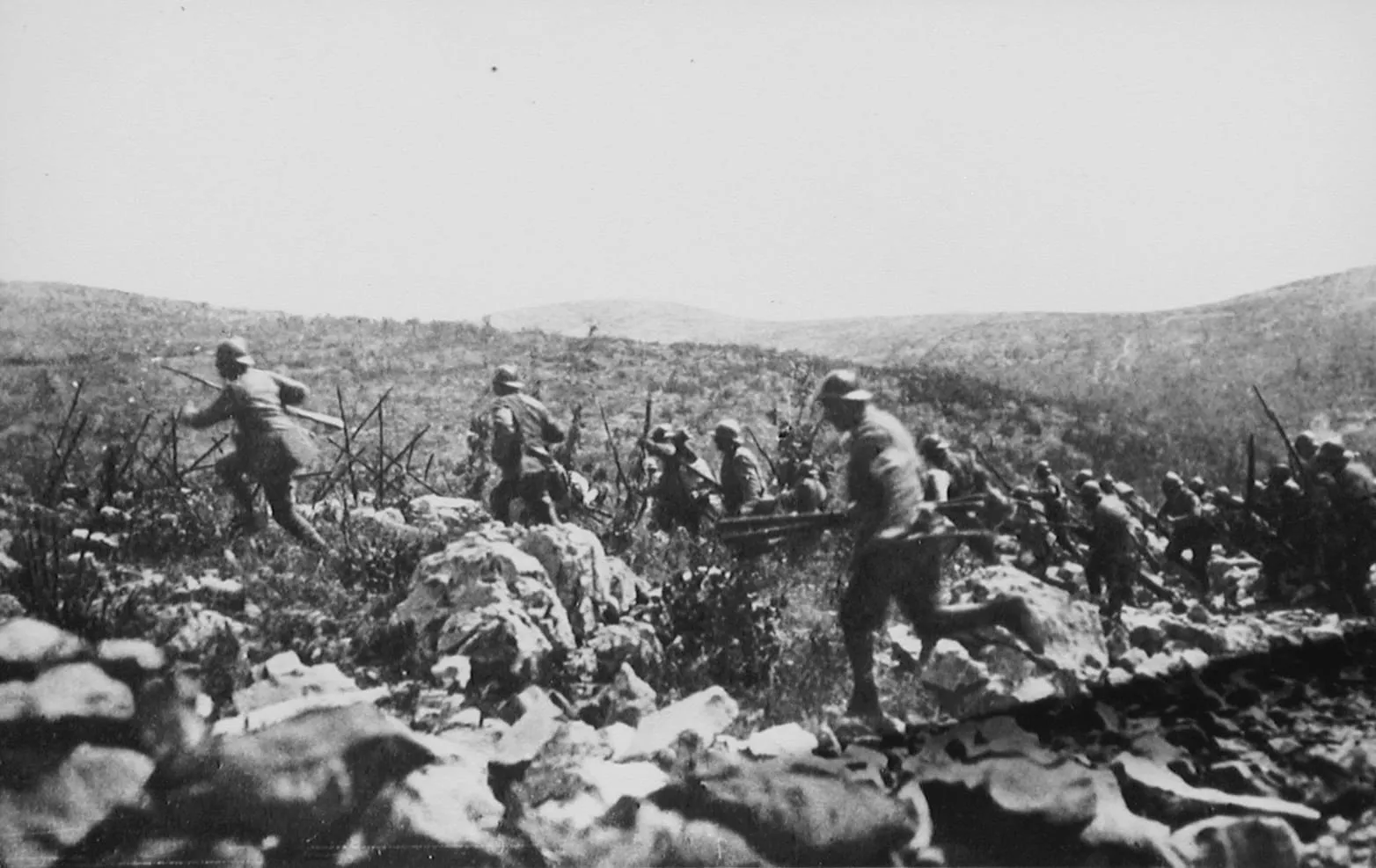
The Ninth Battle of the Isonzo was the last of three short autumn offensives with which General Luigi Cadorna struck at the Karst plateau in 1916. Three weeks after the Eighth Battle, the Italian 3rd Army of the Duke of Aosta, Emanuele Filiberto, again attacked the northern part of the plateau, and the 2nd Army the hills east of Gorizia. This time the Italian infantry went into the assault right behind the fire of its own artillery, and on 1 November, in the first attack, broke through the Austro-Hungarian front on the Karst. It took the hills of Veliki Hribach and Pečinka, and on 2 November the lower of the two summits of Fajti hrib. For two days the command of the Austro-Hungarian 5th Army had not a single battalion left in reserve. The Italians did not follow up their success, however, and on 3 and 4 November the defenders repulsed their attacks on a new line before Kostanjevica. The battle brought the Italians their greatest territorial gains on the Karst since August, but no breakthrough, and cost each side about 30,000 men.
Name and dates
In Italian the battle is called the nona battaglia dell’Isonzo, and Cadorna in his memoirs called it the “third offensive on the Karst”. In German it is the neunte Isonzoschlacht, and the Austrian official history also calls its main part the Ninth Battle of the Karst (neunte Karstschlacht). That history, as well as Italian studies, dates the battle to 31 October – 4 November. On the morning of 31 October the Italian artillery began a bombardment that lasted all night, and in the afternoon the Italian infantry tried in many places to approach the trenches. That day the Austrians reported a great attack, but Italian sources move it to 1 November, when the real assault began at 11 a.m. For this reason some studies, especially English-language ones, date the battle from 1 November. We adopt the dates 31 October – 4 November.
Background
On 12 October, after the Eighth Battle, Boroević’s army stood on the northern part of the Karst on a line that did not deserve to be called a position. Between the northern edge of the plateau and Lukatič the soldiers lay behind low stone walls and single rows of chevaux de frise, and whatever they built at night the Italian mortars smashed the next day. The line moreover ran along the western slopes of the Veliki Hribach and Pečinka hills, in full view of the Italian positions. The Austro-Hungarian command, however, did not want to fall back onto the hills themselves, because on the road to Trieste it was to defend every inch of ground until a new line further east, from Fajti hrib through Kostanjevica, was completed. Instead, the VII Corps of Archduke Joseph August decided to hold the front line weakly during bombardments and keep its reserves far to the rear, in order to spare men.
On 16 October General Svetozar Boroević reported to the high command that his 5th Army was in crisis. Since mid-August it had lost about 100,000 men in battle, and replacements were only enough to cover the ordinary wastage in the trenches. He demanded fresh troops, artillery, ammunition and steel helmets. The high command could give little. The exhausted 20th Honvéd Division was relieved in the line by the 44th Rifle Division, and from 28 October the 14th Infantry Division, released from the Eastern Front thanks to German help, was travelling from Złoczów in Galicia to the Isonzo.
On the same 16 October Cadorna ordered the 2nd and 3rd Armies to be ready to attack from 24 October, leaving the Duke of Aosta to decide the day of the start, depending on the weather. The battle was to be a simple continuation of the previous one, with the same objectives: to take the Trstelj–Hermada line. On a front eight and a half kilometres wide between Veliki Hribach, Hudi Log and Jamiano, eight divisions of the XI and XIII Corps were to attack, while the 2nd Army was only to pin down the enemy at Gorizia. All the guns and trench mortars that the fronts in the Tyrol and Carinthia could do without were brought to the 3rd Army. According to the Austrian official history, the Italians had a total of 225 battalions on the attack sector, while Boroević had only 91 battalions and 19 reserve battalions, as well as 543 guns. This time the Italian command also did not keep most of its reserves in the rear: by the end of the battle only 13 battalions remained in the army reserve.
Course
Waiting (23–31 October)
As early as 23 October everything pointed to an imminent attack: the Italians were relieving units in the trenches, deserters were appearing, artillery fire was increasing, and Italian aircraft bombed Trieste. On 24 October, however, the weather broke and the attack was postponed. On 25 October the Italian fire grew so heavy that it looked like the start of the artillery preparation, but at noon rain and fog silenced it. On the following days both sides fired whenever the weather cleared. Prisoners agreed that this time there would be no bombardment lasting many days and that the infantry would go in after a short barrage. Boroević’s soldiers therefore waited in constant readiness, in downpours against which the makeshift shelters gave no protection. On the Vertojbica water flooded the trenches and brought down the parapets. From 24 to 28 October the 5th Army lost almost 500 killed and over 2,300 wounded in the Vipava valley and on the Karst.
On 30 October the weather cleared. At 8 a.m. on 31 October the Italian artillery and mortars opened full fire. Italian aircraft bombed Sežana, Dutovlje and Miramare Castle near Trieste. In the afternoon the Italian infantry approached the trenches in many places, but was everywhere repulsed. The bombardment went on all night.
1 November
At dawn on 1 November the Italian fire rose to a drumfire, and before noon, according to Cadorna at 11 a.m., the infantry went into the assault along the whole front from Gorizia to the sea. At Gorizia the attack of the 2nd Army achieved little. The Austrian XVI Corps repulsed the Italians in the wood near Panovec, at Tivoli, south of San Marco and at Sober, and on the flooded Vertojbica the Italian infantry waded waist-deep in water and mud. Cadorna wrote, however, that extensive trenches had been taken on the western slopes of Tivoli and San Marco and on the hills east of Sober.
On the Karst the main blow succeeded in its first wave. This time the Italian infantry advanced right behind its own fire and got ahead of the Austrian barrage. The weak, bled-white trench garrisons could not stop it: whoever was not killed in hand-to-hand fighting was taken prisoner. The Italian 45th Division broke through the position of the Austrian 28th Division on the ridge at the northern edge of the plateau, and before 11 a.m. the Italian 4th Division, in columns eight to ten ranks deep, passed through the levelled trenches of the 87th Rifle Brigade and shattered companies of the 2nd and 21st Rifle Regiments. The 45th Division, contrary to the usual Italian practice up to then, did not halt after the breach: it took the hill of Veliki Hribach (343 m), turned south and unexpectedly seized Pečinka. From Veliki Hribach to the road from Oppacchiasella to Kostanjevica a gap three kilometres wide yawned in the front of the VII Corps, through which the Italians got as far as the Austrian artillery positions. Some batteries fired to the last moment and fell into their hands. Cadorna wrote that the XI Corps had taken the hills of Veliki Hribach and Pečinka and the ground as far as hills 376 and 308 and the crossroads on hill 202 by the road to Kostanjevica.
Further south the XIII Corps attacked the group of General Alfred von Schenk between Hudi Log and hill 208. Schenk held his front: local breaches were quickly closed by counter-attacks of the nearest reserves, the 32nd Landsturm Regiment held out at Lukatič and Hudi Log, and the attacks on hill 144 near Jamiano collapsed. By evening the Italians had gone no further than Veliki Hribach and Pečinka, and the arriving Austrian reserves formed a makeshift line. Boroević gave the corps almost the whole army reserve and ordered the old positions to be retaken by a pincer attack, but Schenk’s group was too exhausted, and Archduke Joseph August did not want to throw into the fight the 17th Division, the last reserve on the Karst. Only eight battalions of the 28th Division and the 44th Rifle Division went into the counter-attack, and they lost many men on the way to the front, under fire that included gas shells. At that time the Austrians still had too few gas masks.
2 November
During the night and on the morning of 2 November the Austrian counter-attack at first succeeded. The defenders regained ground in the west, recovered ten guns abandoned the day before and took about 500 prisoners west of hill 308. Around noon, however, the sky cleared and the Italian artillery was able to fire with full force. Fire from the flank and rear almost destroyed the five-battalion assault group of the 28th Division, and the Italian 45th Division struck along the ridge and in its first attack took the lower summit of Fajti hrib (432 m), which the Austrians called “little Fajti”. Further south the Italian 4th Division again shattered the bled-white 87th Rifle Brigade, and the artillery stationed there lost more guns. The gap in the front opened again, wider than the day before. The VII Corps then threw the 17th Division onto the new line before Kostanjevica. Cadorna wrote that the 4th and 45th Divisions, with the Spezia, Barletta, Toscana, Lombardia and Trapani brigades and the bersaglieri of the 1st Brigade, took that day the whole front from Fajti hrib to hill 229 by the road to Kostanjevica, about 700 metres from the village. According to some Italian battlefield guides, Fajti hrib fell only on 3 November.
At Gorizia the XVI Corps again repulsed all attacks, and in the evening Schenk’s group held its entire position. The crisis of the battle reached its peak in the late afternoon of 2 November. Boroević no longer had a single battalion in reserve and was waiting for the 14th Division, whose first trains were only just arriving. The high command also gave him the resting, under-strength 20th Honvéd Division. The Italians, however, again advanced cautiously and did not venture deep into the pocket that had formed between the flanks held by the Austrians. When they entered this pocket, they came under the concentrated fire of Austrian batteries from the northern part of the Karst. Pitreich, head of the operations section at army headquarters, later called that day, All Souls’ Day, one of the most critical of all the days of fighting on the Isonzo.
3 and 4 November
On 3 November fighting continued only in some sectors. On the northern slope of the plateau the Italian 49th Division of General Armando Diaz, later commander-in-chief of the Italian army, took hills 123 and 126 south of Bilje, from which the Italian artillery could thereafter fire into the flank of the Austrian positions on the hills east of Gorizia. In the morning the Italian 45th Division, with three regiments, struck from little Fajti at the higher summit of Fajti hrib (464 m), the key point of the new line of defence, and broke into its unfinished trenches. Battalion IV/61 of Captain Peter Roósz, which was just preparing a counter-attack there, together with the remnants of the garrison threw the Italians out of the position, taking 11 officers, 500 men and 7 machine guns. For this Roósz received the Knight’s Cross of the Military Order of Maria Theresa. According to Cadorna, further south the Italians advanced more than a kilometre and along the road from Oppacchiasella came to within 200 metres of Kostanjevica. The commanders of the 17th and 28th Divisions advised against the counter-attack planned for the afternoon, which would have forced them to leave a well-sited, partly fortified line. Boroević called it off and ordered them to defend the position they held to the last.
On 4 November the Italians tried to open up the “Hudi Log pocket”, attacking with three divisions of the XIII Corps on the sector from Hudi Log to hill 208 in the direction of the village of Selo. After a short, violent barrage their attacks collapsed under the fire of the Austrian infantry and artillery, although fighting went on until 8 p.m. That day the 14th Division finally closed the gap between Kostanjevica and Hudi Log. According to Cadorna the Italians moved their lines forward by a further 350 metres or so south of the road to Kostanjevica, after which the attack was halted.
Losses
According to official Italian figures cited by the Austrian official history, the Italian army lost 825 officers and 28,100 men. A tally of Italian infantry losses from other official sources gives about 975 officers and 31,800 men, which the Austrian authors estimated at about 35,000 men in all, including 3,000 prisoners. The southern wing of Boroević’s army lost about 28,000 men, almost a third of the strength of the soldiers in the front line. Cadorna wrote that the Italians took 8,982 prisoners, including 259 officers, as well as 24 guns, 9 trench mortars and 62 machine guns. The Austrian official history, citing Italian data, gives 23 guns and 42 machine guns lost.
Significance
This time the Italians gained more ground than in the two previous battles, but again, instead of a breakthrough, they won only a dent in the front. They did not seriously threaten the Austrian positions on the hills east of Gorizia, nor did they force the defenders of the southern part of the Karst, who still held the mouth of the Vallone valley near Jamiano, to retreat. Trieste was still far away. The Austrians, on the other hand, for the first time since August also stood on the northern part of the plateau on a favourable, better fortified line before Kostanjevica, which in the following weeks over ten thousand labourers extended. Their attempt to spare men by holding the front line weakly ended in disaster: the bled-white garrisons were killed before the reserves could arrive. The command of the 5th Army concluded that it needed a defensive position several lines deep.
Cadorna explained that he broke off each of the three autumn offensives on the Karst after a few days, as soon as the losses no longer matched the gains, because experience taught that most is gained in the first blow. The Austrian official history bitterly observed that the Italian attacks always stopped just when the defenders were running out of reserves. Cadorna named as the most important result of these battles that they prevented the Austrians from sending troops against Romania, but the Austrians replied that despite the fighting on the Isonzo three mountain brigades had left from there for Transylvania. After the battle the Italians prepared yet another attack, but the November and December downpours did not allow it, and on 26 December Cadorna finally gave up major offensives until the spring. The next, Tenth Battle of the Isonzo began only in May 1917.
Spotted a mistake?Report an error