Italy · The Entente
Armando Diaz
Chief of the General Staff and commander-in-chief of the Italian Army (1917–1919), Minister of War (1922–1924), Marshal of Italy (1924)
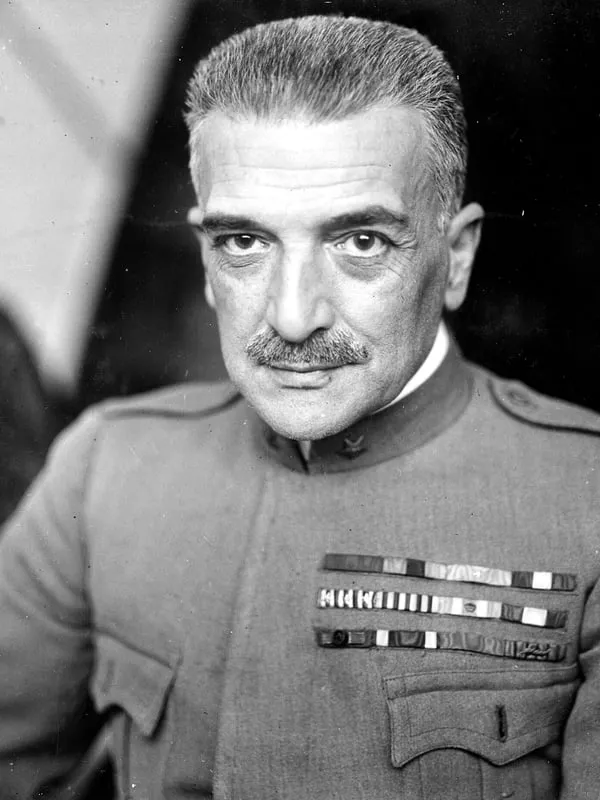
- Born:
- 5 December 1861, Naples (Italy)
- Died:
- 29 February 1928, Rome
- Author:
- Łukasz Skowroń
- Photo:
- autor nieznany, domena publiczna, Wikimedia Commons

Armando Diaz took command of the Italian Army on 8 November 1917, when after the defeat at Caporetto it was falling back to the Piave, having lost hundreds of thousands of men and nearly half its artillery. Within a year he turned it into an army that in June 1918 repulsed Austria-Hungary’s last great offensive and in October routed it at Vittorio Veneto. He was neither a brilliant nor a daring commander. He was, however, the opposite of his predecessor, Luigi Cadorna: he cared for his soldiers, trusted his subordinates and worked with the government and the Allies. Foch and some Italian politicians criticised him for the caution with which he delayed the final offensive, but in Italy he was remembered as the “Duke of Victory”, the author of the bulletin announcing the end of the war with Austria on 4 November 1918.
Before the war
He was born on 5 December 1861 in Naples, into the family of a naval officer of Spanish descent. He graduated from the Nunziatella military school in Naples and the artillery academy in Turin, and in 1884 began service in the field artillery. In 1894 he graduated first in his class from the war college, and over the following years alternated service on the general staff with command of a battalion and a regiment. During the Italo-Turkish War he commanded the 93rd Infantry Regiment in Libya and was wounded at Zanzur in 1912. On his return he worked in the secretariat of the chief of staff, General Alberto Pollio, and after Pollio’s sudden death in July 1914 remained with the new chief of staff, Luigi Cadorna.
Under Cadorna
When Italy entered the war in May 1915, Diaz, by then a major general, headed the operations section of the Supreme Command. He was thus a close collaborator of Cadorna in planning the first battles of the Isonzo and came to know well the flaws of his centralised, mistrustful style of command. In June 1916 he himself asked for a posting to the front. As a lieutenant general he took over the 49th Division in the 3rd Army of the Duke of Aosta, Emanuele Filiberto. In the Ninth Battle of the Isonzo at the beginning of November 1916 his division took the hills south of Bilje, from which Italian artillery could fire into the flank of the Austrian positions east of Gorizia.
In April 1917 he took over XXIII Corps on the Karst plateau. The corps fought in the Tenth and Eleventh Battles of the Isonzo, in the latter of which, on 19 August, it broke into the lines of the Austrian 12th Division near Veršič. Diaz was wounded in the arm and received the Silver Medal of Military Valour. Unlike Cadorna, therefore, he knew at first hand the war on the Karst, its costs and the mood of the soldiers.
The Piave and the Grappa
On 24 October 1917 the Germans and Austrians broke through the front at Caporetto, and the Italian Army fell back from the Isonzo to the Tagliamento and then to the Piave. At the Rapallo Conference the British and French made their help conditional on a change of commander-in-chief, and the prime minister, Vittorio Emanuele Orlando, meant to get rid of Cadorna in any case. On the evening of 8 November King Victor Emmanuel III dismissed Cadorna and appointed the 55-year-old Diaz chief of staff. The choice was a surprise: Diaz was one of the younger corps commanders, and many had expected rather the popular Duke of Aosta. Generals Gaetano Giardino and Pietro Badoglio became Diaz’s deputies. The new chief of staff declared briefly that he was taking up his post and counted on the faith and self-sacrifice of all. According to accounts, he added that the weapon he had been given to wield was blunted, but would be sharpened anew.
Diaz took over the defensive line chosen by his predecessor: from the Adriatic along the Piave, across the Monte Grappa massif, to the Asiago plateau. It was more than two hundred kilometres shorter than the old front, and on the Grappa Cadorna had been building roads and fortifications since 1916. Diaz firmly rejected suggestions to fall back further, to the Adige or the Mincio. According to some studies he had only about 33 divisions fit for battle, roughly half the strength before Caporetto. The Allies sent to Italy five British divisions under General Herbert Plumer and six French ones under General Émile Fayolle, but they did not enter the line until December. In the First Battle of the Piave, from 10 November to the end of December 1917, the Italians stopped the Austrians and Germans on their own. Diaz did not interfere in every move of his army commanders, and the defence of the Grappa was conducted flexibly, with rapid counter-attacks. In an order of 18 November he praised the eighteen-year-old recruits of the class of 1899 who had just had their baptism of fire.
Rebuilding the army
In the winter of 1917/1918 Diaz, together with Badoglio, rebuilt the army almost from scratch. Dozens of infantry brigades and hundreds of batteries were re-formed, and the units received new machine guns, Villar Perosa submachine guns, mortars and flamethrowers. The arditi assault units, the air service and intelligence were expanded, and the defence was based on deep positions and reserves ready to counter-attack. Even more important was the change in attitude towards the soldiers. Discipline remained strict, but the most brutal practices of Cadorna’s time, including the decimation of units, were abandoned. Food was improved, spells in the front line were shortened, pay and leave were increased, and in cooperation with the government free insurance for soldiers was introduced. A new propaganda service published trench newspapers and explained to the soldiers what they were fighting for. Diaz also tried to keep good relations with the King and Orlando’s government, although, like his predecessor, he could not abide interference in matters of command.
As early as the end of January 1918 the Italians retook on the Asiago plateau three hills lost in December. In the spring Diaz sent II Corps to the Western Front, and most of the French divisions and some of the British returned to France to help repel the German offensives. In May Orlando agreed that the coordinating authority of Ferdinand Foch should extend to the Italian front as well, but command of the Italian Army remained in Diaz’s hands.
June 1918
On 15 June 1918 Austria-Hungary attacked for the last time: Franz Conrad von Hötzendorf’s army group in the mountains and Svetozar Boroević’s group on the Piave. Italian intelligence knew the date and even the hour at which the bombardment would begin, and Diaz, who had been preparing an attack himself, abandoned it and deployed strong reserves ready to be moved by lorry and rail to any threatened sector. In the Second Battle of the Piave the attack in the mountains collapsed within a single day, while on the river the Austrians seized bridgeheads on the Montello and on the lower Piave, but the swollen river swept away their bridges. On the evening of 20 June Emperor Karl ordered a retreat. Diaz judged that his tired troops had no chance in a counter-offensive and that, since the enemy had to withdraw anyway, there was no reason to shed more blood. This decision brought him the criticism of the Allies, who believed he had wasted a chance to destroy a beaten army.
Vittorio Veneto
In the summer and in September Foch, the British commander Lord Cavan and Prime Minister Orlando pressed ever harder for the Italians to go on the offensive. Diaz delayed. He feared a blow from the Grappa into the flank of his armies and believed that without the divisions sent to France he lacked sufficient superiority. At the end of September he finally decided to attack. The plan provided for an attack in the Grappa massif and the main thrust across the Piave between the Montello hill and the island of Papadopoli, towards Vittorio, to split the junction of the Austrian armies. The offensive, postponed by flooding, began on 24 October, exactly on the anniversary of Caporetto.
The Battle of Vittorio Veneto began with bloody and unsuccessful assaults on the Grappa. The crossing of the swollen Piave did not begin until the night of 26–27 October, and for a day the bridgeheads that had been seized were in a critical position. But the Austro-Hungarian Army, in which Hungarian, Czech, Croatian and other regiments had begun to mutiny, no longer had the strength to counter-attack. On 28 October it began to withdraw, and on 30 October the Italians entered Vittorio. The Austrians had been asking for an armistice since 28 October, but Diaz played for time: he wanted no enemy soldier to be standing on Italian soil when the armistice came. The Armistice of Villa Giusti, signed by Badoglio on 3 November, did not come into force until 3 p.m. on 4 November. When the Austrian chief of staff, Arthur Arz von Straußenburg, protested that his troops had already stopped fighting, Diaz replied that taking prisoners until that hour was entirely proper. According to the Italian bulletin, about 300,000 men were taken prisoner in the last day and a half of the war. At noon on 4 November Diaz issued the famous bulletin no. 1268, the Bollettino della Vittoria, which stated that the war against Austria-Hungary was won and the enemy army annihilated.
After the war
In November 1919 Diaz stepped down because of ill health, and Badoglio succeeded him. He had been a senator since February 1918. In 1921 the King gave him the title of Duke of Victory (Duca della Vittoria), and during a visit to the United States New York held a parade in his honour. In October 1922, during the fascist March on Rome, he advised the King against a solution by force. Then, at the monarch’s wish, he became Minister of War in the first government of Benito Mussolini and held the office until April 1924, agreeing among other things to the creation of the fascist militia. On 4 November 1924, the anniversary of the victory, he received, together with Cadorna, the baton of a Marshal of Italy. He died in Rome on 29 February 1928 and was buried in the basilica of Santa Maria degli Angeli.
Assessment
Most historians rate Diaz more highly than his predecessor, though less enthusiastically than the Italian patriotic tradition. They stress that after Caporetto he gave the army what it needed most: calm, confidence and better treatment of the soldiers, and that the new, decentralised command worked far more efficiently than Cadorna’s headquarters. Diaz himself said that his only merit had been to balance the forces and talents of others, and to bring calm among the generals and confidence among the soldiers. The British historian Denis Mack Smith drew attention above all to his concern for the soldiers’ welfare and to the fact that for the first time the aims of the war were explained to them.
Critics, especially in France and Britain, accused him of excessive caution: no counter-offensive after the June battle on the Piave, and delaying the final offensive until the moment when the Habsburg monarchy was falling apart from within. They also pointed out that at Vittorio Veneto the decisive breach was made by Lord Cavan’s 10th Army with its British divisions. Diaz’s defenders reply that an army which a year earlier had nearly disintegrated could not afford another bloody defeat, and that his patience saved the lives of many soldiers. His undisputed achievement is considered to be that after Caporetto Italy did not drop out of the war.
Sources
Spotted a mistake?Report an error
Commanded in battles
(04)Mentioned in battles
(04)Often appears with
People who appear in the same events.