Italy · The Entente
Pietro Badoglio
Commander of II and XXVII Corps (1917), deputy chief of staff of the Italian Army (1917–1919), Army chief of staff (1919–1921), Marshal of Italy (1926)
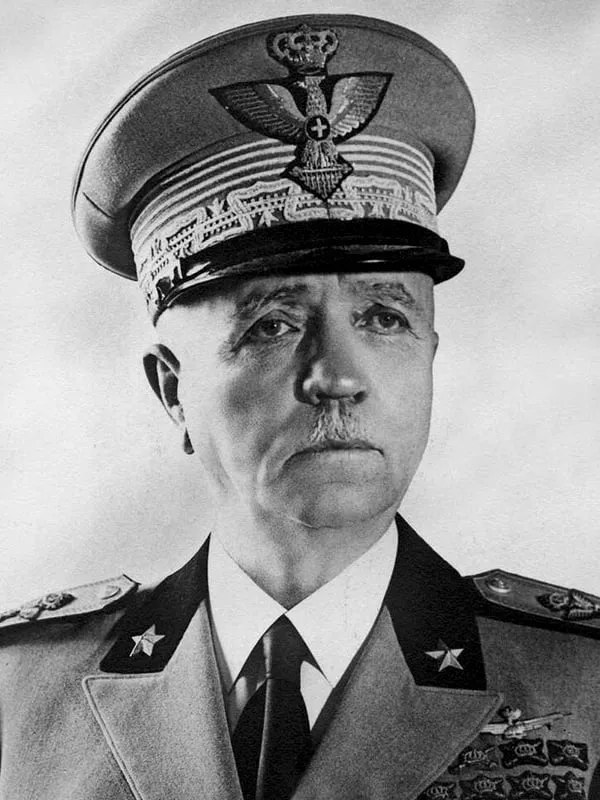
- Born:
- 28 September 1871, Grazzano Monferrato, now Grazzano Badoglio (Italy)
- Died:
- 1 November 1956, Grazzano Badoglio (Italy)
- Author:
- Natalia
- Photo:
- autor nieznany, domena publiczna, Wikimedia Commons

During the First World War Pietro Badoglio made a career without precedent in the Italian Army: in February 1915 he was a staff lieutenant-colonel, and by the autumn of 1917 a lieutenant-general and corps commander. He made his name with the carefully prepared capture of Monte Sabotino on the Isonzo in August 1916. A year later his XXVII Corps found itself at the very centre of the breakthrough at Caporetto, yet Badoglio not only escaped responsibility but became deputy to the new chief of staff, General Armando Diaz. As his right-hand man he helped rebuild the army and win the victory at Vittorio Veneto, and on 3 November 1918 he signed the armistice with Austria-Hungary on behalf of the Allies. His later path, from the conquest of Ethiopia to the fall of Mussolini in 1943, has made him to this day one of the most controversial figures in twentieth-century Italian history.
Before the war
He was born on 28 September 1871 at Grazzano Monferrato in Piedmont, into a family of modest landowners. The village, where he later died, now bears his name. He graduated from the artillery and engineering academy in Turin and in 1890 became a second lieutenant of artillery. After the defeat at Adwa in 1896 he volunteered for Eritrea, where he spent more than two years. On his return he completed the war college, served on the general staff in Rome and made himself known as an intelligent and hard-working officer, though brusque and reserved. During the Italo-Turkish War in Libya he worked on a corps staff, prepared the successful operation at Zanzur and was promoted to major for war merit. On 25 February 1915, as Italy prepared for war, he became a lieutenant-colonel of the general staff.
Monte Sabotino
After Italy entered the war Badoglio served on the staff of the Second Army and then as chief of staff of the 4th Division near Gorizia. The bridgehead with which the Austrians defended the city on the western bank of the Isonzo was closed to the north by Monte Sabotino and to the south by Monte San Michele, and the Italians bled themselves white against both mountains throughout 1915. In February 1916 Badoglio took charge of the earthworks on Sabotino. For several months his men cut approach trenches and caverns into the rock, bringing the Italian lines from more than a kilometre to about eighty metres from the Austrian trenches. In May he was promoted to colonel and became chief of staff of General Luigi Capello’s VI Corps, but continued to oversee the work on the mountain.
On 6 August 1916, the first day of the Sixth Battle of the Isonzo, Badoglio led one of the two assault columns that quickly took the summit of Sabotino. The defenders, caught by surprise in their caverns, had no time to resist. The fall of the mountain opened the way to Gorizia, taken in the following days. On 27 August Badoglio was promoted to major-general for war merit. In the autumn he commanded the “Cuneo” Brigade in a difficult sector east of Gorizia.
1917: Kuk, Bainsizza and Caporetto
In the spring of 1917 Capello, commander of the Gorizia sector, again took Badoglio as his chief of staff. When the Tenth Battle of the Isonzo began in May, Capello decided that the commander of II Corps at Plava was not up to the task and on 13 May handed the corps to Badoglio. A major-general suddenly found himself commanding three lieutenant-generals. His divisions took the Kuk ridge and on 18 May the summit of Vodice, although they then had to defend themselves against fierce counter-attacks. In the Eleventh Battle of the Isonzo in August II Corps pinned down Austrian forces on the Bainsizza plateau, and on 22 August, in the middle of the battle, Capello entrusted him with command of XXVII Corps, which was attacking the hills near Tolmin ineptly. There he managed no more than local successes. Even so, in August he was promoted to lieutenant-general, and in October he formally took over XXVII Corps.
The corps was stretched out on both banks of the Isonzo, with three divisions on the eastern bank and one on the western, because Capello was preparing for a counter-offensive rather than for defence. On 24 October 1917 the Germans and Austrians struck at Caporetto precisely against the left wing of XXVII Corps and its junction with General Alberto Cavaciocchi’s IV Corps. The German 12th Division advanced along the Isonzo valley from Tolmin to beyond Kobarid, getting into the rear of IV Corps, while the Alpenkorps broke onto the hills above Tolmin. Badoglio’s artillery, its telephone lines cut, barely responded to the German bombardment. The general himself was cut off from his troops for most of the day and only in the afternoon began to understand what had happened. In the following days his corps, rebuilt several times from remnants and reinforcements, fell back through Udine, while Badoglio, with a handful of arditi and cavalry, covered the retreat near San Daniele and on 30 October crossed the Tagliamento.
Badoglio’s role in the Twelfth Battle of the Isonzo is still disputed. His defenders argue that he was the victim of his superiors’ mistakes: Capello did not carry out Cadorna’s orders to go over to the defensive, and the rule of opening barrage fire only at the last moment failed in the fog and under gas. His critics point out that the two decisive breakthroughs took place on his sector, that his sector lacked artillery counter-preparation, and that the general, who wrote at length about his other achievements, wrote nothing about 24 October 1917.
Diaz’s deputy
On 8 November 1917 the King dismissed Cadorna. The new chief of staff was Armando Diaz, with General Gaetano Giardino and Badoglio as his deputies. According to the Treccani Biographical Dictionary, Badoglio’s appointment was announced two days after Diaz’s. He owed it above all to the patronage of the minister Leonida Bissolati, who called him his old friend, and also to the fact that the scale of the defeat for a long time made it impossible to apportion responsibility. Cadorna, in his communiqué of 28 October, had put all the blame on the soldiers.
In this triumvirate Badoglio dealt mainly with organisation. Within a few months fifty infantry brigades and more than four hundred batteries were rebuilt for an army that had lost almost half its artillery and hundreds of thousands of men at Caporetto. In mid-February 1918 Giardino left the Supreme Command and Badoglio became the sole deputy chief of staff, Diaz’s true right hand. When the commission investigating the causes of the Caporetto defeat wanted to question him, Diaz refused to make him available before the expected Austrian offensive. Badoglio drew on his bitter experience on the Isonzo: he helped devise new rules for defence in depth and for the use of artillery and machine guns, which proved themselves in June 1918 in the Second Battle of the Piave. After the battle he was given the rank of army commander.
He also took part in preparing the autumn offensive that ended in the Battle of Vittorio Veneto. When on 31 October General Viktor Weber’s Austro-Hungarian armistice commission arrived at Villa Giusti near Padua, it was Badoglio who conducted the talks with it. On 1 November he read the armistice terms to the Austrians and declared that they were not open to discussion. On 3 November, when Weber accepted them and asked for an immediate cessation of hostilities, Badoglio replied that this was not possible within less than a day and proposed that arms be laid down on 4 November at 3 p.m. That evening he signed the Armistice of Villa Giusti on behalf of the Allies. In the last day and a half of the war the Italians took hundreds of thousands of prisoners from an army that believed the fighting was already over, which in Austria was for years regarded as unfair.
After the war
In February 1919 Badoglio became a senator. The report of the Caporetto commission, published in the summer of that year, placed the main responsibility on Cadorna, Capello and several other generals, and spared him. According to some historians thirteen pages concerning his command were removed from the report, though this has never been proved. In the autumn of 1919, after Gabriele D’Annunzio seized Fiume, he was extraordinary commissioner in Venezia Giulia, and in November he succeeded Diaz as chief of staff of the army. He left the post in 1921.
He was at first distrustful of Fascism, but soon came to terms with it. In 1925 Benito Mussolini made him chief of the general staff, and in 1926 he received the baton of a Marshal of Italy. He was governor of Libya, where he bloodily crushed the resistance of the local population, and in 1935–1936 he directed the conquest of Ethiopia, in which poison gas was used on a massive scale. In December 1940, after the defeat in Greece, he resigned. On 25 July 1943, after Mussolini was overthrown, the King entrusted him with the government. Badoglio concluded an armistice with the Allies, announced on 8 September, and then fled south from Rome with the King, leaving the army without orders. He governed until June 1944. He died on 1 November 1956 in his native village.
Assessment
In the history of the First World War Badoglio is regarded as one of the ablest staff officers of the Italian Army, a master of the carefully prepared attack, as Sabotino proved, and an efficient organiser to whom Diaz owed a great deal in 1917–1918. At the same time he was a general whose career did not stall despite a defeat in which his corps played a key part. Italian historians, from the author of his entry in the Treccani Biographical Dictionary to scholars of Caporetto, point to a marked disproportion between the severity with which Cadorna and Capello were treated and the leniency shown to Badoglio, who was protected by influential connections. His later choices, from the war in Ethiopia to the flight from Rome in 1943, mean that judgements of his career as a whole are mostly harsh.
Sources
Spotted a mistake?Report an error
Commanded in battles
(05)- 12 May – 5 June 1917Tenth Battle of the IsonzoItalian Front
- 17 August – 12 September 1917Eleventh Battle of the IsonzoItalian Front
- 24 October – 9 November 1917Twelfth Battle of the IsonzoItalian Front
- 15–24 June 1918Second Battle of the PiaveItalian Front
- 24 October – 4 November 1918Battle of Vittorio VenetoItalian Front
Mentioned in battles
(02)Often appears with
People who appear in the same events.