1917: The Italian front
Twelfth Battle of the Isonzo
- Dates:
- 24 October – 9 November 1917
- Front:
- Italian Front
- Location:
- The upper Isonzo between Bovec (Plezzo, Flitsch) and Tolmin, with Kobarid (Caporetto, Karfreit) in the middle, the Kolovrat and Matajur ridges, then the Friuli plain from the Isonzo through Udine to the Tagliamento and the Piave, Austria-Hungary and Italy (now Slovenia and Italy)On the battle map →
- Sides:
- ItalyLuigi Cadorna, Luigi Capello, Luca Montuori, Prince Emanuele Filiberto, Duke of Aosta, Alberto Cavaciocchi, Pietro BadoglioGermany and Austria-HungaryArchduke Eugen of Austria, Otto von Below, Konrad Krafft von Dellmensingen, Svetozar Boroević, Alfred Krauss
- Result:
- Decisive Central Powers victory. The Italian 2nd Army was routed and the whole Italian army fell back from the Isonzo more than a hundred kilometres, behind the Piave. The Italians lost nearly 300,000 prisoners and more than 3,000 guns, but stopped the enemy on the Piave and Monte Grappa.
- Author:
- Łukasz Skowroń
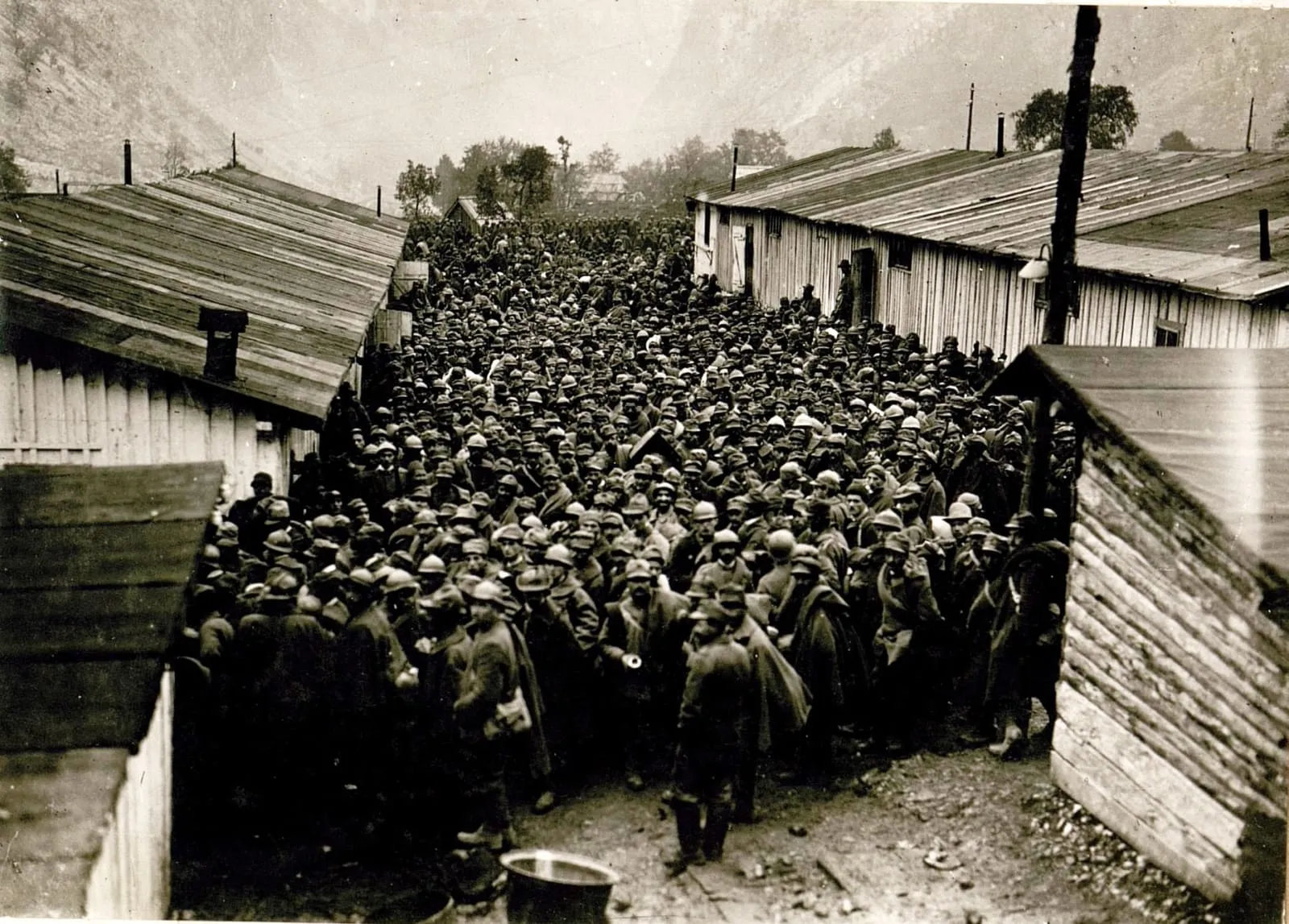
The Twelfth Battle of the Isonzo, better known as the Battle of Caporetto, was the greatest defeat of the Italian army in the whole war. On 24 October 1917 the new German 14th Army of General Otto von Below, made up of German and Austro-Hungarian divisions, struck on the upper Isonzo at Bovec and Tolmin, at the weakest point of the Italian 2nd Army. After a night gas bombardment the infantry passed through the Italian lines along the valley floor in rain and fog, and by the afternoon of the first day the Germans were in Kobarid, in Italian Caporetto. Within three days the whole Italian front from the Carnic Alps to the sea collapsed. General Luigi Cadorna ordered a retreat first behind the Tagliamento and then behind the Piave, some hundred and fifty kilometres from the starting line. Nearly 300,000 Italian soldiers were taken prisoner, and hundreds of thousands of scattered soldiers and civilian refugees flooded the roads of Friuli and Venetia. The front came to a halt only on the Piave and Monte Grappa, and Cadorna lost his post.
Name and dates
In Italian the battle is called the battaglia di Caporetto, and in everyday Italian the word “Caporetto” has become a synonym for disaster. In German it is the zwölfte Isonzoschlacht or the “miracle of Karfreit” (Wunder von Karfreit), after the German name of Kobarid, and in Slovene the battle of Kobarid. The dates of the battle differ from source to source. The Austrian official history (Österreich-Ungarns letzter Krieg) calls only the breakthrough of 24–27 October the Twelfth Battle of the Isonzo, and describes the further fighting as separate stages of the pursuit: the battle of Codroipo and Latisana, the forcing of the Tagliamento and the pursuit to the Piave. Italian studies usually end the battle with the army’s arrival on the Piave between 9 and 12 November, and some English-language works count it as late as 19 November, including the first fighting on the new line. The Polish Wikipedia gives conflicting dates. We adopt the dates 24 October – 9 November 1917: on 9 November the last Italian rearguards went over to the western bank of the Piave, the Austro-Hungarian troops reached the river everywhere, and General Cadorna handed over command to his successor. The battles for Monte Grappa and on the Piave, fought from the middle of November, were already a new stage of the fighting.
Background
After the Eleventh Battle of the Isonzo in August and September 1917 both armies on the Isonzo were exhausted. The Austrians had held out, but concluded that they might not survive another such battle, and asked the Germans for help with a pre-emptive blow. Field Marshal Paul von Hindenburg agreed after the ground had been reconnoitred by a Bavarian specialist in mountain warfare, Lieutenant-General Konrad Krafft von Dellmensingen, and on 12 September the South-Western Front command received its orders. The Germans sent seven divisions, among them the Alpine Corps and the Württemberg Mountain Battalion, which had fought in Romania in the summer at Oituz. Together with eight Austro-Hungarian divisions they formed Below’s 14th Army, with Krafft as chief of staff. According to the Austrian official history, on 24 October the army had 1,678 guns and 44 batteries of trench mortars, and the neighbouring group of General Kosak of the 2nd Isonzo Army a further 424 guns. Guns, ammunition and infantry were moved by night into the valleys around Tolmin and Bovec and onto the bridgehead that the Austrians had held for two years on the western bank of the Isonzo at Tolmin.
The plan called for a narrow, deep breakthrough between Bovec and Tolmin, followed by a descent from the mountains onto the Friuli plain into the rear of the Italian troops on the lower Isonzo. On 4 October Below ordered his army to break the front “at Flitsch and Tolmein” and, “in an uninterrupted attack carried on day and night”, to take the ridges from Kanin to Matajur and Kolovrat. The group of General of Infantry Alfred Krauss (Austro-Hungarian I Corps) was to advance down the Isonzo valley from Bovec, the group of the Bavarian General Hermann von Stein (with the German 12th Silesian Division, the Alpine Corps and the Austro-Hungarian 50th Division) was to climb the Kolovrat ridge and Matajur, and the groups of Generals Albrecht von Berrer and Karl Scotti were to take Ježa hill and Globočak. The German officers brought the experience of the Western Front: a short, violent bombardment instead of one lasting many days, assault detachments (Stoßtruppen) with light machine guns and mortars, and the principle that the leading units should push forward without looking to their neighbours. According to the plan, the further objective was to be the line of the Tagliamento, although at the outset no one counted on so great a success.
On the Italian side the sector from Rombon to the Bainsizza was held by General Luigi Capello’s 2nd Army, according to the Austrian official history 25 divisions with 353 battalions and 2,430 guns. Its commander, the conqueror of Gorizia in 1916, was ill, and his troops, deployed for attack after the summer successes, stood largely on the eastern bank of the Isonzo, on the Bainsizza plateau. On 18 September Cadorna, fearing an enemy offensive after the collapse of Russia, ordered a switch to the defensive. Capello, however, did not fully obey him: he wanted to meet the blow with a counter-attack from the flank and did not withdraw his heavy artillery behind the river. Italian intelligence knew of the concentration of German troops. On 20 and 21 October three Austro-Hungarian officers who had deserted, a Czech and two Romanians, gave the Italians almost the whole plan, including the gas bombardment and the place of the attack. On 22 October Cadorna toured the threatened corps and moved one division to Kobarid, but did not believe that the enemy could develop a great offensive in such difficult mountain terrain. The weakest point was the junction of the Italian IV Corps of General Alberto Cavaciocchi and XXVII Corps of General Pietro Badoglio in the Isonzo valley between Tolmin and Kobarid.
Course
24 October. In rain, fog and snowstorms on the peaks, at 2 a.m. the Central Powers’ artillery opened fire with gas shells along the whole front of the attack. At Bovec the German 35th Pioneer Battalion fired several tonnes of phosgene from 894 projectors dug into the ground, modelled on the British Livens projectors, into a gorge where soldiers of the Italian 87th Infantry Regiment of the Friuli Brigade were sheltering. According to German accounts 500–800 men died there, most of them before they could put on their masks. At 6.30 a.m. the destructive bombardment began, and at 8 a.m. at Tolmin and 9 a.m. at Bovec the infantry moved off. The German 12th Division of General Arnold Lequis advanced along the floor of the Isonzo valley, ignoring the heights on either side, broke into Kobarid at 4 p.m., and before midnight its advance guard stood on the old frontier at Robič, 23 kilometres from where it had set out. The Austro-Hungarian 50th Division took the village of Krn, the Alpine Corps in the evening the key hill 1114 on the Kolovrat ridge, and the German 200th Division Ježa hill. The Austro-Hungarian 22nd Rifle Division passed through Bovec. By the evening the front had been torn open over 32 kilometres, and the cut-off Italian divisions in the Krn massif began to surrender. The artillery of Badoglio’s XXVII Corps, its telephone lines cut, remained almost silent, which later became the subject of long disputes. At 9.30 p.m. Cadorna ordered the troops to withdraw from the Bainsizza plateau.
25–26 October. On 25 October German units began to roll up the Italian positions on the Kolovrat from the north, and before dawn on 26 October Austro-Hungarian riflemen of Krauss’s group climbed the Stol ridge above the Isonzo valley. That day Capello went to the headquarters in Udine and recommended an immediate retreat behind the Tagliamento. Cadorna told him first to put this in writing, but when the new commander of the 2nd Army, General Luca Montuori, judged in the evening that resistance in the mountains in front of the plain was still possible, he held back the order he had prepared. Capello, because of his illness, handed over command to Montuori. On the morning of 26 October a detachment of the Württemberg Mountain Battalion under Lieutenant Erwin Rommel, outflanking the Italian positions along the ridges, reached the summit of Matajur (1,641 m). According to Rommel’s own account, his detachment of a few companies took about 9,000 Italians prisoner and captured 81 guns in about 50 hours, losing 6 killed and 30 wounded. Rommel described this fighting in his book “Infanterie greift an”, published in 1937, and in December 1917 he received the Pour le Mérite. By the evening of 26 October the Central Powers’ troops had broken through the Italian positions on a width of 50 and a depth of 20 kilometres.
27–28 October. Shortly after midnight on 27 October news of the loss of the summit of Montemaggiore reached Cadorna. At 2.30 a.m. he issued the order to retreat behind the Tagliamento to the Carnic group, then to the 3rd Army of the Duke of Aosta, Emanuele Filiberto, which held the front from Gorizia to the sea, and at 3.20 a.m. to the 2nd Army. In the afternoon the Supreme Command left Udine and moved to Treviso and Padua. The same day the Alpine Corps occupied burning Cividale. On the night of 27–28 October the Austro-Hungarian 58th Division entered Gorizia, and on 28 October the German 200th Division occupied the abandoned Udine. Near the city the group commander, General Berrer, was killed. Split into two parts, the 2nd Army fell back in ever greater disorder, and on 28 October Cadorna, in a war bulletin, publicly accused its units of having “retreated in cowardly fashion without fighting or shamefully surrendered to the enemy”.
29 October – 4 November. On the plain a race was under way for the bridges over the Tagliamento, swollen by the rains. The roads to the crossings at Codroipo and Latisana were choked with columns of troops, transport and refugees. On 30 October the Germans took Codroipo, and Italian engineers blew up the bridges, cutting off tens of thousands of 2nd Army soldiers on the eastern bank, who were taken prisoner. The 3rd Army, however, mostly managed to cross to the other bank in good order. According to the Austrian official history, the 14th Army alone had taken 200,000 prisoners by 2 November. On the evening of 2 November a battalion of the Bosnian-Herzegovinian 4th Infantry Regiment crossed on ladders and the remains of the blown railway bridge at Cornino and won a bridgehead on the western bank of the Tagliamento. On 4 November Cadorna ordered a retreat to the Piave.
5–9 November. The Italians fell back across the Livenza and Monticano rivers, covered by rearguards. In the mountains Krauss’s troops descended the Piave valley into the rear of the Italian 4th Army withdrawing from the Cadore, and on 9–10 November at Longarone took about 10,000 men of its rearguard prisoner; Rommel again distinguished himself in this fighting. By 8 November the main forces of the 2nd and 3rd Armies stood on the western bank of the Piave, and on 9 November the last rearguards went over there. On the evening of 8 November King Victor Emmanuel III dismissed Cadorna, and General Armando Diaz became his successor. The new front line from the sea along the Piave through Monte Grappa to the Asiago plateau was more than two hundred kilometres shorter than that of 24 October.
Losses
According to the Austrian official history, based here on the figures of the Italian commission of inquiry, from 24 October to 10 November the Italians lost 10,000 killed, 30,000 wounded and 293,000 prisoners. About 350,000 scattered soldiers and stragglers wandered about the rear areas. Other studies give about 11,000–13,000 killed and 265,000–300,000 prisoners. Italy lost 3,150 guns and 1,732 trench mortars, almost half its artillery, as well as about 300,000 rifles and 3,000 machine guns. By the middle of November 22 infantry brigades had been disbanded. The Austrian official history estimates the losses of the Central Powers at about 70,000 men in five weeks of fighting, including the first fighting on the new line. Several hundred thousand civilians from Friuli and Venetia also fled their homes.
Significance
The defeat at Caporetto very nearly knocked Italy out of the war. It caused a political crisis: on 25 October Paolo Boselli’s government lost a confidence vote in the Chamber of Deputies, and the new government of Vittorio Emanuele Orlando, formed at the end of October, called on the country to defend itself at any cost. Britain and France, which as recently as September had taken back their heavy guns from Cadorna, had to send five British and six French divisions to Italy. On 5–7 November, at the conference at Rapallo, the prime ministers of Britain, France and Italy decided to set up the Supreme War Council, the Allies’ first joint body for directing the war. The Allied divisions, however, took no part in the battle, and the front on the Piave and Monte Grappa was held in November and December by the Italians alone.
The Central Powers won one of the most spectacular victories of the war, but did not achieve their strategic aim. The Italian army lost its 2nd Army, but did not fall apart, and the 3rd Army escaped the trap. The Austrian official history admitted that the victors had been unable to cut off and destroy whole armies, and that the pursuit on the plain was slowed by a lack of cavalry, destroyed bridges and choked roads. The Germans soon took their divisions away to the Western Front. The battle became a model of breakthrough by surprise, a short bombardment and the deep penetration of assault detachments, which the Germans applied on a large scale in the spring of 1918. In Italy Caporetto became a national trauma. The commission of inquiry, which finished its work in 1919, laid the blame above all on Cadorna and Capello, and the dispute over responsibility, including Badoglio’s role, went on for decades. The retreat from Caporetto was described in the novel “A Farewell to Arms” by Ernest Hemingway, who himself came to the Italian front as an ambulance driver only in the summer of 1918. A year after Caporetto, in October 1918, the Italian army set out from the Piave on the victorious Battle of Vittorio Veneto.
Spotted a mistake?Report an error