Italy · The Entente
Victor Emmanuel III
King of Italy (1900–1946), formal supreme commander of the Italian Army during the war
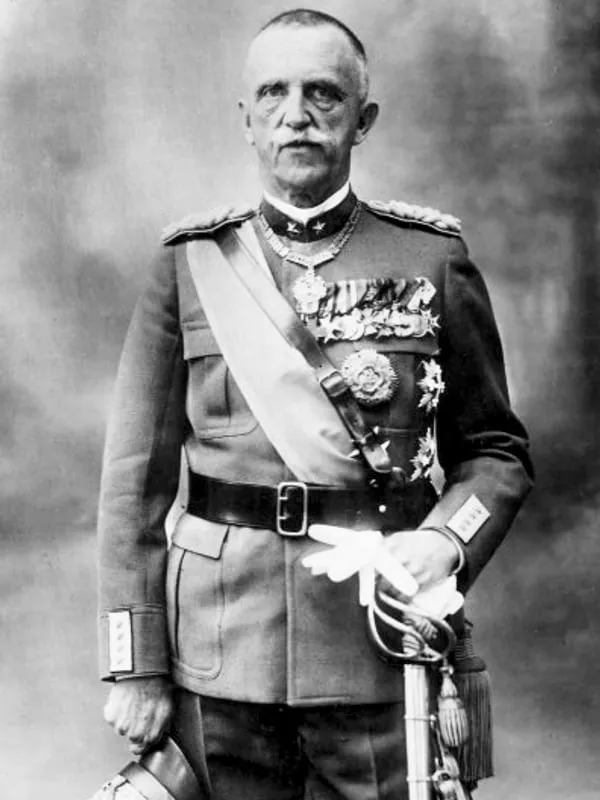
- Born:
- 11 November 1869, Naples (Italy)
- Died:
- 28 December 1947, Alexandria (Egypt)
- Author:
- Natalia
- Photo:
- Possibly Mario Nunes Vais, domena publiczna, Wikimedia Commons

Victor Emmanuel III was King of Italy for almost half a century, but the war of 1915–1918 was the only period in which he enjoyed the sincere esteem of most of his subjects. In May 1915 it was his decision that settled Italy’s entry into the war on the side of the Entente, although the majority of parliament preferred neutrality. Under the constitution he was supreme commander, but he handed the direction of operations to the chief of staff, General Luigi Cadorna, while he himself lived near the front for three and a half years, touring the trenches, hospitals and rear areas every day. The press called him the “soldier king” (re soldato). At the hardest moment, after the defeat at Caporetto, he struck the Allies as a calm man, certain that the army would hold. The memory of this was later overshadowed by his role in the fascists’ rise to power, which the Italians did not forgive the dynasty.
Before the war
He was born on 11 November 1869 in Naples, the only son of the heir to the throne, the future King Umberto I, and Margherita of Savoy. He was a grandson of Victor Emmanuel II, the first king of united Italy. His parents were cousins, and their son grew up very short, which throughout his life was a source of complexes and of malicious jokes. Brought up strictly, he received a thorough military education and served for several years in an infantry regiment in Naples, but he was more interested in numismatics than in the army, and devoted a multi-volume catalogue of Italian coins to it. In 1896 he married Elena, daughter of the prince, and later king, of Montenegro Nicholas I.
He came to the throne unexpectedly on 29 July 1900, when the anarchist Gaetano Bresci shot his father dead at Monza. The first years of his reign brought a retreat from the authoritarian government of the 1890s. The King accepted the liberal cabinets of Giovanni Giolitti, but looked on parliamentary intrigues with irritation and willingly used the powers given him by the Albertine Statute: it was he who appointed prime ministers and, at least formally, decided on war and peace. In foreign policy he was less attached to the Triple Alliance than his father had been and distrustful of Austria, which still ruled Italian-speaking Trentino and Trieste. He welcomed the rapprochement with France and Russia. In 1911 he supported the war with Turkey over Libya. In March 1914, on the advice of the outgoing Giolitti, he entrusted the government to Antonio Salandra.
Neutrality and the choice of war
In July 1914 the King, like the government, considered that Austria-Hungary, by starting a war with Serbia without consulting its allies, had released Italy from its obligations under the Triple Alliance. On 3 August Italy declared its neutrality. Over the following months Salandra and the Foreign Minister Sidney Sonnino bargained with both sides, and the King supported them and was one of the few who knew the details of the talks. When on 26 April 1915 Italy signed a secret agreement with the Entente in London, undertaking to enter the war within a month, apart from two ministers he was practically the only person in Rome who knew of it. Parliament, in which Giolitti’s supporters had a majority, had no idea of the agreement.
The decision came in May. When some three hundred deputies and a hundred senators left their visiting cards at the home of Giolitti, an advocate of further negotiations with Vienna, as a sign of support for him, on 13 May Salandra resigned. For three days the King looked for another prime minister, but neither Giolitti nor other politicians wished to take upon themselves the breaking of commitments signed in the name of the Crown. On 16 May he rejected Salandra’s resignation. Under the pressure of street demonstrations by supporters of war, parliament granted the government full powers, and on 23 May 1915 Italy declared war on Austria-Hungary. Historians still debate whether this was a decision in keeping with the constitution or an assault on the will of the parliamentary majority. There is no doubt that without the King’s support Salandra and Sonnino would not have managed to take the country into the war.
The soldier king
On the same day the King signed a decree that formally made him supreme commander, but orders were to be issued and carried out in his name by the chief of the general staff. In practice Cadorna commanded on his own, not allowing the government to interfere in operations, and the monarch was his main support. The King entrusted power at home to his uncle, Prince Tommaso, Duke of Genoa, as his lieutenant, and went to the front himself. He did not live at the headquarters in Udine, but in a small villa at nearby Torreano di Martignacco, with a small retinue of officers. Every morning he drove by car to the front line or to the rear, and in the evening a staff officer briefed him on the situation. He took photographs, talked to the soldiers and listened to the commanders, but did not interfere in the conduct of operations. Queen Elena meanwhile cared for the wounded in military hospitals.
The King stepped into politics only when he considered it necessary, but then his voice was decisive. In May 1916, during the Austro-Hungarian offensive in Trentino, Salandra wanted to dismiss Cadorna, but the King sided with the general, and in June the government fell. He appointed the aged Paolo Boselli as the new prime minister, and in the autumn of 1917 Vittorio Emanuele Orlando. On 9 August 1916, when the Italians took Gorizia, he thanked the soldiers in a proclamation, and in January 1916 at Brindisi he showed goodwill to the Serbian ministers who had fled through Albania.
Caporetto and Peschiera
He played his most important role in the autumn of 1917. After the breakthrough at Caporetto the army was retreating in disorder behind the Tagliamento and the Piave, and Cadorna blamed his own soldiers for the defeat. At the Rapallo Conference the prime ministers of Britain and France, David Lloyd George and Paul Painlevé, made Cadorna’s dismissal a condition for sending their divisions. On the morning of 8 November the King received them at Peschiera del Garda on Lake Garda. According to the participants’ accounts he spoke calmly and confidently, defended the decisions of the Italian command, did not agree with all the charges against Cadorna, but gave assurances that the army would hold on the Piave, and approved the decisions taken at Rapallo. The British and French left convinced that Italy would not collapse. That evening the King dismissed Cadorna and appointed General Armando Diaz chief of staff. In doing so he passed over his cousin, the popular Duke of Aosta Emanuele Filiberto, who seemed to many the natural candidate. According to some historians the King feared his ambitions.
Victor Emmanuel’s faith was justified. The army stopped the Austrians and Germans in the First Battle of the Piave, in June 1918 repulsed the last Austro-Hungarian offensive, and in the autumn routed the enemy at Vittorio Veneto. The victory bulletin of 4 November 1918 spoke of a war conducted “under the supreme guidance of His Majesty the King, supreme commander”. When the government wished to award the King the gold medal for military valour, he reportedly refused, explaining that he had not taken any summit or won any battle.
After the war
Victory brought Italy Trentino, South Tyrol, Trieste and Istria, but not Dalmatia or Fiume, which the nationalists could not forgive the liberal governments. The country sank into an economic crisis and a wave of strikes, and the King, disillusioned with the politicians, trusted parliament less and less. On 28 October 1922, during the March on Rome, he refused to sign the decree on a state of siege demanded by the government of Luigi Facta, and the next day he entrusted the government to Benito Mussolini. For more than twenty years he tolerated the dictatorship, signed the racial laws and accepted the crowns of Emperor of Ethiopia and King of Albania. On 25 July 1943, when the war was lost, he had Mussolini arrested, and in September he fled from Rome to the south. In 1944 he handed power to his son, and on 9 May 1946 he abdicated in favour of Umberto II. A month later the Italians voted for a republic in a referendum. Victor Emmanuel died in exile in Alexandria on 28 December 1947. In 2017 his remains were moved to the sanctuary at Vicoforte in Piedmont.
Assessment
The assessment of Victor Emmanuel as a monarch is dominated by the years 1922–1943. Many historians, among them the British scholar of the Italian monarchy Denis Mack Smith, believe that without his consent the fascists would not have come to power, and portray him as a distrustful, faint-hearted ruler more attached to the dynasty than to the constitution. His role in May 1915 is also judged critically: the King, two ministers and the street took the country into a war that the majority of parliament did not want, and the precedent of bypassing the chamber was to be repeated in 1922.
The war years are, however, the period of his reign that even his critics judge most kindly. His modest way of life at the front, his courage and his constant presence among the soldiers brought him a popularity he had never had before and never had afterwards. His calm at Peschiera helped convince the Allies that Italy would survive the defeat at Caporetto. His defenders add that he kept to his constitutional role, leaving the conduct of the war to the generals and politics to the governments. His critics reply that precisely for this reason he protected Cadorna from the government for two and a half years and did nothing to curb his cruel methods of command.
Sources
Spotted a mistake?Report an error
Mentioned in battles
(04)Often appears with
People who appear in the same events.