Montenegro · The Entente
Nicholas I of Montenegro
Prince (1860–1910) and King of Montenegro (1910–1918), commander-in-chief of the Montenegrin army
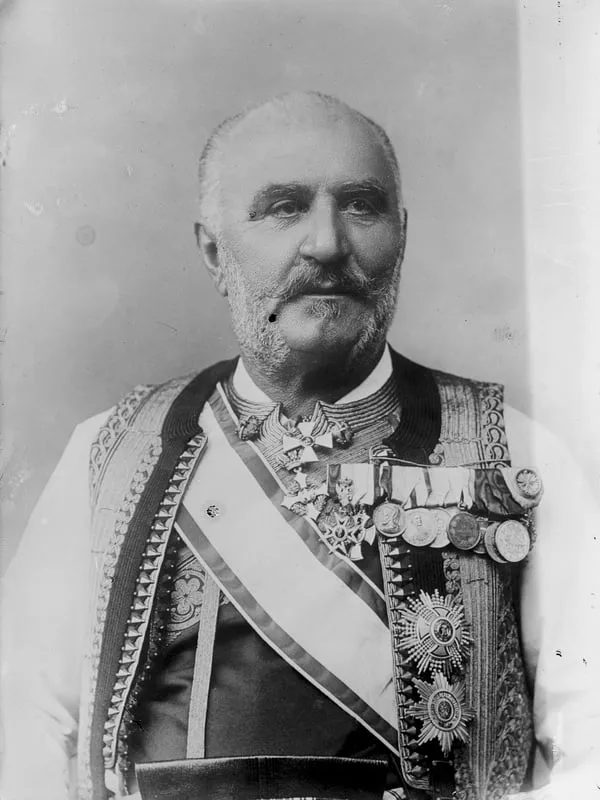
- Born:
- 7 October 1841, Njeguši (Montenegro)
- Died:
- 1 March 1921, Antibes (France)
- Author:
- Natalia
- Photo:
- Bain News Service, domena publiczna, Wikimedia Commons

Nicholas I Petrović-Njegoš, in Polish Petrowić-Niegosz, ruled Montenegro for nearly sixty years, longer than most of the European monarchs of his day. He turned a small mountain principality into an independent kingdom, and through his daughters’ marriages became related to the courts of Russia, Italy and Serbia. In 1914 he was the first to stand by Serbia against Austria-Hungary. The war, however, brought him defeat: in January 1916 the Austrians overran his country in a few days, and he himself went into an exile from which he never returned. Accused by the Serbs of treachery and by the Allies of disloyalty, he was deposed in November 1918, and Montenegro became part of the new Yugoslav state.
Before the war
He was born on 7 October 1841 (25 September in the Julian calendar) in Njeguši, the home village of the dynasty, which from the end of the 17th century had given Montenegro its vladikas, or prince-bishops. He was the nephew of Prince Danilo, who had secularised the state. He was educated in Trieste and Paris, and in August 1860, after his uncle’s assassination, he ascended the throne at the age of eighteen. In the wars with Turkey of 1876–1878 he took Nikšić, Bar and Ulcinj, and the Congress of Berlin recognised Montenegro’s independence and gave it access to the sea. He was also a poet and playwright; his song “Onamo, ’namo!” was sung throughout the Serbian world.
He ruled in a paternal and authoritarian manner. He granted a constitution only in 1905, and dealt harshly with the opposition, often supporters of closer ties with Serbia. He won a position in Europe, however, through his children. His daughter Zorka married Peter Karađorđević, later King of Serbia; Elena became Queen of Italy as the wife of Victor Emmanuel III; and Milica and Anastasia married Russian grand dukes, the latter Nicholas Nikolaevich. Hence the nickname “father-in-law of Europe”. For years Russia supported Montenegro with money and arms. On 28 August 1910, the fiftieth anniversary of his reign, Nicholas assumed the title of king.
In 1912 he was the first to declare war on Turkey, starting the Balkan Wars. His greatest ambition was Scutari: after a long siege he took it in April 1913, but under threat of intervention by the Great Powers he had to hand it over to the newly created Albania. Montenegro emerged from the Balkan Wars enlarged by part of the Sanjak and Metohija, but exhausted and in debt, and in the country the conviction grew that its future lay in a common state with Serbia.
1914–1915: at Serbia’s side
In July 1914 the king was not immediately ready for war. As late as the middle of the month he was assuring the Russian envoy that the Montenegrins would not attack first. The mood in the country, however, was unequivocally pro-Serbian. On 26 July the government ordered mobilisation, and at the beginning of August Montenegro declared war on Austria-Hungary, on 5, 6 or 7 August according to different sources, and a few days later broke with Germany. Nicholas was commander-in-chief, but by agreement with Belgrade the Serbian general Božidar Janković became his chief of staff.
The Montenegrin army was more a levée en masse than a modern force. Its most important asset was the Lovćen massif above the Austro-Hungarian naval base at Kotor. In the autumn of 1914 the French hauled their guns up there, but after a few weeks they had to withdraw them. At the same time the troops of Serdar Janko Vukotić, together with the Serbs, advanced into eastern Bosnia and Herzegovina. In response the Austrians blockaded the coast and shelled the port of Bar, through which aid for the country was arriving. Montenegro was increasingly afflicted by hunger.
In the summer of 1915 the king, taking advantage of the lull at the front, reached for his old goal. On 27 June his troops entered Scutari, and soon afterwards they occupied the port of San Giovanni di Medua. The Entente powers, which in the Treaty of London had postponed the settlement of Albania’s fate until the end of the war, protested, and at the end of July formally warned Cetinje that they would not recognise the occupation. The Montenegrins nevertheless stayed. It was then that rumours began to circulate that the king was in secret contact with Vienna. They were never proven, but in Belgrade and in the Allied capitals distrust of Nicholas grew.
When the Central Powers attacked Serbia in the autumn, Montenegro declared war on Bulgaria, and its troops covered the Serbian army’s retreat from the west. At the turn of November and December tens of thousands of starving Serbian soldiers and refugees passed through Montenegro and the Scutari it occupied, and the Serbian government stopped at Scutari. In January 1916, at the king’s request, the last Serbian units left Montenegro, because the local authorities complained about their requisitions.
January 1916: collapse
At the beginning of January 1916 the Austro-Hungarian 3rd Army of General Hermann Kövess attacked Montenegro (the conquest of Montenegro). In the north the Montenegrins held out at Mojkovac, but in the west, in the battle for Lovćen, the hungry and poorly armed units, commanded among others by the king’s youngest son, Prince Petar, could not withstand the fire of heavy artillery. The summit fell on 10 January. The next day the government asked for an armistice, and on 13 January the Austrians entered Cetinje. The king then wrote to Franz Joseph asking for an “honourable peace”, but Vienna demanded first that the whole army lay down its arms.
On 19 January Nicholas left the country and, according to the Austrian official history, landed at Brindisi the next day. From there he announced that he rejected the enemy’s terms and would fight on, and the negotiations collapsed. His son Mirko and some of the ministers, however, remained in the country. Vukotić disbanded the army, and on 25 January Montenegrin representatives signed the terms of surrender. This course of events became the source of lasting accusations. Opponents of the dynasty claimed that the king had come to an understanding with the Austrians and that Lovćen had been surrendered prematurely. His defenders pointed to hunger, the lack of ammunition and the enemy’s overwhelming superiority. The Austrian official history describes hard fighting for the mountain and mentions no agreement, and the charge of treachery was never proven.
Exile and deposition
From Italy the king went to France. He settled in Lyon, and in March 1916 moved with his family and government to Bordeaux, later to Neuilly-sur-Seine near Paris. Unlike the Serbs, who were rebuilding their army on Corfu, he no longer had an army. Montenegrins who wanted to fight ended up in the Serbian army, which the king disliked. His government in exile became increasingly divided. Prime Minister Andrija Radović urged him to agree to unification with Serbia, and when the king refused, he resigned and in 1917 became head of a Serbian-financed unification committee. The Corfu Declaration, signed in July 1917 by Nikola Pašić and the Yugoslav Committee, announced a common kingdom under the Karađorđević sceptre without asking Montenegro’s opinion.
Nicholas tried to save his throne to the end. On 20 October 1918 he issued a proclamation in which he came out in favour of Montenegro joining Yugoslavia, but as a confederation. It was already too late. Serbian troops entered the country, and on 26 November the Great National Assembly in Podgorica deposed the king and his dynasty and proclaimed union with Serbia. Nicholas and his supporters regarded this as unlawful. At the beginning of 1919 his followers launched the Christmas Uprising, which failed. By then only Italy, ruled by his son-in-law, supported him, and even it had no intention of fighting for him.
After the war
To the end of his life the king never recognised his deposition and sent protests against it to the powers deliberating in Paris. He died in exile in Antibes on 1 March 1921 (some sources, especially Serbian ones, give 2 March). He was buried in San Remo in Italy. In 1989 his remains and those of Queen Milena were transferred to Cetinje.
Assessment
The judgement of Nicholas I long depended on who was making it. In Yugoslavia the prevailing image was of an authoritarian and vain ruler who held back the unification of the Serbs for the sake of his own dynasty, who in 1915 went adventuring in Albania instead of fighting the Austrians, and who in 1916 left his country in enemy hands. In Montenegro, especially since it regained independence in 2006, the prevailing image is of the last defender of Montenegrin statehood, pushed aside by Serbia and by the Allies, who did not keep their commitments to him. In 2018 the Montenegrin parliament annulled the resolutions of Podgorica.
Historians point out that neither version tells the whole truth. Nicholas was a skilful diplomat who for half a century knew how to turn the rivalry of the Great Powers to the advantage of a small country. In the Great War these skills were no longer enough. Montenegro was too weak to pursue a policy of its own, and the king, who thought in dynastic terms to the end, could not reconcile its interests with the aspiration of most Serbs to unification. The charge of treachery in 1916 was never proven, but the distrust he sowed at that time sealed his fate in 1918.
Sources
Spotted a mistake?Report an error
Commanded in battles
(02)Often appears with
People who appear in the same events.