Serbia · The Entente
Alexander I of Yugoslavia
Regent of the Kingdom of Serbia and commander-in-chief of the Serbian army (1914–1918), king from 1921
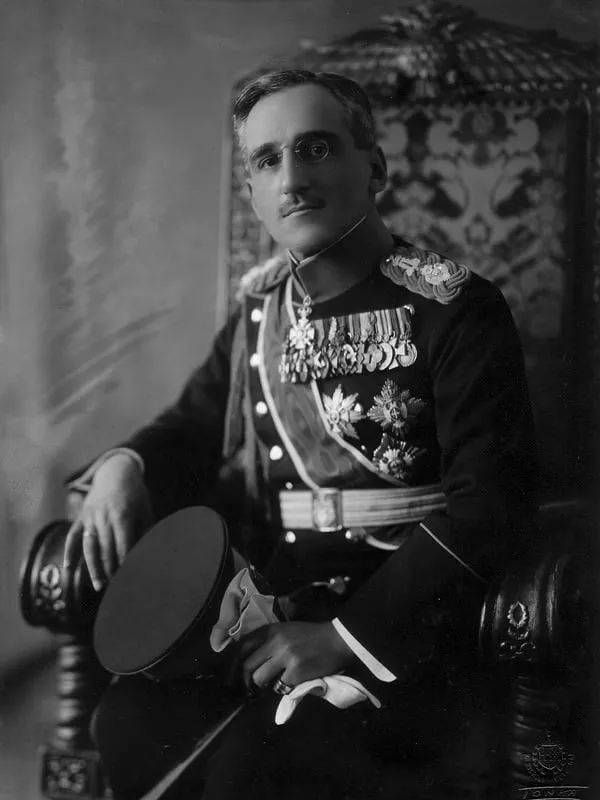
- Born:
- 16 December 1888, Cetinje (Montenegro)
- Died:
- 9 October 1934, Marseille (France)
- Author:
- Łukasz Skowroń
- Photo:
- autor nieznany, domena publiczna, Wikimedia Commons

Alexander Karađorđević, in Polish Karadziordziewić, was twenty-five when, four days before the assassination in Sarajevo, his ailing father, King Peter I, handed power to him. As regent and formal commander-in-chief he went through the whole war with the Serbian army: the victories of 1914, the defeat and the retreat through Albania in the winter of 1915, exile on Corfu, three years on the Salonika front and the return to Belgrade in the autumn of 1918. Operations were directed by the chiefs of staff, but in war policy and army affairs Alexander had more and more say, and his power grew at the expense of the politicians and officers with whom he competed. On 1 December 1918 it was he who proclaimed the Kingdom of Serbs, Croats and Slovenes, the future Yugoslavia, which he then ruled as king until his death at the hands of an assassin in 1934.
Before the war
He was born on 16 December 1888 (4 December by the Julian calendar) in Cetinje, the capital of Montenegro, the younger son of Peter Karađorđević, the exiled pretender to the Serbian throne, and Princess Zorka, daughter of Prince Nicholas I. His mother died when he was not yet two. He spent his childhood in Montenegro and in Geneva, and then, together with his elder brother George, studied at the Page Corps in St Petersburg, where he was received by Tsar Nicholas II. The Russian years left him with an attachment to Russia and to a monarchy in which the ruler truly governs.
In 1903, after a bloody coup in Belgrade, his father became King of Serbia. The heir to the throne was at first George, hot-tempered and unpredictable, but in March 1909, after a scandal in which his servant died, and under pressure from politicians and officers, he renounced his rights to the crown. Alexander became heir. In 1910 he went through a severe bout of typhus, after which he suffered from stomach trouble for the rest of his life. In the First Balkan War he commanded the Serbian First Army, which won at Kumanovo and at Bitola. In practice it was led by his chief of staff, Colonel and later General Petar Bojović, but the young prince was present when decisions were taken and was often in the front line. In the Second Balkan War the First Army beat the Bulgarians on the Bregalnica.
After the Balkan Wars Alexander sided with the government of Nikola Pašić in its dispute with the officers of the secret organisation the Black Hand over the administration of conquered Macedonia. Its leader, Colonel Dragutin Dimitrijević “Apis”, organiser of the 1903 coup, wanted to be the guardian of the throne and the army, and the heir to the throne saw him as a threat. On 24 June 1914 the ailing Peter I transferred his royal powers to his son. Alexander became regent.
1914: regent and commander-in-chief
After the assassination in Sarajevo and the Austro-Hungarian ultimatum the regent appealed by telegram to Tsar Nicholas II for help. On 25 July, the day the ultimatum expired, mobilisation was proclaimed in his name, and the government and the principal offices were moved to Niš. As regent Alexander was ex officio commander-in-chief, but the army was directed by the chief of staff of the Supreme Command, Vojvoda Radomir Putnik. The regent did not interfere with his plans, though he had his own views. In September 1914, when Putnik broke off the offensive in Syrmia, Alexander, like his father and the army commanders, opposed withdrawing from a region inhabited largely by Serbs. A few days earlier, on 10 September, he had entered captured Zemun.
In the autumn, in the hardest days before the Battle of Kolubara, he approved the change at the head of the First Army, which General Živojin Mišić took over from the wounded Bojović. He ordered houses to be searched for rifles and ammunition, which the army lacked, and visited units at the front. After the victorious counter-offensive he entered recaptured Belgrade on 15 December. In 1914–1915 he lived in Kragujevac, at the headquarters of the Supreme Command.
1915: defeat and retreat
In August 1915, when the Entente offered Serbia territorial gains in return for ceding part of Macedonia to Bulgaria, Pašić consulted the king and the regent. Concessions did not save the situation. In the autumn Serbia was attacked by Mackensen’s armies, and Bulgaria entered the war. At the end of November, in Prizren, the decision was taken to retreat through the mountains to the Adriatic. According to some accounts the regent accepted Putnik’s plan, although many officers preferred to die in their own country. Alexander marched with the army, ill and exhausted, but according to contemporary accounts he did not spare himself, and he reached Scutari ahead of the staff, which was carrying the sick Putnik in a litter.
In December 1915 and January 1916 the army’s fate depended on the Allies, who argued over where and how to transport it. The regent begged Nicholas II for rescue, and the Tsar interceded for the Serbs with the French and the British. More than a hundred thousand soldiers were shipped to Corfu. Bojović succeeded Putnik as chief of staff. Alexander and the Supreme Command stayed with the army when the government sailed to Brindisi and then settled on Corfu. In the summer of 1916 the regent moved to Salonika, to which the reconstituted army had returned.
The Salonika front
In the autumn of 1916 the Serbs took Kajmakčalan, and in November, together with the French and the Russians, they entered Bitola, the first Serbian town to be recovered. The regent arrived there two days later. In the spring of 1917, together with Bojović, he demanded that the offensive on the Vardar be stopped, fearing that another bloody and failed attempt would break the exhausted army. General Maurice Sarrail blamed precisely the Serbs for the defeat.
The same year brought the darkest episode of his regency. At the turn of 1916 and 1917 Apis and a group of Black Hand officers were arrested, accused of plotting against the regent’s life. The trial in Salonika ended in death sentences, and on 26 June 1917 Dimitrijević and two others convicted were shot. Historians agree that the charges were largely fabricated. Most believe that Alexander wanted in this way to rid himself of a dangerous rival and free the army from the conspirators, although they disagree about Pašić’s part. In 1953 a court in Belgrade rehabilitated the condemned men.
The regent was also sceptical about plans to unite all the South Slavs. On 20 July 1917 Pašić’s government and the Yugoslav Committee of Ante Trumbić signed the Corfu Declaration, which announced a common kingdom under the Karađorđević dynasty. Abroad Alexander spoke of Yugoslav unity, but to his own soldiers he spoke above all of the liberation of Serbia, and he denied Trumbić the right to speak on behalf of the Slavs of the Habsburg monarchy.
In 1918, when General Louis Franchet d’Espérey took over the Allied command, the regent backed the plan to break through the front in the mountains in the Serbian sector. Mišić became chief of staff. On the night of 13–14 September Alexander and Mišić kept watch at an observation post above the valley, and on 15 September the Serbs and the French attacked at Dobro Pole. Within two weeks Bulgaria asked for an armistice, and on 1 November the Serbian First Army entered Belgrade. A few days later the regent arrived there alongside Franchet d’Espérey.
Unification and kingdom
The collapse of the Habsburg monarchy accelerated events. The South Slav lands of Austria-Hungary proclaimed the independent State of SHS, and its National Council in Zagreb, threatened by Italian claims and internal chaos, pressed for a swift union with Serbia. According to historians the regent also made sure that his grandfather, King Nicholas, whom the Podgorica Assembly deposed at the end of November, did not return to Montenegro. On the evening of 1 December 1918, in the Krsmanović house on Terazije, Alexander received the delegation from Zagreb and in his father’s name proclaimed the Kingdom of Serbs, Croats and Slovenes. He placed Stojan Protić at the head of the first government rather than Pašić, whom he disliked.
After the war
After the death of Peter I in August 1921 Alexander became king. The new state, governed under the centralist constitution of 1921, was torn by disputes between Serbs and Croats. After the Croatian peasant leader Stjepan Radić was shot in parliament in 1928, on 6 January 1929 the king dissolved parliament and introduced a dictatorship, and renamed the state the Kingdom of Yugoslavia. On 9 October 1934, at the start of a visit to France, he was killed in Marseille, shot by Vlado Chernozemski, an assassin from the Macedonian revolutionary organisation working together with the Croatian Ustaše. The French foreign minister Louis Barthou was also killed. The throne passed to the king’s eleven-year-old son, Peter II.
Assessment
Serbian memory calls Alexander the Unifier. Historians stress that during the war he was no ornament of the staff: he shared the hardships of the retreat through Albania with the army, was often at the front and knew how to choose men, as shown by his appointments of Mišić in 1914 and 1918. He nevertheless left actual command to professional officers, and his contribution to the victories is hard to separate from their work.
Critics point out that the war taught him to rule with a strong hand. The Salonika trial showed that to strengthen his own power he was prepared to send to their deaths officers to whom his dynasty owed the throne. His reluctance to accept an equal union with the Croats and Slovenes, already visible in 1917–1918, weighed on the whole new state. To some, therefore, he was the creator of Yugoslavia and the symbol of Serbian victory; to others, a monarch who squandered the chance of giving it a democratic and equal form.
Sources
Spotted a mistake?Report an error
Mentioned in battles
(06)Often appears with
People who appear in the same events.
On the timeline
(26)1914
July
- 25
- Serbian government orders mobilisationOn 25 July 1914, before replying to the ultimatum, Serbia announced general mobilisation, and the authorities began to leave Belgrade.
- Serbian government moves from Belgrade to NišOn 25 July 1914 Regent Alexander decided to move Serbia's government, parliament and administration to Niš, which became the country's wartime capital.
September
December
1915
1916
January
- 15
- Serbian government moves to BrindisiIn mid-January 1916 Pašić's government left threatened Scutari and sailed to Brindisi in Italy. A few days later it moved on from there to Corfu.
- King Peter leaves SalonikaOn 15 January 1916 King Peter I of Serbia sailed from Salonika on a French warship. He went to take a cure at the spa of Edipsos on the Greek island of Euboea.