State of Slovenes, Croats and Serbs · The Entente
Svetozar Pribićević
Leader of the Croat-Serb Coalition (1910–1918), vice-president of the National Council of Slovenes, Croats and Serbs (1918)
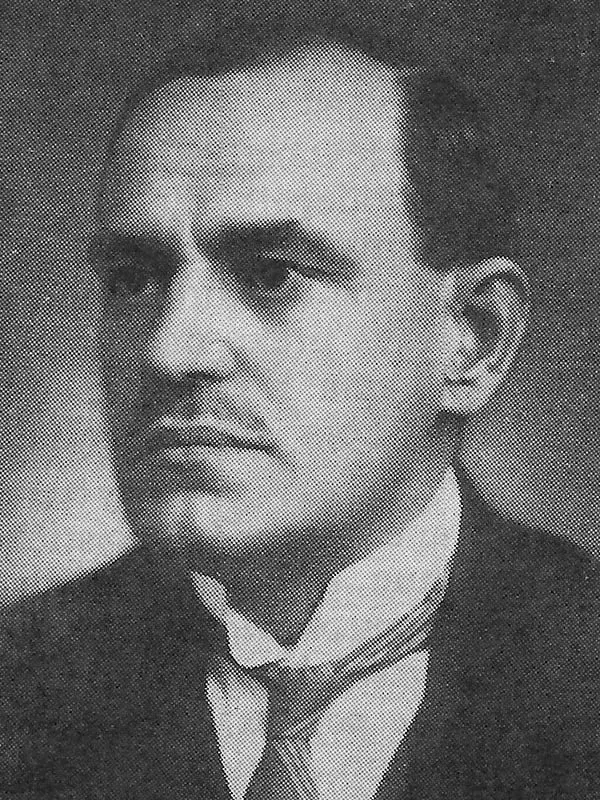
- Born:
- 26 October 1875, Hrvatska Kostajnica (Croatia-Slavonia, Austria-Hungary)
- Died:
- 15 September 1936, Prague
- Author:
- Natalia
- Photo:
- autor nieznany, domena publiczna, Wikimedia Commons

Svetozar Pribićević was a Croatian Serb who spent most of the war in Austro-Hungarian prison and internment, and who in the autumn of 1918 turned out to be the most influential politician in Zagreb. As leader of the Croat-Serb Coalition, which governed Croatia, and vice-president of the National Council of Slovenes, Croats and Serbs, he prepared the Sabor’s break with the monarchy on 29 October 1918, and then brought about the union of the State of SHS with Serbia without any constitutional guarantees. At the time he was a fervent supporter of a unitary, centralised state. Ten years later he became one of its harshest critics.
Before the war
He was born on 26 October 1875 in Hrvatska Kostajnica, in the former Military Frontier on the border with Bosnia, into a Serbian Orthodox family. He studied mathematics and physics in Zagreb and briefly taught at Serbian teacher-training schools. Already as a student he argued that Croats and Serbs were one nation with two names, and in 1897 he set out this programme in the almanac “Narodna misao”. In the early twentieth century he edited the newspaper of the Serb Independent Party, and in 1903 he became its leader. His brothers also played a part in politics: Adam was an activist of the same party, Valerijan an Orthodox priest and later bishop, and Milan an officer who went over to the Serbian army.
In 1905 Pribićević and his party joined the “new course” policy initiated by Croats from Dalmatia, Frano Supilo and Ante Trumbić. From the agreement between Croatian and Serbian politicians grew the Croat-Serb Coalition, which from 1906 won successive elections to the Sabor. The Austrian and Hungarian authorities tried to break it up. In 1909, 53 Serbs, among them two of Pribićević’s brothers, were tried for high treason in Zagreb, and in the same year the coalition’s politicians sued the Austrian historian Heinrich Friedjung for libel after he had accused them of working for Serbia. Both trials discredited the authorities. After Supilo left in 1910, Pribićević became the coalition’s sole leader, and in 1913 he reached an agreement with the new royal commissioner Ivan Skerlecz which brought the coalition back to power in Croatia.
Prison and internment
After the Sarajevo assassination Pribićević did not flee the monarchy, although as leader of the Croatian Serbs he had to reckon with repression. According to Serbian biographers, after the outbreak of war he spent several months in a military prison and then nearly three years in internment, among other places in Budapest. Meanwhile the coalition, deprived of its leader, governed in Zagreb in agreement with Ban Skerlecz and with the government of István Tisza in Budapest, supported the war effort and tried to prevent the suspension of constitutional government in Croatia. Critics, among them the writer Miroslav Krleža, later accused it of opportunism and loyalty to Hungary, including voting for war credits.
Pribićević returned to Zagreb and to the Sabor in 1917, when Emperor Charles announced an amnesty for political prisoners, and took over the leadership of the coalition again. In June 1917 the coalition formally took over the government of Croatia, backing the new ban, Antun Mihalović. Pribićević long kept his distance from the movement around the May Declaration, proclaimed in Vienna by Anton Korošec. When in March 1918 Croatian and Muslim politicians in Zagreb adopted a declaration that no longer mentioned the Habsburgs, the coalition and the Bosnian Serbs stood aside. Pribićević also rejected the idea that the future Yugoslav state should be a loose union in which a separate Croatian statehood would survive.
1918: the National Council and 29 October
The coalition joined the unification movement only in the autumn of 1918, when after the breakthrough on the Salonika front the monarchy’s defeat had become obvious. Pribićević agreed with the organisers of the gathering in Zagreb that the coalition would be invited into the National Council of Slovenes, Croats and Serbs. It joined on 8 October or, according to some accounts, a few days later. On 17–19 October the Council elected its leadership: Korošec became president, with Pribićević and Ante Pavelić, leader of one of the factions of the Party of Rights, as vice-presidents. Formally he was the second vice-president, but as head of the largest party in the Sabor he in fact directed the Council’s work, especially after Korošec left for Switzerland at the end of October.
During the night of 28–29 October the Council’s Central Committee adopted his motion that the Sabor should break its ties with the monarchy on the basis of the right of nations to self-determination. On 29 October the Sabor unanimously resolved to sever all constitutional ties with Hungary and Austria and handed supreme power to the National Council. The State of Slovenes, Croats and Serbs came into being, and Pribićević became one of its three leaders.
November 1918: union without conditions
The new state had neither recognition from the Allies nor an effective army. Bands of deserters, the so-called Green Cadres, roamed the countryside, and after the armistice with Austria-Hungary Italian troops began occupying Istria, Dalmatia and Rijeka, which had been promised to Italy in the Treaty of London. Pribićević concluded that the only salvation lay in uniting as quickly as possible with Serbia, whose army had just reached Belgrade. He wanted to leave constitutional questions for later, and he himself favoured a unitary state, without autonomy for the historic lands.
He therefore did not support the agreement that Korošec and Trumbić had negotiated with the Serbian prime minister Nikola Pašić at the Geneva conference. It provided for a confederation with equal participation by Serbia and the State of SHS. When the Serbian government rejected it, Pribićević backed that position, and on 25 November he informed Pašić by telegram that he did not consider himself bound by the Geneva Declaration. Some historians, following Ivo Banac, believe that the Serbs’ apparent acceptance of the agreement and its subsequent rejection also served to weaken Korošec’s position in favour of Pribićević.
In the second half of November Pribićević encouraged the provincial government of Dalmatia to present the Council with an ultimatum on union. He also used as an argument an alleged plot by General Anton Lipošćak to overthrow the Council. The accusations proved false and the general was acquitted. According to some sources it was Pribićević’s supporters who spread them; other historians point out that there is no evidence of this. On 23–24 November the National Council decided to unite with Serbia and Montenegro, against the warnings of Stjepan Radić, and gave its delegation instructions setting out constitutional conditions.
The delegation left Zagreb on 27 November. In Belgrade Pribićević sat on a six-member committee that settled how unification would be proclaimed, and persuaded the delegates to set the instructions aside. Pavelić at first objected, but in view of Italian advances on the coast he gave way. On 1 December 1918 the delegation read to Prince Regent Alexander an address without any reservations, and the regent proclaimed the Kingdom of Serbs, Croats and Slovenes. Pribićević was one of the signatories of the act of unification.
After the war
On 20 December 1918 Pribićević became minister of the interior in the kingdom’s first government. In that post he fought hard against opponents of centralism, especially Radić and his peasant party. He was one of the founders of the Democratic Party, and his ideas largely shaped the centralised Vidovdan Constitution of 1921. He later served as minister of education. In 1924 he founded the Independent Democratic Party.
From the mid-1920s his views changed. He concluded that centralism served Serbian hegemony; in 1927 he formed an alliance with his former enemy Radić, and together with him led the Peasant-Democratic Coalition, which demanded a federation. On 20 June 1928 he was sitting next to Radić when Radić was fatally shot in parliament. After King Alexander introduced his dictatorship in 1929, Pribićević was interned in Serbia, and in 1931 he was allowed to go abroad. In exile in Paris and Prague he published the book “The Dictatorship of King Alexander” and argued for a federal and republican Yugoslavia. He died in Prague on 15 September 1936.
Assessment
Croatian historians mostly judge Pribićević’s role in 1918 critically. They believe that he exploited fear of Italy and of unrest in the countryside to bring about unification without guarantees for Croats and Slovenes, and that he bears the greatest responsibility for the way the kingdom came into being, and therefore for the disputes that weighed on it throughout the interwar period. They also point to his later repression as minister of the interior.
His defenders and some Serbian historians stress that in November 1918 the State of SHS, unrecognised and defenceless against Italian troops, had no real alternative, and that Pribićević acted in accordance with a conviction he had defended since his youth: that Serbs and Croats were one nation. Many authors note the paradox of his life. The politician who did most to create a centralised state called its government, in the last years of his life, the worst regime under the sun, and died in exile as a supporter of federation.
Sources
Spotted a mistake?Report an error
Often appears with
People who appear in the same events.