Key event
Proclamation of the Kingdom of Serbs, Croats and Slovenes
- Category:
- Politics
- Date:
- 1 December 1918
- Author:
- Łukasz Skowroń
- Tags:
- Serbia, Alexander Karađorđević, Belgrade, Italy
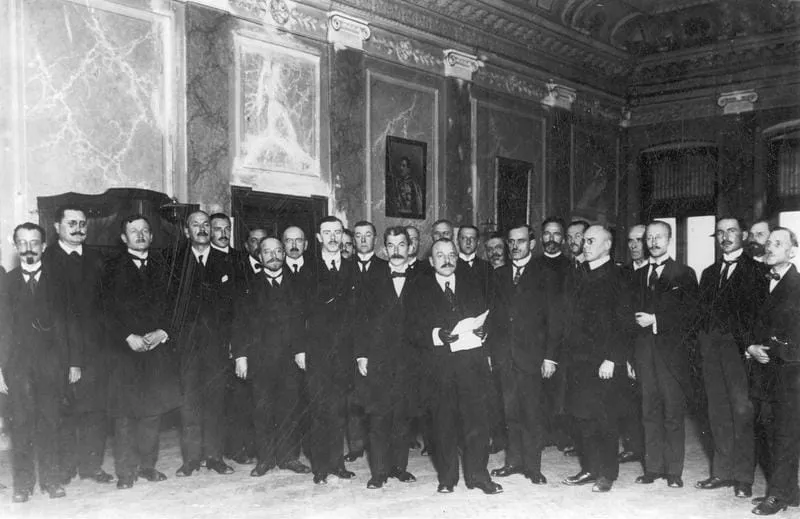
On the evening of 1 December 1918 in Belgrade, the Regent of Serbia, Alexander, received a delegation of the National Council from Zagreb, listened to its address and, in the name of his father, King Peter I, proclaimed the union of Serbia with the lands of the State of Slovenes, Croats and Serbs in a single Kingdom of Serbs, Croats and Slovenes. Thus the first common state of the South Slavs came into being, known for short as the Kingdom of SHS and, from 1929, officially as the Kingdom of Yugoslavia. The union, however, was achieved without any agreement on how the new state was to be organised, and this unspoken question weighed on it throughout the interwar period.
The delegation in Belgrade
The State of SHS, proclaimed in Zagreb on 29 October, found itself in a hopeless position after a month of existence. Nobody had recognised it, it had no effective army, deserters were roaming the countryside, and the Italian army was occupying Istria, Rijeka and part of Dalmatia, invoking the 1915 Treaty of London. The Geneva agreement, which had envisaged a union on equal terms, had been rejected by the Serbian government. On 24 November the National Council therefore decided to unite with Serbia and Montenegro and gave its delegation written instructions setting out the conditions of union. Two days later the assembly in Podgorica deposed King Nicholas I and proclaimed the union of Montenegro with Serbia.
The delegation, some thirty strong, left Zagreb on the morning of 27 November and arrived in Belgrade the next day, where it was given a ceremonial welcome. The Serbian Prime Minister, Nikola Pašić, was abroad at the time, so the guests were received by the Regent himself, while Stojan Protić, Ljubomir Jovanović and Momčilo Ninčić negotiated with them on behalf of the government. The Slovene delegates arrived on 30 November. The manner of proclaiming the union was settled by a six-member committee in which, alongside three Serbian ministers, sat the vice-president of the National Council, Svetozar Pribićević, and Ante Pavelić, together with the Dalmatian politician Josip Smodlaka.
It was Pribićević, a Croatian Serb and a supporter of a centralised state, who persuaded the delegation to set the Zagreb instructions aside and leave the question of the constitution for later. Pavelić objected at first, but the pressure was too strong. The Serbian government would not hear of conditions, and on 30 November a telegram arrived from Dalmatia in which the provincial government there begged for haste in the face of Italian advances along the coast. The delegates decided they could not delay. According to historians, the Council’s secretary, Janko Šimrak, had the instructions in his pocket the whole time, but nobody looked at them.
An evening in the Krsmanović house
On 1 December both sides made a final review of the text of the address and of the Regent’s reply. The ceremony took place in the evening, according to some accounts at 8 p.m., in the house of the merchant Krsmanović on Terazije square, where the Regent had lived since returning to the capital, because the royal palace was in ruins. The address was read by Pavelić, a dentist by profession. It recalled that the National Council had already declared itself for union with Serbia and Montenegro on 19 October and had proclaimed it by its resolution of 24 November. Royal power over the whole state was to be exercised by King Peter I and, on his behalf, by the Regent. The delegation expressed its wishes: a common parliamentary government, a provisional national representation, the retention for the time being of the existing autonomous authorities, and a constituent assembly elected by universal, equal, direct and proportional suffrage no later than six months after the conclusion of peace. All of these, however, were merely requests, without the reservations and guarantees demanded in Zagreb. The address ended with a cheer for “a free, united Yugoslavia”.
The Regent replied that he received the news of the resolution of 24 November with deep joy, because it fulfilled what the best sons of the nation “of all three faiths and all three names” had striven for. He then declared: “In the name of His Majesty King Peter I, I proclaim the union of Serbia with the lands of the independent State of Slovenes, Croats and Serbs in a unitary Kingdom of Serbs, Croats and Slovenes.” He gave an assurance that the government would at once deal with the matters of the transitional period and the election of a constituent assembly, and finally added that he would be king “only of free citizens” of the new state. The reply said nothing about Montenegro or about any autonomy. Historians also draw attention to the wording of the act. The Regent was not uniting two equal states, but Serbia with the “lands” of the State of SHS, whose statehood Belgrade had never recognised.
December in Zagreb
News of the proclamation reached Zagreb on the evening of 2 December. The National Council announced the act of union on 3 December and organised celebrations. A British chronology of the war records under 4 December that the National Council in Zagreb proclaimed the union of all Serbs, Croats and Slovenes in a single state. On the same day the authorities banned the daily Hrvatska, the organ of the nationalist Frankists of the Party of Rights, which had published an appeal condemning a union made without asking the nation.
In many Croatian towns the mood was hostile. The leader of the Croatian People’s Peasant Party, Stjepan Radić, who on 24 November had warned members of the Council not to “rush like geese into the fog”, was increasingly popular in the countryside, and republican slogans were spreading among the soldiers. On the afternoon of 5 December several hundred soldiers of the Zagreb regiments, the 25th Home Guard Regiment and the 53rd Infantry Regiment, left their barracks with their weapons and a band and marched to Jelačić Square, shouting for the republic and for Radić and against King Peter. In the square they were awaited by members of the National Guard, including former sailors, and volunteers from the Sokol, posted in the surrounding buildings. After brief negotiations shooting broke out. Who fired first is not known. According to the official report 13 people were killed and 17 wounded; other accounts speak of 18 dead. Most of the victims were soldiers, and Croats remember them as the “December victims”. The National Council disbanded both regiments, and soon all the former Austro-Hungarian units on its territory, and relied on the Serbian army.
Unresolved questions
The new kingdom comprised Serbia with Macedonia, Montenegro, Vojvodina, Croatia and Slavonia, Dalmatia, Bosnia and Herzegovina, and the Slovene lands, but nobody had yet drawn its borders. The great powers were in no hurry to recognise it, Italy in particular opposing recognition, and at the peace conference the kingdom’s delegation was at first treated as the delegation of Serbia. The dispute with Rome over Rijeka, Istria and Dalmatia was to drag on for another two years. King Nicholas I and his supporters did not recognise the Podgorica resolutions. The Regent appointed the first common government only on 20 December.
The most serious dispute proved to be over the form of the state. Serbian politicians and Pribićević wanted a centralised state, while most Croats, led by Radić, wanted a federation or even a republic. The Vidovdan Constitution, adopted in June 1921, introduced a centralised system. It was passed by a simple majority, with Radić’s party boycotting the vote. The dispute between Serbs and Croats, left unresolved in Belgrade on 1 December 1918, became the main axis of Yugoslav politics until the fall of the kingdom in 1941. In interwar Yugoslavia 1 December was celebrated as Unification Day, but many Croats remembered rather the victims of Jelačić Square.
Remember the articles you have read? Only in this browser; nothing is sent anywhere.How it works
Read ·
Spotted a mistake?Report an error
Meanwhile
(04)Elsewhere in the same days.
- 1 December 1918 · Western FrontAllies enter GermanyOn 1 December 1918 British cavalry, the US Third Army, the Belgians and the French entered Germany. The Americans took Trier and the Belgians Aachen.
- 3 December 1918 · Balkan FrontBulgarians leave DobrujaIn early December 1918 the last Bulgarian troops withdrew from Dobruja. Romanian administration returned to Constanța, and the British guarded the ports.
- 28 November 1918 · Eastern FrontVoluntary Legion of WomenOn 28 November 1918 the first volunteers in Lviv joined Aleksandra Zagórska's women's militia. In December it became the Voluntary Legion of Women.
- 28 November 1918 · Eastern FrontBolsheviks take NarvaOn 28 November 1918 the Red Army attacked Narva, which the Germans were leaving. The Estonians had to give up the town. The Estonian War of Independence began.
Related events
(04)The same battle, people or subject.
- 6 November 1918 · Balkan FrontRegent Alexander in BelgradeIn early November 1918 Regent Alexander came to liberated Belgrade with General Franchet d'Espèrey. The old King Peter I returned to the capital only in 1919.
- 20 December 1918 · PoliticsProtić prime minister of the Kingdom of SCSOn 20 December 1918 Regent Alexander formed the first government of the Kingdom of SCS under Stojan Protić. Nikola Pašić, premier since 1912, lost office.
- 7 November 1918 · DiplomacyGeneva conferenceOn 6–9 November 1918 in Geneva Pašić, Korošec and Trumbić agreed on a joint government of Serbia and the State of SCS. Belgrade soon rejected the agreement.
- 29 October 1918 · PoliticsIndependence of the State of Slovenes, Croats and SerbsOn 29 October 1918 the Croatian Sabor cut its ties with Austria-Hungary, and the National Council took power in the new State of Slovenes, Croats and Serbs.