Serbia · The Entente
Peter I of Serbia
King of Serbia (1903–1918) and of the Kingdom of Serbs, Croats and Slovenes (1918–1921)
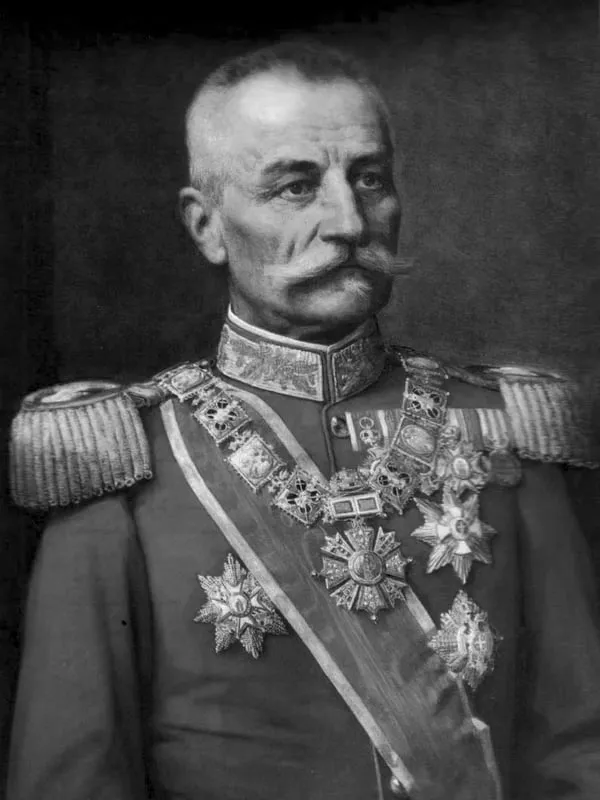
- Born:
- 11 July 1844, Belgrade (Serbia)
- Died:
- 16 August 1921, Belgrade
- Author:
- Łukasz Skowroń
- Photo:
- Uroš Predić, domena publiczna, Wikimedia Commons

Peter I Karađorđević (in Polish Piotr I Karadziordziewić) was King of Serbia throughout the Great War, but hardly ruled at all. Four days before the assassination in Sarajevo, ill and weary of the conflict between the politicians and the officers, he handed his royal powers to his son Alexander, who as regent and commander-in-chief led the country until the end of the war. Even so, the old king, a former volunteer of the Foreign Legion and guerrilla fighter in Bosnia, became one of the war’s most recognisable figures. He appeared at the front at the hardest moments, and in the winter of 1915, aged over seventy and almost blind, he crossed the mountains of Montenegro and Albania with the army. The Serbs called him King Liberator, and colloquially simply “the old king”.
Before the war
He was born on 11 July 1844 (29 June in the Julian calendar) in Belgrade, the son of the Prince of Serbia Alexander Karađorđević and grandson of Karađorđe, leader of the First Serbian Uprising against the Turks. He was fourteen when in 1858 his father lost the throne to the rival Obrenović dynasty, and he spent almost half a century in exile. He studied in Geneva and Paris, graduated from the French military school of Saint-Cyr, and in 1868 published his own translation of the essay “On Liberty” by John Stuart Mill. In the Franco-Prussian War he fought under an assumed name in the Foreign Legion and was awarded the Legion of Honour. In 1875, as “Petar Mrkonjić”, he commanded a band of insurgents against the Turks in Bosnia.
In 1883 in Cetinje he married Zorka, the eldest daughter of the ruler of Montenegro, Nicholas I. He was widowed in 1890 and a few years later moved with his children to Geneva. The throne came to him only through the bloody May Coup of 1903, in which conspirator officers murdered King Alexander Obrenović and Queen Draga. On 15 June 1903 parliament elected Peter king. He did not punish the killers to whom he owed his crown, which for several years cut Serbia off from Britain and weighed on his whole reign, as the conspirators in time formed their own faction in the army.
As king he kept to the principles of constitutional monarchy. The years 1903–1914 are remembered in Serbia as a time of political freedom, a free press and a flowering of culture, and the government was held above all by the Radicals of Nikola Pašić. In the Balkan Wars he was formally commander-in-chief, but operations were directed by the chief of staff, Radomir Putnik. In the spring of 1914 the conflict between the government and the officers of the Black Hand over the administration of conquered Macedonia turned into a political crisis. The ailing king did not want to take either side and on 24 June 1914 handed his powers to his son, the heir to the throne Alexander, who became regent. Formally Peter I did not abdicate.
1914: the old king at the front
When war broke out, mobilisation was proclaimed already in the regent’s name. Peter I stayed mostly at spas, but he was not indifferent to military matters. In September 1914, together with the regent and some of the generals, he opposed Putnik’s decision to withdraw the troops from Syrmia, a region largely inhabited by Serbs. The vojvoda, however, did not give way.
He was remembered most for his visits to the front in the autumn of 1914, when the army, deprived of ammunition, was retreating behind the Kolubara. According to Serbian tradition the king then addressed the soldiers, releasing from their oath those who wished to return home and announcing that he himself would stay at the front with his son. These words cannot be reconstructed exactly today, but the account became a permanent part of the legend of the war. On 3 December, the first day of the Serbian counter-offensive on the Kolubara, the aged king came to the units of the Third Army to raise their spirits. A dozen or so days later the Serbs retook Belgrade, and according to some sources Peter I entered the capital together with the regent.
1915: the retreat across the mountains
In 1915 the king took part in the most important councils. When in August the Allies demanded concessions in Macedonia from Serbia, Pašić went that same evening to consult the king and the regent. In the autumn, when the armies of the Central Powers and Bulgaria conquered Serbia, Peter I retreated together with the court and the supreme command. In November he was in Prizren, the last larger town before the Albanian mountains. According to the British correspondent Gordon Gordon-Smith, the authorities left it over three days: first the ministers, then the king with the court and the guard, and finally Putnik’s staff. Bulgarian studies state that a few days later near Prizren a Bulgarian regiment even captured the royal carriage.
The king, who was already 71 and had very poor eyesight, crossed the mountains ahead of the main body of the army, partly in a cart drawn by buffaloes or oxen, and in places carried by soldiers. According to the Austrian official history he reached Scutari on 7 December. Photographs of him from the retreat, in an ox-drawn cart, went round the Allied press and became one of the symbols of the Serbian tragedy. From Scutari the king travelled on to the port of San Giovanni di Medua, from where, according to the Italian historian Franco Favre, he sailed for Brindisi on 24 December.
Exile
In Italy he was reportedly offered the palace at Caserta, but he wanted to be close to his soldiers. On 1 January 1916 he arrived in Salonika, where the Entente troops were stationed, and received Generals Sarrail and Mahon there. The President of France, Raymond Poincaré, noted in his diary at the time that the king felt offended by the attitude of the Italian authorities, which well reflects the tensions between Serbia and Italy at the time. After two weeks, on 15 January, he sailed from Salonika on a French warship and that same day reached Edipsos, a spa on the Greek island of Euboea. He took the cure there for more than four months. A correspondent of an American agency who visited him in February described a man physically broken and almost blind, but cheerful. “I believe in the freedom of Serbia as I believe in God,” the king is said to have said.
Until the end of the war he remained in Greece, far from politics and from the army, which the regent led on the Salonika front. He took no part in the great decisions of 1916–1918, from the trial of the Black Hand officers to the Corfu Declaration. On 1 December 1918 the regent proclaimed in his name the Kingdom of Serbs, Croats and Slovenes, and Peter I became its first monarch. The British chronology of the war wrongly records his return to Belgrade as early as November 1918. In reality it was the regent who arrived in the capital at that time, and the old king returned to the country only in July 1919.
After the war
He spent his last years in Belgrade, ailing and not interfering in government. He died on 16 August 1921 and was buried in the Church of St George at Oplenac near Topola, which he himself had founded as the dynasty’s mausoleum. His son succeeded him as Alexander I.
Assessment
In the memory of the Serbs, Peter I remained the best loved of their monarchs: a liberal brought up in France, a constitutional king who respected parliament, and an old man who in 1915 shared the fate of ordinary soldiers. His figure was associated with Serbia’s “golden age” before 1914 and with the liberation of 1918, hence the epithet Liberator. For many years he also became a symbol of South Slav unity, since it was in his name that the common kingdom was proclaimed.
Historians point out, however, that he had less and less real power. He owed his throne to the conspirators of 1903 and never managed to bring the army under his control, which opened the way to the influence of the Black Hand, and in 1914, at the most difficult moment, he withdrew from politics. From June 1914 decisions in his name were taken by Regent Alexander and Prime Minister Pašić, and his role during the war was above all symbolic. That does not diminish the fact that as a symbol he proved very important for fighting Serbia.
Sources
Spotted a mistake?Report an error
Mentioned in battles
(01)Often appears with
People who appear in the same events.
On the timeline
(15)1908
1914
1915
1916
January
- 15
- Serbian government moves to BrindisiIn mid-January 1916 Pašić's government left threatened Scutari and sailed to Brindisi in Italy. A few days later it moved on from there to Corfu.
- King Peter leaves SalonikaOn 15 January 1916 King Peter I of Serbia sailed from Salonika on a French warship. He went to take a cure at the spa of Edipsos on the Greek island of Euboea.