Serbia · The Entente
Radomir Putnik
Chief of staff of the Supreme Command of the Serbian army (1912–1915), vojvoda
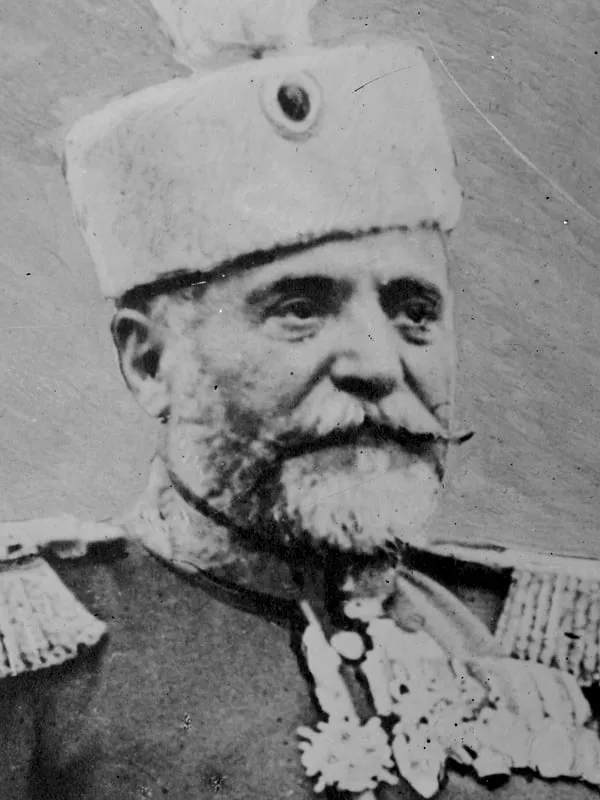
- Born:
- 24 January 1847, Kragujevac (Serbia)
- Died:
- 17 May 1917, Nice (France)
- Author:
- Natalia
- Photo:
- George Grantham Bain Collection (Library of Congress), domena publiczna, Wikimedia Commons

Radomir Putnik was the brain of the Serbian army in the two Balkan Wars and in the first years of the Great War. Formally the commander-in-chief was the regent, Alexander, but operations were directed by the chief of staff of the Supreme Command, an ailing, taciturn old gentleman who for years had scarcely left his office. In 1914 his armies three times repulsed the Austro-Hungarian invasion and in December recaptured Belgrade. A year later, attacked simultaneously by the Germans, the Austrians and the Bulgarians, Putnik avoided encirclement and led the army through the mountains of Montenegro and Albania to the Adriatic. He made the journey himself in a litter, and soon afterwards lost his post. He died in exile, without living to see his return home.
Before the war
He was born on 24 January 1847 (12 January in the Julian calendar) in Kragujevac, the first capital of the revived Serbian principality, the son of a teacher. He graduated from the artillery school in Belgrade and fought in the wars against Turkey in 1876–1878 and in the war against Bulgaria in 1885. He then lectured at the military academy, and in 1890 became deputy chief of the general staff. Under the Obrenović dynasty he fell into disfavour, suspected of sympathy for the Radicals of Nikola Pašić, and in the mid-1890s had to leave the army.
He was brought back only by the coup of 1903, which placed Peter I Karađorđević on the throne. Putnik became a general and chief of the general staff, and three times also minister of war. He rejuvenated the officer corps, prepared new mobilisation plans and surrounded himself with able collaborators, among them Živojin Mišić and Stepa Stepanović. In the First Balkan War he directed the army that in October 1912 defeated the Turks at Kumanovo. He then received, as the first in Serbian history, the highest military rank of vojvoda, the equivalent of field marshal. A year later, in the war against Bulgaria, his troops repulsed the Bulgarian attack on the Bregalnica. In 1914 he was 67 years old and had long suffered from lung disease.
July 1914: return from a cure
News of the Austro-Hungarian ultimatum reached Putnik while he was taking a cure at the spa of Gleichenberg in Styria. On the way home, in the days when Serbia was proclaiming mobilisation, he was detained in Budapest. The Austro-Hungarian authorities soon released him, however, according to most accounts on the orders of Franz Joseph I himself. The British historian Peter Hart calls the gesture chivalrous but suicidal for the monarchy. According to Putnik’s Serbian biographer, Sava Skoko, the vojvoda fell ill with pneumonia on the journey through Romania and reached headquarters in Kragujevac only on 5 August. Until then General Stepanović deputised for him. Putnik is said to have immediately asked the king to relieve him on grounds of age and health, but Peter I refused.
1914: Cer, the Drina and the Kolubara
The plan, prepared earlier with Mišić, was cautious. Serbia could not defend its whole long border, so Putnik kept the main forces in the interior, in Šumadija, in order to throw them wherever the main blow fell. He expected it from the north, across the Sava and the Danube. General Oskar Potiorek, however, attacked on 12 August from the west, across the Drina. For several days Putnik took this attack for a feint, but once he realised the truth he sent Stepanović’s Second Army by forced marches into the Jadar valley. In the Battle of Cer the Austro-Hungarian Fifth Army was routed, and by 24 August there were no longer any of Potiorek’s troops on the Serbian bank. It was the first Allied victory of the war.
Later things became harder. Under pressure from Russia and France, which wanted to tie down as many Austro-Hungarian troops as possible, Putnik agreed to the offensive in Syrmia, though he stipulated that in case of danger the troops would return home. When Potiorek crossed the Drina for the second time on 8 September, on 11 September, over the objections of the regent and some of the commanders, he broke off the expedition and threw the First Army westwards. In the Battle of the Drina the Serbs halted the enemy in the mountains above the river but did not drive him back across it, and the front froze into trenches. The worst problem was the shortage of ammunition. At the end of October the commander of the Second Army asked to be relieved because he had nothing with which to answer the fire of the Austro-Hungarian artillery. After a sharp telephone conversation Putnik persuaded him to stay and agreed to the withdrawal of troops from Mačva.
The third invasion, launched on 6 November, forced Putnik to retreat into the interior, behind the Kolubara. At the end of the month, when the Austrians broke through the First Army’s front on Suvobor, he accepted the plan of its new commander, Mišić, to fall back further, let the soldiers rest and only then strike. This meant giving up Belgrade without a fight. The capital fell on 2 December, but Potiorek’s exhausted troops were already at the end of their strength, and the Serbs had at last received French and Russian shells. On 3 December the counter-offensive began. Serbian historians still dispute whether the order for it came from Putnik or from Mišić. According to Skoko the idea matured within the whole Supreme Command, and Putnik himself, pleased with the first successes, did not interfere in the work of the army commanders. His most important decisions are counted as sending reinforcements to the weak right wing, where the Austrians were trying to outflank the front, and directing the Second and Third Armies on Belgrade when the Sixth Army had already been broken. On 15 December the Serbs returned to the capital, and there were no longer any enemy soldiers in the country.
1915: three armies against Serbia
The winter and spring of 1915 were dominated by an epidemic of typhus, and Putnik’s health kept deteriorating. A French correspondent who visited him in Kragujevac described an empty, cold room and a choking cough coming from behind the door. Much of the work was taken over by the deputy chief of staff, Živko Pavlović. Putnik opposed Allied projects for a new offensive across the Sava, believing that the Entente merely wanted to draw enemy troops onto Serbia while no Allied army was supporting Serbia. Above all he feared Bulgaria. When in September Sofia bound itself to Germany and began mobilising, the Serbian command wanted to attack it before it finished, but the British and the Russians, still hoping to win the Bulgarians over, categorically forbade it.
In October Serbia was attacked simultaneously by the armies of August von Mackensen from the north and the Bulgarians from the east (conquest of Serbia). Putnik counted on help from the troops who on 5 October began landing at Salonika, and weakened the eastern front to save the north. The French, however, got no further than the Vardar valley, and the Bulgarians quickly cut the railway to Salonika. Putnik withdrew his armies step by step, trying not to let them be encircled, and at the end of October gave up Kragujevac without a fight, where the arsenal was blown up. In November he tried once more to break through to the French via the gorge at Kačanik, but the Bulgarians repulsed the Serbs. On the Field of Kosovo he was left with a choice between capitulation and retreat through the mountains. He chose retreat: according to various sources, on 23 or 25 November he ordered the army to cross Montenegro and northern Albania to the Adriatic, where the Allies were to feed and arm it.
Retreat and departure
The retreat, known in Serbia as the Albanian Golgotha, cost the lives of tens of thousands of soldiers and refugees. Putnik, who could not ride, crossed the mountains in a litter knocked together from planks and carried by soldiers. He reached Scutari on 6 December, according to the Austrian official history a day later. The next day he reported to Prime Minister Pašić, advised that the army be evacuated to Salonika, and asked for several months’ leave to restore his health. The regent agreed, and on 8 December the vojvoda ceased to be chief of staff. He was succeeded by General Petar Bojović, according to some sources at once, according to others only in January 1916.
At the end of December Putnik left Scutari and at the beginning of January sailed for Brindisi, and from there to Corfu. Skoko relates that the old vojvoda learned in February that he had finally been removed from command from a paymaster who paid him his salary without the allowance due to the chief of staff. To the end of his life he resented not the dismissal itself, for which no one would have blamed the regent, but the manner of it. In the autumn of 1916 he moved to Nice, where the French authorities received him with honours. He died there on 17 May 1917. His coffin was placed temporarily in the crypt of the Russian church, and was brought back to Belgrade only in November 1926. He was buried in the New Cemetery under the inscription “To Radomir Putnik from a grateful Fatherland”.
Assessment
In Serbia Putnik is regarded as the greatest commander in the country’s history, and the victories at Cer and on the Kolubara as proof that a small, well-led army can defeat a great power. Historians stress his calm, his ability to wait until the enemy exposed himself and his skilful shifting of reserves to wherever they were most needed. They also credit him with saving the army from encirclement and captivity in 1915, in a hopeless situation, so that it could be reborn on Corfu and return home in 1918.
There is, however, no shortage of reservations. Some authors point out that the Serbs owed their successes of 1914 also to the disastrous mistakes of Potiorek, who dispersed his forces and underestimated the enemy, and that the expedition into Syrmia, though undertaken under Allied pressure, weakened the defence on the Drina. The dispute over the respective shares of Putnik and Mišić in the victory on the Kolubara has not died down to this day. In 1915 illness increasingly limited his part in command, and the decisions of the Supreme Command depended to a great extent on Allied promises that were not kept. Even so, even his critics acknowledge that over a year and a half of war Putnik got more out of a small, poorly armed army than anyone had expected.
Sources
Spotted a mistake?Report an error
Commanded in battles
(08)- 12 August – 15 December 1914Serbian campaign of 1914Balkan Front
- 15–24 August 1914Battle of CerBalkan Front
- 6–14 September 1914Serbian offensive in SyrmiaBalkan Front
- 7 September – 4 October 1914Battle of the DrinaBalkan Front
- 16 November – 15 December 1914Battle of KolubaraBalkan Front
- 6–9 October 1915Defence of BelgradeBalkan Front
- 6 October – 4 December 1915Conquest of SerbiaBalkan Front
- 5–21 November 1915Battle of KačanikBalkan Front
Mentioned in battles
(01)Often appears with
People who appear in the same events.
On the timeline
(39)1913
1914
July
August
September
- 08
- Second Austro-Hungarian invasion of SerbiaDuring the night of 7/8 September 1914 Potiorek's armies crossed the Drina again. Austria-Hungary meant to draw the Serbs out of Syrmia and avenge Cer.
- Battle of the Drina beginsOn 8 September 1914 Austro-Hungarian troops crossed the Drina. In the mountains of western Serbia a battle began that turned into trench warfare.
- 17
- Serbs evacuate SemlinFor 17 September 1914 the British chronology records the Serbs leaving Syrmia and Semlin. The Austro-Hungarians returned, and with them reprisals.
- Austro-Hungarian offensive on the Drina runs out of steamAround 17 September 1914 the force of Potiorek's second offensive on the Drina was spent. Heavy fighting for the heights, however, went on for weeks.
October
November
December
1915
October
- 22
- Bulgarians take Kumanovo and SkopjeOn 22 October 1915 the Bulgarian 3rd Division entered Skopje, two days after taking Kumanovo. Serbia lost the most important road junction in its south.
- Austro-Hungarians take ŠabacThe British chronology records the capture of Šabac under 22 October 1915. Austro-Hungarian Landsturm had entered the town unopposed on 20 October.
November
- 23
- Capture of Mitrovica and PristinaOn 23 November 1915 Germans entered Pristina and Austro-Hungarians Mitrovica. Trapped on the Field of Kosovo, the Serbs began retreating to the Adriatic.
- Serbian government leaves PrizrenIn late November 1915 the Serbian government, king and high command left Prizren, the last seat of power in the country, and set out across Albania to Scutari.