1914: The first invasion of Serbia
Battle of Cer
- Dates:
- 15–24 August 1914
- Front:
- Balkan Front
- Location:
- Mount Cer and the Jadar valley, western SerbiaOn the battle map →
- Sides:
- SerbiaRadomir Putnik, Stepa Stepanović, Pavle Jurišić ŠturmAustria-HungaryOskar Potiorek, Liborius von Frank
- Result:
- Serbian victory. The Austro-Hungarian forces withdrew across the Drina and the Sava.
- Author:
- Natalia
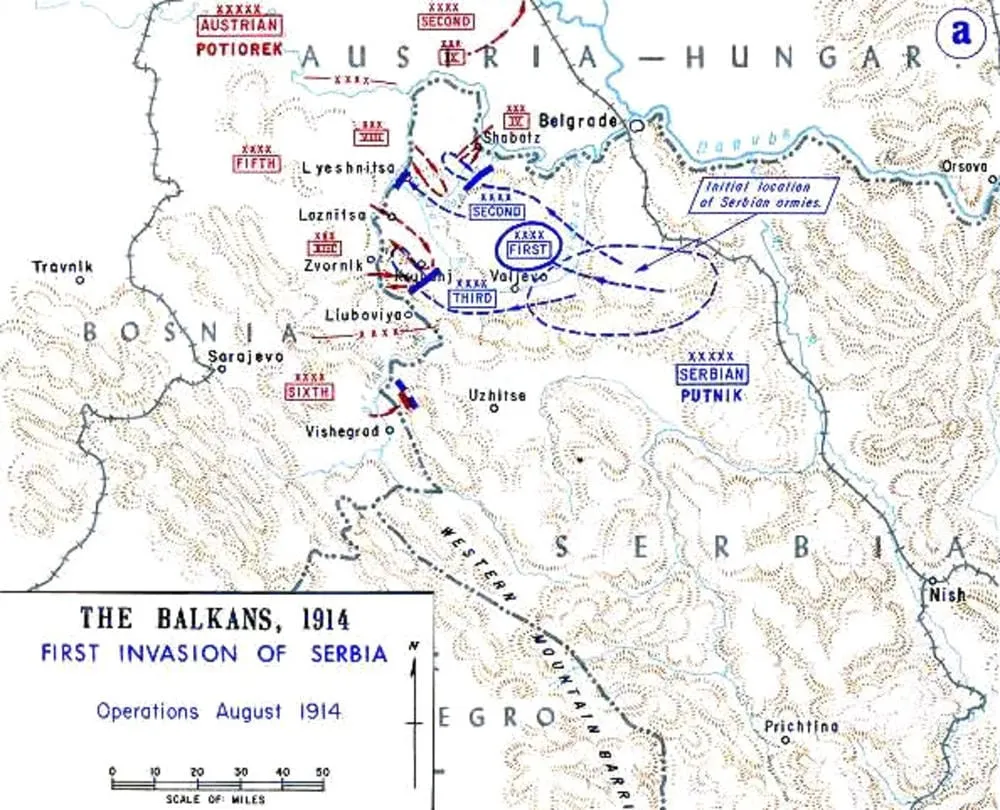
The Battle of Cer, also known as the Battle of the Jadar, was fought on 15–24 August 1914 in western Serbia. It ended in the rout of the Austro-Hungarian forces and was the first Allied victory of the First World War.
The invasion
On 12 August the troops of Austria-Hungary began the invasion of Serbia. The main thrust came from the west, across the Drina, by the Fifth Army under General Liborius von Frank, while units of the Second Army attacked from the north, across the Sava at Šabac. The whole operation was commanded by General Oskar Potiorek, who wanted to deal Serbia a decisive blow as quickly as possible.
The Austro-Hungarian columns advanced slowly through mountainous, wooded terrain, in the heat and with poor supplies. The Serbian Commander-in-Chief, Vojvoda Radomir Putnik, recognised that the main thrust was coming from the west and sent there the Second Army under General Stepa Stepanović, reinforced with units of the Third Army.
Night fighting on the Cer
On the night of 15–16 August Serbian units moved onto the slopes of Mount Cer, a range of hills dominating the Jadar valley. Fierce, chaotic fighting followed in the darkness, in the woods and on the ridges. The Serbs exploited the fact that the Austro-Hungarian columns were scattered and did not support one another, while the terrain favoured defenders who knew the area.
Over the following days the fighting went on for key heights and villages. The Serbian infantry, experienced from the recent Balkan Wars, attacked with determination, and the artillery gave effective support. Alongside the Second Army, the Third Army under General Pavle Jurišić Šturm took part in the fighting.
Collapse
On 19 August the morale of the Austro-Hungarian troops collapsed. Thousands of soldiers fell back in disorder towards the Drina, and many drowned while crossing. The Serbs took Mount Cer and began to drive the enemy out of the Jadar valley. By 24 August the Austro-Hungarian forces had withdrawn across the Drina and the Sava, and the Serbs had recaptured Šabac.
Some 180,000 Serbian and some 200,000 Austro-Hungarian soldiers took part in the battle. Austro-Hungarian losses amounted to more than 40,000 killed, wounded and taken prisoner, Serbian losses to some 18,000–20,000.
Significance
The victory on the Cer was a huge success for Serbia and a humiliation for Austria-Hungary, which had intended to defeat its neighbour in a few days. Stepa Stepanović was promoted for it to the highest military rank, vojvoda. It resonated widely across Europe as the first Allied victory of the war. The fighting also left a trail of crimes: during the invasion Austro-Hungarian troops murdered civilians in Mačva and around Šabac. Potiorek renewed the invasion twice more in 1914, but these attempts also ended in defeat.
Spotted a mistake?Report an error