Austria-Hungary · The Central Powers
Oskar Potiorek
Governor of Bosnia and Herzegovina (1911–1914), commander of Austro-Hungarian forces in the Balkans (1914)
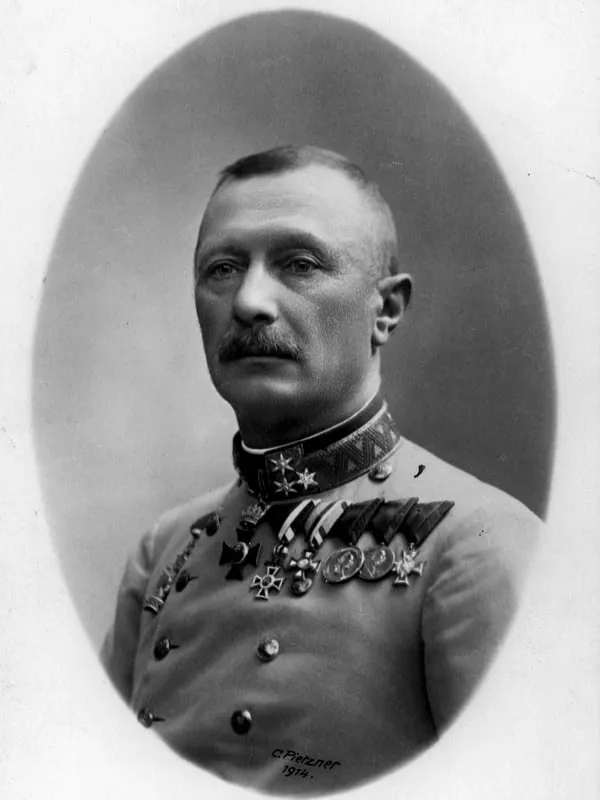
- Born:
- 20 November 1853, Bad Bleiberg (Carinthia)
- Died:
- 17 December 1933, Klagenfurt
- Author:
- Natalia
- Photo:
- Carl Pietzner, domena publiczna, Wikimedia Commons

Oskar Potiorek was the man who failed the Habsburg monarchy twice in a single year. On 28 June 1914, as governor of Bosnia and Herzegovina, he was sitting in the car with Archduke Franz Ferdinand when the fatal shots were fired in Sarajevo. A few weeks later he took command of the troops that were to punish Serbia for the assassination. Between August and December 1914 he invaded Serbia three times and three times had to withdraw. Defeat on the Kolubara ended his career. He is regarded as one of the weakest commanders of the first year of the war, although historians point out that mistakes were also being made at the time in Vienna and in the high command.
Before the war
He was born on 20 November 1853 in Bad Bleiberg in Carinthia. His father Paul, from a family of Czech origin, was a mining official. Oskar graduated from the Technical Military Academy and the war school in Vienna, and from the late 1870s served almost without interruption on the general staff. In 1892 he took over the operations bureau, in 1898, as a major general, he commanded a brigade in Budapest, and in 1902 Emperor Franz Joseph I appointed him deputy chief of the general staff. He was considered a capable, ambitious and extremely hard-working staff officer, but he had no experience of commanding large formations in the field.
He expected to take the place of the aged chief of staff Friedrich Beck when the latter retired. In 1906, however, at the wish of the heir to the throne, Franz Ferdinand, the post went to the younger Franz Conrad von Hötzendorf. From then on the two generals were rivals, and their mutual dislike was to have grave consequences in 1914. Potiorek took over III Corps in Graz and was promoted to general of artillery (Feldzeugmeister). In 1910 he became an army inspector, and in 1911 governor of Bosnia and Herzegovina. In Sarajevo he combined civil authority with command of the troops in a province which the monarchy had annexed only three years earlier and in which the Serb national movement was growing.
Sarajevo
It was Potiorek who invited Franz Ferdinand to the summer manoeuvres of the troops in Bosnia. They took place on 26 and 27 June 1914, and for 28 June, the Serbian feast of Vidovdan, a visit by the archduke and his wife Sophie to the provincial capital was planned. Protection of the route was weak. No troops were posted along it, and security was left mainly to the local police. According to accounts from the archduke’s entourage, Potiorek had earlier opposed shortening the visit because he feared for his own prestige.
On the morning of 28 June he was riding in the archducal couple’s car when Nedeljko Čabrinović threw a bomb at it, which wounded people in the following car. After the reception at the town hall it was decided to visit the wounded in hospital and to change the route. When one of the archduke’s officers warned of the danger, Potiorek is said to have replied that Sarajevo was not full of assassins, and to have taken responsibility upon himself. The driver, however, was not told of the change of route. The car turned into a side street by the Latin Bridge, and when it stopped, Gavrilo Princip fired two shots. Franz Ferdinand and Sophie were killed, while Potiorek came out unscathed. Princip later testified that he had intended the second bullet for the governor.
Despite his responsibility for the disastrously organised visit, Potiorek kept his post. In the following days anti-Serb riots broke out in Bosnia, and the provincial authorities arrested thousands of Serbs. The auxiliary Schutzkorps militia, recruited mainly from Bosnian Muslims, was also used in the persecution. Some historians attribute the main responsibility for these reprisals to Potiorek himself; others stress that they were part of the policy of the monarchy as a whole.
1914: three invasions
After the outbreak of war Potiorek became commander of all Austro-Hungarian forces in the Balkans, and at the same time personally took command of the 6th Army in Bosnia. According to contemporary accounts he repeatedly said that he had survived Sarajevo in order to avenge the assassination. His task was hampered from the start by Conrad’s plan. The monarchy had to fight Russia, so the 2nd Army, concentrated on the Sava and the Danube, could remain in Serbia only until mid-August and was then to leave for Galicia. Potiorek obtained the emperor’s consent for part of its forces to fight on the Sava for longer, but the main burden fell on the 5th Army of General Liborius von Frank and his own 6th Army. He decided to strike not from the north, where the Serbs expected him, but from the west, across the Drina, into mountainous, sparsely populated country through which it was difficult to bring up supplies.
On 12 August the 5th Army crossed the Drina, and units of the 2nd Army took Šabac. Potiorek’s columns, however, marched in the heat, through forests and ravines, far apart from one another, and the 6th Army set off later and did not support the main thrust. Vojvoda Radomir Putnik sent the forces of Stepa Stepanović against the 5th Army and in the Battle of Cer routed it within a few days. By 24 August there were no Austro-Hungarian troops left on the Serbian bank. The invasion left behind a trail of crimes against the civilian population of Mačva and the Šabac area.
Potiorek wanted to wipe out this defeat as quickly as possible. When on 6 September the Serbs entered Syrmia, he decided that the best answer would be a renewed thrust across the Drina deep into Serbia. On the night of 7/8 September both his armies crossed the river. The 5th Army held only small bridgeheads in Mačva, but the 6th Army forced its way onto the mountain ridges of Gučevo and Jagodnja. Putnik had to break off the expedition into Syrmia. In the Battle of the Drina both sides suffered enormous losses, and the bloodiest fighting was for the summit of Mačkov Kamen. There was no decision, and the front froze in the mountains for several weeks.
At the beginning of November Potiorek launched his third and largest offensive. This time the exhausted Serbian army, short of ammunition, had to fall back. The Austro-Hungarians took Valjevo, and from 16 November they attacked on the Kolubara in rain and snow. On 2 December, the 66th anniversary of Franz Joseph’s accession to the throne, Potiorek reported to the emperor by telegram the capture of Belgrade. Vienna celebrated, and at his headquarters it was believed that the war with Serbia was coming to an end. He also directed the main forces of the 5th Army towards the capital instead of pursuing the retreating Serbs. His troops, meanwhile, were at the end of their strength. Supply lines stretched for tens of kilometres along waterlogged mountain roads, and there was a shortage of food, warm clothing and ammunition.
Kolubara and dismissal
In the meantime the Serbs had received ammunition from their allies. On 3 December the 1st Army of General Živojin Mišić went over to the counter-offensive and within two days recaptured the Suvobor ridge. For a long time Potiorek believed that the Serbian attack would exhaust itself. On 6 December, however, he had to order the 6th Army to retreat behind the Kolubara, and the retreat quickly turned into flight. He then noted in his diary that after rest and reinforcement he would “yet make good this setback”. By mid-December the remnants of the 6th Army had withdrawn behind the Drina and the Sava. On 14 December in Zemun Potiorek heard from Frank that Belgrade could not be held, and ordered a retreat across the river. The next day the Serbs returned to their capital. The whole Serbian campaign of 1914 ended where it had begun: on the border.
According to the Austrian official history, the Balkan forces lost about 274,000 men in this campaign, including more than 28,000 killed and nearly 77,000 missing and taken prisoner. A great power had failed to defeat a small neighbour with which it had itself started the war. In the second half of December Potiorek lost his command. Most studies give the date as 22 December, some a few days later. The forces in the Balkans were taken over by Archduke Eugen, and with effect from 1 January 1915 Potiorek was placed on the retired list. As governor of Bosnia he was succeeded by General Stjepan Sarkotić. According to some accounts, after his dismissal he contemplated suicide.
After the war
He spent the rest of his life in seclusion in Klagenfurt. In his flat he kept the sofa on which the dying Franz Ferdinand had been laid in Sarajevo. Today it is an exhibit in the Museum of Military History in Vienna. He died on 17 December 1933 after several strokes. He was buried in Klagenfurt, and in 1966 his coffin was moved to the cemetery of the Theresian Military Academy in Wiener Neustadt.
Assessment
Historiography’s verdict on Potiorek is almost unanimously harsh. In Sarajevo he failed as host and organiser of the visit, and through his role in the assassination he became one of the war’s first scapegoats. As a field commander he ignored supply and terrain, demanded the impossible of his soldiers and dispersed his forces. The German historian Günther Kronenbitter writes that Potiorek displayed with particular clarity a belief in the decisive role of willpower and a ruthlessness in squandering soldiers’ lives. The same author holds him responsible for the careless security in Sarajevo and for not allowing the archduke to be taken out of the city immediately after the first attempt. Critics also reproach him for having been carried away in December by the capture of Belgrade and failing to see that his armies were exhausted.
Some scholars, however, notably Rudolf Jeřábek, author of the 1991 biography “Potiorek. General im Schatten von Sarajevo”, point to mitigating circumstances. Potiorek was given too few troops, and the 2nd Army left for Galicia in the middle of the first invasion. The dispute with Conrad and the unclear division of responsibilities between him and the high command hampered planning. His opponent was an army experienced in two Balkan wars, fighting for the survival of its state on its own soil. Historians agree that Vienna underestimated Serbia, and that Potiorek was the most visible executor of that policy. His defeat dashed the hope of a quick victory in the Balkans, weakened the monarchy’s prestige and held Austria-Hungary back from Serbia for almost a year; Serbia’s eventual defeat in 1915 required German and Bulgarian armies.
Sources
Spotted a mistake?Report an error
Commanded in battles
(05)Often appears with
People who appear in the same events.
On the timeline
(15)1914
July
August
September
- 08
- Second Austro-Hungarian invasion of SerbiaDuring the night of 7/8 September 1914 Potiorek's armies crossed the Drina again. Austria-Hungary meant to draw the Serbs out of Syrmia and avenge Cer.
- Battle of the Drina beginsOn 8 September 1914 Austro-Hungarian troops crossed the Drina. In the mountains of western Serbia a battle began that turned into trench warfare.